
Renew BLS Certification: Complete 2026 October Guide to Recertification
Learn how to renew BLS certification in 2026 October. Compare AHA & Red Cross renewal classes, 📗 costs, exam prep, and study tips to pass on the first try.
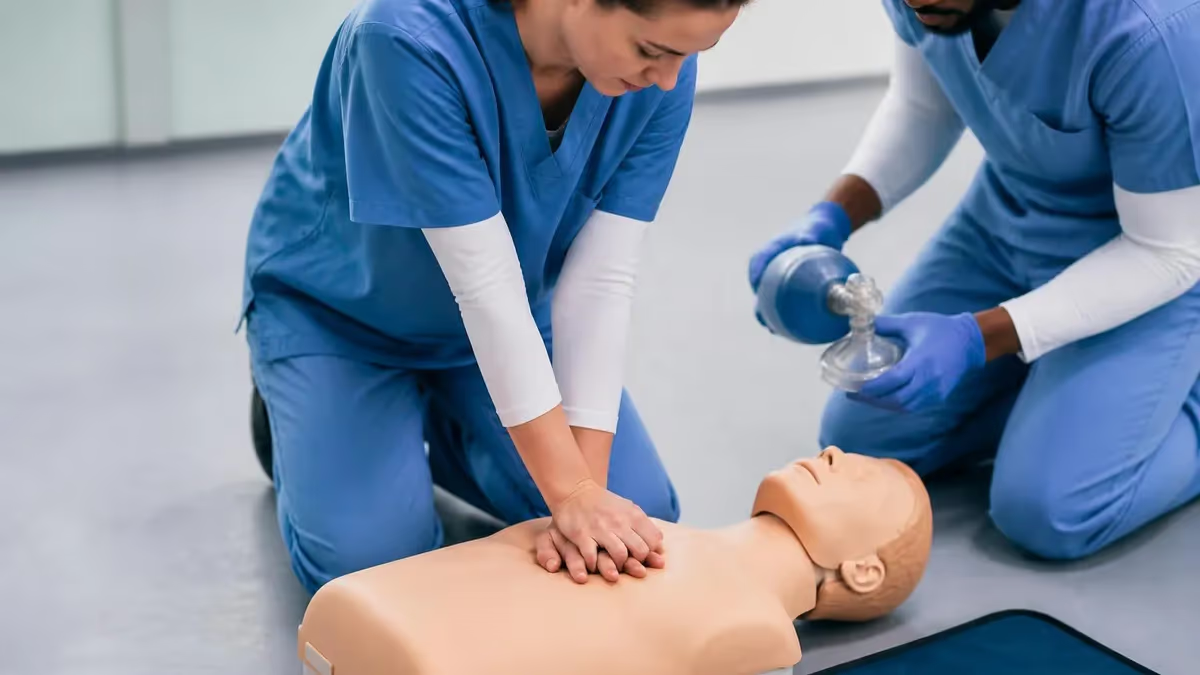
If your provider card is approaching its two-year mark, it is time to renew BLS certification before it lapses and locks you out of clinical shifts. Understanding what is a bls certification matters because employers, licensing boards, and credentialing committees treat an expired card the same as no card at all. Renewal protects your scope of practice, keeps you compliant with hospital bylaws, and ensures your skills reflect the most recent emergency cardiovascular care guidelines from the American Heart Association and the American Red Cross.
Basic Life Support certification verifies that healthcare professionals can recognize cardiac arrest, deliver high-quality chest compressions, operate an automated external defibrillator, relieve foreign-body airway obstruction, and coordinate care as part of a resuscitation team. Renewal is not a casual refresher — it is a formal competency check that tests both written knowledge and hands-on skill performance. Most providers complete renewal every 24 months, although some employers shorten that window to 12 months for high-acuity units.
Across the United States, more than 4 million healthcare workers renew their BLS card each year. Nurses, paramedics, dental hygienists, respiratory therapists, surgical techs, physical therapists, medical assistants, and physicians are all required to maintain current certification. Even nonclinical staff such as security officers, lifeguards, athletic trainers, and childcare directors often hold BLS as a condition of employment. Renewal exists because cardiac arrest survival depends on muscle memory that fades quickly without scheduled practice.
The 2025–2030 guideline cycle introduced subtle but important changes to compression depth verification, ventilation timing during advanced airway placement, and feedback device expectations. Renewal courses incorporate these updates so you do not perform outdated techniques during a real code. If you trained before late 2020 and have not renewed since, expect noticeable differences in algorithm language, team dynamics emphasis, and the way instructors assess high-quality CPR metrics during megacode scenarios.
Choosing the right pathway is the first decision. The American Heart Association offers an in-person Provider course, a HeartCode blended option, and a Renewal-specific class that runs roughly half the length of an initial course. The American Red Cross offers a comparable Basic Life Support for Healthcare Providers renewal track with similar blended and instructor-led formats. Both organizations issue credentials accepted by The Joint Commission, CMS, state nursing boards, and virtually every hospital system in the country.
This guide walks through every step of recertification: eligibility windows, course selection, cost comparisons, study strategies, the written exam, the hands-on skills checkoff, and what to do if your card has already expired. You will also find practice questions, a study schedule, and answers to the questions providers most often ask. If you are still weighing whether the two organizations differ in meaningful ways, our comparison of is bls the same as cpr explains the relationship between the broader CPR landscape and provider-level BLS credentialing.
By the end of this article you will know exactly which renewal class to register for, how to prepare in two to three focused study sessions, and what to expect on exam day. Read straight through if you have a deadline this month, or use the table of contents to jump to the section that matches your timeline. Either way, plan to invest four to six total hours — far less than retaking the full initial course — and you will walk out with a fresh two-year card.
BLS Renewal by the Numbers

Renewal Pathways You Can Choose
A 3 to 4 hour classroom session that combines a short knowledge review, video-guided practice, and a hands-on skills test. Best for visual or tactile learners who want immediate feedback from a live instructor.
Online cognitive modules completed at your own pace, followed by an in-person skills session of about 60 to 90 minutes. Ideal for busy clinicians who want flexibility but still need the required hands-on checkoff.
An adaptive online course using branching scenarios that respond to your decisions, paired with a short skills validation. Strong fit for providers who prefer scenario-based learning over lecture content.
If you completed online cognitive training through a partner site, you may schedule just the in-person skills portion. Confirm acceptance with your employer before choosing this shortest path to a renewed card.
The two dominant credentialing bodies in the United States are the American Heart Association and the basic life support renewal class offered through the American Red Cross. Both deliver evidence-based courses aligned with the International Liaison Committee on Resuscitation guidelines, and both produce cards recognized nationwide. Still, there are real differences in classroom flow, instructor scripting, scenario style, and digital card delivery that may influence which provider you pick for your next renewal cycle.
AHA courses follow a standardized video that plays during the entire instructor-led session. Instructors pause the video to help practice, debrief skills, and coach team dynamics. Renewal students see a condensed version of the same content covered in the full Provider course, with extra time devoted to the high-quality CPR rubric and the skills test stations. Many hospital systems have long-standing AHA training centers on site, which can make AHA the path of least resistance for staff renewals.
Red Cross renewal classes lean more heavily on instructor-led discussion and case scenarios rather than continuous video playback. The Red Cross digital course platform issues an electronic card immediately upon successful completion, and that card is verifiable through a QR code that employers can scan. Pricing is often slightly lower than AHA at independent training centers, and the simulation learning option appeals to providers who dislike lecture-style content.
Both organizations test the same core skills: adult one- and two-rescuer CPR, child CPR, infant CPR, bag-mask ventilation, AED operation, and relief of foreign-body airway obstruction in responsive and unresponsive patients of all ages. The written exam under either brand is open- or closed-book depending on the instructor's discretion, and the passing threshold sits at 84 percent for AHA and 80 percent for Red Cross. Skills must be performed without coaching prompts during the formal evaluation.
Employer acceptance is the deciding factor for most clinicians. Before registering, log into your hospital's learning management system or call the education department to confirm which credential your unit accepts. Many systems accept either, but specialty units such as labor and delivery, the emergency department, or critical care occasionally specify AHA only. Travel nurses and contract staff should verify acceptance for every new assignment because reciprocity is not automatic across all states.
Cost ranges from roughly $55 for a community Red Cross renewal in a low-cost-of-living region to about $120 for an AHA HeartCode bundle that includes the online key plus a private skills session at a premium training center. Group rates, employer reimbursement, and union benefits can drop the out-of-pocket cost to zero. Avoid bargain websites that advertise BLS for under $30 with no skills component — those certificates are not accepted by Joint Commission accredited facilities and will not satisfy a credentialing audit.
Timeline matters too. AHA cards expire on the last day of the month two years after issue. Red Cross cards expire exactly 24 months from the issue date. Both organizations allow renewal up to 30 days before expiration without shortening your next cycle. Renewing earlier than 30 days resets your validity from the new issue date, effectively losing a few weeks of coverage, so target the four-week window leading up to your card's expiration for the cleanest extension.
BLS Practice Test Questions
Prepare for the BLS - Basic Life Support exam with our free practice test modules. Each quiz covers key topics to help you pass on your first try.
BLS High-Quality CPR & Provider Skills
BLS Exam Questions covering BLS High-Quality CPR & Provider Skills. Master BLS Test concepts for certification prep.
BLS Special Situations & Scenarios
Free BLS Practice Test featuring BLS Special Situations & Scenarios. Improve your BLS Exam score with mock test prep.
BLS Adult, Child & Infant Resuscitation
BLS Mock Exam on Adult, Child & Infant Resuscitation. BLS Study Guide questions to pass on your first try.
BLS Airway Management & Ventilation
BLS Test Prep for Airway Management & Ventilation. Practice BLS Quiz questions and boost your score.
BLS Automated External Defibrillator (AED)...
BLS Questions and Answers on Automated External Defibrillator (AED) Use. Free BLS practice for exam readiness.
BLS Certification: Cardiac Arrest
BLS Mock Test covering Certification: Cardiac Arrest. Online BLS Test practice with instant feedback.
BLS Certification: Choking
Free BLS Quiz on Certification: Choking. BLS Exam prep questions with detailed explanations.
BLS Certification: Respiratory Arrest
BLS Practice Questions for Certification: Respiratory Arrest. Build confidence for your BLS certification exam.
BLS Chain of Survival
BLS Test Online for Chain of Survival. Free practice with instant results and feedback.
BLS CPR Techniques & Procedures
BLS Study Material on CPR Techniques & Procedures. Prepare effectively with real exam-style questions.
BLS Legal & Ethical Considerations
Free BLS Test covering Legal & Ethical Considerations. Practice and track your BLS exam readiness.
BLS Post-Resuscitation Care
BLS Exam Questions covering Post-Resuscitation Care. Master BLS Test concepts for certification prep.
Inside the AHA Basic Life Support Exam
The aha basic life support exam consists of 25 multiple-choice questions covering high-quality CPR metrics, the chain of survival, AED operation, airway management, special resuscitation situations, and team dynamics. You have unlimited time during renewal, although most candidates finish in under 30 minutes. A passing score is 84 percent, meaning you can miss no more than four questions.
Questions are scenario-based rather than rote definitions. Expect prompts like a 62-year-old collapses in the cafeteria with no pulse — what is your first action? The exam reinforces decision points, not memorized trivia. Reading each scenario twice and ruling out distractors that violate algorithm sequence is the fastest way to push your score above the pass threshold during the renewal test.

Should You Choose a Blended Renewal Course?
- +Complete cognitive modules on your own schedule around shifts
- +Skills session typically takes only 60 to 90 minutes
- +Instant digital card delivery in most cases
- +Reduces classroom time by 50 to 70 percent
- +Module progress saves automatically if interrupted
- +Cost is often comparable to or lower than full classroom format
- +Better fit for self-directed learners who dislike lecture pacing
- −Online modules can feel repetitive for experienced providers
- −Requires two scheduling steps instead of one
- −Skills checkoff sites may have limited evening availability
- −Computer or tablet with reliable internet is required
- −No live instructor questions during the cognitive phase
- −Some employers do not accept blended completion for new hires
- −Technical issues with the online key can delay the skills appointment
BLS Renewal Day Checklist
- ✓Bring a government-issued photo ID matching your registration name
- ✓Print or save your online completion certificate if you took a blended course
- ✓Wear comfortable clothing that allows kneeling on the floor
- ✓Arrive 15 minutes early to complete sign-in paperwork
- ✓Have your current BLS card available in case verification is requested
- ✓Eat a balanced meal beforehand — compressions are physically demanding
- ✓Bring a pen for any paper-based scenarios or skill sheets
- ✓Silence your phone before the precourse video begins
- ✓Review the AHA pocket reference card the night before
- ✓Notify the instructor of any physical limitations that affect manikin work
Renew during the final 30 days before expiration
The AHA and Red Cross both accept renewals up to 30 days before expiration without shortening your next two-year cycle. Renewing earlier resets validity from the new issue date, costing you weeks of coverage. Mark your calendar for the day exactly 30 days before your current card expires.
If your card has already expired, do not panic — but do not wait either. AHA does not technically distinguish between an initial course and a renewal in its training materials, meaning you can still attend a renewal-format class if a training center is willing to accept you. Most centers allow lapsed providers a grace window of 30 days past expiration before requiring the full Provider course. Red Cross policies are similar, although individual training centers may be stricter for cards expired by more than 60 days.
Employer rules add another layer. Hospital credentialing offices typically suspend clinical privileges the day a required certification expires. Even if your training center allows a quick renewal class, your manager may pull you from the schedule until the new card is in your file. This is why many hospital education departments send automated reminders 90, 60, and 30 days before expiration. Add your own calendar alerts as a backup so a busy month does not turn into a missed deadline.
If you are more than a few months expired, plan on the full initial course rather than a renewal. Initial classes run six to eight hours instead of three to four and include extended practice on every skill station. You will also pay slightly more — typically $90 to $150 — and the cognitive material is presented at a slower pace because the audience includes providers who have never held a card. Treat this as an opportunity to rebuild fundamentals rather than a punishment for the delay.
Travel nurses, locum physicians, and contract therapists face an extra wrinkle: state-specific reciprocity. Most states accept both AHA and Red Cross cards across borders, but a few hospital networks contractually require AHA only. Check your assignment paperwork before booking a renewal class. If your assignment is in a state where AHA dominates, choose AHA even if Red Cross is more convenient at home. The card is portable but the employer's policy is not.
Public safety roles — firefighters, EMTs, lifeguards, police officers — sometimes have additional state or county requirements layered on top of the standard BLS curriculum. Renewal for these roles may include extra skills like oxygen administration or pediatric epinephrine auto-injector use. Confirm with your agency training officer whether your renewal needs to be a standard AHA or Red Cross class or whether you require an agency-specific bundle that includes those extras.
Dental professionals, including hygienists and dental assistants, must renew BLS to maintain licensure in nearly every state. Some state dental boards require the in-person skills component and explicitly reject fully online certificates. Verify your state board's wording before registering. The same caution applies to physical therapy assistants, surgical technologists, and certain pharmacy roles that have adopted BLS as a license maintenance requirement in recent years.
For broader context on how BLS sits within the larger CPR landscape, our overview of the aha basic life support exam walks through video answers to the most commonly missed exam questions. Watching a scenario unfold and seeing the correct decision path reinforces algorithm memory more effectively than rereading a textbook page. Use video practice the week before your renewal as a fast confidence-builder.

If your BLS card expires, most hospitals will suspend your clinical privileges immediately — not at the end of the pay period. That can mean lost shifts, lost income, and a formal note in your personnel file. Renew within the final 30 days before expiration to avoid any gap in eligibility.
A pass-first-try strategy for renewal begins three to four weeks before your class date, not the night before. The biggest mistake providers make is assuming that two years of clinical work has kept their textbook knowledge fresh. In reality, the exam tests specific compression metrics, ventilation ratios, and algorithm sequences that you rarely verbalize at the bedside. A short structured review beats long unstructured cramming every time, especially when your goal is the 84 percent AHA threshold.
Start by downloading the current student manual or e-book through your training center. Skim the high-quality CPR chapter and the AED chapter first because those topics dominate the written exam. Pay special attention to compression depth ranges for adults, children, and infants, the compression-to-ventilation ratio for one and two rescuers in each age group, and the timing of ventilations once an advanced airway is in place. These are the most commonly missed exam items year after year.
Next, practice with a question bank. Spaced repetition over five short sessions of 20 questions each produces better retention than one marathon session of 100 questions. The goal is not to memorize answers but to recognize how scenarios are phrased. Many providers know the correct action but get tripped up by wording like first action, next intervention, or most appropriate. Reading 80 to 100 practice items trains your eye for those subtle cues.
Three days before class, practice compressions on any firm surface. Place your hands in the correct position, push to a depth of two inches at a tempo of 110 per minute, and check for full recoil between each compression. Use a metronome app or a song with the right beat. Two minutes of practice at a time is enough — the goal is muscle memory, not endurance. This rehearsal alone can be the difference between passing and remediating on the skills station.
The day before class, sleep at least seven hours and avoid heavy late meals. Skills testing involves real physical effort, and a tired or sluggish provider performs measurably worse on compression rate and depth metrics. Pack your ID, current card, completion certificate if applicable, and a water bottle. Lay out comfortable clothing. Eliminating last-minute stress lets you walk into class focused on the material rather than on logistics.
During class, ask questions early. Instructors expect renewal students to know the basics, but they also expect questions about updates since your last cycle. If a video scene shows a technique you do not recognize, raise your hand. The discussion that follows often clarifies exam questions for everyone in the room. Treat renewal as a real learning opportunity, not a hurdle to clear — your patients will benefit from sharper skills regardless of your test score.
Finally, after passing, save both digital and physical copies of your new card immediately. Email a copy to yourself, upload it to your hospital's learning management system, and store the image in a cloud folder you can access from any device. Set a calendar reminder for 90 days before your new expiration. That single action prevents the most common renewal failure of all: forgetting to renew on time and ending up with a lapsed card during your busiest clinical month.
Final preparation tips begin with replicating exam conditions during the last week. Sit in a quiet room, set a 30-minute timer, and take a full 25-question practice exam without stopping. Score honestly. If you scored below 84 percent, identify the chapters where you missed items and reread only those sections. Repeating the full manual is rarely necessary and often wastes time you could spend on targeted weak-area review during your final week before the renewal class begins.
Drill the algorithm sequences out loud. Recite the adult chain of survival, the pediatric chain of survival, and the steps of the BLS healthcare provider algorithm without looking at notes. Speaking the steps aloud activates auditory memory that visual reading alone does not engage. Many providers find this method especially helpful for the post-arrest care steps and the recognition of agonal breathing versus normal breathing — two of the most frequently confused exam topics on the renewal written test.
Practice the skills you find most awkward, not just the ones you find comfortable. Most providers default to adult compressions because they are familiar. Yet infant CPR and bag-mask ventilation are where renewal students lose the most points. Borrow an infant manikin if your workplace has one, or practice the two-thumb encircling-hands technique on a rolled towel that approximates infant chest size. Five minutes of practice in advance pays huge dividends at the skills station.
Form a small study group with one or two coworkers renewing at the same time. Quiz each other on compression depth, ventilation rate, AED pad placement, and the steps for choking relief in different age groups. Teaching a concept to another person is the most powerful retention technique available — neuroscience research consistently shows that explaining a topic aloud produces deeper learning than passive review of the same material. Schedule one 45-minute session per week during the prep period.
On exam day itself, arrive hydrated and slightly hungry rather than overfed. A light meal two hours before class provides sustained energy for the skills station without causing the sluggishness that follows a heavy lunch. Avoid caffeine spikes that crash mid-session. Wear shoes you can kneel comfortably in, since most skills tests happen on a low floor mat. Bring layers because training rooms vary widely in temperature and you do not want shivering or sweating to distract you from the performance.
If you are renewing as part of a hospital cohort, take advantage of any peer review sessions your education department offers. These informal practice rounds let you cycle through skills stations with corrective feedback before the official test day. Even a 30-minute peer session reveals habits like inadequate hand-overlap position or rushed AED pad placement that you can correct before they cost you points. Most education departments will gladly schedule these for any unit that requests one.
For deeper algorithm review specific to younger patients, our guide to the basic life support exam american heart association walks through each step of the pediatric pathway with sample questions and rationales. Pediatric items appear on every renewal exam regardless of your clinical setting, so a focused 30-minute review of that algorithm the week before your class is one of the highest-yield preparation tasks you can complete to lock in a confident first-attempt pass.
BLS Questions and Answers
About the Author

Registered Nurse & Healthcare Educator
Johns Hopkins University School of NursingDr. Sarah Mitchell is a board-certified registered nurse with over 15 years of clinical and academic experience. She completed her PhD in Nursing Science at Johns Hopkins University and has taught NCLEX preparation and clinical skills courses for nursing students across the United States. Her research focuses on evidence-based exam preparation strategies for healthcare certification candidates.
Join the Discussion
Connect with other students preparing for this exam. Share tips, ask questions, and get advice from people who have been there.
View discussion (8 replies)