
ASWB Practice Exam: Free Social Work Licensing Test Prep 2026 October
🗨️ Free ASWB Practice test with questions and answer explanations. Prepare for the 2026 October exam with instant scoring.
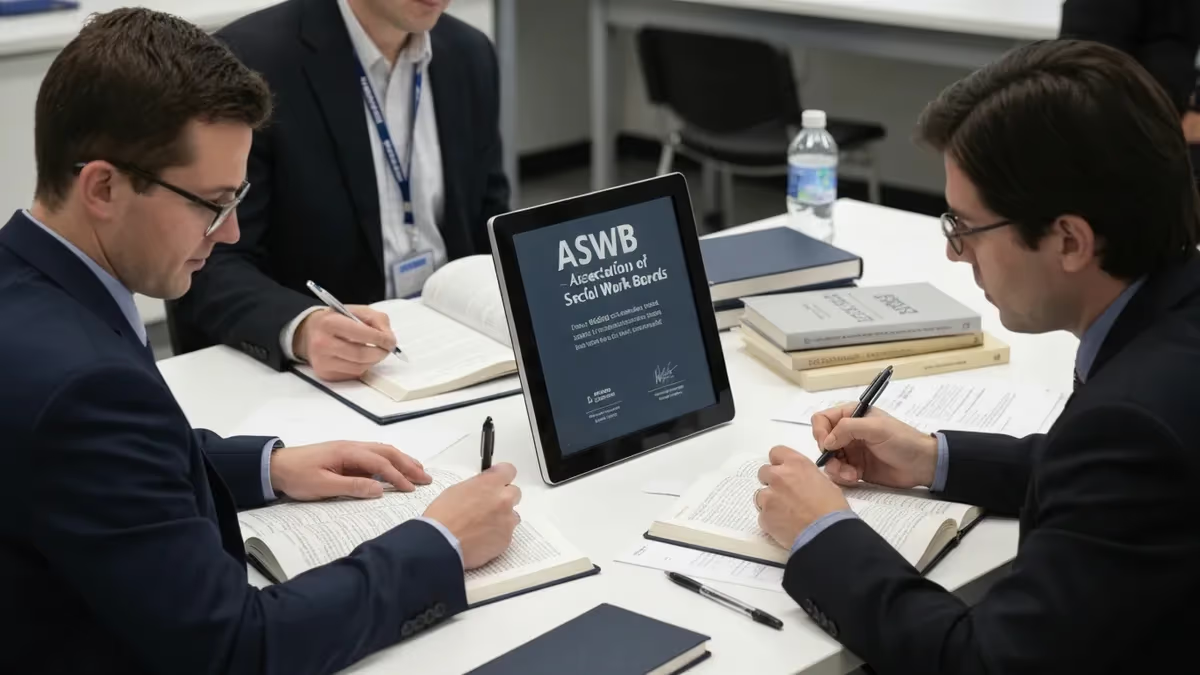
What Is the ASWB Exam?
The ASWB (Association of Social Work Boards) exam is the standardized licensing examination required for social work licensure across the United States and Canada. Administered by ASWB, it ensures that licensed social workers meet a consistent professional standard regardless of state. The exam is computer-based, delivered at Pearson VUE testing centers, and scored on a criterion-referenced basis — meaning your passing score is based on a set cut score, not a curve relative to other test takers. Each exam level has its own independently established cut score, so there is no single universal passing number.
All ASWB exam levels share the same format: 122 total questions (110 scored items + 12 unscored pretest items), with a 4-hour time limit. The pretest questions are embedded throughout and cannot be identified, so every question deserves full effort. Scores are reported within 1–3 business days. Candidates who do not pass must wait 90 days before retesting, and the exam can be taken up to three times within a testing year.
ASWB Exam Levels
ASWB offers five exam categories, each aligned with a specific tier of social work education and experience. Understanding which exam applies to your license type is the critical first step in your ASWB exam prep. The Associate and Bachelor exams target BSW-level practitioners, the Masters and Advanced Generalist exams target MSW graduates without clinical specialization, and the Clinical exam targets those seeking the LCSW or LICSW designation. First-attempt pass rates vary significantly by level — the Clinical exam carries an approximate 65–70% first-attempt pass rate nationally, underscoring the importance of thorough preparation with quality ASWB practice tests.
Did You Know? Passing the ASWB exam on your first attempt saves both time and money. Start with diagnostic practice tests to identify weak areas.

ASWB Practice Exam Strategy
Passing the ASWB social work licensing exam requires more than reviewing content — it demands deliberate, exam-style practice that mirrors the cognitive demands of real test questions. ASWB questions are scenario-based: they describe a client situation and ask what the social worker should do first, next, or most appropriately. The answer almost always prioritizes assessment before intervention, client self-determination over worker-directed action, and the least restrictive appropriate response. Understanding this decision framework is more valuable than memorizing isolated facts.
Official ASWB practice test: ASWB sells an official practice exam through its portal for $85, providing 85 questions with detailed rationales. This is the gold-standard resource because questions are drawn from the same item bank used for actual licensing exams. Use it as a final-stage diagnostic 2–3 weeks before your test date, not as your primary study tool.
Content-area targeting: Use your ASWB study guide to identify weak domains first. For Masters candidates, Direct & Indirect Practice (45%) yields the highest return on study time — a 10% improvement in that domain moves your score more than a 10% gain in Ethics. Build a 10–12 week study schedule that front-loads content review and transitions to timed practice exams in the final 4 weeks.
Time management: With 122 questions in 4 hours, you have roughly two minutes per question. In practice, most questions take 30–60 seconds and a handful require 2–3 minutes. Flag long or uncertain questions, keep moving, and return at the end. Running out of time is rare if you maintain consistent pacing from the first section.
Ethical dilemma questions: When ethics and law conflict, ethics wins on ASWB. When client self-determination and safety conflict, safety wins. Mandatory reporting duties override confidentiality. If two answers both seem correct, choose the one that preserves the therapeutic relationship while meeting professional obligations.
Social Worker Salary
Earning your license unlocks meaningful salary growth. Nationally, Licensed Clinical Social Workers (LCSW) earn between $68,000 and $90,000 per year, with median salaries around $76,000 according to BLS data. High-cost-of-living states offer significantly higher compensation: LCSW salaries in California and New York typically range from $80,000 to $120,000, with senior practitioners in private practice or hospital systems reaching $130,000+. LMSWs (Masters-level without clinical licensure) typically earn $52,000–$68,000 nationally, representing a clear financial incentive to pursue the Clinical exam and supervised hours. Specializations in child welfare, healthcare, and psychiatric settings command higher rates than school or community mental health settings.
- ✓Confirm your exam appointment and location
- ✓Bring required identification documents
- ✓Arrive 30 minutes early to check in
- ✓Read each question carefully before answering
- ✓Flag difficult questions and return to them later
- ✓Manage your time — don't spend too long on one question
- ✓Review flagged questions before submitting

- +Validates your knowledge and skills objectively
- +Increases job market competitiveness
- +Provides structured learning goals
- +Networking opportunities with other certified professionals
- −Study materials can be expensive
- −Exam anxiety can affect performance
- −Requires dedicated preparation time
- −Retake fees apply if you don't pass
Pros and Cons at a Glance
| Pros | Cons |
|---|---|
| Validates your knowledge and skills objectively | Study materials can be expensive |
| Increases job market competitiveness | Exam anxiety can affect performance |
| Provides structured learning goals | Requires dedicated preparation time |
| Networking opportunities with other certified professionals | Retake fees apply if you don't pass |
Sample ASWB - Association of Social Work Boards Practice Questions
Try these questions from our free ASWB - Association of Social Work Boards practice tests. The correct answer and an explanation follow each question.
How is the DSM-5 categorized for ADHD?
- A. Neurological disorders
- B. Neurocognitive disorders
- C. Neurodevelopmental disorders
- D. Neurocranial disorders
Answer: C. Neurodevelopmental disorders
In the Diagnostic and Statistical Manual of Mental Disorders, Fifth Edition (DSM-5), Attention-Deficit/Hyperactivity Disorder (ADHD) is classified under the category of Neurodevelopmental Disorders. This category includes conditions that typically manifest early in development and are characterized by developmental deficits that produce impairments in personal, social, academic, or occupational functioning.
A type of response bias in which a general or initial assessment of a person (or any other thing being evaluated) transfers or spreads into an assessment of more particular traits or qualities, even though there is no logical justification for or connection between the overall assessment and other qualities being judged
- A. Face Validity
- B. Fundamental Attribution Error
- C. Halo Effect
- D. Projection
Answer: C. Halo Effect
The Halo Effect is a cognitive bias where an observer's overall positive or negative impression of a person, object, or brand influences their feelings and thoughts about that entity's specific traits or qualities. For example, if someone is perceived as generally attractive, they might also be assumed to be intelligent or kind, even without specific evidence, because the initial positive impression 'spreads' to other attributes.
Listeners try to comprehend the speaker and provide the speaker some suggestions.
- A. reflective listening
- B. external validity
- C. collective rationalization
- D. turning against self
Answer: A. reflective listening
Reflective listening is a communication technique where the listener actively seeks to understand the speaker's message, both its content and underlying emotions. The listener then paraphrases or reflects this understanding back to the speaker, demonstrating empathy and clarifying communication. This process encourages the speaker to elaborate and fosters a deeper connection, aiding in problem-solving.
A client informs a social worker that he "can't tolerate it longer," but he doesn't think he can make the necessary changes in his life. He talks to the social worker about what his life would be like if he didn't have his problematic behaviors. Which stage of transformation is the client most likely in?
- A. Precontemplation
- B. Contemplation
- C. Preparation
- D. Maintenance
Answer: B. Contemplation
In the contemplation stage of change, individuals acknowledge that a problem exists and are actively thinking about making a change, but they are not yet fully committed to taking action. The client's statements about 'not tolerating it longer' and imagining a different life indicate an awareness of the problem and a desire for change, but also a struggle with the commitment to act, which is characteristic of contemplation.
Take the full ASWB - Association of Social Work Boards practice test
ASWB Exam Questions and Answers
More Social Work & Counseling Resources
Join the Discussion
Connect with other students preparing for this exam. Share tips, ask questions, and get advice from people who have been there.
View discussion (7 replies)