
AFOQT Study Guide: Training Programs, Tutoring, and Prep Resources 2026 October
Pass your AFOQT Study Guide: Training Programs, exam on the first attempt. Practice questions with detailed answer explanations, hints, and instant ✍🏼
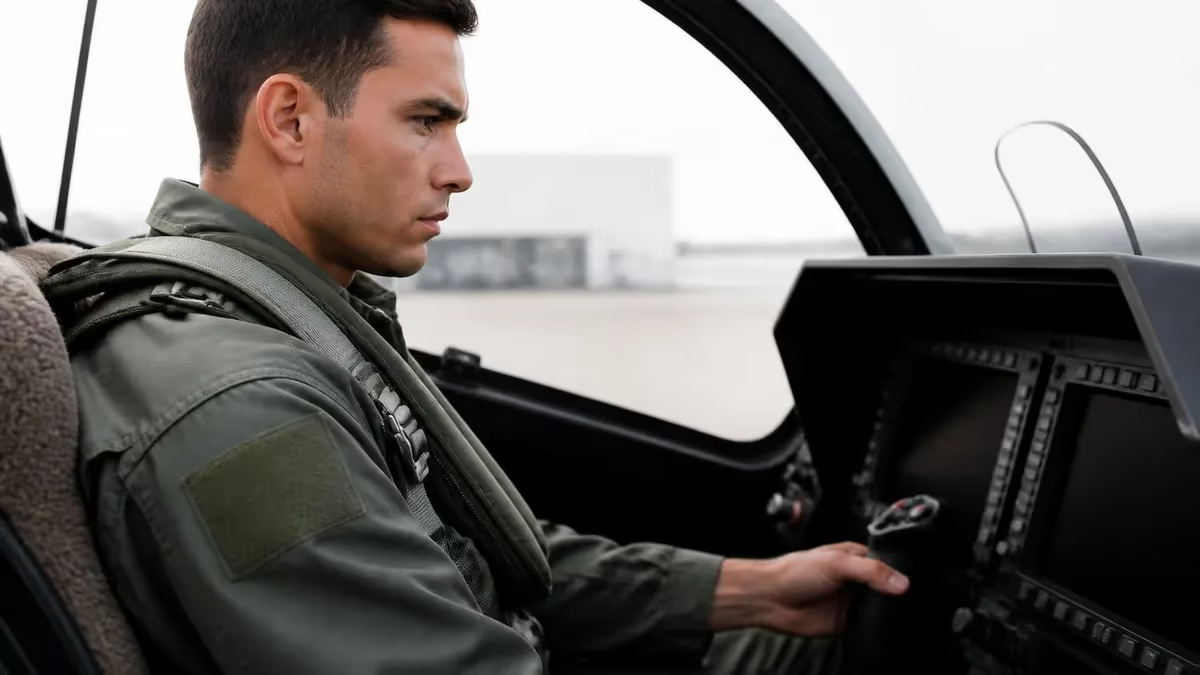
The Air Force Officer Qualifying Test (AFOQT) is a standardised aptitude examination administered by the United States Air Force that serves as a qualifying requirement for commissioning as an officer in the US Air Force or US Space Force. The test is required for candidates pursuing a commission through the Air Force Reserve Officer Training Corps (AFROTC), Officer Training School (OTS), the Air Force Academy, and other officer commissioning pathways.
The AFOQT measures a broad range of verbal, quantitative, aviation, and situational judgment aptitudes through twelve distinct subtests, and the subtest scores are combined into composite scores that are used to determine eligibility for specific officer career fields — most critically, the Pilot and Combat Systems Officer composites for aviation-track candidates.
The AFOQT consists of twelve subtests: Verbal Analogies, Arithmetic Reasoning, Word Knowledge, Math Knowledge, Reading Comprehension, Situational Judgment, Self-Description Inventory, Physical Science, Table Reading, Instrument Comprehension, Block Counting, and Aviation Information. The twelve subtests are organised into six composite scores — Academic Aptitude, Verbal, Quantitative, Pilot, Combat Systems Officer (CSO), and Air Battle Manager (ABM) — each calculated from a specific combination of subtest scores.
Different Air Force officer career paths have different minimum composite score requirements, with aviation composites (Pilot and CSO) having specific thresholds that are among the most competitive requirements in the commissioning process for candidates pursuing pilot training.
The Pilot composite — which is typically the most scrutinised score for aviation-aspiring AFOQT candidates — is calculated from the Table Reading, Instrument Comprehension, Math Knowledge, Arithmetic Reasoning, and Aviation Information subtests. Each of these contributing subtests rewards specific types of preparation. Table Reading assesses the ability to quickly locate values in data tables — a skill improved through repeated practice with timed table reading exercises rather than content knowledge review.
Instrument Comprehension tests the ability to read and interpret aircraft instrument displays, including attitude indicators and directional gyroscopes, which requires familiarisation with how instrument readings correspond to aircraft position and orientation — a knowledge domain directly available through aviation study resources. Aviation Information tests general knowledge of aviation history, aircraft systems, aerodynamics, and flight principles — content that can be studied directly through aviation reference materials.
Verbal preparation for the AFOQT focuses on two primary content areas: vocabulary and the ability to identify relationships between concepts. The Verbal Analogies subtest presents word pairs and asks candidates to identify the analogous relationship from provided options — a question type that rewards both broad vocabulary knowledge and strong abstract reasoning with language. Word Knowledge tests vocabulary in isolation, requiring candidates to identify synonyms or definitions of words from a list.
Reading Comprehension presents passages and tests careful reading and inference skills. Building vocabulary systematically — using high-frequency GRE-style vocabulary lists or military officer examination preparation word lists — is one of the highest-yield verbal preparation activities for candidates with vocabulary gaps in the academic and technical vocabulary that AFOQT verbal subtests draw from.
The AFOQT measures aptitude across twelve distinct cognitive domains, and each composite score is calculated from a specific subset of those subtests. Understanding which subtests feed each composite you need to compete for helps focus preparation time on the highest-use areas.
The quantitative components of the AFOQT — Arithmetic Reasoning and Math Knowledge — assess foundational mathematical skills at the level of algebra, geometry, and numerical reasoning that is typically covered by the end of secondary school. Arithmetic Reasoning presents word problems requiring multi-step reasoning and basic mathematical operations. Math Knowledge tests specific mathematical knowledge including algebra, coordinate geometry, quadratic equations, and properties of shapes.
Candidates whose secondary mathematics background is strong typically find the AFOQT quantitative subtests manageable with targeted review. Candidates with significant gaps in their mathematics preparation — particularly in algebra and geometry — benefit from structured mathematics review using standardised test preparation materials that cover the specific content areas tested, rather than general mathematics review that may not emphasise the question formats the AFOQT uses.
The Physical Science subtest tests general knowledge of physics and chemistry at the high school level — Newton's laws, energy, waves, chemical reactions, atomic structure, and similar topics. This subtest is one that is often underemphasised by candidates who focus their preparation heavily on the quantitative and pilot-specific subtests, but it contributes to the Academic Aptitude composite and can affect an overall AFOQT performance profile.
Candidates who have been out of high school for several years and have not applied physics or chemistry knowledge recently often experience a rustiness in this area that a focused review of high school level physical science content — using the physical science section of an AFOQT study guide — can address effectively in a relatively short study period.
The Combat Systems Officer (CSO) composite and Air Battle Manager (ABM) composite draw on overlapping but distinct subtest clusters. The CSO composite incorporates scores from Table Reading, Instrument Comprehension, Block Counting, and Aviation Information — the same instrument-heavy skills valued for pilot candidates, with a greater emphasis on spatial reasoning and three-dimensional awareness. The ABM composite emphasises Math Knowledge, Table Reading, and Instrument Comprehension, reflecting the coordination and situational-awareness demands of airspace management roles. Candidates applying for both rated and non-rated positions benefit from strengthening spatial and instrument-interpretation skills, as those subtests contribute to multiple composites simultaneously.
Minimum score thresholds vary by commissioning source and career field. ROTC detachments, Officer Training School boards, and the Air Force Academy each publish competitive benchmarks, and rated positions — particularly pilot and CSO slots — are significantly more competitive than non-rated officer roles. Scores are reported as percentiles on a scale of 1 to 99, with most competitive pilot candidates posting Pilot composite scores above 70 and AA composite scores above 50. Verifying current minimums directly with your detachment or recruiter is essential, as benchmarks shift with accession demand and cohort size each cycle.
The AFOQT is administered in a proctored setting through ROTC detachments, Military Entrance Processing Stations (MEPS), or designated Air Force testing centres. The test is delivered in paper-and-pencil format across a full day, with timed sections for each subtest and mandatory breaks between certain segments. Candidates are required to bring identification and are not permitted to use calculators, reference materials, or electronic devices. Reporting to the testing site well in advance, understanding the check-in procedures, and arriving familiar with the timing rules for each subtest reduces day-of stress and ensures full time is used on every section.
Reviewing official Air Force guidance on composite score requirements for specific Air Force Specialty Codes (AFSCs) and rated positions, available through your ROTC detachment or recruiter, is an important step in aligning your preparation priorities with the actual benchmarks that will determine your competitiveness for the career field you are pursuing. Confirming these benchmarks early prevents wasted preparation effort on composites that are less relevant to your specific goal.

| Section | Questions | Time | Notes |
|---|---|---|---|
| Verbal Analogies | ~25 questions / 8 minutes | Contributes to: Verbal, Academic Aptitude | Identify analogous word relationships; broad vocabulary and abstract reasoning; systematic vocabulary study is highest-yield prep |
| Arithmetic Reasoning + Math Knowledge | ~25 + 25 questions | Contributes to: Quantitative, Academic Aptitude, Pilot (Math Kn.) | Word problems + algebraic/geometric knowledge; review through high school algebra, geometry, and AFOQT quantitative prep materials |
| Table Reading + Instrument Comprehension | ~40 + 25 questions | Contributes to: Pilot, CSO, ABM | Table Reading: speed-critical data lookup; Instrument Comprehension: aircraft attitude/heading reading; critical for Pilot composite |
| Aviation Information | ~20 questions | Contributes to: Pilot, CSO, ABM | Aircraft systems, aerodynamics, aviation history, flight principles; study using dedicated aviation reference and AFOQT prep materials |
| Reading Comprehension + Word Knowledge | ~25 + 25 questions | Contributes to: Verbal, Academic Aptitude | Reading Comprehension: passage-based inference; Word Knowledge: vocabulary; build academic vocabulary for both subtests |
| Block Counting + Physical Science | ~30 + 20 questions | Contributes to: CSO, ABM / Academic Aptitude | Block Counting: 3D spatial reasoning (practise with flashcard sets); Physical Science: HS physics/chemistry concepts |
AFOQT preparation is most effective when approached as a targeted, subtest-by-subtest review rather than a general study effort. Because the AFOQT measures a range of distinct aptitudes through separate subtests, and because different officer candidates have different starting strengths and weaknesses across those subtests, a preparation plan that begins with a diagnostic assessment — taking a full-length practice AFOQT under timed conditions to identify which subtests produce the lowest scores — is more efficient than attempting equal preparation across all twelve subtests.
Candidates who use practice test results to identify their weakest contributing subtests for their target composite (Pilot, Verbal, Quantitative, Academic Aptitude) can focus the majority of their preparation time where improvement will most affect the composite scores that matter for their commissioning pathway.
AFOQT-specific tutoring programmes have grown significantly in availability, reflecting the competitive nature of the examination and the high stakes of the two-attempt lifetime limit. Tutors specialising in AFOQT preparation typically provide personalised diagnostic assessment, subtest-specific drill materials, study scheduling guidance, and test-taking strategy coaching targeted at the AFOQT's specific question formats and time pressure.
The per-session cost of AFOQT tutoring varies widely, and candidates should evaluate tutors based on their specific experience with AFOQT preparation (not general test prep), the clarity of their diagnostic process, and documented outcomes from previous clients. For candidates targeting the highly competitive Pilot composite scores required at top AFROTC units, or who have limited preparation time before a scheduled test date, professional AFOQT tutoring can provide more efficient preparation than self-directed study alone.
AFOQT study guides from Barron's, Kaplan, and similar test preparation publishers provide structured content review, full-length practice tests, and question-type breakdowns that form the foundation of most candidates' self-study programmes. These guides typically include separate chapters for each subtest, sample questions with detailed answer explanations, and strategies for approaching the specific question formats used in each section.
The official AFOQT preparation materials published by the Air Force — including the official AFOQT practice test — should be part of any serious preparation programme, as they represent the closest available approximation to the actual test's difficulty level and format. Third-party study guides vary in their quality of alignment to the current AFOQT version, and candidates should verify that any guide they use reflects the current twelve-subtest structure of the examination.
Time management during the AFOQT is a critical determinant of performance across several of the most time-constrained subtests. Table Reading, in particular, is designed to measure reading speed and accuracy under significant time pressure — candidates who attempt to be perfectly accurate on every item at the expense of completing all questions typically score lower than those who work at a pace that maximises the number of items attempted while maintaining reasonable accuracy.
Practising the Table Reading subtest specifically under timed conditions — using practice materials that mimic the actual test's time limits — is one of the most effective preparations for this subtest, as it builds the scanning technique and pacing discipline that time-pressed performance requires. Similar time management considerations apply to Word Knowledge, which also requires efficient item processing rather than extended analysis of each question.

Effective AFOQT preparation combines structured content review with repeated timed practice. Candidates who approach each subtest as a distinct skill domain — rather than treating the test as a single monolithic assessment — consistently outperform those who rely on general test-taking ability alone.
The Situational Judgment subtest assesses candidates' judgment in realistic Air Force officer leadership scenarios, presenting situations and asking candidates to select the most and least effective responses from a set of options. This subtest measures decision-making and values alignment rather than content knowledge, and it is one where excessive 'gaming' of the test — attempting to identify what the Air Force wants to hear rather than responding authentically — can actually hurt performance.
The best preparation for the Situational Judgment subtest is developing genuine familiarity with Air Force core values, officer responsibilities, and leadership principles through AFROTC course materials, the Air Force Core Values document (Integrity First, Service Before Self, Excellence in All We Do), and conversations with active duty officers or experienced AFROTC cadre members. Candidates who understand the Air Force's leadership culture authentically perform better on this subtest than those who try to reverse-engineer specific answers through test strategy alone.
The Self-Description Inventory (SDI) is a personality assessment component of the AFOQT that does not have a direct preparation strategy — unlike the aptitude subtests, the SDI measures personality characteristics and does not have correct or incorrect answers in the conventional sense. Candidates sometimes ask whether the SDI can be 'studied for' or whether there are correct responses to target; the consensus among AFOQT preparation professionals is that honest, consistent responses that reflect a candidate's genuine personality traits and values produce the best outcomes on this component.
Inconsistent responses — which the SDI is designed to detect — can flag a profile as unreliable. Candidates should approach the SDI by answering each statement honestly and consistently, reflecting the leadership orientation and service commitment that drew them to pursue an Air Force commission.
Online practice platforms supplement printed study guides by providing timed, adaptive practice in a format that mirrors actual AFOQT conditions. Reputable platforms allow candidates to isolate individual subtests — such as Table Reading or Instrument Comprehension — and track accuracy by category over repeated attempts. When evaluating an online resource, look for platforms that include answer explanations rather than just answer keys, as understanding why an answer is correct is more valuable for score improvement than simply memorising responses. Free resources from military-focused test prep communities also provide useful supplemental material, particularly for Aviation Information vocabulary and instrument reading exercises.
A structured study schedule of eight to twelve weeks is generally sufficient for candidates who start with a solid academic foundation. Dedicating ninety minutes to two hours per day — with heavier sessions on weaker subtests early in the schedule and full timed practice tests in the final two weeks — produces consistent gains.
Scheduling a full-length practice test under realistic conditions at least twice before the official examination allows candidates to identify pacing problems, manage fatigue across the full testing day, and confirm that their preparation has addressed initial weak areas. Tracking subtest scores over time provides objective evidence of improvement and directs remaining study time toward highest-impact areas.
Score validity and retesting rules are among the most consequential facts for any AFOQT candidate to internalise. AFOQT scores are valid for life but candidates are permitted a maximum of two attempts. There is a mandatory 180-day waiting period between the first and second attempt.
Because a second attempt replaces all scores — not just weaker ones — retesting carries genuine risk for candidates who performed well on some composites but poorly on others. The decision to retest should be made only after thorough additional preparation and with a realistic expectation that scores on all relevant composites will improve, not just the primary one of concern.

The AFOQT can only be taken twice in your lifetime. A poor performance on the first attempt is recoverable if you prepare effectively for the second — but a second poor performance is permanent. Do not sit the AFOQT without thorough preparation. Take at least two full-length practice tests under timed conditions, identify your weakest subtests, and address those weaknesses specifically before scheduling your actual test date. The stakes of each attempt are too high to treat the first sitting as a 'diagnostic run.'
- ✓Take a full-length timed practice AFOQT before starting your main study programme to identify your weakest subtests and composites
- ✓Obtain an AFOQT-specific study guide (Barron's, Kaplan, or similar) that covers all twelve subtests with practice questions and answer explanations
- ✓For the Pilot composite, focus specifically on Instrument Comprehension, Table Reading, and Aviation Information — these have the greatest improvement potential through targeted study
- ✓Build academic vocabulary systematically using GRE-level or military officer test vocabulary lists to address both Verbal Analogies and Word Knowledge subtests
- ✓Review high school algebra and geometry for the Math Knowledge and Arithmetic Reasoning subtests; identify specific concept gaps through practice question performance
- ✓Review high school physical science (physics and chemistry basics) for the Physical Science subtest — a commonly underprepped area
- ✓Practise the Table Reading subtest under strict time pressure to develop the scanning speed and accuracy the subtest requires
- ✓Practise Block Counting using spatial reasoning exercises to build 3D visualisation skills if this is a weak area
- ✓Familiarise yourself with Air Force core values, officer leadership principles, and AFROTC culture to approach the Situational Judgment subtest authentically
- ✓Take at least two full-length timed practice tests in the weeks before your actual test to build stamina and simulate the full testing experience
AFOQT Pros and Cons
- +Structured AFOQT guides organize content in exam-aligned order
- +Combining guides with practice questions builds test fluency
- +Focused plans let you prioritize weak areas
- +Free and low-cost resources make prep accessible at any budget
- +Spaced repetition improves long-term retention
- −No single guide covers everything — most candidates need 2–3 resources
- −Guides can become outdated when exam content changes
- −Self-study requires discipline without external accountability
- −Coverage breadth can create false confidence
- −Real prep time is typically 30–50% longer than guides estimate
Pros and Cons at a Glance
| Pros | Cons |
|---|---|
| Structured AFOQT guides organize content in exam-aligned order | Guides can become outdated when exam content changes |
| Combining guides with practice questions builds test fluency | Self-study requires discipline without external accountability |
| Focused plans let you prioritize weak areas | Coverage breadth can create false confidence |
Sample AFOQT Practice Questions
Try these questions from our free AFOQT practice tests. The correct answer and an explanation follow each question.
The AFOQT Reading Comprehension subtest primarily measures a candidate's ability to do what?
- A. Memorize technical manuals
- B. Derive meaning from written passages
- C. Identify grammatical errors
- D. Spell complex words
Answer: B. Derive meaning from written passages
The subtest tests understanding and interpretation of written passages.
Why is it important to read the X value before the Y value on AFOQT tables?
- A. X is always larger than Y
- B. The convention fixes column first, then row, preventing transposition errors
- C. Y values are optional
- D. X is read down the side
Answer: B. The convention fixes column first, then row, preventing transposition errors
Consistently taking column (X) then row (Y) avoids swapping coordinates under time pressure.
The AFOQT Academic Aptitude composite score, used for non-rated officer selection, is derived from which subtests?
- A. Arithmetic Reasoning and Aviation Information
- B. Verbal Analogies and Word Knowledge
- C. Instrument Comprehension and Table Reading
- D. Rotated Blocks and Block Counting
Answer: B. Verbal Analogies and Word Knowledge
The Academic Aptitude composite combines scores from the Verbal Analogies and Word Knowledge subtests to assess general academic potential.
In the AFOQT Rotated Blocks subtest, examinees must determine whether a 3D figure has been rotated or what other transformation applied?
- A. Scaled larger or smaller
- B. Reflected (mirror-imaged)
- C. Colored differently
- D. Split into separate parts
Answer: B. Reflected (mirror-imaged)
The Rotated Blocks subtest presents figures where some are valid rotations and others are mirror reflections, which cannot be achieved by rotating alone.
AFOQT Questions and Answers
About the Author
Retired Military Officer & Armed Forces Test Preparation Specialist
United States Army War CollegeColonel Steven Harris (Ret.) served 28 years in the US Army, earning a Master of Arts in Military Science from the Army War College and a Bachelor of Science in Criminal Justice. He has coached thousands of military enlistment and officer candidate program applicants through the ASVAB, AFQT, AFCT, OAR, and officer selection assessment processes across all military branches.