
ServSafe Manager Quizlet 2026 August: Free Practice Tests & Certification Study Guide
Master the ServSafe Manager exam with free 2026 August practice tests. 🎯 Quizlet-style questions, study tips, and certification guidance. Start practicing now!

If you are searching for quizlet servsafe manager 2024 study sets to pass your ServSafe certification exam, you have landed in the right place. The ServSafe Manager exam is one of the most widely recognized food safety credentials in the United States, issued by the National Restaurant Association Educational Foundation (NRAEF). Thousands of food service professionals take this exam every year, and using practice questions that mirror the real test format is one of the most effective preparation strategies available to candidates at every experience level.
The ServSafe certification program covers six core domains: foodborne illnesses and allergens, personal hygiene, time and temperature control, cross-contamination prevention, cleaning and sanitation, and food safety management systems. Each of these domains is represented on the 90-question multiple-choice exam, and passing requires a minimum score of 75 percent. Many candidates underestimate the breadth of content, leading to retakes that cost both time and money. Starting your prep early with structured practice materials dramatically improves your first-attempt pass rate.
Unlike static flashcard decks, our free practice tests are organized by topic, timed to mimic real exam conditions, and updated to reflect the current ServSafe Manager 7th Edition content. Whether you studied on Quizlet, used a printed study guide, or attended a classroom course, these questions serve as an ideal final-stage review tool. You can pinpoint weak areas, revisit targeted content, and then re-test until you consistently score above 80 percent before sitting for the official exam.
One of the most important things to understand about the servsafe food protection manager certification is that it is not just a formality — it is a legally recognized credential that many states and localities require for at least one employee per food service establishment. In jurisdictions like Illinois, California, and Texas, health departments mandate that a certified food protection manager be on staff or on-call during all hours of operation. Failing to maintain this certification can result in fines, temporary closure orders, or failed health inspections.
The exam itself is proctored by a certified ServSafe Instructor or Proctor and must be completed in a secure testing environment. You have 2 hours to answer 90 questions, 10 of which are unscored pilot questions embedded throughout the test. Because you will not know which questions are unscored, you must treat every question with full effort. The scored section contains 80 questions, and you must answer at least 60 of them correctly — that equates to the 75 percent passing threshold that ServSafe officially requires of all manager-level candidates.
Study materials for the ServSafe Manager exam have evolved significantly over the past several years. While Quizlet study sets remain popular for quick review sessions and memorizing key vocabulary like FIFO, HACCP, TCS foods, and critical control points, they often lack the question depth and scenario-based format that the real exam uses. The official ServSafe exam frequently presents multi-step scenarios — for example, asking you to identify the correct action when a food handler reports symptoms of a foodborne illness — rather than simple definition-recall questions. Our practice tests are designed specifically to replicate that scenario-based style.
Getting serious about exam prep means using more than one resource. Combine our free practice tests with a solid review of the ServSafe Manager textbook, attend an accredited classroom or online course if your schedule allows, and schedule your exam only when you are consistently achieving practice scores of 80 percent or higher. The investment in proper preparation is far smaller than the cost of a retake exam fee, which typically runs between $36 and $70 depending on the testing provider and your location across the United States.
ServSafe Manager Certification by the Numbers
ServSafe Manager Exam Format
| Section | Questions | Time | Weight | Notes |
|---|---|---|---|---|
| Foodborne Illnesses & Allergens | 15 | ~20 min | ~19% | Pathogens, symptoms, high-risk populations |
| Personal Hygiene & Health | 10 | ~13 min | ~12% | Handwashing, illness policies, PPE |
| Safe Food Handling & Temperature | 20 | ~27 min | ~25% | TCS foods, cooking temps, cooling |
| Cross-Contamination Prevention | 15 | ~20 min | ~19% | Storage order, allergen separation |
| Cleaning, Sanitation & Facilities | 10 | ~13 min | ~12% | Chemical concentrations, sanitizer types |
| Food Safety Management Systems | 10 | ~13 min | ~12% | HACCP, active managerial control |
| Total | 90 | 2 hours | 100% |
Understanding exactly what the ServSafe Manager exam covers gives you a decisive edge before you ever sit down in the testing room. The exam is built on the seventh edition of the ServSafe Manager textbook, which the NRAEF updates periodically to reflect changes in the FDA Food Code, emerging pathogen research, and evolving best practices in commercial food service operations. Candidates who use older study materials — including many Quizlet sets that have not been updated since 2019 or 2020 — risk preparing for content that no longer accurately reflects the exam blueprint.
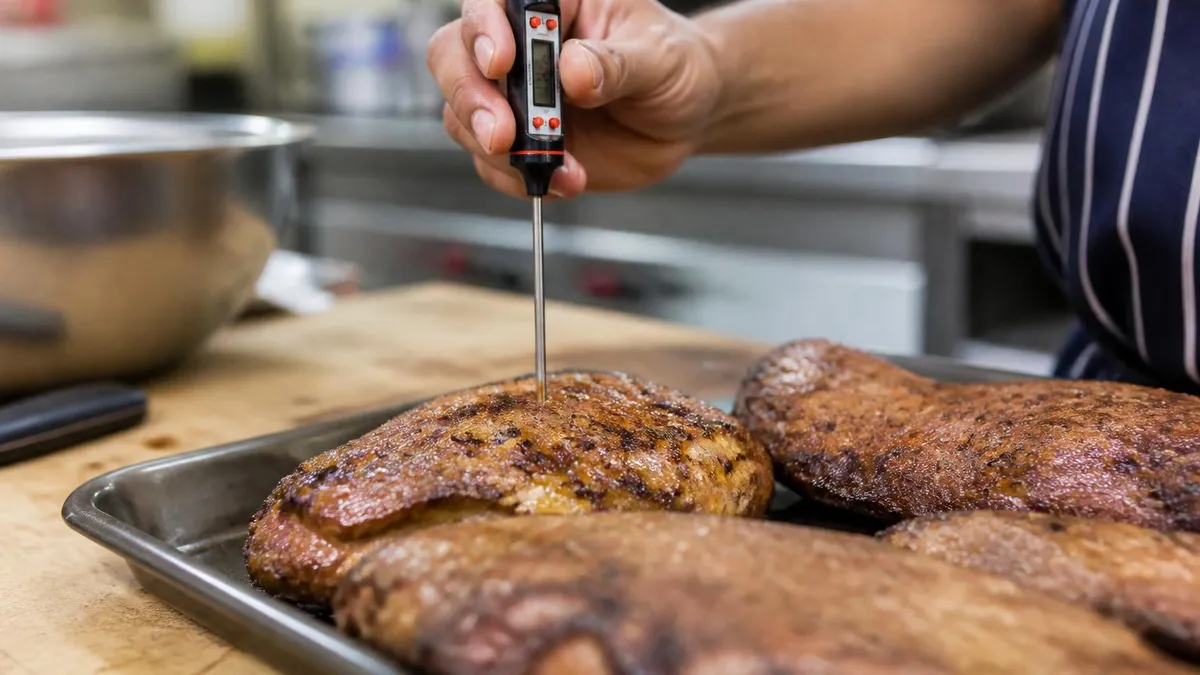
The largest single content area on the exam is safe food handling and temperature control, which accounts for roughly 25 percent of all scored questions. This section tests your knowledge of temperature danger zones (41°F to 135°F), required minimum internal cooking temperatures for various protein types, proper cooling procedures (from 135°F to 70°F within 2 hours, then to 41°F within an additional 4 hours), and the correct use of calibrated thermometers. You must also understand when to discard time-temperature abused food and how to document temperature logs as part of an active food safety management system.
Foodborne illnesses and allergens make up the second-largest content block on the ServSafe Manager exam. You will be expected to identify the major pathogens — including Salmonella Typhi, Hepatitis A, Shigella spp., Norovirus, and E. coli O157:H7 — along with their associated foods, symptoms, incubation periods, and transmission routes. The exam also covers the Big Nine allergens recognized by the FDA since the FASTER Act of 2021 expanded the original Big Eight to include sesame. Knowing how to prevent allergen cross-contact and how to communicate allergen information to guests is tested at both the awareness and procedural level.
Personal hygiene and employee health policies represent another high-priority content area. The ServSafe Manager exam expects you to know when an employee must be excluded from the operation entirely (diagnosed with a Big Six illness) versus when they may be restricted to non-food-contact duties (experiencing symptoms like vomiting or diarrhea). Handwashing is tested in remarkable detail — the correct procedure involves at least 20 seconds of scrubbing with soap, and the exam will present scenarios in which you must identify whether a handwashing step was performed correctly or skipped entirely.
You can explore study materials covering these topics through our servsafe manager quizlet 2024 resource hub for additional textbook-aligned review content.
Cross-contamination prevention covers proper food storage hierarchy in refrigerators and walk-in coolers — ready-to-eat foods on top, followed by seafood, whole cuts of beef and pork, ground meats, and poultry on the bottom. The exam tests your ability to apply this hierarchy in realistic scenarios, including situations where space is limited and creative storage solutions might inadvertently create contamination risk. Allergen cross-contact is treated as a distinct and equally serious concern, requiring dedicated equipment, separate preparation surfaces, and staff training protocols that go beyond what standard sanitation procedures cover.
Cleaning and sanitation questions require you to distinguish between cleaning (removing visible dirt and food residue) and sanitizing (reducing pathogens to safe levels using heat or chemical agents). The exam will test chemical sanitizer concentrations — chlorine solutions must typically fall between 50 and 100 parts per million (ppm), iodine solutions between 12.5 and 25 ppm, and quaternary ammonium compounds according to manufacturer specifications. You must also understand three-compartment sink procedures, the proper order of operations (wash, rinse, sanitize, air dry), and when to change sanitizer solution due to contamination or concentration decline.
Food safety management systems, including Hazard Analysis Critical Control Points (HACCP) and active managerial control (AMC), round out the exam content. HACCP is a preventive, science-based system that identifies biological, chemical, and physical hazards at specific points in the food preparation process and establishes critical limits, monitoring procedures, corrective actions, verification steps, and record-keeping requirements.
The ServSafe Manager exam tests your ability to identify the seven HACCP principles, recognize critical control points in a given production flow, and describe what happens when a critical limit is not met. Understanding these systems deeply — rather than just memorizing terminology — is what separates candidates who pass on the first attempt from those who need a second try.
ServSafe Manager Practice Test Study Strategies
Quizlet flashcards are excellent for memorizing definitions, minimum internal cooking temperatures, and pathogen names during early study phases. They are fast, mobile-friendly, and easy to review in short bursts. However, flashcard recall is fundamentally different from the scenario-based reasoning the ServSafe Manager exam demands. Candidates who rely exclusively on flashcard sets frequently struggle with multi-step questions that require applying knowledge rather than simply retrieving it.
Full-length practice tests are the gold standard for final-stage exam prep. Taking timed, 80-question mock exams under conditions that mimic the real test environment — quiet room, no notes, strict time limit — trains your brain to work efficiently under pressure. Research on test-taking performance consistently shows that active retrieval practice through full exams improves long-term retention more effectively than repeated passive review of notes or flashcard decks, making practice tests an irreplaceable part of any serious ServSafe study plan.

ServSafe Manager Certification: Is It Worth It?
- +Nationally recognized credential accepted by health departments across all 50 states
- +Required by law in many states, eliminating the choice for food service operators
- +Demonstrates food safety leadership to employers and increases hiring competitiveness
- +Certification is valid for five full years, providing long-term professional value
- +Online and in-person course formats make it accessible for varied work schedules
- +Passing the exam often qualifies managers for higher pay grades and supervisory roles
- −Exam fee plus course costs can total $150 or more, which is a significant expense for hourly workers
- −The 75 percent passing threshold is unforgiving — even one bad section can cause failure
- −Study materials must be edition-specific; using outdated 6th edition content for a 7th edition exam creates risk
- −Proctored exam requires scheduling in advance, which may be difficult with unpredictable restaurant shift schedules
- −Recertification is required every five years, creating ongoing time and cost obligations
- −Some states require additional state-specific food handler or manager certifications on top of ServSafe
ServSafe Manager Exam Day Preparation Checklist
- ✓Complete at least three full-length 80-question practice tests and score 80% or higher on each
- ✓Review all six content domains using the current ServSafe Manager 7th Edition textbook
- ✓Memorize minimum internal cooking temperatures for poultry (165°F), ground meat (155°F), seafood (145°F), and whole cuts (145°F)
- ✓Practice the correct two-step cooling procedure: 135°F to 70°F within 2 hours, then to 41°F within 4 more hours
- ✓Study the Big Six reportable illnesses requiring employee exclusion from food service operations
- ✓Review the seven HACCP principles and be able to identify critical control points in a food production flow
- ✓Memorize chemical sanitizer concentration ranges for chlorine (50-100 ppm), iodine (12.5-25 ppm), and quat compounds
- ✓Study the correct refrigerator storage hierarchy from top shelf to bottom for cross-contamination prevention
- ✓Bring a valid government-issued photo ID to the testing site on exam day
- ✓Arrive at the testing location at least 15 minutes before your scheduled exam start time

75% Is the Magic Number — Here's What That Means in Practice
The ServSafe Manager exam contains 90 questions, but only 80 are scored. You must answer at least 60 of those 80 scored questions correctly to pass. That means you can miss up to 20 scored questions and still earn your certification. Understanding this math helps reduce test anxiety and allows you to allocate your preparation time efficiently — focus on mastering the highest-weighted content domains rather than trying to achieve perfection across every single topic area.
Once you pass the ServSafe Manager exam, the certification process moves quickly. Your proctor submits your score to the NRAEF, and your official ServSafe Manager Certification — valid for five years from the date of your exam — is issued electronically within a few business days. You will receive an email with access to your digital certificate, and a printed certificate can also be ordered through your ServSafe account portal. Many employers will want to see your certificate number and issue date, so keep this information easily accessible in your employment records.
The passing score of 75 percent translates to 60 correct answers out of 80 scored questions. If you fail the exam on your first attempt, you must wait at least 24 hours before scheduling a retake. After a third failure, the waiting period extends to 60 days. Each retake requires paying a new exam fee, which typically ranges from $36 to $70 depending on whether you test through a ServSafe-registered instructor, a third-party testing center, or the online proctored option. For this reason alone, thorough preparation before your first attempt is a sound financial strategy.
Your ServSafe Manager Certification is recognized by food safety regulatory authorities across the United States and is accepted as meeting the Certified Food Protection Manager (CFPM) requirement established by the FDA Food Code. This makes your credential portable — if you relocate or change employers, your certification follows you and continues to satisfy state and local food safety requirements in most jurisdictions. Some states, including California, require an additional state-specific food safety exam (the California Food Handler Card), but ServSafe Manager certification satisfies the higher-level CFPM requirement in all states that have adopted the model FDA Food Code framework.
Several major certification bodies — including ANSI-CFP (American National Standards Institute Conference for Food Protection) — have accredited the ServSafe Manager exam, which is a key distinction that matters for regulatory compliance. Not all food safety manager certifications carry this accreditation status, and some employers and health departments specifically require an ANSI-CFP accredited certification rather than just any food safety training program. When you earn your ServSafe Manager Certification, you are earning a credential that meets the highest industry and regulatory standards for food safety management in commercial food service operations throughout the country.
For those pursuing leadership roles in large restaurant chains, hospital food service departments, school cafeterias, or catering companies, the ServSafe Manager Certification is often a baseline prerequisite rather than an optional enhancement. Many national restaurant brands require all general managers and kitchen managers to hold an active ServSafe Manager Certification before they can be promoted into those roles. This organizational requirement means that allowing your certification to lapse — even briefly — can create complications for career advancement at the exact moments when you most need your credentials to be current and verifiable by your employer or franchisor.
Beyond the individual career benefits, ServSafe Manager Certification serves a genuine public health function. Foodborne illness affects an estimated 48 million Americans every year, resulting in 128,000 hospitalizations and approximately 3,000 deaths annually according to the Centers for Disease Control and Prevention (CDC). Certified food protection managers who actively implement HACCP principles, enforce proper temperature control procedures, and maintain rigorous personal hygiene standards in their operations are directly responsible for preventing many of these illnesses from ever occurring.
The knowledge you gain through the ServSafe certification process is not just exam content — it is practical, life-saving information that makes a real difference in community health outcomes.
Managers who hold active ServSafe certification also report greater confidence when conducting employee training, responding to health department inspections, and making real-time food safety decisions during busy service periods. The certification validates your expertise, but the study process itself builds the deep, integrated knowledge base that makes food safety judgment intuitive rather than effortful. Candidates who invest seriously in their exam preparation — using practice tests, structured review schedules, and multiple learning modalities — consistently report that the certification experience transformed them into more effective, confident food safety leaders in their workplaces.
Many Quizlet study sets for ServSafe Manager certification were created for the 6th Edition textbook and have not been updated to reflect 7th Edition content changes, including the expanded Big Nine allergen list (sesame was added in 2023) and updated FDA Food Code guidance on cooling procedures and employee illness policies. Using outdated materials can lead you to memorize incorrect information and answer exam questions incorrectly based on superseded guidance. Always verify that any study materials you use — including Quizlet sets, YouTube videos, and third-party websites — are specifically aligned with the current 7th Edition ServSafe Manager curriculum.
Renewing your ServSafe Manager Certification before it expires is just as important as earning it in the first place. Certifications expire exactly five years from the date of your exam, not the date your certificate was printed or mailed. If your certification lapses — even by a single day — you will be considered uncertified for any regulatory compliance purposes, which can trigger health department violations if your jurisdiction requires a certified food protection manager to be on-site or on-call during operating hours. Set a calendar reminder at least 60 days before your expiration date to begin the renewal process.
Renewing your ServSafe Manager Certification requires passing the full 90-question exam again — there is no abbreviated renewal exam or continuing education shortcut available under the current program structure. This means your renewal preparation should be treated with the same rigor as your original exam preparation. Many experienced food service professionals are surprised to discover that their practical, day-to-day knowledge of food safety procedures does not automatically translate into strong performance on the exam without deliberate review of the specific terminology, numerical thresholds, and regulatory framework that the ServSafe Manager exam tests.
The good news is that renewal candidates typically find exam prep faster and more efficient the second time around, because they already have a foundational understanding of the content from their initial certification. Most renewal candidates report needing two to three weeks of focused review — rather than the four to six weeks often recommended for first-time test-takers — to achieve consistent practice scores above 80 percent.
The most common weak areas for renewal candidates are numerical thresholds (cooking temperatures, sanitizer concentrations, and cooling time requirements) that may have shifted slightly across textbook editions, and emerging content areas like the Big Nine allergen requirements that were not part of older editions of the exam.
Online proctored exam options have made the renewal process significantly more convenient in recent years. ServSafe now offers a fully online testing option in which a live remote proctor monitors your exam session via webcam.
This eliminates the need to travel to a testing center, allows you to test from home or a private office, and provides much greater scheduling flexibility for busy food service managers who cannot easily step away from their operations for an entire exam day. The online format uses the same question bank and passing standards as the in-person proctored version, so your preparation strategy should be identical regardless of which format you choose.
Some food service professionals choose to pursue the ServSafe Alcohol certification in addition to — or alongside — their ServSafe Manager renewal. The alcohol certification is a separate credential focused on responsible alcohol service, checking identification, recognizing signs of intoxication, and understanding liability under dram shop laws. It is particularly relevant for restaurant managers, bar managers, and hospitality professionals whose operations include a significant alcohol service component. The dual-certification combination of ServSafe Manager and ServSafe Alcohol represents the most comprehensive food and beverage safety credential package available through the NRAEF program portfolio.
For food service operators who manage multiple locations or large teams, tracking certification expiration dates across an entire management staff can become logistically complex. Many multi-unit restaurant operators use HR software or simple shared spreadsheets to monitor certification expiration dates for all certified managers on staff.
Some operators build certification renewal into their annual performance review cycle, scheduling all manager recertification exams during a predictable window each year so that compliance status is easy to audit. Whichever tracking system you use, the key principle is the same: never allow your certified food protection manager coverage to lapse, because the regulatory and reputational consequences can be significant and difficult to reverse quickly once a violation has been cited by a health inspector.
The financial investment in ongoing ServSafe certification — both initial and renewal — is modest relative to the value it provides. Most food service operators spend between $100 and $200 per manager per certification cycle when factoring in course materials, exam fees, and any study resources used during preparation.
Compare this to the potential cost of a single foodborne illness incident — which can include legal liability, civil settlements, negative press coverage, and permanent reputational damage that affects customer traffic for years — and the return on investment becomes immediately clear. Maintaining current certifications is one of the most cost-effective risk management strategies available to any food service operation of any size.
Building a practical, day-by-day study schedule is the single most effective thing you can do to improve your ServSafe Manager exam score. Most first-time candidates benefit from four to six weeks of structured preparation, allocating between 30 and 60 minutes of focused study time per day. Sporadic cramming sessions — a common approach among busy food service professionals — are far less effective than consistent daily review because the brain consolidates new information more effectively through repeated, spaced exposure rather than through marathon single-session study blocks.
In your first week of preparation, focus on understanding the overall exam structure and taking a full-length diagnostic practice test without any review materials. Your raw diagnostic score tells you exactly where your baseline knowledge is strong and where it needs development. Document your score by content domain, not just your overall percentage, so you can allocate your remaining study weeks proportionally. A candidate who scores 90 percent on personal hygiene questions but only 55 percent on food safety management systems should spend three times as much study time on HACCP and active managerial control than on employee health policies.
Weeks two and three of your study plan should focus on the two heaviest content domains: safe food handling and temperature control, and foodborne illnesses and allergens. These two areas collectively represent approximately 44 percent of your scored questions, meaning that mastering them efficiently gives you the highest return on study time invested. Use a mix of textbook reading, topic-specific practice quizzes, and temperature chart memorization exercises. Physical flashcards — or even Quizlet digital sets for these specific numerical facts — work well for drilling cooking temperature thresholds, cooling time requirements, and pathogen incubation periods until they become automatic responses.
Week four should be dedicated to cross-contamination prevention, personal hygiene, and cleaning and sanitation. These domains are interconnected — the principles that prevent biological cross-contamination also apply to allergen management, and proper sanitation procedures directly support the hygiene standards that prevent illness transmission among food service staff. Study these three domains together as a unified operational system rather than three separate content blocks, which helps you understand how they interact in real kitchen environments and makes scenario-based exam questions easier to reason through logically.
In week five, shift your focus to food safety management systems — HACCP, active managerial control, and regulatory compliance frameworks. This content area is more conceptual and requires understanding relationships between principles rather than memorizing isolated facts.
The best way to study HACCP is to walk through a realistic food production scenario — such as preparing a roasted chicken dish from receiving through service — and identify each of the seven HACCP principles as they apply at each stage of that process. This narrative, scenario-based approach mirrors exactly how the exam presents HACCP questions, and practicing it repeatedly makes the framework intuitive rather than abstract.
Your final week before the exam should be spent almost entirely on full-length practice tests rather than content review. Take one complete practice test per day during your final five days, review your wrong answers immediately after each test, make brief notes on the specific facts or concepts you missed, and then review those notes the following morning before your next practice test.
This tight review-and-retest cycle maximizes your retention of previously missed content while simultaneously maintaining your comfort with the full exam format and pacing. Aim to average 82 percent or higher across your final five practice tests — that 7-point buffer above the 75 percent passing threshold gives you meaningful protection against any unexpected content areas or moments of test-day anxiety that might cost you a few points on the real exam.
On the day before your exam, avoid intensive studying. A light review of your personal notes and key numerical thresholds — cooking temperatures, sanitizer concentrations, cooling timeframes — is appropriate, but a full study session the night before typically does more harm than good by increasing anxiety and disrupting sleep.
Instead, confirm your testing appointment, prepare your identification documents, plan your route to the testing center, and get a full night of rest. Arriving at the exam rested, prepared, and calm is the final piece of a comprehensive preparation strategy that positions you to earn your ServSafe Manager Certification confidently on the very first attempt.
ServSafe Questions and Answers

ServSafe Cleaning Agents: Which Cleaning Agent Best Removes Baked-On Food?

ServSafe Manager Book 6th Edition: Complete Study Guide & Certification Prep Hub

ServSafe Illinois: Complete Guide to Food Handler & Manager Certification (2026)

Which Is an Example of Possible Chemical Contamination ServSafe: Complete Guide

ServSafe Manager Practice Test 2024: Free Questions & Certification Guide
About the Author

Registered Sanitarian & Food Safety Certification Expert
Cornell University College of Agriculture and Life SciencesThomas Wright is a Registered Sanitarian and HACCP-certified food safety professional with a Bachelor of Science in Food Science from Cornell University. He has 17 years of experience in food safety auditing, regulatory compliance, and foodservice management training. Thomas prepares food industry professionals for ServSafe Manager, HACCP certification, and state food handler examinations.
Join the Discussion
Connect with other students preparing for this exam. Share tips, ask questions, and get advice from people who have been there.
View discussion (7 replies)