
K53 Learner's Licence Test Practice 2026 October (South Africa)
🗨️ Free K53 learner's licence practice tests for South Africa. Master road signs, rules of the road, vehicle controls and the K53 defensive driving method before your DLTC test.

What is the K53 learner's licence test?
The learner's licence is the first step to driving legally in South Africa. Before you can apply for a driver's licence and book a road test, you must hold a valid learner's licence. The written learner's test is built around the K53 system, the official defensive driving method the country uses to train and assess new drivers. K53 is not just a syllabus of facts to memorise; it is a way of thinking about the road that puts observation, anticipation and safe vehicle control first.
The test itself is taken on a touch-screen computer or on paper at the DLTC, depending on the centre. It is split into three clear sections, and you have to pass each one on its own. You cannot make up a weak section with a strong one. That is why steady, balanced practice across signs, rules and controls matters so much. Many learners are confident about road signs but lose marks on the rules of the road, or the other way round.
There are three vehicle codes you can write for. Code 1 covers motorcycles, Code 2 covers light motor vehicles such as cars and bakkies, and Code 3 covers heavy vehicles like trucks and buses. The number of questions you answer changes slightly with the code, but the core knowledge stays the same. The practice tests on this page focus on the Code 2 learner's test, which is by far the most common, while still teaching principles that apply to every code.
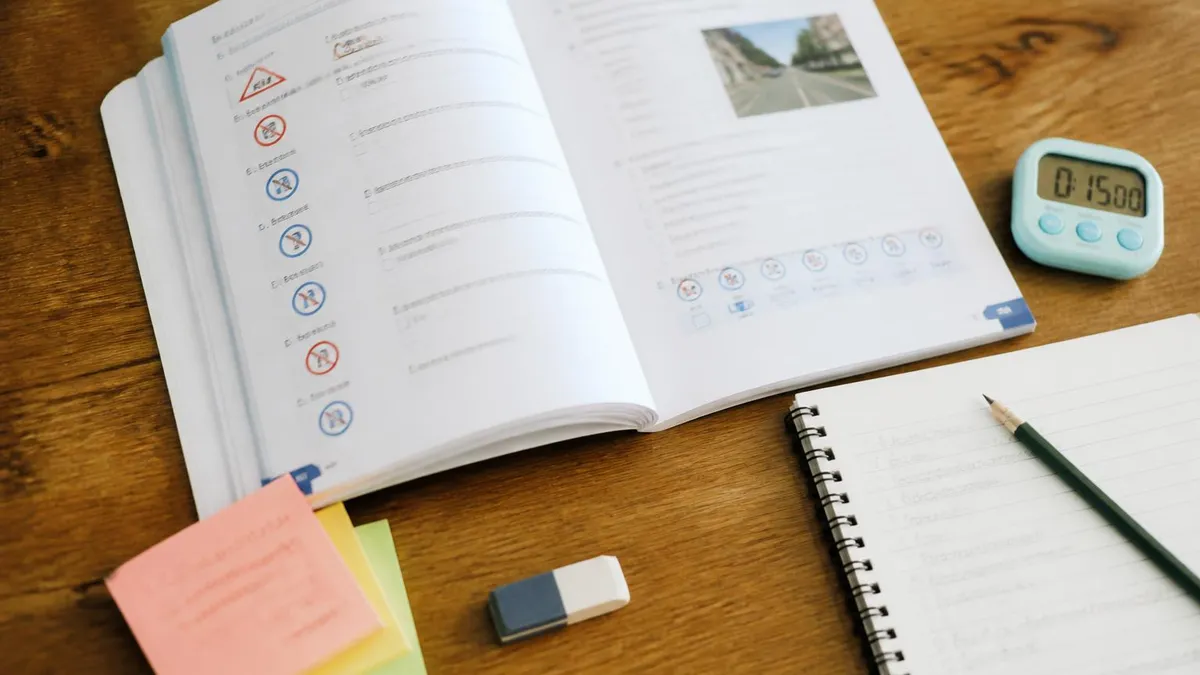
How the learner's test is structured
The South African learner's licence test is divided into three sections, and you must pass all of them in the same sitting. The first section is road signs, where you identify regulatory, warning, command, information and other signs and explain what each one means. The second section is rules of the road, covering speed limits, right of way, following distance, overtaking, robots and general traffic law. The third section is controls of the vehicle, which tests your knowledge of the clutch, brake, accelerator, gears, handbrake, indicators and other instruments.
For a Code 2 (light motor vehicle) learner's test you typically answer 28 questions on signs, 28 on rules of the road and 8 on vehicle controls, giving 64 questions in total. You must score at least 22 out of 28 on signs, 23 out of 28 on rules, and a perfect 8 out of 8 on controls. Because the controls section allows no mistakes, it pays to know your vehicle instruments cold.
Road signs: the biggest section to master
Road signs make up a large part of the learner's test, and they are also where careful study pays off fastest. South African road signs fall into clear families. Regulatory signs tell you what you must or must not do: a red octagon means stop, an inverted red-bordered triangle means yield, a red disc with a white bar means no entry, and a number in a red circle sets the speed limit. Command signs are blue circles with white symbols, instructing you to do something such as keep left or proceed straight. Prohibition signs are round with a red border and often a diagonal line, forbidding actions like overtaking or U-turns.
Warning signs are triangular with a red border and alert you to hazards ahead, from sharp curves and slippery roads to crossing children and animals. At roadworks you will also see diamond-shaped yellow temporary warning signs. Information and guidance signs are usually blue or green rectangles, pointing you to hospitals, parking, routes and destinations. Once you can place any sign into the correct family by its shape and colour, the meaning usually follows, and the road-signs section becomes much less intimidating.

A learner's licence in South Africa is valid for 24 months. You must pass your practical driving test within that period, or you will have to write the learner's test again.
Rules of the road and the safe-driving mindset
The rules-of-the-road section tests the everyday law that keeps traffic moving safely. You drive on the left in South Africa and overtake on the right under normal conditions. The default speed limit is 60 km/h in built-up areas, 100 km/h on rural roads outside towns, and 120 km/h on freeways, unless a sign says otherwise. At a four-way stop, vehicles proceed in the order they stopped; if two arrive together, the driver on the left yields to the one on the right.
Robots (traffic lights) follow the obvious logic: red means stop behind the line, green means go if the way is clear, and a steady amber means stop if you can do so safely because red is coming. A flashing red robot is treated as a stop sign. The legal blood-alcohol limit for an ordinary driver is below 0.05 grams per 100 millilitres of blood, and lower for professional drivers. Following distance matters too: the two-second rule gives you space to react, and you should increase it in rain, fog or at night. These rules reward understanding over memorising, which is exactly what the practice tests on this page build.
- ✓Score 90 percent or higher on all six practice tests above
- ✓Know every road-sign family by shape and colour
- ✓Memorise the controls section perfectly (8/8 required)
- ✓Learn the default speed limits: 60, 100 and 120 km/h
- ✓Understand four-way-stop and right-of-way rules
- ✓Book your DLTC slot early with ID, photos and proof of residence
- ✓Pass or bring your eye-test result on the day
- ✓Arrive early and bring your booking confirmation

Vehicle controls: the section you cannot afford to miss
The controls section is short but unforgiving, because you need a perfect score. It checks that you can identify and explain every instrument and control in the vehicle. You should know that the clutch disengages the engine from the gearbox so you can change gears, that the brake slows and stops the car, that the accelerator increases speed, and that the handbrake holds the vehicle still when parked or stopped on a hill. You also need to know the indicators, headlights, hooter, demister and the gear lever, including that a manual car must be started in neutral with the clutch depressed.
K53 adds an important habit on top of the bare controls: observation before action. Before moving off you check your mirrors, glance over your shoulder to clear the blind spot, signal your intention and only then pull away when it is safe. Keeping both hands on the wheel except when changing gear or signalling gives you full control. The practice test on vehicle controls and K53 above drills exactly these points so they become second nature.
How to book your learner's licence at the DLTC
Booking the learner's test in South Africa takes a little planning, and getting the admin right means you will not be turned away on the day. You start at a Driving Licence Testing Centre, where you complete the LL1 application form. You will need a certified copy of your South African identity document, two black-and-white identity photographs, and proof of residential address such as a recent utility bill. If the address is not in your own name, you bring a letter from the account holder together with their proof of address. An eye test is also required, either done at the centre or supplied as a certificate from a registered optometrist.
Because so many people are learning to drive, popular centres are often fully booked weeks ahead. It is worth phoning around or using the online booking systems that some provinces now offer to find an earlier slot. On the day, arrive well before your appointment time, carry your booking confirmation, your ID and your eye-test result, and pay the prescribed fee. If you arrive late, many centres simply give your slot away, so plan your travel with traffic in mind.
The fees are modest and set by each province, and they cover the test itself rather than any tuition. Once you pass, the centre issues your learner's licence on the spot or shortly afterwards. From that moment you may drive only while accompanied by a licensed driver and while displaying the required signage, until you pass your practical test and receive a full driver's licence.
The vehicle-controls section trips up more candidates than any other, because it allows no mistakes at all. Learn every instrument and control until you can name it without hesitation, and you remove the most common cause of a failed learner's test.
Common mistakes and how to avoid them
Most learners who fail the K53 test do so for predictable reasons. The first is under-practising the controls section, where a single wrong answer means failure. The second is confusing sign families, especially mixing up command signs (blue circles, telling you what you must do) with prohibition signs (red-bordered circles, telling you what you must not do). The third is guessing on rules of the road instead of learning the underlying logic of right of way, following distance and speed limits.
You can avoid all three by using the six practice tests above in a structured way. Repeat the controls test until you score full marks every time. Study signs by shape and colour so the meaning follows naturally. Read every explanation, even on questions you answered correctly, because the reasoning is what carries over to unfamiliar questions on test day. Treat each practice attempt as a real exam, work quietly and time yourself, and you will build both knowledge and the calm confidence that helps you pass at the DLTC.
📚 How many sections are in the K53 learner's test?
Three: road signs, signals and markings; rules of the road; and vehicle controls. You must reach the pass mark in every section in the same sitting, so a strong signs score cannot rescue a weak rules score.
START RULES OF THE ROAD PRACTICE TEST✅ What is the pass mark for the Code 2 learner's test?
For a light motor vehicle you need 22 out of 28 on road signs, 23 out of 28 on rules of the road and a perfect 8 out of 8 on vehicle controls. That is 64 questions in total, marked section by section.
START ROAD SIGNS PRACTICE TEST🚗 Why do so many people fail the vehicle controls section?
Because it allows no mistakes at all: 8 out of 8 is required. One slip about the clutch, handbrake or an instrument fails the whole test, which is why learners license practice questions on controls are worth repeating until they are automatic.
START VEHICLE CONTROLS PRACTICE TEST🎂 How old must you be to write the K53 learner's test?
Code 1 (motorcycle up to 125 cc) from 16; Code 1 for a motorcycle over 125 cc from 18; Code 2 (cars, bakkies and vehicles up to 3 500 kg) from 17; Code 3 (vehicles over 3 500 kg) from 18. The age applies on the date of the test.
START K53 PRACTICE TEST📅 How long is a South African learner's licence valid?
A learner's licence is valid for 24 months and cannot be extended. If you have not passed your driving licence test by then, you must write the learner's test again.
START DEFENSIVE DRIVING PRACTICE TEST📝 Which form do you complete to apply for a learner's licence?
Form LL1, the Application for a Learner's Licence, available at any Driving Licence Testing Centre (DLTC). Applicants aged 65 or older must also hand in a Medical Certificate form (MC).
START LEARNERS TEST PRACTICE🪪 What do you bring to the DLTC to book the learner's test?
Your identity document, identical black-and-white ID photographs (confirm the number with your DLTC), proof of postal and residential address, and the booking fee. You also do an eye test at the centre or bring one from a qualified optometrist.
START ROAD MARKINGS PRACTICE TEST💻 Can you book the learner's test online?
Gauteng residents are directed to apply for the learner's licence online through the NaTIS portal at online.natis.gov.za. Elsewhere you book at your nearest DLTC, and fees are set per province, so check the local amount before you go.
START K53 LEARNERS TEST PRACTICE🛑 What is the difference between regulatory and warning road signs?
Regulatory signs tell you what you must or must not do, such as stop, yield or a speed limit, and disobeying them is an offence. Warning signs alert you to a hazard ahead, such as a sharp bend or pedestrians, so you can slow down and prepare.
START WARNING SIGNS PRACTICE TEST🎉 What happens on the day you pass the learner's test?
You pay the issue fee and the DLTC issues your learner's licence the same day. From then on you may drive only while supervised by a licensed driver, and you must still pass the practical driving test within 24 months.
START K53 PRACTICE TESTSample K53 Learner's Licence Test Practice Questions
Try these questions from our free K53 Learner's Licence Test practice tests. The correct answer and an explanation follow each question.
During the K53 test, why must you do an all-round observation (including the blind spot) before pulling off?
- A. To save fuel
- B. Because it is optional but looks good
- C. To check for traffic, pedestrians or cyclists the mirrors do not show
- D. To adjust the radio
Answer: C. To check for traffic, pedestrians or cyclists the mirrors do not show
Mirrors have blind spots. K53 requires a physical glance over your shoulder to make sure no cyclist, pedestrian or vehicle is hidden before you move off.
Why does K53 require you to keep both hands on the steering wheel except when changing gear or signalling?
- A. To rest your arms
- B. To look professional
- C. Because the law fines one-handed driving
- D. To maintain full control and react quickly to hazards
Answer: D. To maintain full control and react quickly to hazards
Keeping both hands on the wheel gives you maximum control and lets you respond quickly and safely to any hazard while driving.
Before a long journey, a defensive driver should check what on the vehicle?
- A. Nothing, the garage handles it
- B. Only the fuel
- C. Tyres, lights, brakes, oil, water and indicators
- D. Just the radio
Answer: C. Tyres, lights, brakes, oil, water and indicators
A pre-trip check of tyres, lights, brakes, oil, water and indicators helps prevent breakdowns and keeps the vehicle roadworthy and safe.
A circular sign shows a bicycle in red with a diagonal line. What does this regulate?
- A. No bicycles allowed
- B. Cycle parking area
- C. Cycle lane ahead
- D. Bicycles must use this lane
Answer: A. No bicycles allowed
A bicycle symbol inside a red circle with a diagonal line is a prohibition sign meaning bicycles are not permitted on that road.
Official Resources
- South African Government: Apply for a learner's licence sets out the vehicle codes, minimum ages, documents, the LL1 form and the 24-month validity of the learner's licence.
- Road Traffic Management Corporation (RTMC) is the national road traffic authority and links to the NaTIS online portal used for learner's licence bookings.
- National Department of Transport publishes the road traffic legislation and policy behind the K53 learner's and driving licence tests.
About the Author

South African licensing & matric exam-prep specialist
University of Cape TownThandeka Nkosi is a South African education specialist focused on the K53 learner's and driving licence tests, matric (NSC) exams, the NBT and professional licensing such as firearm competency and RE5. She develops practice tests and study guides matched to the official South African formats.