
WPPSI Age Range: A Complete Guide 2026 October
✍🏼 Pass your WPPSI Age Range: A Complete Guide exam on the first attempt. Practice questions with detailed answer explanations, hints, and instant scoring.
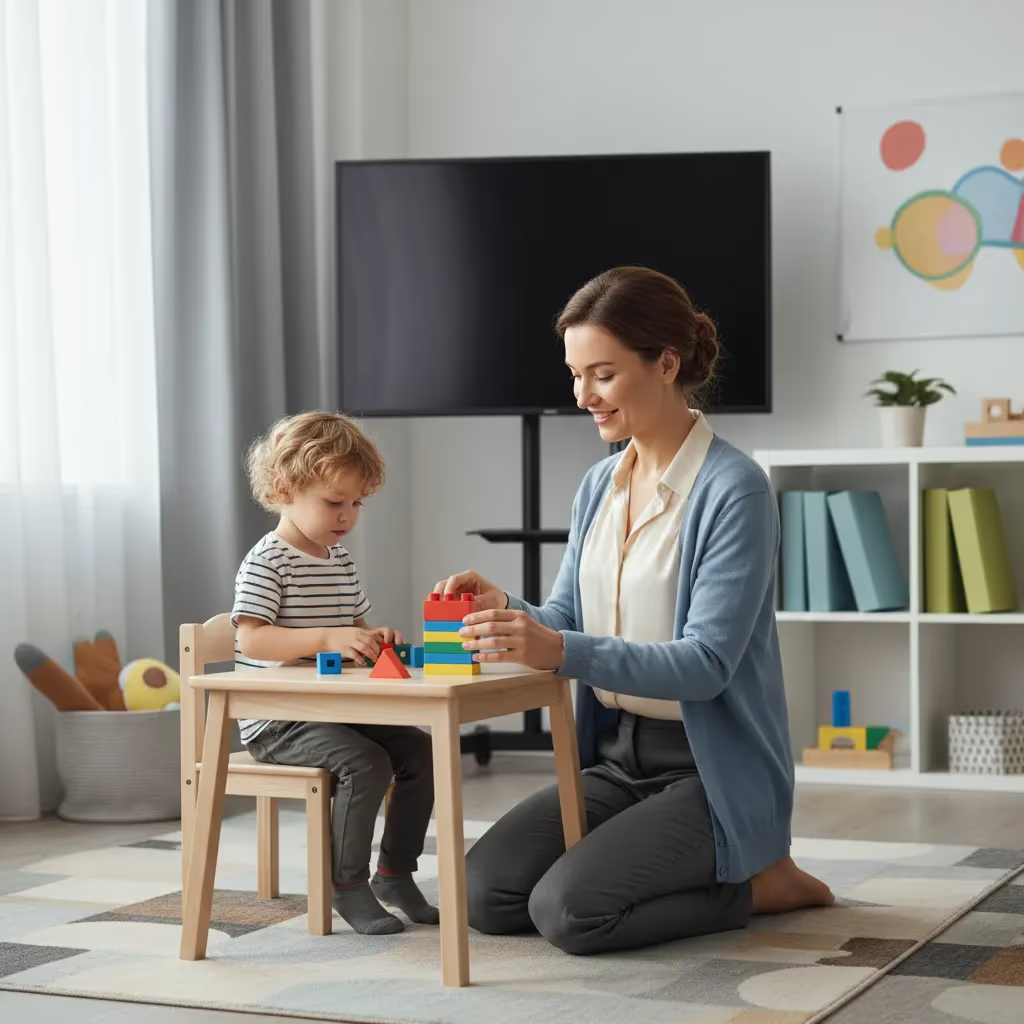
The Wechsler Preschool and Primary Scale of Intelligence (WPPSI) represents one of the most comprehensive cognitive assessment tools designed for young children. Understanding the WPPSI age range is crucial for parents, educators, and psychologists evaluating intellectual development during critical early years.
The WPPSI age range spans from 2 years 6 months through 7 years 7 months, making it the premier intelligence assessment for preschool and early primary school-aged children. This range reflects profound developmental changes during early childhood, when cognitive abilities undergo rapid transformation. The current edition, WPPSI-IV, features innovative, developmentally appropriate subtests that engage young children while measuring cognitive functioning across verbal comprehension, visual-spatial processing, fluid reasoning, working memory, and processing speed.
Candidates preparing for wppsi can build exam confidence with our WPPSI intelligence test 2026, which covers all key topics and question formats used in the real assessment.
WPPSI Practice Test Questions
Prepare for the WPPSI - Wechsler Preschool and Primary Scale of Intelligence exam with our free practice test modules. Each quiz covers key topics to help you pass on your first try.
WPPSI Knowledge
WPPSI Exam Questions covering Knowledge. Master WPPSI Test concepts for certification prep.
WPPSI Picture Concepts
Free WPPSI Practice Test featuring Picture Concepts. Improve your WPPSI Exam score with mock test prep.
WPPSI Developmental Considerations & Age-A...
WPPSI Mock Exam on Developmental Considerations & Age-Appropriate Testing. WPPSI Study Guide questions to pass on your first try.
WPPSI - Wechsler Preschool and Primary Sca...
WPPSI Test Prep for - Wechsler Preschool and Primary Scale of Intelligence Administration and Scoring Rules. Practice WPPSI Quiz questions and boost your score.
WPPSI - Wechsler Preschool and Primary Sca...
WPPSI Questions and Answers on - Wechsler Preschool and Primary Scale of Intelligence Fluid Reasoning Index. Free WPPSI practice for exam readiness.
WPPSI - Wechsler Preschool and Primary Sca...
WPPSI Mock Test covering - Wechsler Preschool and Primary Scale of Intelligence Index Score Interpretation. Online WPPSI Test practice with instant feedback.
WPPSI - Wechsler Preschool and Primary Sca...
Free WPPSI Quiz on - Wechsler Preschool and Primary Scale of Intelligence Processing Speed Subtests. WPPSI Exam prep questions with detailed explanations.
WPPSI - Wechsler Preschool and Primary Sca...
WPPSI Practice Questions for - Wechsler Preschool and Primary Scale of Intelligence Psychometric Properties and Norms. Build confidence for your WPPSI certification exam.
WPPSI - Wechsler Preschool and Primary Sca...
WPPSI Test Online for - Wechsler Preschool and Primary Scale of Intelligence Subtest Substitution Guidelines. Free practice with instant results and feedback.
WPPSI - Wechsler Preschool and Primary Sca...
WPPSI Study Material on - Wechsler Preschool and Primary Scale of Intelligence Verbal Comprehension Subtests. Prepare effectively with real exam-style questions.

- ✓Review the official WPPSI exam content outline
- ✓Take a diagnostic practice test to identify weak areas
- ✓Create a study schedule (4-8 weeks recommended)
- ✓Focus on your weakest domains first
- ✓Complete at least 3 full-length practice exams
- ✓Review all incorrect answers with detailed explanations
- ✓Take a final practice test 1 week before exam day
WPPSI: Pros and Cons
- +wppsi — wPPSI credential is recognized by employers and industry professionals
- +Higher earning potential compared to non-credentialed peers
- +Expanded career opportunities and professional advancement
- +Structured learning path builds comprehensive knowledge
- +Professional development that stays current with industry standards
- −Preparation requires significant time and study commitment
- −Associated costs for exams, materials, and renewal fees
- −Continuing education needed to maintain credentials
- −Competition for advanced positions can be challenging
- −Requirements and standards may vary by state or region
Pros and Cons at a Glance
| Pros | Cons |
|---|---|
| wppsi — wPPSI credential is recognized by employers and industry professionals | Preparation requires significant time and study commitment |
| Higher earning potential compared to non-credentialed peers | Associated costs for exams, materials, and renewal fees |
| Expanded career opportunities and professional advancement | Continuing education needed to maintain credentials |
| Structured learning path builds comprehensive knowledge | Competition for advanced positions can be challenging |
| Professional development that stays current with industry standards | Requirements and standards may vary by state or region |
Sample WPPSI - Wechsler Preschool and Primary Scale of Intelligence Practice Questions
Try these questions from our free WPPSI - Wechsler Preschool and Primary Scale of Intelligence practice tests. The correct answer and an explanation follow each question.
What is the age range for children assessed using the WPPSI-IV?
- A. 2 years 6 months to 7 years 7 months
- B. 3 years to 8 years
- C. 4 years to 10 years
- D. 1 year to 6 years
Answer: A. 2 years 6 months to 7 years 7 months
The WPPSI-IV is designed for children aged 2:6 to 7:7, divided into two age bands (2:6–3:11 and 4:0–7:7), each with its own set of subtests appropriate for the developmental stage.
The WPPSI is normed for children ages ______.
- A. 1 - 5
- B. 2 - 7
- C. 3 - 8
- D. 4 - 10
Answer: B. 2 - 7
Explanation: The Wechsler Preschool and Primary Scale of Intelligence (WPPSI) is designed to assess the cognitive abilities of children between the ages of 2 years 6 months and 7 years 7 months.
According to standard WPPSI-IV guidelines, which of the following is NOT considered a valid reason to substitute a core subtest?
- A. The examiner believes the supplemental subtest better reflects the child's ability.
- B. The child has a physical impairment, such as a motor deficit, that hinders performance on the core subtest.
- C. The administration of the core subtest was spoiled by an external event like a fire drill.
- D. The child has a significant language impairment that makes the core subtest an invalid measure.
Answer: A. The examiner believes the supplemental subtest better reflects the child's ability.
Substitution should only occur when a core subtest is invalidated or when specific, documented child characteristics (e.g., physical or language impairment) make the core subtest inappropriate. Substituting based on an examiner's belief that a child will perform better or that it is a 'better estimate' without a standard, valid reason violates standardized procedure.
The Processing Speed subtests on the WPPSI-IV, such as Bug Search and Animal Coding, were designed to be more developmentally appropriate for young children than previous versions. A key adaptation is the use of:
- A. Abstract symbols to challenge reasoning
- B. A pencil and paper for fine motor practice
- C. Complex verbal instructions
- D. An ink dauber and engaging, colorful stimuli
Answer: D. An ink dauber and engaging, colorful stimuli
The WPPSI-IV Processing Speed subtests were intentionally made more 'game-like' and child-friendly. This includes using an ink dauber, which reduces fine motor demands, and employing engaging, familiar images like bugs and animals instead of abstract symbols.
Take the full WPPSI - Wechsler Preschool and Primary Scale of Intelligence practice test
(WPPSI) Wechsler Preschool and Primary Scale of Intelligence Questions and Answers

Conclusion
The WPPSI age range from 2 years 6 months to 7 years 7 months encompasses a critical developmental period when cognitive abilities undergo profound transformation. Understanding this age range and WPPSI-IV assessment capabilities enables parents, educators, and clinicians to make informed decisions supporting children's cognitive and educational development.
The WPPSI's division into developmentally appropriate age bands, comprehensive coverage of cognitive domains, and strong psychometric properties make it the premier intelligence assessment for young children. Whether identifying giftedness, diagnosing learning disabilities, planning interventions, or understanding cognitive profiles, the WPPSI provides invaluable data.
Parents considering assessment should consult qualified psychologists who can determine whether the child falls within the appropriate WPPSI age range and explain how results will inform educational planning. With proper preparation and thoughtful interpretation, WPPSI assessment provides insights into cognitive abilities that guide children's educational journey.
The WPPSI exam uses a multiple-choice format with questions covering all major domains. Most versions allow 2-3 hours for completion.
Questions test both knowledge recall and application skills. A score of 70-75% is typically required to pass.

About the Author

Child Development Specialist & Early Education Exam Expert
Erikson InstituteDr. Rachel Kim holds a Doctorate in Education and a Child Development Associate credential from the Erikson Institute, a graduate institution exclusively focused on early childhood. With 18 years of experience in early childhood education and childcare licensing, she has prepared thousands of CDA candidates and childcare licensing applicants through her structured exam readiness programs.
Join the Discussion
Connect with other students preparing for this exam. Share tips, ask questions, and get advice from people who have been there.
View discussion (8 replies)