
Wechsler Test — Complete Guide 2026 July
🧠 Free Wechsler practice test with questions and answer explanations. Prepare for the 2026 July exam with instant scoring.

What Are the Wechsler Tests?
The Wechsler tests are a family of individually administered intelligence assessments developed by David Wechsler, a clinical psychologist who first published the Wechsler-Bellevue Intelligence Scale in 1939. His scales revolutionized IQ testing by replacing a single IQ number with a profile of cognitive abilities — reflecting the idea that intelligence is multidimensional.
Today, Wechsler tests are published by Pearson Assessments and are the most widely used intelligence tests globally, administered by licensed psychologists for school placements, neuropsychological evaluations, learning disability assessments, gifted program identification, and clinical diagnosis.
Key principles of Wechsler assessment:
- Measures multiple dimensions of cognitive ability, not just a single IQ number
- Produces a Full Scale IQ (FSIQ) plus composite index scores for specific cognitive areas
- Administered one-on-one by a licensed psychologist — not a self-administered test
- Normed for specific age groups — WPPSI for ages 2:6–7:7, WISC for 6–16, WAIS for 16–90
- Results used for clinical, educational, and forensic decision-making
Explore related cognitive assessment resources in our wechsler test practice materials and iq test overview guides.
Wechsler Index Scores Explained
Modern Wechsler tests (WAIS-IV, WISC-V) produce a Full Scale IQ (FSIQ) plus five primary index scores that measure distinct aspects of cognitive ability:
Verbal Comprehension Index (VCI): Measures the ability to reason with words, understand verbal information, express ideas verbally, and access and apply word knowledge. Subtests include Similarities, Vocabulary, and Information. High VCI scores are associated with strong reading, verbal reasoning, and academic verbal performance.
Visual Spatial Index (VSI): Measures the ability to evaluate visual details and understand visual spatial relationships — to construct geometric designs and to reason with visual information. Subtests include Block Design and Visual Puzzles.
Fluid Reasoning Index (FRI): Measures the ability to detect underlying conceptual relationships and use reasoning to identify and apply rules. Subtests include Matrix Reasoning and Figure Weights. FRI is often described as the best index measure of 'g' — general intelligence.
Working Memory Index (WMI): Measures the ability to register, maintain, and manipulate visual and auditory information in conscious awareness over a short period. Subtests include Digit Span and Picture Span. Working memory is closely linked to academic achievement and executive function.
Processing Speed Index (PSI): Measures the speed and accuracy of visual identification, decision-making, and decision implementation. Subtests include Coding and Symbol Search. Processing speed affects how efficiently other cognitive abilities can be applied.
For IQ and cognitive ability practice, see our wechsler test resources and our guide on iq test score interpretation.
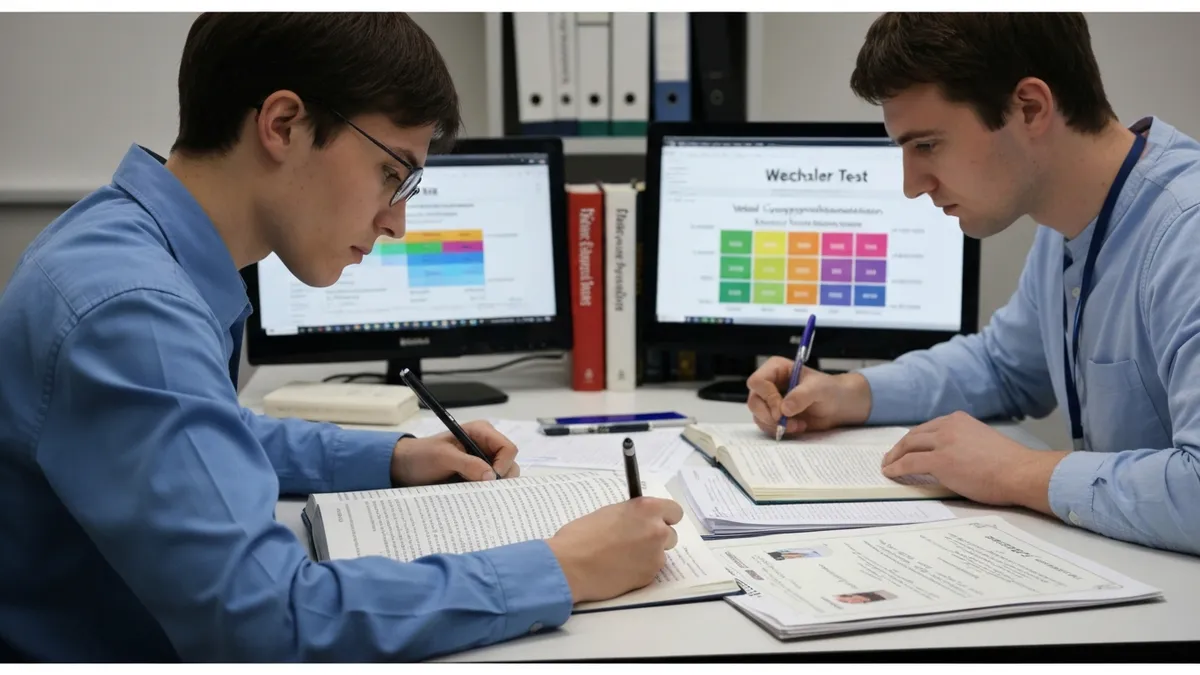
What to Expect During a Wechsler Evaluation
- ✓The Wechsler test is administered one-on-one by a licensed psychologist — it is not a group test or self-administered
- ✓Expect a mix of verbal tasks (vocabulary, reasoning questions), visual-spatial tasks (puzzles, block designs), and timed tasks (coding, symbol search)
- ✓The evaluation typically takes 60–90 minutes depending on age and which version is administered
- ✓For children: ensure they are well-rested and have eaten before the session — fatigue significantly affects performance
- ✓For adults: WAIS evaluations are often part of a larger neuropsychological battery that may take half a day or more
- ✓There is no way to 'study' for the Wechsler in the traditional sense — it measures reasoning ability, not memorized content
- ✓Results are typically shared in a feedback session where the psychologist explains the profile of scores and their implications
- ✓A Wechsler evaluation is often accompanied by other assessments (achievement tests, behavioral ratings) for a complete educational or clinical picture

Wechsler Test Study Tips
What's the best study strategy for Wechsler Test?
Focus on weak areas first. Use practice tests to identify gaps, then study those topics intensively.
How far in advance should I start studying?
Most successful candidates begin 4-8 weeks before the exam. Create a structured study schedule.
Should I retake practice tests?
Yes! Take each practice test 2-3 times. Focus on understanding why answers are correct, not memorizing.
What should I do on exam day?
Arrive 30 min early, bring required ID, read questions carefully, flag difficult ones, and review before submitting.
Wechsler Test Pros and Cons
- +Wechsler has a defined, publicly available content blueprint — candidates know exactly what to prepare for
- +Multiple preparation pathways (self-study, courses, coaching) accommodate different learning styles and schedules
- +A growing ecosystem of study resources means candidates at any budget level can access quality preparation materials
- +Clear score reporting allows candidates to identify specific strengths and weaknesses for targeted remediation
- +Professional recognition associated with strong performance provides tangible career and academic benefits
- −The scope of tested content requires substantial preparation time that competes with existing professional or academic commitments
- −No single resource covers the full content scope — candidates typically need multiple study tools for comprehensive preparation
- −Test anxiety and exam-day performance variability mean preparation effort does not always translate linearly to scores
- −Registration, preparation, and potential retake costs accumulate into a significant financial investment
- −Content and format can change between exam versions, making older preparation materials less reliable
Wechsler Test Questions and Answers



About the Author
Educational Psychologist & Academic Test Preparation Expert
Columbia University Teachers CollegeDr. Lisa Patel holds a Doctorate in Education from Columbia University Teachers College and has spent 17 years researching standardized test design and academic assessment. She has developed preparation programs for SAT, ACT, GRE, LSAT, UCAT, and numerous professional licensing exams, helping students of all backgrounds achieve their target scores.