
Traffic Enforcement Agent Test — Practice Exam Guide 2026 October
🎯 Boost your Traffic Enforcement Agent exam score with practice questions and detailed answer explanations. Track progress with instant feedback.

What Is the Traffic Enforcement Agent Test?
The Traffic Enforcement Agent exam is a competitive civil service examination administered by the NYC Department of Citywide Administrative Services (DCAS). Passing the TEA written exam is the first step in the hiring process for NYC Traffic Enforcement Agents — city employees who enforce parking and standing regulations, direct traffic, and assist in traffic control throughout New York City.
Who hires Traffic Enforcement Agents: NYC Traffic Enforcement Agents are employed by the New York City Police Department (NYPD) Traffic Control Division. TEAs have authority to issue summonses for parking violations, respond to traffic incidents, and direct vehicles and pedestrians at intersections.
The TEA civil service process:
- Step 1 — Written exam: DCAS-administered multiple choice civil service test, open to candidates who meet minimum qualifications. Exam is announced by DCAS and requires online registration during the filing period.
- Step 2 — Candidate list: Candidates who pass are ranked on an eligible list by score. Hiring is done from the list as vacancies arise.
- Step 3 — Background investigation: NYC conducts a background check including criminal history review before appointment.
- Step 4 — Medical and physical fitness: Candidates must pass a medical exam and demonstrate physical fitness standards required for TEA duties.
Use our traffic enforcement agent test practice resources to prepare for the written exam content areas.
TEA Written Exam Format
The NYC Traffic Enforcement Agent exam is a multiple choice civil service exam developed and administered by DCAS. Exam announcements specify the number of questions and time allowed — typical DCAS enforcement exams run 70–100 questions with a 3–4 hour testing window.
Multiple choice structure: All questions are multiple choice with four answer choices. There is no penalty for guessing — answer every question. Scores are reported as scaled scores, and the passing threshold is typically 70. Candidates are ranked on the eligible list by their final score (with veterans preference points added where applicable).
Exam format areas:
- Written comprehension: Reading passages about traffic enforcement procedures, NYPD directives, or public safety rules — then answering questions about content, meaning, and application. Requires careful reading and attention to detail.
- Written expression: Completing incident reports, summons fields, or written forms based on scenario information. Tests ability to document observations accurately and clearly.
- Judgment and problem solving: Situational scenarios involving enforcement decisions, public interaction, and appropriate response to traffic incidents. Tests common sense application of rules.
- Memory and observation: Some DCAS public safety exams include a memory component — viewing a photograph or diagram and then answering questions from memory after the image is removed.
Candidates are notified of the exam date after filing during the announced exam period. Check the DCAS exam calendar for the current Traffic Enforcement Agent (TEA) exam announcement number and filing window.
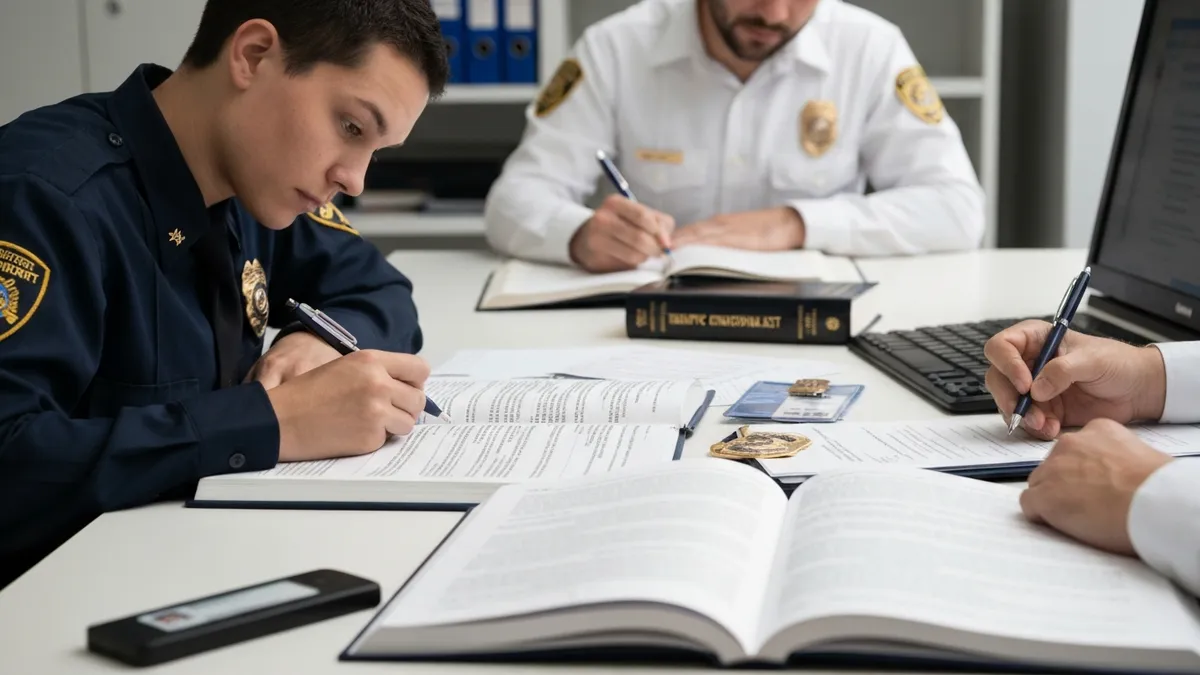
TEA Exam Topics and Content Areas
The Traffic Enforcement Agent written exam focuses on the cognitive abilities needed to perform TEA duties effectively. Based on DCAS exam specifications for law enforcement support roles, the exam assesses:
Reading and Written Comprehension:
Passages drawn from traffic regulations, enforcement directives, or procedural materials. Questions ask you to identify the main point, infer meaning, or apply a rule to a new situation. The key skill is reading carefully and answering based only on what the passage states — not on outside knowledge.
Written Expression and Report Writing:
Given a scenario (e.g., observing a parking violation, witnessing an accident), select the most accurate and complete way to document it in a report or summons. Tests clarity, accuracy, and completeness of written documentation.
Situational Judgment:
Presented with enforcement scenarios: how do you handle an angry driver disputing a summons? What do you do when witnessing an accident? Which response is most appropriate when a vehicle blocks a fire hydrant? These questions assess judgment, professionalism, and appropriate application of authority.
Traffic Law Knowledge:
Basic New York City traffic and parking regulations — parking rule interpretation, no-standing zones, alternate side rules, and fire hydrant clearance requirements. TEAs must apply these rules daily, and the exam tests foundational knowledge.
Map Reading and Spatial Orientation:
Some DCAS enforcement exams include basic map reading: identifying locations, following directions using a street map, or determining the correct route between two points. NYC street grid familiarity is helpful.
Prepare across all these areas with our traffic enforcement agent test practice questions.
Traffic Enforcement Agent Exam Preparation Checklist
- ✓Review the current DCAS exam announcement for TEA (Traffic Enforcement Agent) — exam number, filing dates, and any changes to exam content
- ✓Practice reading comprehension with law enforcement procedural passages — read carefully and answer only from the text
- ✓Practice written expression: given a traffic scenario, select the most complete and accurate report language
- ✓Study NYC parking and standing rules: fire hydrant clearance (15 ft), alternate side regulations, no-standing zones, tow-away zones
- ✓Review situational judgment questions for law enforcement support roles — focus on professional, rule-based responses
- ✓Practice basic NYC street map reading and directional orientation
- ✓If memory/observation is included: practice viewing a diagram for 5 minutes, then answering questions without the diagram
- ✓Take timed full-length practice exams to build speed and accuracy before your test date

Traffic Enforcement Pros and Cons
- +Traffic has a defined, publicly available content blueprint — candidates know exactly what to prepare for
- +Multiple preparation pathways (self-study, courses, coaching) accommodate different learning styles and schedules
- +A growing ecosystem of study resources means candidates at any budget level can access quality preparation materials
- +Clear score reporting allows candidates to identify specific strengths and weaknesses for targeted remediation
- +Professional recognition associated with strong performance provides tangible career and academic benefits
- −The scope of tested content requires substantial preparation time that competes with existing professional or academic commitments
- −No single resource covers the full content scope — candidates typically need multiple study tools for comprehensive preparation
- −Test anxiety and exam-day performance variability mean preparation effort does not always translate linearly to scores
- −Registration, preparation, and potential retake costs accumulate into a significant financial investment
- −Content and format can change between exam versions, making older preparation materials less reliable
Pros and Cons at a Glance
| Pros | Cons |
|---|---|
| Traffic has a defined, publicly available content blueprint — candidates know exactly what to prepare for | The scope of tested content requires substantial preparation time that competes with existing professional or academic commitments |
| Multiple preparation pathways (self-study, courses, coaching) accommodate different learning styles and schedules | No single resource covers the full content scope — candidates typically need multiple study tools for comprehensive preparation |
| A growing ecosystem of study resources means candidates at any budget level can access quality preparation materials | Test anxiety and exam-day performance variability mean preparation effort does not always translate linearly to scores |
| Clear score reporting allows candidates to identify specific strengths and weaknesses for targeted remediation | Registration, preparation, and potential retake costs accumulate into a significant financial investment |
| Professional recognition associated with strong performance provides tangible career and academic benefits | Content and format can change between exam versions, making older preparation materials less reliable |
Sample Traffic Enforcement Agent Test Practice Questions
Try these questions from our free Traffic Enforcement Agent Test practice tests. The correct answer and an explanation follow each question.
A Traffic Enforcement Agent observes that over the past six months, every vehicle ticketed for parking in a 'No Standing' zone on Elm Street between 4 PM and 6 PM has been a commercial delivery truck. The agent concludes that commercial delivery trucks are the primary violators of this specific regulation during those hours. Which type of reasoning has the agent used?
- A. Speculative Reasoning
- B. Inductive Reasoning
- C. Deductive Reasoning
- D. Circular Reasoning
Answer: B. Inductive Reasoning
Inductive reasoning involves making a generalization based on specific observations or patterns. The agent observed a pattern (all ticketed vehicles were commercial trucks) and formed a general conclusion about that specific situation. Deductive reasoning, in contrast, starts with a general rule and applies it to a specific case.
While on patrol, a Traffic Enforcement Agent observes a vehicle parked in a 'No Parking 8 AM - 6 PM' zone at 10:30 AM. Upon closer inspection, the agent sees a valid NYC Parking Permit for People with Disabilities (PPPD) displayed on the dashboard. What is the most appropriate action for the agent to take?
- A. Issue a summons because the vehicle is parked during the restricted hours.
- B. Take no action, as the NYC PPPD allows parking in 'No Parking' zones.
- C. Advise the driver, if present, that they must move the vehicle immediately.
- D. Verify the permit's validity by calling it in before issuing a summons.
Answer: B. Take no action, as the NYC PPPD allows parking in 'No Parking' zones.
A valid NYC Parking Permit for People with Disabilities (PPPD) specifically allows the holder to park in any 'No Parking' zone on New York City streets at any time. Therefore, the vehicle is legally parked despite the posted restriction, and the agent should not issue a summons.
A Traffic Enforcement Agent is given the following rule: 'Any vehicle parked at a broken parking meter is in violation of city code and must be ticketed.' The agent then observes a sedan parked at a meter that is clearly marked 'Out of Order.' Based on the rule, what is the agent's logical next step?
- A. To warn the driver that the meter will be fixed soon.
- B. To wait and see if the driver returns within five minutes.
- C. To issue a parking ticket to the sedan.
- D. To ignore the vehicle because the meter is broken.
Answer: C. To issue a parking ticket to the sedan.
This scenario requires deductive reasoning, which is the application of a general rule to a specific problem to reach a logical conclusion. The general rule is that vehicles at broken meters must be ticketed. The specific problem is a sedan at a broken meter. Therefore, the logical conclusion is to issue a ticket.
A training guide states: 'If a motorist becomes hostile or threatening, the agent should disengage, move to a safe location, and contact dispatch immediately.' An agent is confronted by an angry driver who begins shouting and moving aggressively toward the agent. The agent should:
- A. Stand firm and continue issuing the citation to show authority
- B. Disengage, move to a safe location, and radio dispatch
- C. Physically restrain the driver until police arrive
- D. Apologize and void the citation to de-escalate
Answer: B. Disengage, move to a safe location, and radio dispatch
The training guide's protocol is to disengage, reposition safely, and contact dispatch — not to escalate or void citations.
Traffic Enforcement Agent Exam Questions and Answers
More Civil Service and Law Enforcement Exam Resources




About the Author

Educational Psychologist & Academic Test Preparation Expert
Columbia University Teachers CollegeDr. Lisa Patel holds a Doctorate in Education from Columbia University Teachers College and has spent 17 years researching standardized test design and academic assessment. She has developed preparation programs for SAT, ACT, GRE, LSAT, UCAT, and numerous professional licensing exams, helping students of all backgrounds achieve their target scores.
Join the Discussion
Connect with other students preparing for this exam. Share tips, ask questions, and get advice from people who have been there.
View discussion (8 replies)