
TOEFL Listening
✓ FREE TOEFL Listening practice tests 2026 online. 19 quizzes & 213+ questions on lectures & conversations. Get your score now! ⭐ [Updated March 2026]
- Listening for basic comprehension
- Listening for a pragmatic understanding
- Connecting and synthesizing information
English Test TOEFL Listening Section Format
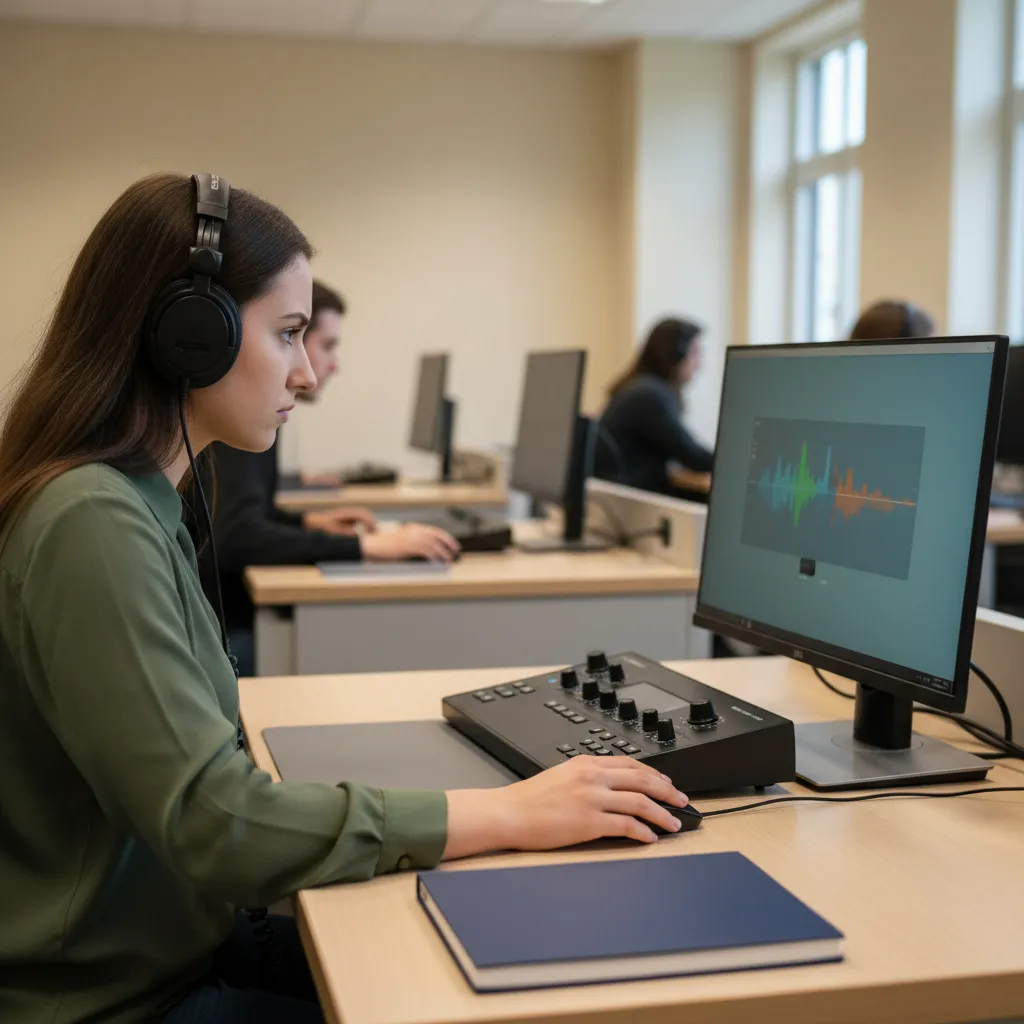
Listening materials in the TOEFL test include academic lectures and long dialogues in which the speech sounds very natural. Exam-takers can jot down notes on any listening material throughout the test.
Listening Material | Number of Questions | Duration |
4 to 6 lectures; 3 to 5 minutes long each; Approximately 500 words | 6 questions per lecture | 60-90 minutes |
2 to 3 dialogues; about 3 minutes long and approximately 12 to 25 exchanges | 5 questions per dialogue | 60-90 minutes |
TOEFL Practice Test Questions
Prepare for the TOEFL - Test of English as a Foreign Language exam with our free practice test modules. Each quiz covers key topics to help you pass on your first try.

TOEFL Academic Vocabulary in Context
TOEFL Exam Questions covering Academic Vocabulary in Context. Master TOEFL Test concepts for certification prep.
Start FREE Test
TOEFL Academic Writing & Argumentation
Free TOEFL Practice Test featuring Academic Writing & Argumentation. Improve your TOEFL Exam score with mock test prep.
Start FREE Test
TOEFL Grammar & Sentence Structure
TOEFL Mock Exam on Grammar & Sentence Structure. TOEFL Study Guide questions to pass on your first try.
Start FREE Test
TOEFL Integrated Speaking & Listening Tasks
TOEFL Test Prep for Integrated Speaking & Listening Tasks. Practice TOEFL Quiz questions and boost your score.
Start FREE Test
TOEFL Listening Comprehension
TOEFL Questions and Answers on Listening Comprehension. Free TOEFL practice for exam readiness.
Start FREE Test
TOEFL Listening for Speaker's Attitude
TOEFL Mock Test covering Listening for Speaker's Attitude. Online TOEFL Test practice with instant feedback.
Start FREE Test
TOEFL Practice Test
Free TOEFL Quiz on Practice Test. TOEFL Exam prep questions with detailed explanations.
Start FREE Test
TOEFL Reading Comprehension
TOEFL Practice Questions for Reading Comprehension. Build confidence for your TOEFL certification exam.
Start FREE Test
TOEFL Reading: Rhetorical Purpose Questions
TOEFL Test Online for Reading: Rhetorical Purpose Questions. Free practice with instant results and feedback.
Start FREE Test
TOEFL Sentence Simplification Questions
TOEFL Study Material on Sentence Simplification Questions. Prepare effectively with real exam-style questions.
Start FREE Test
TOEFL Speaking: Integrated Task Synthesis
Free TOEFL Test covering Speaking: Integrated Task Synthesis. Practice and track your TOEFL exam readiness.
Start FREE Test
TOEFL Speaking & Pronunciation
TOEFL Exam Questions covering Speaking & Pronunciation. Master TOEFL Test concepts for certification prep.
Start FREE Test
TOEFL Strategies & Time Management
Free TOEFL Practice Test featuring Strategies & Time Management. Improve your TOEFL Exam score with mock test prep.
Start FREE Test
TOEFL Vocabulary & Word Usage
TOEFL Mock Exam on Vocabulary & Word Usage. TOEFL Study Guide questions to pass on your first try.
Start FREE Test
TOEFL Writing & Composition
TOEFL Test Prep for Writing & Composition. Practice TOEFL Quiz questions and boost your score.
Start FREE Test
TOEFL Writing for Academic Discussion
TOEFL Questions and Answers on Writing for Academic Discussion. Free TOEFL practice for exam readiness.
Start FREE Test
Jot down notes
How to improve my score in the TOEFL Listening section?
The TOEFL listening section is a tricky one. You have to listen to 4 to 6 lectures, each with 6 questions, and 2 to 3 talks, each with 5 items. The shortened version takes a total of 60 minutes, while the extended version takes 90 minutes, totaling 34 to 51 queries. The additional lectures and conversations will not count on your score when you get the extended section. It's only there to help TOEFL prepare questions for next year. Sadly, you can't determine which items are additional questions, and you should do your best for all of them.
To dominate and pass the listening section, here are the best TOEFL listening tips you can apply to score well on the TOEFL exam.
An essential skill in TOEFL is to take detailed notes quickly. It's a physical and mental skill. It is physical because you can take more notes than anybody else can by moving your hand faster and writing faster. It is also mental since the sentences must be summed up, the words must be condensed, the most relevant sections of a sentence and statements that are not needed should be identified.
Listen to audio
For TOEFL listening, an important way to learn is to listen to audio sources around you. The TV is good, particularly documentary films or channels such as Animal Planet and National Geographic. You can also seek out audio sources like news programs or radios such as CNN Radio, Voice of America, podcasts, or audiobooks as they prepare you for the Standard American Dialect.
Take note of signals
When listening to TOEFL listening comprehension test dialogues or lectures, paying attention to signals is very important as these will tell you which sentences and statements are relevant and not. Below are signal words and phrases listed by the Educational Testing Service (ETS) that tell you what type of information is being given:
- Theory - In theory
- Negatives - not, or words that begin with ‘un’, ‘non’, ‘dis’, or ‘a’
- Opinion - I think, It appears that, It is thought that
- Inference - therefore, then
- Fillers - non-essential information like uh, umm, or er
- examples - for example, such as
- reasons - because, since
- comparisons - in contrast, than
- results - as a result, so, therefore, thus, consequently
- another idea - furthermore, moreover, besides
- restatements of information - in other words, that is
- an opposing idea - on the other hand, however
- a similar idea - similarly, likewise
- conclusions - in conclusion, in summary
Note that very often, speakers use breaks and speed changes to provide insight into how information is organized and grouped.
Practice
Most importantly, keep in mind to practice. The TOEFL Listening portion is a fast and tricky section. Even native speakers have to train as it doesn't come naturally for this section. So the best way to improve is to practice a lot. You can use the TOEFL listening practice test in the official ETS website or use these alternatives such as TOEFL ITP listening practice test free download, TOEFL listening practice test with answers pdf, TOEFL PBT listening test download free, TOEFL paper-based test practice listening, TOEFL PBT listening practice test, TOEFL ITP listening practice test with answers, TOEFL junior listening comprehension practice test, TOEFL listening section practice test, TOEFL listening tests with answers, Listening TOEFL practice free, TOEFL listening practice Kaplan, Listening exercises TOEFL, Practice TOEFL listening section, TOEFL iBT listening practice online, TOEFL listening practice pdf or TOEFL online practice listening.
How to increase my score in reading and listening in TOEFL iBT?
TOEFL Questions
Here are a few points to consider in the future to maintain and enhance your sound skills.
- Visit places in your neighborhood where you can hear spoken English.
- Watch and listen to programs that are documented in English.

- Go to the web sites to practice your listening skills.
- Listen to voice recordings of lectures.
- Practice communicating with other people in English.
How is TOEFL Listening scored?
The calculation of TOEFL Listening scores is simple: for each question you answer correctly, you earn one point, and your raw score is the sum of those points. Your raw score would then be converted to a 0-30 scale to get the final TOEFL listening score.

Is 500 a good score on the TOEFL?
Most schools require student TOEFL ratings of either 90 or 100 overall points on the iBT or 580 or 600 on the PBT. Therefore, a score over 90 on the iBT or over 580 on the PBT is generally regarded to be a decent score.
How long does it take to prepare for Toefl?
Many exam-takers score at least a minimum of 100 out of 120 during the first attempt. Generally, if you'd like a tight time to get ready, then 1 month ought to be fine. However, don't take more than 2 months to prepare for TOEFL, because the test isn't that difficult.
TOEFL Questions and Answers
About the Author
Applied Linguist & Language Proficiency Exam Specialist
Georgetown UniversityDr. Yuki Tanaka holds a PhD in Applied Linguistics and an MA in TESOL from Georgetown University. A former language examiner with the British Council, she has 18 years of experience designing and teaching language proficiency preparation courses for TOEFL, IELTS, CELPIP, Duolingo English Test, JLPT, Cambridge FCE/CAE, and Versant assessments worldwide.