
PTE Exam Fee: What You'll Actually Pay in 2026 October
Free PTE practice test with questions and answer explanations. 🟢 Prepare for the 2026 October exam with instant scoring.
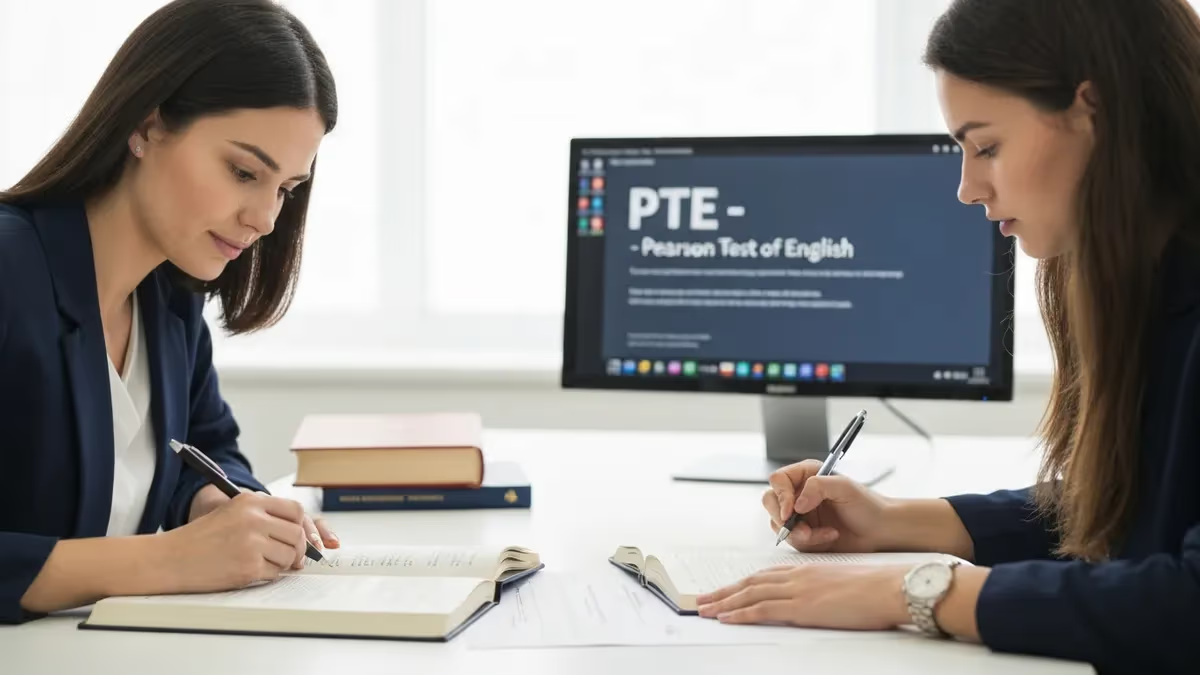
The PTE exam costs roughly $270 USD — but that number shifts depending on where you're sitting for the test. In India, you'll pay around ₹15,900. In Australia, it's closer to AUD $410. The UK? About £190. Pearson sets regional pricing, and exchange rates push those figures around every few months. What stays constant: the base fee covers one attempt at PTE Academic, the computer-based English proficiency test accepted by thousands of universities, governments, and professional bodies worldwide.
Here's what catches people off guard. The registration fee is just the starting number. Reschedule your test less than 7 days before the date? That's 50% of the original fee — gone. Cancel within 48 hours? No refund. Late score reports, additional score sends, name changes on your booking — each one has its own price tag. The pte exam fee cost guide you're reading breaks down every charge so nothing blindsides you on test day or after.
Most test-takers don't realize the PTE test exam pricing structure has changed three times since 2022. Pearson restructured their fee tiers, consolidated some regional pricing bands, and added a new "flexible reschedule" option in select markets. If you looked up PTE costs a year ago, those numbers are probably wrong now. We've verified current pricing directly from Pearson's booking portal as of early 2026 — country by country, fee by fee, with the exact refund windows and penalties you need to know before you commit your money.
Whether you're booking your first attempt or planning a retake after a near-miss score, understanding the full cost picture matters. This isn't just about the exam fee — it's about the total financial commitment from registration to score delivery. Stick with this breakdown and you'll avoid the surprise charges that trip up roughly one in four PTE candidates.

The PTE test exam pricing varies dramatically once you look beyond the headline number. In the United States, the standard PTE Academic fee sits at $270 — straightforward enough. Cross the border to Canada and it's CAD $340. Head to the Middle East and you're looking at roughly $245–$280 depending on the specific country. Southeast Asian markets tend to be cheaper: the Philippines charges around $195, Vietnam about $210. These aren't arbitrary numbers — Pearson benchmarks pricing against local purchasing power and competitive exam fees in each region.
The PTE examination registration window matters more than most people think. Book at least 48 hours before your preferred date — that's the minimum lead time Pearson requires. But here's the real strategy: book 30 or more days in advance. Not because of early-bird pricing (there isn't one), but because popular test centers fill up fast.
If you're flexible on location, you might snag a slot at a less crowded center nearby. If you need a specific date — say, before a visa application deadline — waiting until the last week means you're competing for leftover slots at whatever center still has availability.
One detail that trips up first-time test-takers: the fee is non-negotiable. No student discounts. No group rates. No loyalty pricing for retakes. Every attempt costs the same full fee, whether it's your first try or your fifth. That said, Pearson occasionally runs promotional voucher codes through partner institutions — universities, language schools, immigration consultants. Worth asking your institution before you book, because a 10–15% voucher saves you $30–$40 that's better spent on prep materials.
Regional pricing updates happen without announcement. Pearson doesn't send emails when fees change. You find out when you log into your account and see a different number at checkout. That's why locking in your booking date early — even if you're still prepping — can protect you from a mid-cycle price bump.
Breaking down the PTE exam fee by component helps you understand what you're actually paying for. The $270 covers the test itself — all four communicative skills (speaking, writing, reading, listening) assessed in a single two-hour session. Score reporting to your first institution? Included. Up to five additional score sends within 30 days? Also free. Pearson built unlimited free score sends into the base price back in 2023, which was a big shift from the old model where each additional report cost $15–$20.
The PTE academic exam separates itself from IELTS and TOEFL on cost in a few important ways. IELTS charges $255–$310 depending on the country, plus $25–$40 per additional score report after the first five. TOEFL iBT costs $185–$300 with a $20-per-report fee after four free sends. PTE's unlimited free score reporting makes it genuinely cheaper for candidates applying to multiple programs — if you're sending scores to eight universities, you save $60–$100 compared to IELTS. That math matters when you're already paying for visa applications, document translations, and shipping.
The PTE exam fee also includes your detailed score report — the one that shows your performance on each skill area, enabling skills like grammar, oral fluency, pronunciation, spelling, vocabulary, and written discourse. This granular breakdown costs extra on some other English tests. With PTE, it's baked in. You get your results within 48 hours (usually faster — many candidates report seeing scores in 24 hours), delivered electronically to your Pearson account.
What isn't covered: any prep materials, practice tests, or study tools. Pearson sells their own official prep bundle for $35–$60, but that's entirely optional. Third-party prep courses range from free to $300+. The exam fee is purely the assessment itself.
PTE Fee Breakdown by Region
United States: $270 USD — the global benchmark price. Canada: CAD $340 (approximately $250 USD). Brazil: BRL 1,050 (~$195 USD). Mexico: MXN 4,800 (~$265 USD). Colombia: COP 950,000 (~$230 USD).
North American pricing is among the highest globally. South American countries benefit from Pearson's regional adjustment — Brazil and Colombia are 10–28% cheaper than the US base rate.
Smart PTE exam practice starts before you spend a single dollar on registration. Here's the uncomfortable truth: 23% of PTE test-takers retake the exam at least once. Each retake costs the same full PTE academic exam fee — no discount, no reduced rate. That means nearly a quarter of candidates end up paying $540+ for what should've been a one-shot deal. The most expensive mistake isn't the exam fee itself — it's booking before you're genuinely ready.
How do you know when you're ready? Mock scores. Pearson's own scored practice test (around $35) uses the same AI engine that scores the real exam. If your mock composite sits 5+ points above your target, book with confidence. If you're within 2–3 points of your target? That's the danger zone. Scores fluctuate by 3–5 points between attempts — one bad pronunciation segment or a tricky summarize-written-text prompt can swing things. Spend another two weeks drilling weak areas instead of gambling $270 on a maybe.
The PTE academic exam fee hits hardest for candidates in developing markets who earn in local currency but pay in globally-benchmarked prices. In India, ₹15,900 represents roughly 40% of the average monthly salary. In Nigeria, the $215 fee equals about two weeks' wages for a mid-career professional. Pearson doesn't offer income-based sliding scales, so the burden falls disproportionately — and that's before you factor in travel costs to the nearest test center, which might be in a different city entirely.
Worth knowing: Pearson's refund and reschedule policies are time-gated. Reschedule more than 14 days before your test date? Free. Between 7 and 14 days? There's a partial fee. Less than 7 days? You'll lose 50% of what you paid. Cancel within 48 hours of your test? No refund at all. Zero. These windows are rigid — no exceptions for emergencies, illness, or travel disruptions.
Finding a PTE exam center near me is the first practical step after deciding to take the test. Pearson operates over 400 test centers across 115+ countries — but distribution isn't even. Major cities like London, Sydney, Mumbai, Dubai, and Toronto have multiple centers with daily availability. Smaller cities might have one center running tests twice a week. Rural areas? You're probably traveling to the nearest metro.
The PTE exam price doesn't change based on which center you choose within the same country. A test in downtown Manhattan costs exactly the same as one in Omaha. But the hidden cost — travel, accommodation if it's far, taking a day off work — varies wildly. Some candidates spend more getting to the test center than on the exam itself. Before you book, search Pearson's center locator and compare travel logistics for all centers within reasonable distance. A 30-minute drive beats a 3-hour train ride even if the farther center has better availability.
Pearson's test center network expanded significantly in 2024–2025, adding locations in tier-2 and tier-3 Indian cities, sub-Saharan Africa, and Central Asia. That's good news for candidates who previously had to fly to a different city or even country. Still, center density in Africa and South America lags behind Asia and Europe — which is worth factoring into your timeline if you're in a region with limited availability.
Test center quality matters too. All Pearson-approved centers meet minimum standards — individual workstations, noise-canceling headsets, recording equipment for speaking tasks — but some centers are newer with better equipment and more comfortable seating. Online reviews from other test-takers can help you pick a center that won't add stress to an already high-pressure morning.
PTE Exam Fee: Pros and Cons vs Other English Tests
- +Unlimited free score reports to any number of institutions worldwide
- +Results in 48 hours — fastest turnaround of any major English proficiency test
- +Single session covers all four skills — no separate module fees
- +Computer-scored with AI — eliminates human examiner bias in scoring
- +Year-round availability at 400+ centers means flexible scheduling
- +Detailed subscore breakdown included at no additional cost
- −No student discounts, group rates, or loyalty pricing for retakes
- −Late reschedule penalty is a steep 50% of the full exam fee
- −48-hour cancellation window means zero refund if plans change last minute
- −Regional pricing disparities hit developing-market candidates harder
- −No income-based fee adjustments despite global candidate base
- −Official practice tests cost extra ($35–$60) on top of the exam fee
Understanding the total PTE exam cost means looking beyond the registration fee. Here's a realistic budget for a first-time candidate: $270 for the exam, $35 for Pearson's official scored practice test, $0–$150 for third-party prep materials, and $0–$200 for travel to the test center depending on your location. Grand total: anywhere from $305 to $655 for a single attempt. Retaking bumps the minimum to $575 — before prep and travel.
The Pearson PTE exam pricing structure hasn't always been this straightforward. Before 2023, score reports beyond the first five cost $15–$20 each. Before 2021, some test centers charged a separate "facility fee" on top of the base price. Pearson consolidated these into the flat rate, which simplified things but also raised the base fee by $15–$20 in most markets. You're paying more upfront but less overall if you need multiple score sends.
One thing that separates PTE from competitors: no hidden processing fees at checkout. When you book through mypte.pearsonpte.com, the price shown is the price charged. No "technology surcharge," no "administrative fee," no tax surprises in most jurisdictions (though local taxes apply in some countries — India adds 18% GST on top of the listed price, for example). That ₹15,900 figure for India? It's actually ₹15,900 + 18% GST = ₹18,762 at checkout. Not exactly a hidden fee, but definitely one that catches people off guard.
For budget-conscious candidates, timing your booking can help. While Pearson doesn't offer seasonal discounts, they periodically distribute promotional codes through education fairs, university partnerships, and migration agent networks. These codes typically offer 10–15% off — saving you $27–$40. Ask your university's international admissions office or your immigration consultant if they have current Pearson voucher codes before you pay full price.
PTE Exam Booking Checklist
- ✓Create your Pearson PTE account at mypte.pearsonpte.com with your passport details
- ✓Verify your name matches your passport exactly — name mismatches can void your test
- ✓Search for test centers by city and compare dates, times, and distance
- ✓Book at least 30 days in advance for best center and date availability
- ✓Check if your country adds local taxes (India: 18% GST, others vary)
- ✓Ask your university or migration agent for promotional voucher codes before paying
- ✓Save your booking confirmation email and note the cancellation/reschedule deadlines
- ✓Download and complete at least one official scored practice test before your exam date
- ✓Bring valid, unexpired passport on test day — no other ID accepted at most centers
- ✓Arrive 30 minutes early — late arrivals forfeit the full exam fee with no refund
The PTE exam test format directly impacts how you should budget your prep time and money. Unlike IELTS — where speaking is a face-to-face interview scheduled separately — every PTE section happens back-to-back in one sitting. That means you're paying for one booking, one trip to the test center, and one block of time. From a cost perspective, that's efficient. From an energy perspective, it's demanding. Two hours of sustained concentration with no real breaks.
For the PTE English exam, the scoring is entirely AI-driven. Pearson's automated system evaluates your speaking responses, written essays, reading comprehension, and listening tasks using machine learning models trained on millions of scored responses. The advantage: consistency. Your speaking score won't vary because one examiner was having a rough morning. The disadvantage: the AI doesn't account for accent diversity as generously as a human might, and some candidates find the computer format intimidating compared to a face-to-face conversation. But that's what your $270 buys — a standardized, bias-reduced assessment.
Score validity lasts two years from the test date. After that, your results expire and you'd need to retake — another full fee. Some immigration authorities (Australia's Department of Home Affairs, for instance) accept PTE scores only if they're less than 36 months old under certain visa subclasses, giving you a slight extension. Universities almost universally enforce the two-year window. Plan your test timing relative to your application deadlines so you don't end up paying for a retake just because your scores expired.
The PTE exam test is available nearly every day at major centers. That flexibility means you can book strategically — avoid Monday mornings (highest demand, most stressed candidates in the waiting room) and aim for mid-week slots when centers are quieter. Same fee either way, but the lower-stress environment could make a marginal difference in your performance.
PTE reading examples from official prep materials give you a preview of what the exam actually tests — and they're worth studying before you invest $270 in the real thing. The reading section includes multiple-choice (single and multiple answer), re-order paragraphs, and fill-in-the-blank tasks. Each question type has specific scoring rules: some use negative marking (wrong answers subtract points), while others only award positive marks. Understanding these mechanics before test day prevents costly mistakes.
For PTE academic exam booking, the process is entirely online through Pearson's portal. No phone bookings, no in-person registration, no paper forms. You'll need a valid passport (the same one you'll bring to the test center), a credit or debit card for payment, and about 15 minutes to complete the registration. The system walks you through center selection, date selection, and payment — fairly intuitive if you've booked anything online before.
One booking strategy that saves candidates real money: if you're applying for Australian immigration, check whether your visa subclass accepts PTE Core (the newer, shorter, cheaper test) instead of PTE Academic. PTE Core launched in 2023 and costs 15–20% less than PTE Academic in most markets.
It's specifically designed for migration and work visa purposes — not academic admissions — and covers the same four skills in a condensed format. Not every visa pathway accepts it yet, but the list is growing. Booking the wrong test and having to retake the right one is a $270+ mistake you don't want to make.
After booking, Pearson sends a confirmation email with your test date, center address, reporting time, and a checklist of what to bring. Save that email. Screenshot it. Put the date in your calendar with reminders at 7 days and 1 day. Missing your slot because you forgot the date — yes, it happens — costs exactly the same as a no-show. Full fee, no refund, no sympathy.
PTE Academic is for university admissions and some visa pathways. PTE Core is for migration and work visas (primarily Canada and Australia). They're different tests with different fees. Check your target institution's or immigration authority's requirements page before booking — taking the wrong one means paying twice.
The total PTE test cost goes up significantly when you factor in preparation — and most candidates underestimate this part of the budget. Pearson's official practice materials range from free sample questions (limited) to their $35 scored mock test (uses the real AI scoring engine) to their $60 prep bundle (mock test + study guide + skill-specific drills). Third-party courses on platforms like E2Language, PTE Magic, and Magoosh range from free basic content to $100–$300 for full courses with teacher feedback.
For a PTE mock exam that actually predicts your real score, Pearson's scored practice test is the only reliable option. Third-party mocks use different scoring algorithms, so a 78 on a third-party test doesn't necessarily translate to a 78 on the real thing. The Pearson mock gives you the closest approximation because it runs on the same AI engine. Is it worth $35? If it prevents a $270 retake, absolutely.
Budget template for a realistic first attempt — itemized so you can plan: exam registration $270, official scored mock $35, prep course (optional) $0–$200, travel to test center $0–$150, time off work (opportunity cost) variable. Conservative total without prep course: $305. With a mid-range prep course and modest travel: $505. With a premium prep course and significant travel: $650+. That's the real PTE exam cost — not just the number on Pearson's booking page.
The honest answer about whether PTE is "expensive": compared to IELTS and TOEFL, PTE Academic is competitively priced — especially when you count the unlimited free score reports. For a single-institution application, costs are roughly equal across all three tests. For multi-institution applications (5+ universities), PTE saves $75–$150 on score reporting alone. That saving doesn't make the base fee any less painful, but it does shift the total cost comparison in PTE's favor for candidates casting a wide net.
PTE Practice Test Questions
Prepare for the PTE - Pearson Test of English exam with our free practice test modules. Each quiz covers key topics to help you pass on your first try.
PTE Academic Knowledge
PTE Exam Questions covering Academic Knowledge. Master PTE Test concepts for certification prep.
PTE Academic Knowledge Questions and Answers
Free PTE Practice Test featuring Academic Knowledge Questions and Answers. Improve your PTE Exam score with mock test prep.
PTE Academic Questions and Answers
PTE Test Prep for Academic Questions and Answers. Practice PTE Quiz questions and boost your score.
PTE Academic Reading
PTE Questions and Answers on Academic Reading. Free PTE practice for exam readiness.
PTE Academic Reading Questions and Answers
PTE Mock Test covering Academic Reading Questions and Answers. Online PTE Test practice with instant feedback.
PTE Academic Reading Skills
Free PTE Quiz on Academic Reading Skills. PTE Exam prep questions with detailed explanations.
PTE Academic Writing Skills
PTE Practice Questions for Academic Writing Skills. Build confidence for your PTE certification exam.
PTE Essay Writing
PTE Test Online for Essay Writing. Free practice with instant results and feedback.
PTE Listening Comprehension
PTE Study Material on Listening Comprehension. Prepare effectively with real exam-style questions.
PTE Listening for Detail
Free PTE Test covering Listening for Detail. Practice and track your PTE exam readiness.
PTE Pronunciation & Fluency
PTE Exam Questions covering Pronunciation & Fluency. Master PTE Test concepts for certification prep.
PTE Integrated Task Skills
Free PTE Practice Test featuring PTE Integrated Task Skills. Improve your PTE Exam score with mock test prep.
PTE Test Format & Scoring
PTE Mock Exam on PTE Test Format & Scoring. PTE Study Guide questions to pass on your first try.
PTE Reading Comprehension
PTE Test Prep for Reading Comprehension. Practice PTE Quiz questions and boost your score.
The PTE test cost conversation isn't complete without addressing retake strategy. Pearson requires a minimum 5-day gap between attempts — you can't retake the next day even if you wanted to. There's no limit on total attempts, but each one costs the full fee. Some candidates take the test 3–4 times chasing a specific score threshold (65 for Australian PR, 79 for certain UK universities). At $270 per attempt, that's $810–$1,080 — a significant investment that better preparation could have reduced to a single attempt.
A PTE mock exam taken under real test conditions — timed, no breaks, noise-canceling headphones on — is the best predictor of whether you're genuinely ready. If your mock composite is at or barely above your target, wait. Drill your weakest skill area for another 2–3 weeks. The cost of a retake ($270) versus the cost of two extra weeks of prep ($0 if using free resources) makes this the most obvious financial decision in the entire process.
Retake scores replace previous scores only if you choose to send them. Pearson keeps all your score records, but you control which scores get sent to institutions. That means a bad retake doesn't erase a good previous score — you can always send the higher one. This is different from some other tests where the most recent score is automatically sent. It reduces the financial risk of retaking slightly, because a bad day doesn't undo previous progress.
Final budget consideration: some candidates find that investing $100–$200 in targeted tutoring for their weakest skill (often speaking pronunciation or summarize spoken text) pays for itself by avoiding a retake. A single hour of expert feedback on your speaking delivery might be the difference between a 72 and a 77 — which could be the difference between one attempt and two. Think of prep spending as retake insurance.
PTE Questions and Answers
About the Author

Registered Nurse & Healthcare Educator
Johns Hopkins University School of NursingDr. Sarah Mitchell is a board-certified registered nurse with over 15 years of clinical and academic experience. She completed her PhD in Nursing Science at Johns Hopkins University and has taught NCLEX preparation and clinical skills courses for nursing students across the United States. Her research focuses on evidence-based exam preparation strategies for healthcare certification candidates.
Join the Discussion
Connect with other students preparing for this exam. Share tips, ask questions, and get advice from people who have been there.
View discussion (8 replies)