
Private Investigator Requirements: Complete 2026 June Guide to Licensing, Training, Experience, and State-by-State Standards
Complete guide to private investigator requirements: licensing, training hours, exam standards, bonds, insurance, and state-by-state rules for 2026 June.
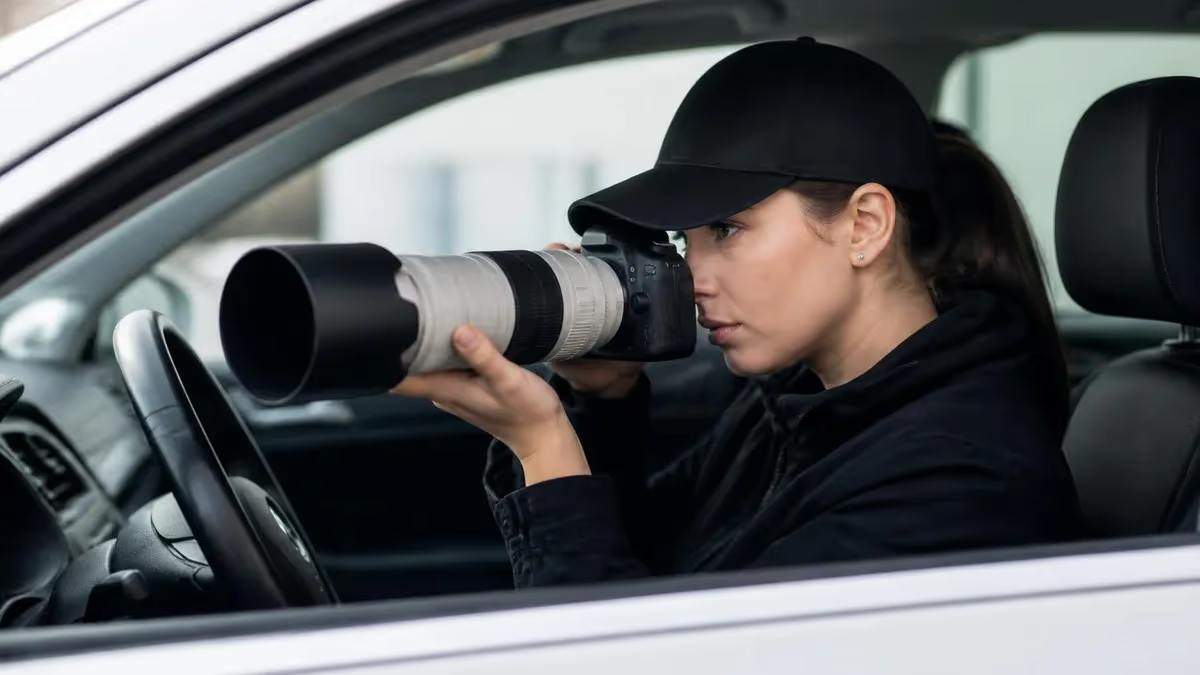
Understanding private investigator requirements is the single most important step before launching a career in the surveillance and investigations industry, because every state imposes a distinct combination of licensing rules, training hours, background checks, bonding mandates, and continuing education obligations that determine whether you can legally accept paid casework. Whether you searched for a private investigator near me or you want to become one, the underlying eligibility framework is surprisingly consistent: clean record, verifiable experience, written exam, insurance, and state-issued license.
Most jurisdictions require applicants to be at least 18 or 21 years old, hold a high school diploma or GED, demonstrate United States citizenship or lawful residency, and submit fingerprints for a state and FBI criminal history check. Disqualifying convictions typically include felonies, crimes of moral turpitude, and recent misdemeanors involving fraud, dishonesty, or violence. Some states also screen for unresolved civil judgments, unpaid child support, or pending criminal matters that would compromise an investigator's credibility in court.
The experience requirement is where applicants face the steepest barrier. States like California require 6,000 hours (three years) of compensated investigative work, while Texas requires three years under a licensed agency, and Florida requires two years of qualifying experience plus a 40-hour training course. Acceptable experience usually includes military intelligence, law enforcement, insurance claims, legal investigations, or paralegal work — but documentation must be verifiable through W-2 records, sworn affidavits, or employer letters on official letterhead.
Training requirements range from zero hours in unregulated states like Alabama, Colorado, Idaho, Mississippi, Missouri, South Dakota, and Wyoming, to highly structured curricula in California, New York, and Florida. Coursework typically covers surveillance law, evidence collection, report writing, ethics, firearms handling (if armed status is sought), and applicable statutes like the Fair Credit Reporting Act, the Gramm-Leach-Bliley Act, and state-specific privacy laws. Many applicants complete an approved 40 to 80-hour pre-licensing course before sitting for the state exam.
The licensing examination itself usually contains 100 to 150 multiple-choice questions covering investigative procedures, legal statutes, ethics, surveillance techniques, and report writing standards. Passing scores generally fall between 70% and 75%, and most states allow two to three retakes within a 12-month window before requiring a full reapplication. Exam fees range from $50 to $150, and the entire licensing package — including application, fingerprinting, training, and bonding — typically costs $500 to $2,000 depending on jurisdiction.
Beyond the individual license, every state requires either an agency license or sponsorship under a licensed agency owner, plus liability insurance (commonly $500,000 to $1,000,000) and a surety bond ranging from $5,000 to $25,000. These financial safeguards protect clients from negligent investigation, illegal surveillance, or breach of contract claims that arise from active casework. Continuing education obligations of 8 to 24 hours per renewal cycle keep licensees current on evolving privacy law, digital forensics, and case law.
This guide walks through every layer of private investigator requirements for 2026 so you can plan your path, budget realistically, and avoid the application mistakes that cost candidates months of delay. We cover eligibility, experience documentation, training, exams, bonding, insurance, reciprocity, and the practical steps that separate licensed professionals from amateurs who operate illegally and risk criminal charges, civil exposure, and permanent industry blacklisting.
Private Investigator Requirements by the Numbers
Core Eligibility Requirements Every Applicant Must Meet
Most states require applicants to be 18 or 21 years old, hold US citizenship or lawful permanent residency, and provide a Social Security number plus government-issued photo identification at the time of application submission.
No felony convictions, no crimes of moral turpitude, and typically no misdemeanors involving fraud, theft, violence, or dishonesty within the past 7 to 10 years. Fingerprint-based FBI and state background checks are mandatory.
Two to three years of compensated investigative experience in law enforcement, military intelligence, insurance claims, legal investigations, or under a licensed PI agency. Documentation must include W-2s, sworn affidavits, or employer letters.
Completion of a state-approved 40 to 80-hour pre-licensing course covering surveillance law, evidence collection, ethics, report writing, and applicable federal and state privacy statutes that govern investigative work.
Surety bond of $5,000 to $25,000 plus general liability and errors-and-omissions insurance ranging from $500,000 to $1,000,000 in coverage limits. Proof of coverage must be filed with the licensing board.
Training hour requirements are the most misunderstood component of private investigator requirements, because the actual curriculum and delivery format vary dramatically from state to state. California requires no formal pre-licensing course but mandates 6,000 hours of compensated experience, while Florida requires 40 hours of professional training plus two years of qualifying work. Texas asks applicants to pass a state exam administered by the Department of Public Safety after working under a licensed agency. New York requires 25 hours of approved coursework plus three years of investigative experience documented through sworn employer affidavits.
State-approved courses typically cover ten core subject areas: surveillance techniques and ethics, applicable federal and state laws, evidence handling and chain of custody, report writing for court admissibility, interviewing and statement-taking, skip tracing and database research, undercover assignments, civil and criminal procedure, firearms safety for armed investigators, and emergency response protocols. Schools must be accredited by the state licensing board, and certificates of completion typically expire within 12 to 24 months of issuance if the license application is not submitted.
Online training has expanded rapidly since 2020, and most states now accept hybrid or fully online pre-licensing programs from accredited providers like the National Association of Legal Investigators, Pursuit Magazine Academy, and state-specific community college programs. Tuition ranges from $300 to $1,500 depending on length and accreditation, and many programs bundle the state exam preparation, ethics training, and continuing education credits into a single package that satisfies multiple requirements at once.
If you plan to carry a firearm, additional training is required in every state that permits armed private investigators. California requires a 14-hour firearms permit course plus quarterly range qualification, Florida requires a 28-hour Class G firearms training program, and Texas requires a separate Personal Protection Officer license layered on top of the standard PI license. Background checks for armed status are more stringent and typically disqualify any applicant with a domestic violence conviction, restraining order, or history of mental health commitment.
Many candidates underestimate continuing education obligations, which kick in immediately at first renewal. California requires zero CE hours but mandates a clean disciplinary record. Florida requires 14 hours of continuing education every two years, including two hours of ethics. Texas requires no mandatory CE but recommends 16 hours per renewal cycle. New York mandates 0 CE hours for the standard license but requires firearms instructors and bail recovery agents to complete additional annual training. When clients call a santa monica private investigator, they expect current legal knowledge.
Experience documentation is where most applications fail. Licensing boards require detailed proof of every claimed hour, including pay stubs, W-2 forms, sworn affidavits from supervisors, copies of investigative reports (with client information redacted), and court testimony transcripts where applicable. Volunteer or unpaid work generally does not count, and self-employed experience must be backed by tax returns showing investigative income. Boards routinely reject applications with vague descriptions like "general investigations" — every entry must specify the case type, dates, hours, and supervising investigator.
The training-to-license timeline runs 6 to 18 months for most applicants. Budget two to three months for the pre-licensing course, four to eight weeks for fingerprint processing and background check completion, two to four weeks for exam scheduling, and four to six weeks for final license issuance after passing. Applicants who already hold the required experience and complete training quickly can be fully licensed within 90 days; those building experience hours from scratch face a multi-year runway before they can apply.
Private Investigator Practice Test Questions
Prepare for the Private Investigator Exam exam with our free practice test modules. Each quiz covers key topics to help you pass on your first try.
Private Investigator Assessment
Private Investigator Exam Questions covering Assessment. Master Private Investigator Test concepts for certification prep.
Private Investigator Exam Guide
Free Private Investigator Practice Test featuring Exam Guide. Improve your Private Investigator Exam score with mock test prep.
Private Investigator MCQ
Private Investigator Mock Exam on MCQ. Private Investigator Study Guide questions to pass on your first try.
Private Investigator Practice Exam
Private Investigator Test Prep for Practice Exam. Practice Private Investigator Quiz questions and boost your score.
Private Investigator
Private Investigator Questions and Answers on Private Investigator. Free Private Investigator practice for exam readiness.
Private Investigator Trivia
Private Investigator Mock Test covering Trivia. Online Private Investigator Test practice with instant feedback.
Private Investigator Exam Evidence & Docum...
Free Private Investigator Quiz on Exam Evidence & Documentation. Private Investigator Exam prep questions with detailed explanations.
Private Investigator Exam Interview & Skip...
Private Investigator Practice Questions for Exam Interview & Skip Tracing. Build confidence for your Private Investigator certification exam.
How to Become a Private Investigator — Exam Pathway
State licensing exams typically contain 100 to 150 multiple-choice questions delivered through computer-based testing centers like PSI, Pearson VUE, or the state's own platform. Candidates have two to three hours to complete the exam, and most jurisdictions require a minimum passing score of 70 to 75 percent. The exam is closed-book and proctored, with strict identification and security protocols including biometric check-in.
Question categories generally include surveillance and investigative procedures (25%), federal and state statutes (20%), ethics and professional conduct (15%), evidence handling and report writing (15%), interviewing techniques (10%), and miscellaneous topics like firearms law, civil procedure, and emergency response (15%). Some states publish detailed candidate handbooks listing every statute and regulation that may appear, while others provide only a broad outline of tested subjects.
Pursuing a Private Investigator Career — Pros and Cons
- +Flexible schedule and independent contractor lifestyle with control over caseload
- +Median private investigator salary ranges from $52,000 to $74,000 with experienced operators earning $100,000+
- +Diverse case types including insurance fraud, infidelity, missing persons, and corporate investigations
- +Strong demand from law firms, insurance companies, and individual clients across every metro area
- +Skills transfer well from law enforcement, military, paralegal, and insurance claims backgrounds
- +Low startup cost compared to most regulated professions, often under $5,000 for solo operators
- +Continuing education keeps work intellectually stimulating across changing technology and case law
- −Irregular hours including nights, weekends, and holidays for active surveillance cases
- −Physical demands of long stakeouts, all-weather work, and stress of confrontation situations
- −Income variability especially in first three years before establishing referral network
- −Strict legal exposure for trespass, illegal recording, and privacy law violations
- −Substantial documentation burden including detailed reports, mileage logs, and time sheets
- −Mandatory continuing education, bond renewal, and insurance premiums that recur annually
- −Emotional toll from infidelity, missing persons, and child custody investigations
Private Investigator License Application Checklist
- ✓Verify you meet age (18 or 21), citizenship, and residency requirements for your state
- ✓Gather proof of high school diploma, GED, or higher education transcripts
- ✓Document 2 to 3 years of verifiable investigative experience with W-2s and supervisor affidavits
- ✓Complete a state-approved 40 to 80-hour pre-licensing training course from an accredited provider
- ✓Submit fingerprints through Live Scan or ink card for state and FBI background check processing
- ✓Obtain a surety bond of $5,000 to $25,000 from a licensed bonding company in your state
- ✓Purchase general liability and errors-and-omissions insurance with $500,000 to $1,000,000 limits
- ✓Pay the state application fee ranging from $150 to $400 and any required exam registration fees
- ✓Schedule and pass the state licensing examination with a minimum score of 70 to 75 percent
- ✓File proof of bond, insurance, and exam results with the state licensing board for final approval
- ✓Renew your license every 1 to 2 years and complete required continuing education credits on time
- ✓Maintain accurate case files, reports, and financial records for at least 5 years per state law
Documented hours beat claimed hours every time
Licensing boards reject roughly 30 percent of first-time applications because of incomplete experience documentation. Every claimed hour must be tied to a specific employer, supervisor, case type, and verifiable pay record. Save W-2s, supervisor affidavits, redacted case summaries, and tax returns from day one — reconstructing them after the fact is nearly impossible and routinely costs applicants 6 to 12 months of delay.
Bonds and insurance are non-negotiable components of private investigator requirements in every regulated state, and they exist to protect clients, the public, and the licensing board from financial harm caused by investigator misconduct or negligence. A surety bond is a three-party agreement between the investigator (principal), the bonding company (surety), and the state (obligee) — if a client wins a judgment against the investigator for fraud, breach of contract, or illegal investigation, the bonding company pays the claim and pursues reimbursement from the investigator.
Bond amounts vary by state. California requires a $10,000 bond for individual investigators and $25,000 for agencies. Florida requires no bond but mandates insurance. Texas requires $10,000 for individual investigators and $20,000 for agencies. New York requires $10,000 for any investigator handling client funds. Bond premiums typically run 1 to 3 percent of the face value annually, meaning a $10,000 bond costs $100 to $300 per year for applicants with strong credit. Bad credit can push premiums to 5 to 10 percent of face value.
General liability insurance protects against bodily injury, property damage, and personal injury claims arising during the course of investigative work — slip-and-fall accidents at a client's office, vehicle damage during surveillance, or defamation claims from a published report. Standard policies provide $1 million per occurrence and $2 million aggregate coverage for $500 to $1,500 annually depending on case mix, claims history, and geographic territory. Many investigators bundle general liability with their commercial auto policy to reduce premiums.
Errors and omissions insurance — also called professional liability — is the most important coverage for active investigators because it pays for legal defense and settlements when a client alleges the investigator made a professional mistake. Examples include misidentifying a subject in a surveillance report, missing critical evidence during a background check, or violating a federal privacy statute during a skip trace.
E&O policies typically provide $500,000 to $1 million in coverage for $400 to $1,200 annually, and many states now require proof of E&O before issuing a license. Always verify a private investigator number belongs to a fully insured licensee before hiring.
Commercial auto insurance is often overlooked but legally required for any investigator who uses a vehicle for surveillance or transportation in the course of paid work. Personal auto policies exclude business use, meaning a claim during active surveillance could be denied. Commercial auto coverage runs $1,200 to $2,500 annually for a single vehicle with $500,000 in liability limits, and policies often require disclosure of typical case types, mileage, and storage location of investigative equipment like cameras and laptops.
Cyber liability insurance has become essential as investigators store more client data digitally. A single data breach involving Social Security numbers, financial records, or sensitive case files can trigger statutory notification requirements, credit monitoring services, and regulatory fines totaling $50,000 to $500,000. Standalone cyber policies cost $400 to $1,500 annually and cover breach response, ransom payments, business interruption, and regulatory defense. Many E&O insurers now bundle cyber coverage into their professional liability packages at a modest premium increase.
Compliance obligations extend beyond bonds and insurance to include record retention, advertising rules, and reporting requirements. Most states require investigators to keep case files for 5 to 7 years, disclose their license number in all advertising, and report criminal arrests or civil judgments to the licensing board within 30 to 90 days. Failure to comply triggers fines ranging from $250 to $5,000 per violation and can result in license suspension or revocation after multiple offenses or any single offense involving client harm.
Operating as a private investigator without a license is a misdemeanor in most states and a felony in California, Florida, and Texas, punishable by fines up to $10,000, jail time up to one year, and permanent disqualification from future licensure. Insurance companies and law firms will not pay invoices from unlicensed investigators, and any evidence collected by an unlicensed person is typically inadmissible in court — making the work commercially worthless even before legal consequences kick in.
Reciprocity between states is limited and inconsistent, so investigators who plan to work across state lines must research each jurisdiction's rules before accepting cases. Full reciprocity agreements exist between only a handful of states — for example, Florida, Georgia, Louisiana, North Carolina, Oklahoma, Tennessee, and Virginia honor each other's licenses for short-term casework. California, New York, and Texas have no reciprocity agreements and require any out-of-state investigator to either obtain a local license or partner with a licensed in-state agency before performing any compensated work within their borders.
Short-term work permits offer a practical alternative for investigators who need to cross state lines for a single case. Most regulated states issue temporary permits valid for 7 to 30 days, allowing licensed investigators from any state to conduct specified investigative activities under defined conditions. Application fees range from $25 to $150, and processing typically takes 5 to 10 business days. Permits usually require proof of home-state licensure, current insurance, and a sponsorship letter from a licensed in-state agency.
Career paths after initial licensure branch into several profitable specialties. Insurance defense investigators earn $60,000 to $90,000 working surveillance and statement assignments for major carriers like State Farm, Allstate, and Progressive. Legal investigators support law firms with witness location, asset searches, and trial preparation, earning $70,000 to $120,000. Corporate investigators handle internal fraud, due diligence, and intellectual property cases for $80,000 to $150,000. Bail recovery agents and process servers occupy adjacent niches with their own licensing requirements.
Specialization in digital forensics, OSINT (open-source intelligence), and cyber investigations has become the fastest-growing segment of the industry, with experienced practitioners commanding $150 to $400 per hour for expert witness work, social media reconstruction, and crypto-asset tracing. Certifications like the Certified Cyber Forensics Professional, Certified Fraud Examiner, and EC-Council Certified Hacking Forensic Investigator add credibility and unlock premium billing rates. Many investigators combine traditional surveillance with digital research to deliver complete reports that satisfy modern court evidentiary standards.
Building a client base requires patience and consistent marketing. Most successful investigators report that 60 to 80 percent of their casework comes from repeat clients and referrals from law firms, insurance companies, and prior satisfied customers. Effective marketing channels include Google Business Profile optimization, professional association membership (NCISS, NALI, ASIS International), bar association sponsorships, LinkedIn outreach to defense attorneys, and content marketing through case study blogs and YouTube channels covering investigative techniques and industry news.
Pricing varies widely. Solo investigators typically charge $75 to $150 per hour for surveillance, $200 to $400 for background investigations, and $500 to $2,500 for complex asset searches or skip traces. Retainer agreements of $1,500 to $5,000 are standard for new clients, and investigators in major metros like New York, Los Angeles, Chicago, and Miami command 20 to 40 percent premiums over national averages. Understanding private investigator bonds and pricing protects both you and your clients.
Long-term success in this industry rests on three pillars: technical competence backed by ongoing education, unimpeachable ethics and legal compliance, and a reputation for delivering court-admissible work product on time and within budget. Investigators who treat licensing requirements as a one-time hurdle rather than an ongoing professional obligation rarely build sustainable practices. Those who view continuing education, insurance renewals, and ethics standards as core business assets routinely earn six-figure incomes within five to seven years and transition into consulting, training, or agency ownership in their second decade of practice.
Practical preparation for meeting private investigator requirements starts with an honest self-assessment of your current experience, financial readiness, and willingness to commit 6 to 18 months to the licensing process. Sit down with the candidate handbook from your state licensing board, list every requirement, and check each one against your documentation. If you lack the experience hours, identify the fastest legal path — paralegal work, insurance claims adjusting, military police, security officer roles, or apprenticeship under a licensed PI all qualify in most states and can be combined to reach the threshold.
Budget conservatively. Plan for $500 to $2,000 in direct licensing costs (training, exam, bond, fingerprints, application), plus $1,500 to $4,000 in first-year insurance premiums, plus another $2,000 to $5,000 in startup equipment (camera, vehicle modifications, surveillance software, professional liability deposit). Total first-year out-of-pocket cost for a solo licensed investigator typically runs $5,000 to $12,000 before generating meaningful revenue. Many candidates underestimate this and end up undercapitalized in their critical first six months.
Choose your pre-licensing school carefully. Verify the program is approved by your state licensing board, check completion-to-license rates, and read reviews from recent graduates. The cheapest course is rarely the best investment — a $300 program that fails to prepare you for the state exam costs more in retake fees and lost months than a $1,200 program with a 95 percent first-time pass rate. Ask schools for their three-year exam pass statistics in writing before enrolling, and walk away from any program that refuses to disclose them.
Practice exam questions are the single highest-leverage study activity. Aim to complete at least 500 unique practice questions before scheduling your state exam, with a target accuracy of 85 percent or higher on full-length timed exams. Free resources from PTG Quiz, state board sample exams, and professional association materials cover the bulk of tested content. Premium prep platforms add value through detailed explanations, performance tracking, and adaptive question selection that targets your weakest topics for additional review.
Document your experience hours in real time. Create a simple spreadsheet with columns for date, hours worked, case type, supervisor name and contact, and pay record reference. Update it weekly and request supervisor sign-offs quarterly. When application time arrives, you'll have a clean, defensible record that licensing boards approve without follow-up questions. Compare this to the alternative — scrambling to reconstruct three years of work from incomplete records — and the time savings alone justify the discipline.
Network early and often within the investigative community. Join your state professional association, attend two or three industry conferences per year, and request informational interviews with licensed investigators in your target specialty. These relationships generate apprenticeship opportunities, referral business after licensure, and mentorship that accelerates your learning curve by years. Most successful investigators credit a single mentor or supervisor with the bulk of their early-career growth, and those relationships almost always start with a polite outreach email or LinkedIn message.
Finally, treat licensing as the beginning of your professional development, not the end. The most successful private investigators read case law summaries weekly, take at least one advanced course annually, and maintain active memberships in two or three professional associations. They cultivate relationships with law enforcement, attorneys, and corporate security professionals who become referral sources and collaborators on complex cases. Licensing gets you in the door; continuous learning, ethical practice, and disciplined business habits keep you there and turn private investigation into a sustainable lifetime career.
Private Investigator Questions and Answers

Private Investigator License Florida: Complete 2026 Guide to Class C, CC, and M Licensing Requirements
Private Investigator Background Check: Complete 2026 Guide to Hiring, Process, Costs, and What to Expect
Private Investigator Prices: Complete 2026 Guide to Costs, Hourly Rates, Retainers, and What You Actually Pay
Private Investigator Insurance: Complete 2026 Guide to E&O, General Liability, Bonds, and Coverage Costs

Private Investigation: Industry Overview, Types of Investigators, Skills, Tools, Income, and Career Paths
About the Author
Educational Psychologist & Academic Test Preparation Expert
Columbia University Teachers CollegeDr. Lisa Patel holds a Doctorate in Education from Columbia University Teachers College and has spent 17 years researching standardized test design and academic assessment. She has developed preparation programs for SAT, ACT, GRE, LSAT, UCAT, and numerous professional licensing exams, helping students of all backgrounds achieve their target scores.