
Navy PICAT: Complete Guide to the At-Home Pre-Screener 2026 October
Free Navy PICAT: 🎯 Complete Guide to the At practice test with instant feedback and detailed answer explanations. Prepare for your exam.
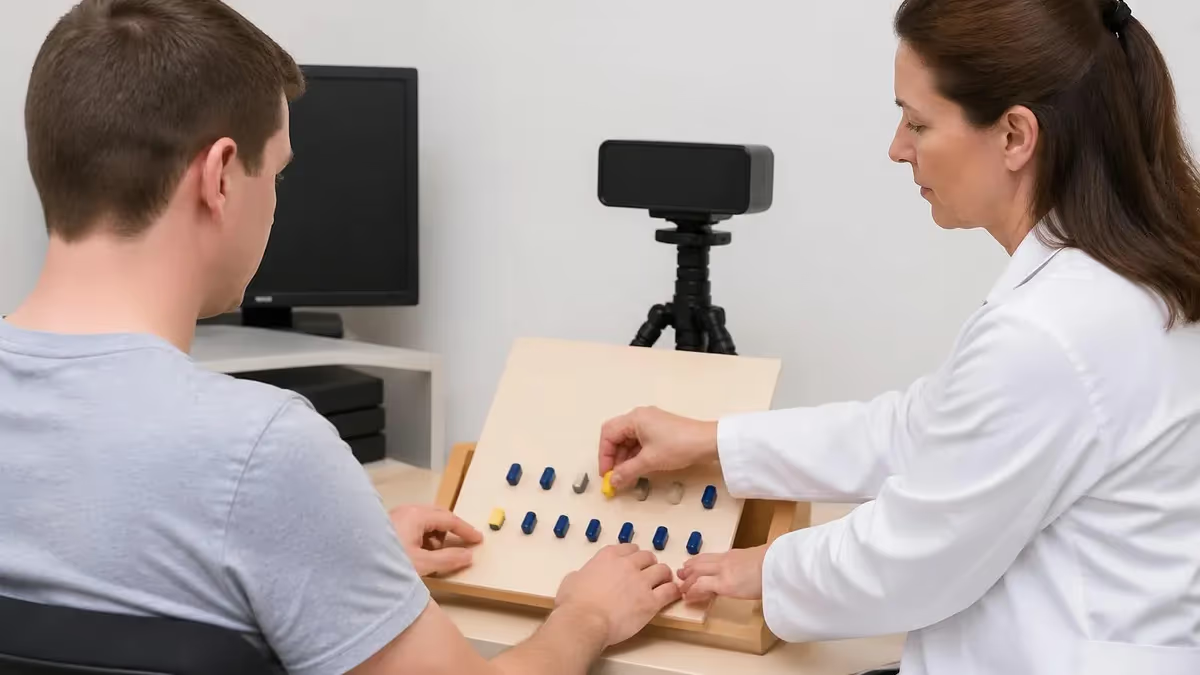
What Is the Navy PICAT?
The Navy PICAT — short for Pending Internet Computerized Adaptive Test — is the military's at-home alternative to the full ASVAB. Recruiters send candidates a secure link, you complete all 145 questions online, and the results follow you to MEPS where a short verification test confirms the score is actually yours.
It's not a separate exam from the ASVAB. Think of it as the same test delivered through a different channel. The content and scoring are identical — the computer just adapts question difficulty based on your previous answers, so two test-takers can sit the same PICAT and see completely different questions. The test was introduced to speed up the accession pipeline. Instead of scheduling a dedicated MEPS testing day just to take the ASVAB, candidates can get that out of the way before they ever step foot on a military installation.
Why does this matter? Because it shifts a big chunk of your testing pressure away from the high-stakes MEPS environment. You can take the PICAT from your own desk, at your own pace. That alone reduces test anxiety for a lot of recruits. Your recruiter will give you a one-time access link — don't share it, don't close the browser mid-test, and make sure your internet connection is stable before you start. Unlike traditional standardized tests, the PICAT has no printed booklet to flip through. Every answer is locked once you click submit, so you can't circle items and return to them later. Take a PICAT practice test before you begin so you know exactly what difficulty level to expect and can gauge your time management.

Subjects Covered
Your AFQT score — the number that determines whether you can enlist — is calculated from just four of the ten PICAT subtests:
- Arithmetic Reasoning (AR): Word problems involving basic math, ratios, percentages, and rates. Typically 15–16 questions. This is the subtest most recruits say they underestimate. Practice with ASVAB Arithmetic Reasoning word problems to build speed.
- Word Knowledge (WK): Vocabulary in context and synonym recognition. ~16 questions. A large word bank directly raises your AFQT ceiling — work on it early.
- Paragraph Comprehension (PC): Short reading passages with inference and main-idea questions. ~11 questions. The easiest subtest to improve quickly if you practice active reading.
- Mathematics Knowledge (MK): High-school algebra, geometry, and number operations. ~15 questions. Work through ASVAB Mathematics Knowledge practice sets to lock in the formulas.
How Scoring Works
The PICAT produces two types of output: your AFQT percentile and your line scores. They serve completely different purposes, and confusing them is one of the most common mistakes new recruits make.
The AFQT (Armed Forces Qualifying Test) percentile is the gate. It tells the Navy whether you're eligible to enlist at all. It's calculated from your AR, WK, PC, and MK subtests and expressed as a percentile from 1–99 — meaning a score of 60 means you outperformed 60% of the 1997 norming population. Yes, they still use that 1997 reference group. Don't overthink it. The Navy's minimum for diploma holders is 35; GED holders need 50.
Line scores are the specialization layer. The Navy combines specific subtest results into composite scores called ratings, and these determine which jobs you can bid for. A high AFQT with a weak Electronics Information score still locks you out of rates like ET (Electronics Technician) or IT (Information Systems Technician). So while the AFQT is your admission ticket, line scores determine your career options inside the Navy. You can't change your AFQT minimum by studying harder once you know it's already above 35 — but you can absolutely push your line scores higher by drilling the technical subtests. Work through ASVAB Arithmetic Reasoning practice and Mathematics Knowledge sets to build the AR and MK foundation that feeds into the most competitive rates.
One thing many recruits miss: you'll see your line score results the same day as your PICAT verification at MEPS. If your scores don't qualify you for the rate you wanted, you can discuss retesting options with your recruiter on the spot. Knowing your target line scores before you test gives you a concrete goal to aim for.
If you want more targeted practice, the picat practice test free page covers the same material with additional questions and explanations.
If you want more targeted practice, the picat practice test page covers the same material with additional questions and explanations.

Navy Line Scores
The Navy uses these composite formulas to calculate line scores from ASVAB/PICAT subtests:
- VE (Verbal Expression): WK + PC — used in many clerical and administrative rates
- AR (Arithmetic Reasoning): raw AR score — engineering, nuclear, and SEAL pipeline
- MK (Mathematics Knowledge): raw MK score — technical and nuclear rates
- EI (Electronics Information): raw EI score — electronics and IT rates
- GS (General Science): raw GS score — medical and scientific rates
- MC (Mechanical Comprehension): raw MC score — hull, machinery, and engineering ratings
The Verification Test at MEPS
Here's the catch that surprises a lot of recruits: the PICAT score doesn't automatically count. You have to verify it. When you arrive at MEPS, you'll sit a 30-question verification test covering the same four AFQT subtests — AR, WK, PC, and MK. The whole thing takes about 30 minutes.
If your MEPS verification score is within 7 AFQT points of your at-home PICAT score, MEPS accepts the PICAT result and you're done. If the gap exceeds 7 points — in either direction — you get flagged and must take the full ASVAB right then and there. That's the full 145-question test in the MEPS testing room, under proctored conditions, on the same day you expected to be done. It's a real recovery situation. You'll be tired from travel, the MEPS environment is unfamiliar, and you weren't mentally prepared to sit a full exam. Avoid it entirely by preparing properly from the start.
This verification system isn't designed to catch cheaters, exactly — it's a statistical validity check. Normal test-to-test variation for the same person is usually within 3–5 AFQT points, so the 7-point threshold gives genuine buffer for test-day nerves or slight fatigue.
What it won't forgive is a 20-point discrepancy. That's a red flag that someone helped you at home, and MEPS will act accordingly. Study on your own, score what you actually know, and your two performances will naturally align. Knock out some PICAT Word Knowledge practice and General Science drills to tighten any weak spots before verification day.

Day-of Tips
- ✓Find a quiet room with stable internet — PICAT locks out on connection drops
- ✓Use a desktop or laptop, not a phone or tablet
- ✓Close all browser tabs and disable notifications before starting
- ✓Have government-issued ID ready (required for some platforms)
- ✓Don't discuss specific questions online — PICAT uses a secured question bank
- ✓Budget 2.5–3 hours; the adaptive format can vary slightly in length
- ✓Screenshot your score confirmation page before closing the browser
- ✓Report your score to your recruiter within 24 hours so MEPS can be scheduled
PICAT Pros and Cons
- +PICAT has a defined, publicly available content blueprint — candidates know exactly what to prepare for
- +Multiple preparation pathways accommodate different learning styles and schedules
- +A growing ecosystem of study resources means candidates at any budget level can access quality preparation materials
- +Clear score reporting allows candidates to identify specific strengths and weaknesses for targeted remediation
- +Professional recognition associated with strong performance provides tangible career and academic benefits
- −The scope of tested content requires substantial preparation time that competes with existing commitments
- −No single resource covers the full content scope — candidates typically need multiple study tools
- −Test anxiety and exam-day performance variability mean preparation effort does not always translate linearly to scores
- −Registration, preparation, and potential retake costs accumulate into a significant financial investment
- −Content and format can change between exam versions, making older preparation materials less reliable
Pros and Cons at a Glance
| Pros | Cons |
|---|---|
| PICAT has a defined, publicly available content blueprint — candidates know exactly what to prepare for | The scope of tested content requires substantial preparation time that competes with existing commitments |
| Multiple preparation pathways accommodate different learning styles and schedules | No single resource covers the full content scope — candidates typically need multiple study tools |
| A growing ecosystem of study resources means candidates at any budget level can access quality preparation materials | Test anxiety and exam-day performance variability mean preparation effort does not always translate linearly to scores |
| Clear score reporting allows candidates to identify specific strengths and weaknesses for targeted remediation | Registration, preparation, and potential retake costs accumulate into a significant financial investment |
| Professional recognition associated with strong performance provides tangible career and academic benefits | Content and format can change between exam versions, making older preparation materials less reliable |
Sample Picat Practice Questions
Try these questions from our free Picat practice tests. The correct answer and an explanation follow each question.
What is the output of `writeln(2 ** 10)` in Picat?
- A. 1024
- B. 20
- C. 210
- D. 1024.0
Answer: A. 1024
The `**` operator in Picat performs integer exponentiation when both operands are integers, so 2**10 evaluates to 1024.
In Picat, what does the `?=>` operator signify in a rule head compared to `=>`?
- A. `?=>` is non-deterministic (allows backtracking); `=>` is deterministic (commits on match)
- B. `?=>` matches only atoms; `=>` matches compound terms
- C. `?=>` requires a guard; `=>` does not
- D. `?=>` is used for predicates only; `=>` is for functions only
Answer: A. `?=>` is non-deterministic (allows backtracking); `=>` is deterministic (commits on match)
Rules using `?=>` are non-deterministic and allow the system to backtrack and try other clauses, while `=>` commits to the first matching clause.
Which Picat directive marks a predicate so that its results are automatically cached?
- A. cache
- B. memo
- C. persist
- D. table
Answer: D. table
The `table` directive placed before a predicate definition enables automatic memoization in Picat.
Which of the following statements correctly describes unification in Picat?
- A. Unification always succeeds, and if terms cannot be made equal, it throws an exception.
- B. Unification is the process of finding a substitution of variables that makes two terms identical, and it can fail if no such substitution exists.
- C. Picat does not support explicit unification, relying solely on pattern matching in rule heads.
- D. The unification operator `=` is only used for arithmetic equality, not for structures or lists.
Answer: B. Unification is the process of finding a substitution of variables that makes two terms identical, and it can fail if no such substitution exists.
Unification is a core concept in logic programming. It is the process by which variables are instantiated to values or other variables to make two terms structurally identical. If the terms cannot be made identical (e.g., unifying `a` with `b`, or `f(X)` with `g(X)`), the unification goal fails.
PICAT Questions and Answers
About the Author

Educational Psychologist & Academic Test Preparation Expert
Columbia University Teachers CollegeDr. Lisa Patel holds a Doctorate in Education from Columbia University Teachers College and has spent 17 years researching standardized test design and academic assessment. She has developed preparation programs for SAT, ACT, GRE, LSAT, UCAT, and numerous professional licensing exams, helping students of all backgrounds achieve their target scores.