
Phlebotomy: Classes, Certification, Salary & Career Guide 2026 October
📚 Get ready for your Phlebotomy: Classes, Certification, certification. Practice questions with step-by-step answer explanations and instant scoring.
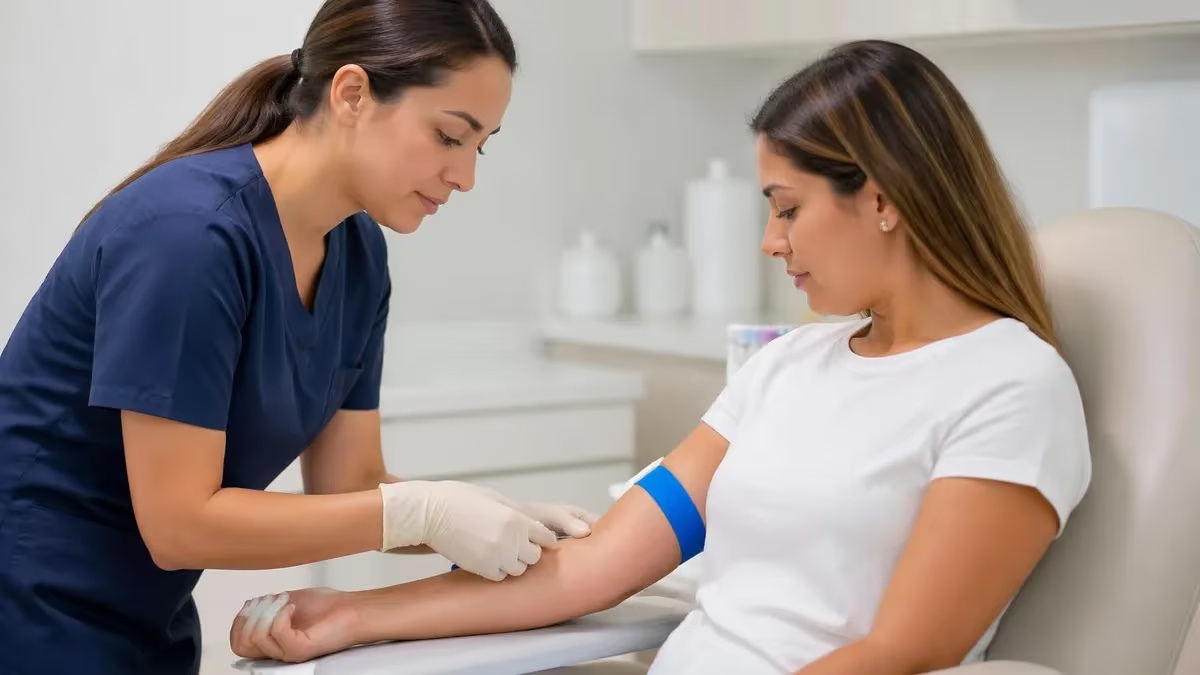
Everything You Need to Know About Phlebotomy
Phlebotomy is one of the fastest ways to break into healthcare. You can go from zero experience to a certified, working phlebotomy technician in under a year -- and demand for blood draw professionals isn't slowing down. If you've been searching for phlebotomy classes near me, you're already on the right track. Training programs are offered at community colleges, vocational schools, hospitals, and online platforms with in-person clinical components. The path is shorter and cheaper than most healthcare careers, but don't mistake accessible for easy -- the skills you'll learn are genuinely critical to patient safety.
Phlebotomists draw blood from patients for lab testing, donations, and medical research. That sounds simple. It isn't. You'll need to master venipuncture technique, identify the right veins, follow strict order of draw protocols, handle anxious patients, and process specimens correctly to avoid contamination or mislabeling. Hospitals, clinics, blood banks, and mobile health services all employ phlebotomists -- and phlebotomy training specialists can help you prepare for any of these settings.
This guide covers every aspect of the phlebotomy career path: certification options, training programs, exam content, salary expectations, and the specific skills you'll need to master. Whether you're considering phlebotomy as a long-term career or using it as a stepping stone to nursing or laboratory science, the information here will help you make smart decisions about your training and certification.

Finding Phlebotomy Training Programs Near You
The first real decision you'll make is where to train. Phlebotomy training specialists and accredited programs are available at community colleges, vocational schools, hospital education departments, and dedicated clinical training companies. Community college programs are the most common route -- they typically run one to two semesters, cost $500 to $2,500, and award a certificate of completion. Many partner directly with the NHA to offer the CPT exam at program completion, which streamlines the certification process.
When searching for phlebotomy courses near me, verify that any program you're considering includes a supervised clinical externship. This is non-negotiable. Classroom instruction teaches you theory -- anatomy, safety protocols, tube types -- but you can't become competent at venipuncture without sticking real veins under supervision. Most certifying bodies require 50 to 100 documented successful venipunctures before you can sit for the exam. A program without clinical hours won't qualify you.
Hospital-based training programs deserve attention. Some large hospital systems train their own phlebotomists internally, and these programs often lead directly to employment at that facility. They're competitive to get into but worth investigating. Military medical training pipelines also produce phlebotomy-certified personnel. For working adults, evening and weekend program formats exist at many community colleges -- you don't necessarily have to quit your current job to complete training.
What Is Phlebotomy and What Do Phlebotomy Technicians Do?
So what is phlebotomy in practical terms? It's the clinical practice of collecting blood specimens from patients. A phlebotomy technician -- also called a phlebotomist or blood draw technician -- performs venipuncture (drawing blood from veins), capillary puncture (fingersticks), and in some settings, assists with arterial blood draws. Every specimen you collect goes to a laboratory where it's analyzed for diagnostic purposes, treatment monitoring, or disease screening.
Day-to-day work varies by setting. Hospital phlebotomists typically handle high volumes -- 20 to 40 patients per shift -- and rotate through different units including the ED, ICU, and general medical floors. Outpatient clinic phlebotomists see a steadier flow of scheduled patients. Blood bank phlebotomists manage donor collections, which involves different equipment and protocols than diagnostic draws. Mobile phlebotomy services send you to patients' homes or corporate offices for health screenings.
The job requires more than technical skill. You'll encounter needle-phobic patients, children, elderly patients with fragile veins, and people having the worst day of their lives. Calm, clear communication is part of the job. You need to verify patient identity, explain procedures, and sometimes talk someone through genuine panic -- all while maintaining a sterile technique and filling tubes in the correct order. It's hands-on patient care, not just a lab task.
Phlebotomy Certification Bodies Compared
Credential: Phlebotomy Technician (PBT). The most widely recognized phlebotomy certification in hospital laboratory settings. Requires a formal training program or documented work experience plus 100 successful venipunctures and 5 capillary punctures. Renewed every 3 years through continuing education. If you're targeting hospital employment, ASCP is often the preferred or required credential.
Phlebotomy Salary and Where the Jobs Are
Let's talk money. The phlebotomy salary nationally sits at a median of about $40,000 per year according to the Bureau of Labor Statistics. Entry-level phlebotomists typically start between $30,000 and $36,000. That's not going to make you rich, but it's a solid income for a career that requires less than a year of training and no college degree. Experienced phlebotomists in high-cost metro areas -- California, New York, Massachusetts, Washington -- can earn $45,000 to $55,000 or more.
Hospital phlebotomists generally earn more than those in outpatient settings, partly because hospitals offer shift differentials. Evening, weekend, and overnight shifts can add $2,000 to $6,000 annually. If you're looking for phlebotomy certification near me options and wondering whether the investment pays off, the math is straightforward: a $1,500 training program that leads to a $40,000 job within months delivers a strong return.
Career advancement is real. Phlebotomy isn't a dead end -- it's a launchpad. Many phlebotomists move into Medical Laboratory Assistant roles, then pursue Medical Laboratory Technician (MLT) or Medical Laboratory Scientist (MLS) credentials. Others use their clinical experience as a foundation for nursing school applications. The patient care hours and healthcare system familiarity you gain as a phlebotomist give you a genuine advantage when applying to advanced programs.
Order of Draw: The Skill That Matters Most
Every phlebotomy exam hammers the order of draw phlebotomy content -- and for good reason. Getting this wrong in practice means contaminated specimens, incorrect lab results, and potentially dangerous clinical decisions based on bad data. The correct sequence is: blood culture bottles first, then light blue (sodium citrate), gold or red (serum separator), green (lithium heparin), lavender or purple (EDTA), and gray (sodium fluoride/potassium oxalate). Memorize it. There's no shortcut.
Therapeutic phlebotomy is a related but distinct procedure worth understanding. Unlike diagnostic blood draws where you're collecting specimens for testing, therapeutic phlebotomy involves removing larger volumes of blood as a medical treatment -- typically for conditions like polycythemia vera or hemochromatosis. Some phlebotomists perform therapeutic draws, though it's more common in specialized settings like hematology clinics and blood banks. The procedure requires additional training beyond standard venipuncture.
Common mnemonics help with memorization. "Boys Love Girls But Prefer Gentlemen" maps to Blood cultures, Light blue, Gold/red, (skip -- B for butterfly/discard tube when applicable), Purple/lavender, Gray. Use whatever mnemonic sticks for you, but the sequence itself must become automatic. Expect 3 to 5 order of draw questions on any phlebotomy certification exam, presented in different formats -- direct sequence questions, clinical scenarios, and error identification.
Phlebotomy Career: Benefits and Drawbacks
- +Training takes 4 to 8 months -- one of the fastest entry points into healthcare
- +No college degree required, just a high school diploma and accredited training program
- +Strong job market with consistent demand across hospitals, clinics, and blood banks
- +Natural stepping stone to MLT, MLS, nursing, and other advanced clinical careers
- +Multiple certification options (ASCP, NHA, AMT, NCCT, AMCA) fit different backgrounds
- +Hands-on patient care work that builds real clinical experience from day one
- −Starting salary of $30,000-$36,000 is modest compared to careers requiring similar commitment
- −Physical demands include standing for long shifts and repetitive hand/wrist motions
- −Exposure risk to bloodborne pathogens despite strict safety protocols and PPE
- −Difficult venipunctures on obese, dehydrated, or elderly patients can be stressful
- −Limited advancement ceiling without pursuing additional education or credentials
- −Night and weekend shifts are common in hospital settings, affecting work-life balance
Pros and Cons at a Glance
| Pros | Cons |
|---|---|
| No college degree required, just a high school diploma and accredited training program | Physical demands include standing for long shifts and repetitive hand/wrist motions |
| Strong job market with consistent demand across hospitals, clinics, and blood banks | Exposure risk to bloodborne pathogens despite strict safety protocols and PPE |
| Natural stepping stone to MLT, MLS, nursing, and other advanced clinical careers | Difficult venipunctures on obese, dehydrated, or elderly patients can be stressful |
| Multiple certification options (ASCP, NHA, AMT, NCCT, AMCA) fit different backgrounds | Limited advancement ceiling without pursuing additional education or credentials |
| Hands-on patient care work that builds real clinical experience from day one | Night and weekend shifts are common in hospital settings, affecting work-life balance |
Becoming a Certified Phlebotomy Technician
The path to becoming a certified phlebotomy technician follows a clear sequence. First, complete an accredited training program that includes both classroom instruction and supervised clinical hours. Second, accumulate the required number of documented venipunctures -- typically 50 to 100 depending on your chosen certifying body. Third, register for and pass the certification exam. The whole process takes 4 to 8 months for most candidates.
Choosing between certifying bodies matters. If you're targeting hospital laboratory positions, ASCP PBT is usually the strongest credential. For candidates in organized training programs, NHA CPT is the most convenient option -- many programs include the exam fee and administer the test on-site. If you've been working as an uncertified phlebotomist and want to formalize your credentials, NCCT allows qualification through documented work experience alone. Research job postings in your area and find a phlebotomy program near me that aligns with your preferred certification.
Exam content is consistent across all certifying bodies. You'll be tested on anatomy and physiology, venipuncture and capillary procedures, order of draw, specimen handling, infection control, OSHA regulations, and legal/ethical issues. The exams are multiple-choice, computer-based, and typically 2 to 3 hours long. Pass rates for first-time candidates who completed accredited programs generally exceed 70% -- adequate preparation makes a real difference.
Phlebotomy Certification Preparation Checklist
- ✓Research which phlebotomy certification your target employers require (ASCP, NHA, AMT, NCCT, or AMCA)
- ✓Enroll in an accredited phlebotomy program with a supervised clinical externship component
- ✓Complete the minimum required venipunctures during training (50-100 depending on certifying body)
- ✓Memorize the order of draw -- it's the most tested topic on every phlebotomy exam
- ✓Study venipuncture anatomy: antecubital fossa, median cubital vein, cephalic vein, basilic vein
- ✓Learn tube colors, additives, and their clinical purposes -- match each top color to its additive
- ✓Review OSHA bloodborne pathogen standards and standard precautions thoroughly
- ✓Practice with phlebotomy exam questions daily in the final 2 to 4 weeks before your test date
- ✓Get your clinical competency sign-off from a supervising phlebotomist before scheduling the exam
- ✓Register for your certification exam within 6 months of completing your training program
Preparing for Your Phlebotomy Practice Test and Exam
Taking a phlebotomy practice test before your actual certification exam is one of the smartest things you can do. Practice questions reveal gaps in your knowledge that you didn't know existed. You might feel confident about venipuncture procedures but realize you're weak on specimen rejection criteria or OSHA regulations. Targeted review after practice testing is far more efficient than rereading your entire textbook.
A good phlebotomy program builds exam preparation into the curriculum, but self-study matters too. Focus your review on the areas that carry the most exam weight: order of draw, anatomy of venipuncture sites, specimen handling and processing, and safety protocols. These four domains account for the majority of questions across all certifying body exams. Pharmacology and laboratory instrumentation show up less frequently but still appear -- don't ignore them entirely.
Timing your practice sessions helps build test-day stamina. Most phlebotomy certification exams give you 2 to 3 hours for 100 to 150 questions. That's roughly one minute per question. Practice under timed conditions so you develop a comfortable pace. If you're spending more than 90 seconds on any single question during the real exam, flag it and move on -- you can return to flagged questions after completing the rest.
Phlebotomy Order of Draw: Complete Breakdown
Let's walk through the phlebotomy order of draw in detail because you'll need to know not just the sequence but why each position matters. Blood culture bottles come first because they require the most sterile technique -- any contamination here could lead to a false-positive blood culture, triggering unnecessary antibiotic treatment. Light blue citrate tubes are second because citrate-to-blood ratio is critical for accurate coagulation testing.
Gold or red serum tubes (SST) come next. These contain clot activator and gel separator. The order of draw for phlebotomy places them after citrate to prevent clot activator from contaminating coagulation specimens. Green heparin tubes follow -- they're used for chemistry panels and specific analytes. Lavender EDTA tubes are near the end because EDTA is a strong chelating agent that would wreck calcium-dependent tests if it carried over to other tubes. Gray fluoride/oxalate tubes are last because they inhibit glycolysis for glucose testing.
Here's a detail that trips up new phlebotomists: when using a butterfly needle (winged infusion set), you may need a discard tube before the light blue top. The butterfly's tubing contains a small dead space of air, and the first tube drawn won't fill completely -- which would give you an incorrect blood-to-citrate ratio in a light blue tube. Drawing a discard tube first (or a blood culture if that's ordered) eliminates this problem. This nuance shows up on exams.
Not all phlebotomy programs qualify you for certification exams. Before enrolling, confirm that the program includes a supervised clinical externship with documented venipunctures. Programs without clinical hours won't satisfy ASCP, NHA, or AMT eligibility requirements. Check directly with your chosen certifying body to verify that the program meets their prerequisites. Unaccredited programs waste your money and time.
Mobile Phlebotomy and Emerging Career Paths
Mobile phlebotomy is one of the fastest-growing segments of the field. Instead of working in a hospital or clinic, mobile phlebotomists travel to patients' homes, assisted living facilities, and corporate offices to perform blood draws. The convenience factor drives demand -- elderly patients, homebound individuals, and busy professionals all prefer having blood drawn at their location rather than visiting a lab. Some mobile phlebotomists work as independent contractors, setting their own schedules and rates.
Starting a mobile phlebotomy business requires certification, liability insurance, a reliable vehicle, and a good supply kit. Earnings can exceed traditional facility-based positions because you're charging per draw rather than earning an hourly wage. Per-draw rates typically range from $25 to $50, and experienced mobile phlebotomists handling 8 to 12 draws per day can earn significantly more than their hospital-based counterparts. It's not passive income -- you're driving between locations and managing your own schedule -- but the earning potential is real.
For those exploring online phlebotomy certification options, understand the distinction: you can complete the cognitive portion of some training programs online, but the clinical externship must be done in person. No legitimate certifying body accepts a fully online phlebotomy credential. Online coursework covers theory, anatomy, and safety protocols, but you'll still need supervised hands-on training at a partnered clinical site. That said, the hybrid model works well for self-motivated learners who want flexibility.
Phlebotomy Practice Test Questions
Prepare for the Phlebotomy Test exam with our free practice test modules. Each quiz covers key topics to help you pass on your first try.
Phlebotomy American Medical Certification ...
Phlebotomy Exam Questions covering American Medical Certification Association Phlebotomy. Master Phlebotomy Test concepts for certification prep.
Phlebotomy American Medical Technologists ...
Free Phlebotomy Practice Test featuring American Medical Technologists Phlebotomy. Improve your Phlebotomy Exam score with mock test prep.
Phlebotomy American Society for Clinical P...
Phlebotomy Mock Exam on American Society for Clinical Pathology Phlebotomy. Phlebotomy Study Guide questions to pass on your first try.
Phlebotomy Association of Phlebotomy Techn...
Phlebotomy Test Prep for Association of Phlebotomy Technicians. Practice Phlebotomy Quiz questions and boost your score.
Phlebotomy National Center for Competency ...
Phlebotomy Questions and Answers on National Center for Competency Testing Phlebotomy. Free Phlebotomy practice for exam readiness.
Phlebotomy National Healthcareer Associati...
Phlebotomy Mock Test covering National Healthcareer Association Phlebotomy. Online Phlebotomy Test practice with instant feedback.
Phlebotomy Order of Draw and Additives
Free Phlebotomy Quiz on Order of Draw and Additives. Phlebotomy Exam prep questions with detailed explanations.
Phlebotomy Legal and Ethics
Phlebotomy Practice Questions for Phlebotomy Legal and Ethics. Build confidence for your Phlebotomy certification exam.
Phlebotomy Safety and Infection Control
Phlebotomy Test Online for Safety and Infection Control. Free practice with instant results and feedback.
Phlebotomy Special Collection Procedures
Phlebotomy Study Material on Special Collection Procedures. Prepare effectively with real exam-style questions.
Phlebotomy Specimen Processing and Handling
Free Phlebotomy Test covering Specimen Processing and Handling. Practice and track your Phlebotomy exam readiness.
Phlebotomy Test Arterial Blood Gas Collection
Phlebotomy Exam Questions covering Test Arterial Blood Gas Collection. Master Phlebotomy Test concepts for certification prep.
Phlebotomy Test Capillary and Dermal Puncture
Free Phlebotomy Practice Test featuring Test Capillary and Dermal Puncture. Improve your Phlebotomy Exam score with mock test prep.
Phlebotomy Test Pediatric Blood Collection
Phlebotomy Mock Exam on Test Pediatric Blood Collection. Phlebotomy Study Guide questions to pass on your first try.
Phlebotomy Test Phlebotomy Anatomy and Phy...
Phlebotomy Test Prep for Test Phlebotomy Anatomy and Physiology. Practice Phlebotomy Quiz questions and boost your score.
Phlebotomy Test Phlebotomy Exam Simulation
Phlebotomy Questions and Answers on Test Phlebotomy Exam Simulation. Free Phlebotomy practice for exam readiness.
Phlebotomy Test Phlebotomy Patient Identif...
Phlebotomy Mock Test covering Test Phlebotomy Patient Identification and Communication. Online Phlebotomy Test practice with instant feedback.
Phlebotomy Test Point of Care Testing
Free Phlebotomy Quiz on Test Point of Care Testing. Phlebotomy Exam prep questions with detailed explanations.
Online Phlebotomy Classes and NHA Exam Preparation
Online phlebotomy classes have expanded significantly in recent years. Programs like those offered through community colleges and platforms like Phlebotomy Training Specialists combine online coursework with arranged clinical externships at nearby healthcare facilities. The online portion covers anatomy, medical terminology, safety regulations, and order of draw theory. You study at home, then complete your clinical hours at a partnered site. This format works particularly well for career changers who can't attend traditional daytime classes.
If you're preparing for the NHA CPT specifically, an nha phlebotomy practice test should be part of your study plan. The NHA exam has 100 scored questions plus 20 pretest (unscored) questions, for 120 total. You'll have 2 hours to complete it. Content breaks down roughly into: safety and compliance (20%), patient preparation (12%), routine collection (26%), specimen handling (24%), and non-routine collection (18%). Targeting your weakest domain based on practice test results is the most efficient way to improve your score.
Free study resources exist alongside paid prep courses. The NHA offers a study guide and practice exam for purchase through their website. Third-party resources like Quizlet decks, YouTube channels focused on phlebotomy content, and practice test platforms can supplement your studying. The key is active recall -- don't just reread notes. Test yourself repeatedly on order of draw, tube colors and additives, anatomy of common venipuncture sites, and safety protocols. Active testing beats passive review every time.
Sample Phlebotomy Practice Questions
Try these questions from our free Phlebotomy practice tests. The correct answer and an explanation follow each question.
What is one benefit of earning the AMCA Phlebotomy Technician Certification?
- A. Guaranteed employment in healthcare facilities
- B. Recognition of professional competency by healthcare employers
- C. Automatic eligibility for supervisory roles
- D. Exemption from continuing education requirements
Answer: B. Recognition of professional competency by healthcare employers
Earning the AMCA Phlebotomy Technician Certification provides official recognition of an individual's professional competency in phlebotomy. This credential assures healthcare employers that the phlebotomist has met established standards of knowledge and skill, making them a more desirable candidate for employment. It signifies a commitment to quality patient care and professional excellence.
How often must the AMCA Phlebotomy Technician Certification be renewed?
- A. Every 1 year
- B. Every 2 years
- C. Every 3 years
- D. Every 5 years
Answer: B. Every 2 years
The AMCA Phlebotomy Technician Certification (PTC) requires renewal every two years. To maintain active certification, professionals must typically complete continuing education requirements and pay a renewal fee. This regular renewal process ensures that certified phlebotomists stay updated with current best practices and advancements in the field.
What certification is offered by the American Medical Technologists (AMT) for phlebotomy professionals?
- A. Certified Phlebotomy Technician (CPT)
- B. Registered Phlebotomy Technician (RPT)
- C. Licensed Blood Collection Technician (LBCT)
- D. Certified Clinical Specialist (CCS)
Answer: B. Registered Phlebotomy Technician (RPT)
The American Medical Technologists (AMT) offers the Registered Phlebotomy Technician (RPT) certification for phlebotomy professionals. This credential signifies that an individual has met AMT's rigorous standards for competence in phlebotomy. The RPT certification is widely recognized and respected in the healthcare industry.
What organization accredits phlebotomy training programs recognized by the ASCP Board of Certification?
- A. NAACLS
- B. JCAHO
- C. CLIA
- D. CAP
Answer: A. NAACLS
NAACLS (National Accrediting Agency for Clinical Laboratory Sciences) accredits programs accepted by ASCP BOC.
Phlebotomy Questions and Answers
Phlebotomy Jobs: Where to Find Work as a Phlebotomy Technician
NHA Phlebotomy Practice Test 2026
Phlebotomy Certification Exam 2026: Complete Guide to NHA CPT, ASCP PBT, AMT, NCCT & ASPT
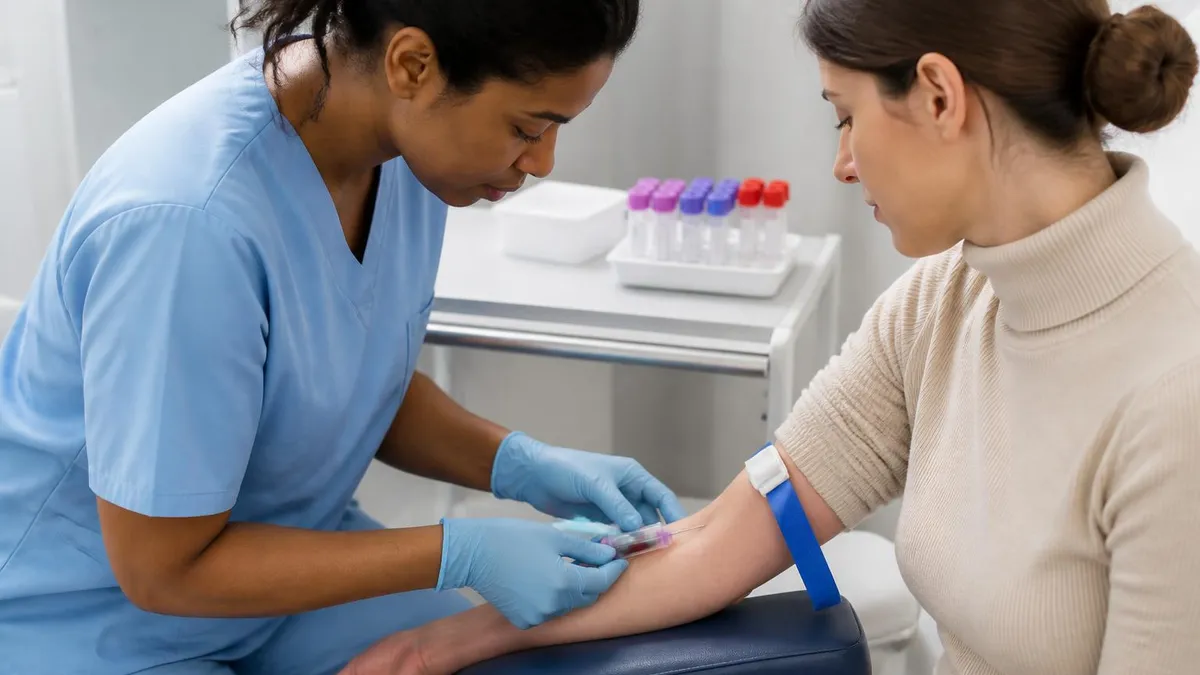
Phlebotomy Knowledge: Order of Draw, Tubes & Procedures
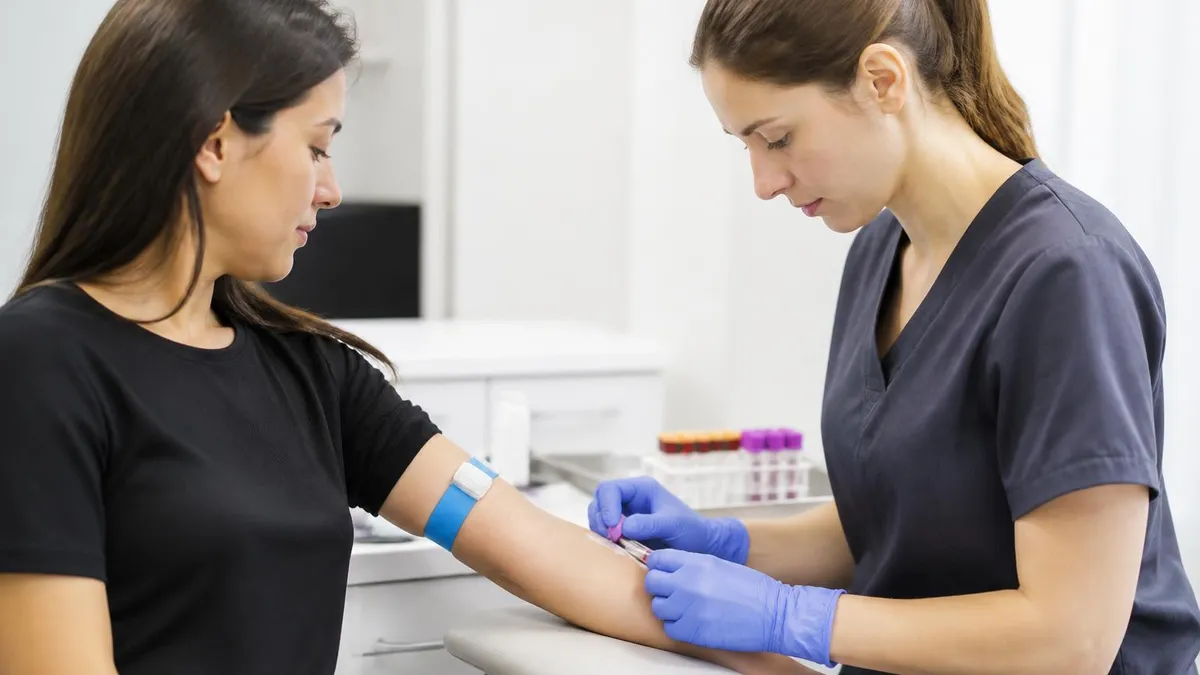
Part Time Phlebotomy Jobs: Schedules, Pay, and Where to Find Them
About the Author

Registered Nurse & Healthcare Educator
Johns Hopkins University School of NursingDr. Sarah Mitchell is a board-certified registered nurse with over 15 years of clinical and academic experience. She completed her PhD in Nursing Science at Johns Hopkins University and has taught NCLEX preparation and clinical skills courses for nursing students across the United States. Her research focuses on evidence-based exam preparation strategies for healthcare certification candidates.