
What Does PCA Mean? Complete Guide to Every Meaning of the Acronym PCA in 2026 October
✏️ PCA stands for many things — Personal Care Assistant, PCA Skin, Principal Component Analysis, and more. Complete 2026 October guide to every PCA meaning.
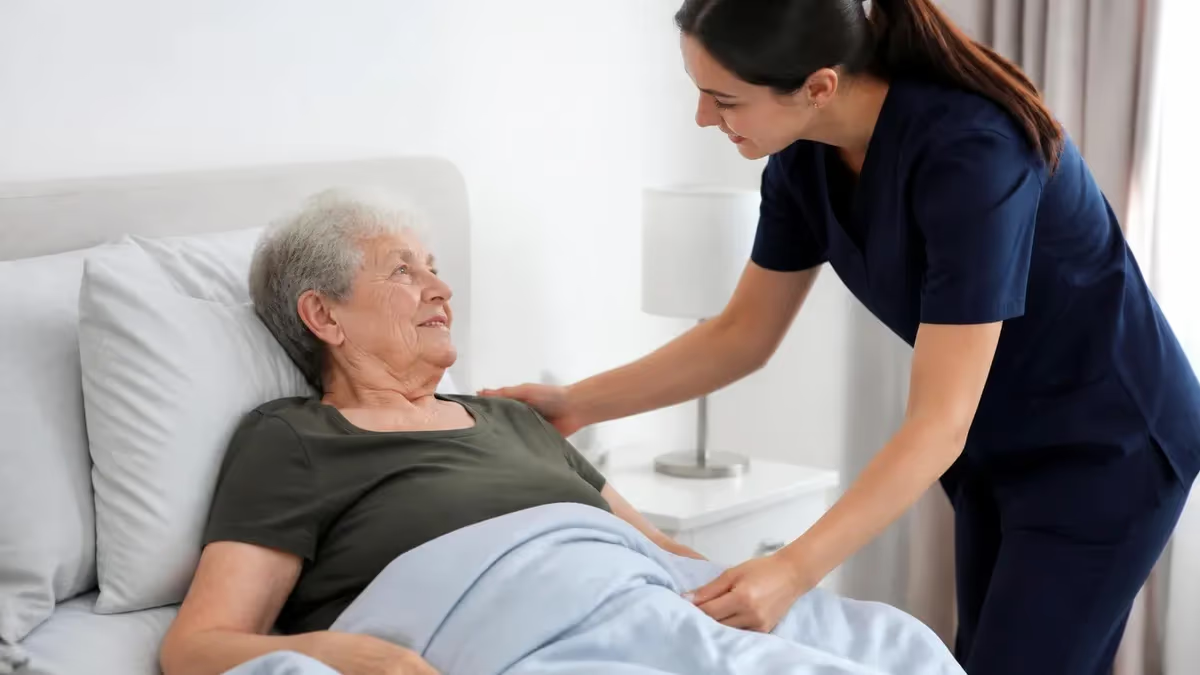
If you have ever typed the three letters into a search bar and wondered what does PCA mean, you are not alone. PCA stands for several distinct things depending on the industry, including Personal Care Assistant in healthcare, PCA Skin in cosmetics, Principal Component Analysis in statistics, Patient Controlled Analgesia in pain medicine, Porsche Club of America in motorsport, and Presbyterian Church in America in religion. The pca meaning shifts dramatically based on context, so understanding which version someone is referring to matters more than memorizing every definition.
This guide unpacks every common usage of the acronym, starting with the most searched ones. In healthcare alone, PCA can describe a job title, a medication delivery device, a billing code, or even a software platform used by nursing agencies. Outside healthcare, the same three letters appear on skincare bottles in dermatology offices, in machine learning textbooks, on Porsche track event invitations, and in church bulletins across the southern United States. Each meaning carries its own pronunciation conventions, certification paths, and search intent.
According to recent search volume data, more than 60,000 Americans look up some version of the PCA acronym every month. The top queries split roughly between skincare buyers researching the PCA Skin product line, families looking up the Personal Care Assistant role for an aging relative, students studying data science, and analytics professionals comparing dimensionality reduction techniques. We will cover each interpretation with concrete examples so you leave with a clear answer rather than more confusion.
The healthcare definition is the most common professional usage in the United States. A Personal Care Assistant — sometimes called a Personal Care Aide depending on the state — helps clients with activities of daily living such as bathing, dressing, meal preparation, light housekeeping, and mobility support. Many readers also encounter the term through the popular pca hydrating toner study materials used to prepare for state certification exams and Medicaid-funded program assessments.
The cosmetic meaning trails closely behind in search popularity. PCA Skin is a professional skincare brand founded in 1990 that built its reputation on chemical peels and targeted serums sold primarily through licensed estheticians and dermatologists. Its hydrating toner, retinol treatments, and acne products generate millions of searches a year, which is why "pca skin" and "pca skincare" dominate consumer-facing results even when shoppers are unsure what the letters originally stood for.
In statistics and machine learning, Principal Component Analysis is a dimensionality reduction technique invented by Karl Pearson in 1901 and refined by Harold Hotelling in the 1930s. Data scientists use PCA to compress hundreds of correlated variables into a handful of orthogonal components that explain the majority of variance in a dataset. Pca stats is one of the most cited entry-level concepts in any quantitative graduate program, and it shows up on resumes across finance, genomics, and computer vision.
Finally, several smaller but loyal communities use the same acronym. The Porsche Club of America has more than 145,000 members and organizes track days nationwide. The Presbyterian Church in America counts roughly 380,000 communicants across more than 1,900 congregations. Each group treats PCA as identity rather than abbreviation. By the end of this guide you will know which PCA fits your situation, the basic vocabulary attached to it, and where to go for deeper learning.
What Does PCA Mean by the Numbers

Every Meaning of PCA Explained
A trained caregiver who helps clients with bathing, dressing, mobility, meals, and light housekeeping. The most common professional pca meaning in the United States, with over 1.4 million workers employed nationally.
A professional-grade dermatology brand founded in 1990. Famous for the pca hydrating toner, chemical peels, retinol treatments, and acne serums sold through estheticians and licensed providers.
A statistical technique used in data science and machine learning to reduce dimensionality. Converts correlated variables into orthogonal components ranked by variance explained, foundational to pca stats coursework.
A pca medical device that lets hospital patients self-administer pre-set doses of pain medication through an IV pump. Common after surgery, childbirth, and during end-of-life care.
The official enthusiast club for Porsche owners, founded in 1955. Hosts track days, autocross events, and the famed porsche experience driving school programs across all 50 states.
The healthcare interpretation of PCA is by far the most consequential for everyday Americans. A Personal Care Assistant works one-on-one with clients who cannot fully care for themselves due to age, disability, chronic illness, or recovery from surgery. The role grew out of older home health aide traditions but has carved out its own scope: PCAs focus on non-medical activities of daily living rather than clinical tasks like wound care or medication administration. Knowing the pca meaning in this context helps families pick the right type of in-home support.
Most states require PCAs to complete training before working with Medicaid clients, though the exact hours vary widely. Minnesota mandates a standardized PCA training and competency test. New York requires 40 hours through a HHA program. Massachusetts uses a 75-hour curriculum that includes infection control, emergency response, and ethics. Other states like Texas allow agencies to deliver in-house training without state oversight. The flexibility makes the role accessible but also means quality varies depending on which agency hires the worker.
The day-to-day work of a PCA looks deceptively simple from the outside. A typical morning shift might begin with helping a client transfer from bed to wheelchair, then assisting with a shower, dressing, breakfast preparation, and medication reminders. Afternoons often involve light cleaning, laundry, grocery runs, doctor appointment transportation, and companionship. Evening shifts wrap with dinner, hygiene routines, and bedtime preparation. The work is physical, emotional, and relational all at once.
Pay for Personal Care Assistants has improved noticeably since 2020 but still trails most healthcare roles. The Bureau of Labor Statistics reported a national median wage of $16.08 per hour in 2024, with significant state variation. Washington, California, and Massachusetts pay above $20 per hour at the median, while several southern states sit closer to $12. Benefits depend heavily on employer type: agency PCAs may receive paid time off and health insurance, while consumer-directed workers paid through Medicaid waivers often work without traditional benefits.
Demand for PCAs is projected to grow 22 percent through 2032, faster than any other major occupation tracked by the federal government. The driver is demographic: roughly 10,000 Americans turn 65 every day, and the vast majority say they want to age at home rather than in nursing facilities. State waiver programs, Veterans Affairs benefits, and long-term care insurance increasingly fund PCA services as a less expensive alternative to institutional care.
If you are considering this career, the entry barrier is low but the path to higher pay requires planning. Many PCAs use the job as a stepping stone toward becoming a Certified Nursing Assistant, Licensed Practical Nurse, or Registered Nurse. Others specialize in pediatric care, dementia care, or hospice support to command premium hourly rates. The role rewards consistency, empathy, and physical stamina more than formal credentials, which is why it remains one of the most accessible healthcare entry points in 2026.
Families hiring a PCA should look beyond hourly rate. Verify state registry status, ask about specific training in conditions relevant to the client (Parkinson's, dementia, stroke recovery), confirm liability insurance, and meet at least two backup workers before signing. Reputable agencies provide written care plans, supervisor visits, and 24-hour on-call coverage. Independent workers may charge less but require the family to handle scheduling, taxes, and replacement coverage during illness or vacation.

PCA Practice Test Questions
Prepare for the PCA - Personal Care Assistant exam with our free practice test modules. Each quiz covers key topics to help you pass on your first try.
PCA Duties and Responsibilities
Free PCA Practice Test featuring Duties and Responsibilities. Improve your PCA Exam score with mock test prep.
PCA Qualifications
PCA Mock Exam on Qualifications. PCA Study Guide questions to pass on your first try.
PCA Working Conditions
PCA Test Prep for Working Conditions. Practice PCA Quiz questions and boost your score.
PCA Assisting with Daily Living Activities
PCA Questions and Answers on Assisting with Daily Living Activities. Free PCA practice for exam readiness.
PCA Basic Nursing Skills
PCA Mock Test covering Basic Nursing Skills. Online PCA Test practice with instant feedback.
PCA Basic Patient Care Skills
Free PCA Quiz on Basic Patient Care Skills. PCA Exam prep questions with detailed explanations.
PCA Communication and Interpersonal Skills
PCA Practice Questions for Communication and Interpersonal Skills. Build confidence for your PCA certification exam.
PCA Ethical and Legal Responsibilities
PCA Test Online for Ethical and Legal Responsibilities. Free practice with instant results and feedback.
PCA Health and Safety Procedures
PCA Study Material on Health and Safety Procedures. Prepare effectively with real exam-style questions.
PCA Health & Safety Protocols
Free PCA Test covering Health & Safety Protocols. Practice and track your PCA exam readiness.
PCA Infection Control
PCA Exam Questions covering Infection Control. Master PCA Test concepts for certification prep.
PCA Mental Health & Emotional Support
Free PCA Practice Test featuring Mental Health & Emotional Support. Improve your PCA Exam score with mock test prep.
PCA Nutrition & Hydration
PCA Mock Exam on Nutrition & Hydration. PCA Study Guide questions to pass on your first try.
PCA Patient Mobility & Transfers
PCA Test Prep for Patient Mobility & Transfers. Practice PCA Quiz questions and boost your score.
PCA Skin, Medical & Tech Meanings
PCA Skin is a professional dermatology brand founded by esthetician Marina Peredo in 1990. The line is sold almost exclusively through licensed skincare providers, which gives it credibility versus mass-market drugstore brands. Hero products include the pca hydrating toner, the Acne Gel, ExLinea peptide smoothing serum, and a chemical peel system used in clinical settings. The brand became part of Colgate-Palmolive in 2017 but kept its professional-only distribution model.
Customers searching for pca skin or pca skincare are usually trying to compare results to alternatives like SkinCeuticals, Obagi, or ZO Skin Health. The brand differentiates with pH-balanced exfoliating acids, broad-spectrum mineral sunscreens, and pigment correctors that work without prescription-strength hydroquinone. Reviews tend to highlight the gentleness of the formulas relative to competitors, especially for sensitive or rosacea-prone skin types that struggle with stronger retinoids.
Is the PCA Acronym Helpful or Confusing?
- +Short and memorable across multiple industries
- +Recognized brand equity for PCA Skin in dermatology
- +Standardized professional title in 40+ state Medicaid programs
- +Universally taught in statistics curricula worldwide
- +Well documented across medical device safety literature
- +Established community identity for Porsche and Presbyterian groups
- +Makes job titles and product lines easy to repeat aloud
- −Same letters mean six completely different things
- −Search results often mix healthcare with skincare and statistics
- −Patients sometimes confuse PCA pumps with PCA caregivers
- −PCA Skin shoppers occasionally land on caregiver job pages
- −Spelling out the acronym is unavoidable in formal writing
- −Internal jobs boards may need filters to separate roles
- −Translation into other languages drops the recognition entirely
Pros and Cons at a Glance
| Pros | Cons |
|---|---|
| Short and memorable across multiple industries | Same letters mean six completely different things |
| Recognized brand equity for PCA Skin in dermatology | Search results often mix healthcare with skincare and statistics |
| Universally taught in statistics curricula worldwide | Patients sometimes confuse PCA pumps with PCA caregivers |
| Well documented across medical device safety literature | PCA Skin shoppers occasionally land on caregiver job pages |
| Established community identity for Porsche and Presbyterian groups | Spelling out the acronym is unavoidable in formal writing |
| Makes job titles and product lines easy to repeat aloud | Internal jobs boards may need filters to separate roles |

How to Identify Which PCA Meaning Applies
- ✓Look for surrounding healthcare words like aide, caregiver, client, or Medicaid
- ✓Check for product packaging, bottle imagery, or esthetician terminology for PCA Skin
- ✓Scan for IV, pump, morphine, or pain management context for PCA medical devices
- ✓Note variance, eigenvector, or dimensionality language for Principal Component Analysis
- ✓Watch for track day, autocross, or 911 model references for Porsche Club of America
- ✓Spot sermon, denomination, or congregation context for Presbyterian Church in America
- ✓Read the URL path — /skincare, /jobs, /stats give immediate clues
- ✓Check the publishing source: WebMD vs Sephora vs Kaggle vs Porsche.com
- ✓Look at the verb attached: hire a PCA, apply PCA toner, run PCA on data
- ✓Confirm the geographic context — PCA pumps are clinical, PCAs work in homes
Context determines which PCA you mean
If you found this article from a job board or family caregiving search, the relevant PCA is almost certainly Personal Care Assistant. If you arrived from a skincare query, you want PCA Skin. If you came from a college statistics course, you want Principal Component Analysis. The same three letters serve four major audiences without overlap, so let the source of your search guide which definition to focus on.
Principal Component Analysis deserves a closer look because it is the version of PCA most often misunderstood by people outside data science. The technique was first described by British mathematician Karl Pearson in 1901 in a paper titled "On Lines and Planes of Closest Fit to Systems of Points in Space." Three decades later, American economist Harold Hotelling formalized the modern matrix-based version that statisticians still teach today. The method predates digital computers by half a century, which is part of why it scales so elegantly to massive datasets.
The intuition behind pca stats is easier than the math. Imagine plotting two highly correlated variables — say, height and weight of 500 adults — on a scatter plot. The points form an elongated cloud tilted along a diagonal line. PCA rotates the coordinate system so the new x-axis aligns with that diagonal. Suddenly, most of the variation in the data is captured by a single new variable rather than two. The second axis, perpendicular to the first, captures the much smaller leftover variation.
Scaling this idea to high dimensions is what makes PCA powerful. A genomics dataset might track 20,000 gene expression levels across 200 patients. Plotting that directly is impossible. PCA can compress those 20,000 dimensions down to two or three principal components that still preserve the major biological signals, allowing researchers to visualize tumor subtypes or population structure on an ordinary scatter plot. The same technique drives eigenface recognition in computer vision and risk factor decomposition in quantitative finance.
Limitations matter as much as strengths. PCA assumes linear relationships between variables, which means it struggles with curved manifolds or strongly nonlinear patterns. It is sensitive to scale, so analysts almost always standardize variables to mean zero and unit variance first. It also produces components that are mathematically optimal but often difficult to interpret biologically or economically. The first principal component might combine 47 different gene expressions in ways no domain expert would write by hand.
Modern alternatives have emerged for situations where PCA falls short. t-SNE and UMAP handle nonlinear structure better and have largely replaced PCA for cluster visualization in single-cell genomics. Independent Component Analysis separates source signals when PCA only separates by variance. Autoencoders extend the dimensionality reduction concept into deep learning. Yet PCA remains the default first step in most analyses because it is fast, deterministic, well-understood, and produces components that downstream models can consume cleanly.
For students or career switchers learning data science in 2026, PCA is non-negotiable. Every introductory statistics course, every machine learning bootcamp, and every quantitative finance interview will touch the topic. The mechanics — covariance matrices, eigendecomposition, singular value decomposition, scree plots, variance explained — appear in technical questions across data analyst, data scientist, and quantitative researcher hiring pipelines. Mastering pca stats early pays dividends throughout a numerical career.
Practitioners should also keep an eye on the algorithm's role in fairness and explainability conversations. Because PCA combines variables in ways that may obscure protected attributes, regulators in finance and hiring increasingly ask for documentation of how dimensionality reduction affects model outcomes. Knowing how to inspect component loadings, communicate variance explained, and justify the number of components retained is now part of responsible analytics, not just an academic exercise.
One of the most common patient safety mix-ups happens when family members hear hospital staff mention "the PCA" and assume they are talking about the personal care assistant rather than the pain medication pump. Always ask the nurse to clarify whether they are referring to the device or the worker. Misunderstandings here can lead to medication errors, missed shift coverage, or confused discharge planning conversations.
Choosing which PCA path matters to you depends entirely on why the acronym entered your life. If you are looking for in-home support for a parent, the relevant choice is Personal Care Assistant, and your next step is contacting pca medical agencies in your county or state to compare hourly rates, training standards, and supervisory practices. Start with three to five providers, request written care plans, and confirm Medicaid participation if applicable.
If you are entering the workforce, the Personal Care Assistant role offers one of the fastest paths into healthcare. Training takes between two and twelve weeks in most states. Background checks, tuberculosis screening, and CPR certification are typically required. Once certified, workers can find jobs through agencies, county human services departments, online platforms like Care.com, or by serving as a paid caregiver for a family member through state self-directed Medicaid waivers. Hourly pay ranges from $13 to $22 depending on location and specialty.
If you are a skincare consumer, the PCA Skin path looks completely different. Start with a consultation at a medical spa or dermatology office that carries the line. The brand sells through professionals partly to ensure customers receive guidance on layering acids, retinols, and sunscreens. The pca hydrating toner is one of the safest entry points because it works for most skin types and complements existing routines without forcing a complete product overhaul.
For students studying machine learning, the PCA path is academic before it is professional. Most universities introduce the technique in a second-year statistics course or a first-year graduate data analysis class. Free resources include the StatQuest YouTube series, the Introduction to Statistical Learning textbook by James, Witten, Hastie, and Tibshirani, and the official scikit-learn documentation. Implementing PCA from scratch in NumPy is a classic interview prep exercise that solidifies the linear algebra fundamentals.
For Porsche enthusiasts, joining the Porsche Club of America requires owning a Porsche (any model, any year) and paying annual dues of around $46. Membership unlocks regional chapter events, the official Panorama magazine, factory tour discounts, and access to the porsche experience driving programs in Atlanta and Los Angeles. The club is widely regarded as one of the best-run owners associations in motorsport, with low-pressure social events alongside serious track competition.
For those exploring church communities, the Presbyterian Church in America is a conservative Reformed denomination that split from the larger Presbyterian Church in 1973. Congregations emphasize expository preaching, confessional theology rooted in the Westminster Standards, and a presbyterian polity that places authority with elders rather than bishops or congregational majorities. Visitors can find a local PCA church through the denomination's official locator at pcanet.org, which lists times, addresses, and pastoral contacts for every member congregation.
No matter which PCA brought you here, the path forward is similar: identify your goal, pick the right resources, and progress one step at a time. The shared acronym is a quirk of language, not a constraint on action. Bookmark the section of this guide that applies to your situation, follow the linked resources, and revisit the rest only when curiosity strikes about how the same three letters came to mean so many different things to so many different people.
For readers who landed here looking for practical advice rather than encyclopedia coverage, this final section gives concrete next steps for each major PCA meaning. Picking one path and going deep is far more useful than skimming all six. If you find yourself overwhelmed, write down which version brought you here and ignore the rest. The acronym shares letters, not subject matter, and your time is better spent mastering one definition than vaguely recognizing all of them.
If you decided you want to hire a Personal Care Assistant, prepare a one-page summary of your loved one's needs before calling agencies. Include diagnoses, medications, mobility level, cognition status, preferred schedule, and any cultural or language preferences. This document saves hours of back-and-forth calls and lets agencies match workers more accurately. Reputable agencies will ask similar questions; if a provider seems uninterested in the details, treat that as a red flag and keep searching.
If you decided to become a PCA yourself, start with your state's Department of Health or Department of Human Services website. Search for "PCA training" or "personal care aide certification" along with your state name. Each state lists approved training programs, application fees, and registry requirements. Many programs run free or low-cost training in exchange for a six- or twelve-month work commitment with a participating agency. Plan for fingerprinting, drug screening, and an initial competency exam.
If you decided to buy PCA Skin products, schedule a consultation rather than ordering blind from a third-party reseller. Counterfeit PCA Skin bottles circulate widely on Amazon and eBay because the brand restricts authorized e-commerce. A licensed esthetician can verify product authenticity, recommend a starter routine, and adjust formulations seasonally. Expect to pay between $35 and $90 per product, with peels and serums priced higher than cleansers and toners.
If you decided to learn Principal Component Analysis, set aside one focused week. Spend two days on the math (eigenvectors, eigenvalues, singular value decomposition), one day implementing PCA from scratch in Python without libraries, one day comparing your output against scikit-learn's PCA class, and the remaining days applying it to two real datasets — one from finance and one from biology. Document your work in a public GitHub repository so future employers can verify your understanding.
If you decided to engage with the Porsche Club of America or Presbyterian Church in America, both communities reward in-person presence over online research. Attend a local chapter meeting or worship service before committing. The PCA car community values track time and shared garage knowledge, while the PCA denomination values long-term congregational membership and theological formation. In both cases, the abbreviation marks identity rather than transaction, so expect relationships rather than quick conversions.
Whatever you choose, treat the acronym as a starting point rather than a destination. The real value lives in the people, products, math, or care behind those three letters. Bookmark this guide, share it with anyone confused about which PCA you mean, and revisit the relevant section whenever you need a refresher. Clarity about which version applies to your situation is the single most useful thing you can take away from any explainer on what does PCA mean.
Sample Personal Care Assistant Practice Questions
Try these questions from our free Personal Care Assistant practice tests. The correct answer and an explanation follow each question.
What does it mean when a patient's skin appears cyanotic?
- A. The skin is dry and flaking
- B. The skin has a bluish discoloration indicating poor oxygenation
- C. The skin is unusually pale from anemia
- D. The skin is red and inflamed from an allergic reaction
Answer: B. The skin has a bluish discoloration indicating poor oxygenation
Cyanosis is a bluish tint to the skin or lips caused by insufficient oxygen in the blood and requires immediate reporting.
A client's medication is labeled 'PRN.' What does this mean for the PCA?
- A. Give the medication at the same time every day
- B. Give the medication only as needed, per the care plan
- C. The medication is no longer active and should be discarded
- D. Give the medication whenever the client requests it without limit
Answer: B. Give the medication only as needed, per the care plan
PRN means 'as needed' and medications must only be given within the parameters specified in the authorized care plan.
A patient has a doctor's order that reads 'NWB left leg.' What does this mean for the PCA during transfers?
- A. The patient may place minimal weight on the left leg
- B. The patient must not put any weight on the left leg at all
- C. The patient needs a walker for all transfers
- D. The patient should use the left leg only for balance
Answer: B. The patient must not put any weight on the left leg at all
NWB (Non-Weight-Bearing) means absolutely no weight is to be placed on that limb during transfers or ambulation.
What does 'NPO' mean in patient documentation?
- A. No physical obstacles in the room
- B. Nothing by mouth — patient must not eat or drink
- C. Normal patient output recorded
- D. New patient orientation required
Answer: B. Nothing by mouth — patient must not eat or drink
NPO stands for 'nil per os,' meaning nothing by mouth, and is ordered before surgeries or certain medical tests.
PCA Questions and Answers

PCA - Personal Care Assistant: Complete Study Guide 2026

What Does a PCA Do? Complete Guide to Personal Care Assistant Duties and Daily Responsibilities
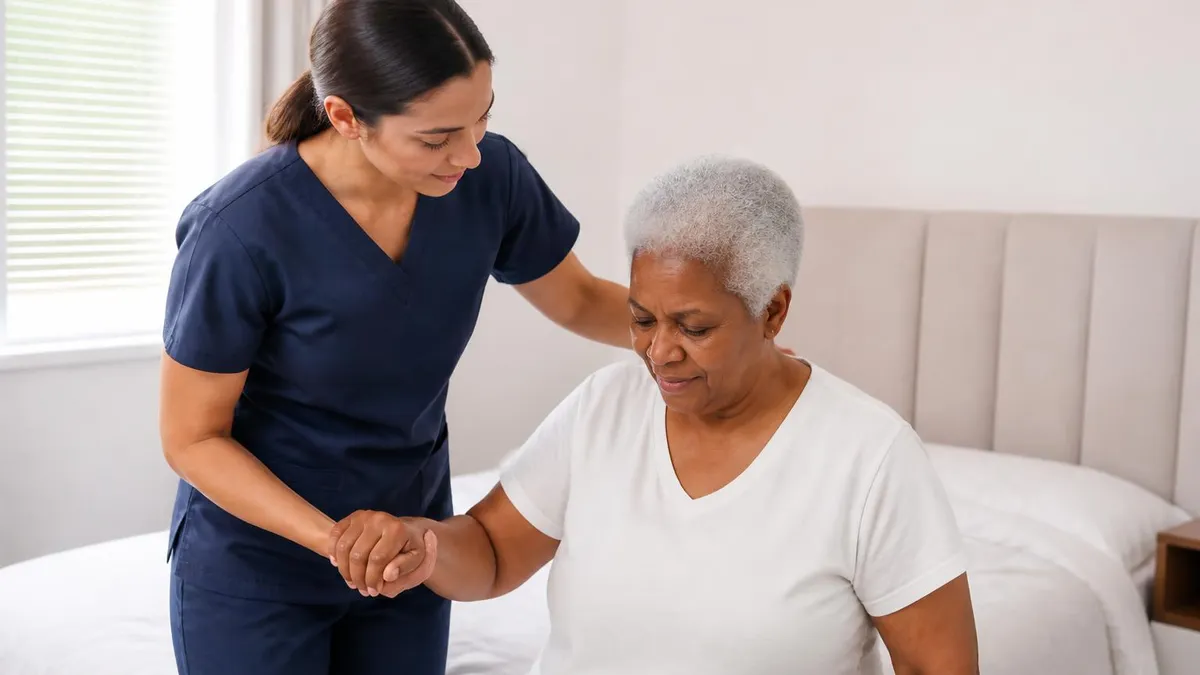
PCA Nurse: Complete Guide to the Personal Care Assistant Role in Modern Nursing Teams

PCA Agencies Near Me: How to Find, Evaluate, and Choose a Local Personal Care Assistant Agency in 2026
PCA - Personal Care Assistant: Career Paths, Salary, and Requirements 2026
About the Author

Registered Nurse & Healthcare Educator
Johns Hopkins University School of NursingDr. Sarah Mitchell is a board-certified registered nurse with over 15 years of clinical and academic experience. She completed her PhD in Nursing Science at Johns Hopkins University and has taught NCLEX preparation and clinical skills courses for nursing students across the United States. Her research focuses on evidence-based exam preparation strategies for healthcare certification candidates.