
PA Boating License: Requirements, Cost & How to Get Certified 2026 July
Pass your PA Boating License: 💡 Requirements, Cost exam on the first attempt. Practice questions with detailed answer explanations, hints, and instant
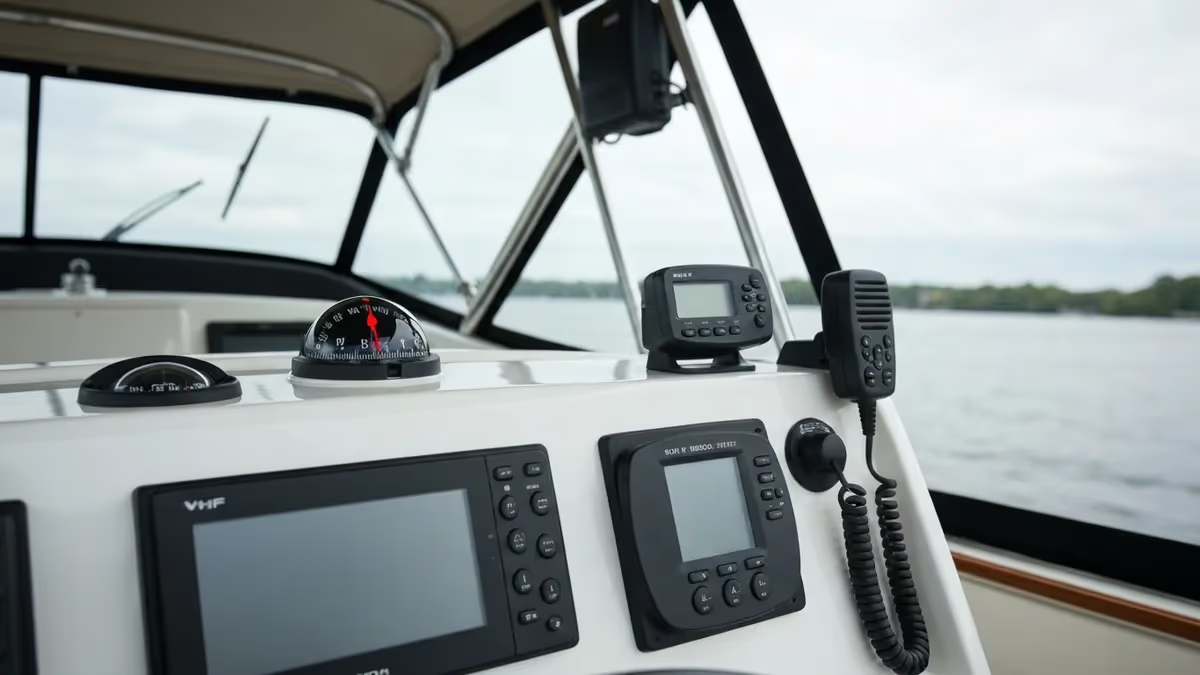
PA Boating License: What the State Actually Requires
Pennsylvania requires a Boating Safety Certificate — commonly called a boating license requirements — for anyone born on or after January 1, 1982 who operates a motorized vessel on PA waters. The certificate is administered by the Pennsylvania Fish & Boat Commission (PFBC) and has no expiration date. Once earned, it's yours for life.
To get your boat license, you must complete a NASBLA-approved boating safety course. Pennsylvania accepts three delivery formats:
- Online course — self-paced, available through PFBC-approved providers such as Boat-Ed and BoaterExam
- In-person classroom course — typically one or two days, offered by PFBC-certified instructors statewide
- Home-study course — printed materials with a proctored final exam
All formats require passing a final exam (minimum score varies by provider but is typically 75–80%). There is no state-administered written test separate from the course exam. Course fees range from $20 to $45 depending on format and provider.
Because the certificate is NASBLA-approved, it satisfies the boating license requirement in most neighboring states — including New York, New Jersey, Maryland, Virginia, Connecticut, New Hampshire, and Massachusetts — under mutual reciprocity agreements. This matters for boaters who cross state lines on the Delaware River, Chesapeake Bay tributaries, or coastal waterways.
This guide covers all seven Mid-Atlantic and New England states in detail: age cutoffs, exam formats, coastal versus freshwater rules, PWC endorsement requirements, and exactly where PA reciprocity holds — and where it doesn't.
State-by-State Boating License Requirements: PA, NJ, MD, VA, CT, NH & MA Compared
Minimum operator age: PA: 12 years old to operate a motorboat; under 16 must be supervised by an adult aboard. NJ: 16 years old to operate a powerboat unsupervised; under 16 requires a licensed adult on board.
Birth-year cutoff: PA: born on or after Jan 1, 1982 must carry a boating safety certificate. NJ: born on or after Sept 1, 1978 must hold a NJ Boating Safety Certificate — a broader cutoff that captures more operators.
Online course accepted: Yes for both states. PA accepts PFBC-approved providers (Boat-Ed, BoaterExam). NJ accepts NJDEP-approved online courses. Both require a proctored final exam to receive the certificate.
In-person PWC skills requirement: PA: no in-water skills test required for any vessel class. NJ: mandates a hands-on in-water PWC skills component before a PWC endorsement is issued — PA reciprocity does NOT satisfy this NJ requirement.
Reciprocity with PA: Full reciprocity: a valid PA PFBC boating safety certificate is accepted in NJ for motorboat operation. Exception: NJ's PWC endorsement requires the in-water skills test regardless of PA certificate status.
Do You Need a Boating License? Age Cutoffs, Exemptions & Who's Required
- ✓PWC operators in all 7 states must be certified — no adult exemption exists
- ✓Do you need a license to drive a boat? Check your state's birth-year cutoff first
- ✓Unpowered vessels (canoes, kayaks) and sailboats under 10 HP are exempt in PA, NJ, MD, CT
- ✓Operators under direct supervision of a certified adult are exempt — supervisor must carry certificate onboard
- ✓Do you need a boating license for rentals? Yes — marinas require certification or a signed safety waiver
- ✓Commercial charter passengers are exempt — captain's license covers the vessel, not individual riders
- ✓Do you need license to operate a boat over 10 HP without a birth-year cutoff? Check NH and MA age rules
- ✓Verify HP threshold and age mandate for your state before launching any motorized vessel
PA Pros and Cons
- +Understanding the full cost structure — exam fees, study materials, retakes, renewal — enables accurate financial planning
- +Many states, employers, and professional associations offer partial or full reimbursement for certification costs
- +Free and library-accessible study resources can significantly reduce preparation costs without sacrificing quality
- +Early investment in quality preparation materials typically reduces the total cost by avoiding costly retakes
- +Certification ROI in salary increases often recoups the total investment within 1–2 years in most markets
- −Total costs including study materials, exam fees, and time investment are typically 2–3x the exam fee alone
- −Fee assistance availability varies widely by employer, state, and professional organization — not universally accessible
- −Cost increases over time as credentialing bodies raise fees — delaying creates additional financial pressure
- −Retake fees (often 50–100% of original exam fee) make first-attempt failure significantly more expensive than budgeted
- −Hidden costs such as study group memberships, supplementary resources, and exam prep services add up quickly
Boating License Test Questions and Answers
More Boating License Test Resources
Alabama Boating License — Requirements, Cost & How to Get One
Do You Need a License to Drive a Boat? State-by-State Guide 2026
Florida Boating License: Requirements & How to Get One
Tennessee Boating License & Midwest States Guide
Ohio Boating License 2026 — Requirements, Age & How to Get One
NYS Boating License 2026 — New York Requirements, Age & How to Get One
About the Author
Master Mariner & Maritime Certification Specialist
Massachusetts Maritime AcademyCaptain David Harrington is a US Coast Guard licensed Master Mariner with a Bachelor of Science in Marine Transportation from Massachusetts Maritime Academy. He has 22 years of deep-sea and coastal navigation experience aboard commercial vessels and specializes in preparing maritime candidates for USCG licensing exams, STCW certification, dynamic positioning (DPO), and officer-of-the-watch qualifications.
Join the Discussion
Connect with other students preparing for this exam. Share tips, ask questions, and get advice from people who have been there.
View discussion (6 replies)