
OAT Study Materials: Best OAT Study Guide Resources (2026 October)
Get ready for your OAT Study Materials: Best OAT Study certification. Practice questions with step-by-step answer explanations and instant scoring. 📚
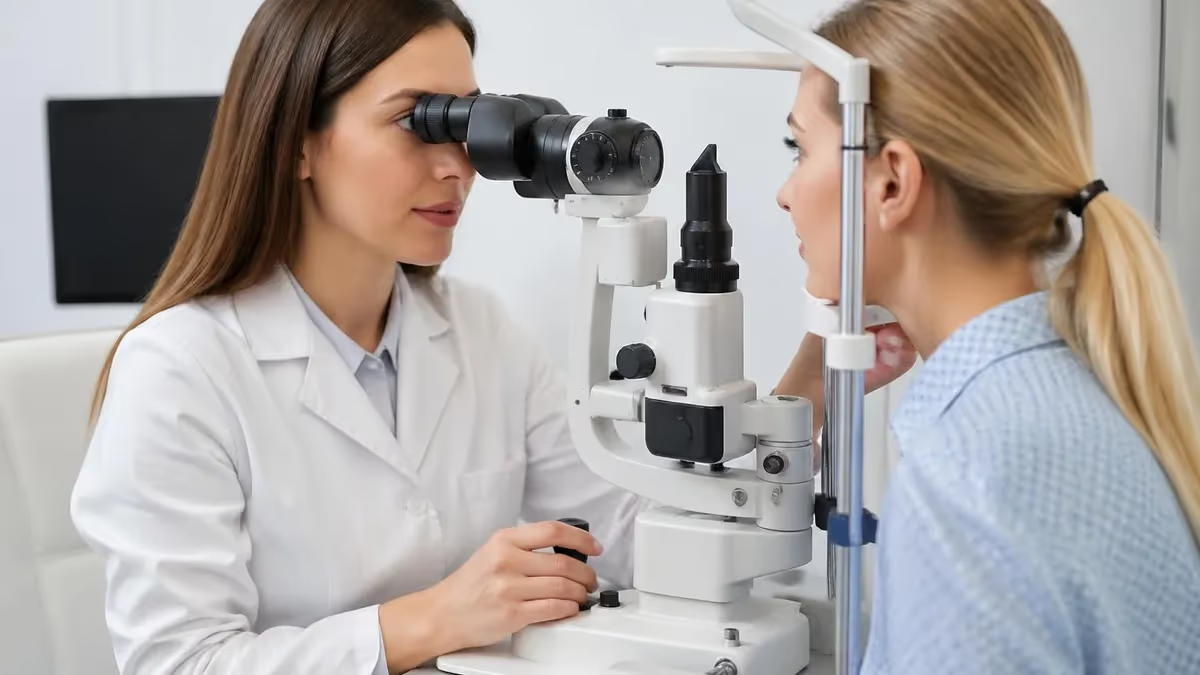
OAT Study Materials: What Works and How to Use It
The OAT (Optometry Admission Test) is administered by the ADA (American Dental Association, which also administers the DAT) and tests six sections: Survey of Natural Sciences (Biology, General Chemistry, Organic Chemistry), Physics, Reading Comprehension, and Quantitative Reasoning. Unlike the MCAT, which has extensive official preparation materials from the AAMC, OAT-specific resources are more limited -- a smaller pool of test-takers means fewer dedicated commercial prep products. This makes the choice of study materials more consequential; using the right resources efficiently matters more than relying on a high volume of average-quality materials. The best OAT study approach combines a comprehensive review guide with a quality practice question bank and section-specific resources for the sections requiring the most individual preparation (typically physics and organic chemistry).
OAT Bootcamp is widely considered the gold standard for OAT-specific practice questions, with a question bank designed specifically for the OAT's content and format. Bootcamp includes full-length OAT practice exams, section-specific question sets, and score reporting that identifies performance patterns by content area. For candidates choosing a single premium resource, OAT Bootcamp delivers the most OAT-specific value. Kaplan OAT is the other major commercial review book, covering all sections with content review plus practice questions; it is more widely available in print and at libraries. OAT Cracker is a community-developed resource that many pre-optometry students rate highly for its concise, high-yield content summaries. Reviewing OAT general chemistry questions and answers covers the stoichiometry, equilibrium, acid-base, electrochemistry, and thermodynamics content that makes up the largest single subject in the Survey of Natural Sciences section. Practicing with OAT biology practice tests covers the genetics, cell biology, physiology, and evolution content that OAT biology tests in greater depth and obscurity than most comparable health professional admissions exams.
For physics, OAT candidates face the distinctive challenge that optometry's focus on vision science means the OAT emphasizes optics and waves more heavily than physics courses or MCAT physics preparation typically does. Geometric optics (lens and mirror equations, refraction and reflection, image formation), wave properties (wavelength, frequency, amplitude, interference, diffraction), and optics calculations are essential content. Candidates who took physics years ago or who never covered optics in depth need dedicated optics review before the OAT -- this is the single most common area of OAT physics surprise. Khan Academy's optics content is freely available and covers the conceptual foundations thoroughly. Supplementing Khan Academy with OAT-specific optics practice questions builds the problem-solving speed the timed exam requires. Reviewing OAT physics optics and waves questions and answers targets the most heavily tested physics content area on the OAT exam. Working through OAT physics principles questions and answers covers kinematics, mechanics, electricity, and the full breadth of physics content the OAT tests beyond optics.
Section-by-Section Study Resource Guide
Biology preparation for the OAT requires depth and breadth that surprises many candidates. OAT biology questions test specific details about organelle functions, enzyme cofactors, hormonal regulation, and developmental biology stages at a level of specificity beyond what general MCAT biology preparation covers. The most effective biology preparation combines a high-yield review of major body systems and cellular processes with targeted practice questions that reveal which specific details are actually tested. Anki flashcard decks created by pre-optometry students (available on AnkiWeb) cover OAT biology high-yield facts efficiently and allow spaced repetition review alongside content study. Reviewing OAT cell and molecular biology questions and answers covers DNA replication, transcription, translation, gene regulation, and cellular processes that generate multiple OAT biology questions. Practicing with OAT general biology questions and answers covers the full breadth of OAT biology content including ecology, evolution, and diversity of life that rounds out the biology survey section.

- ✓Confirm your exam appointment and location
- ✓Bring required identification documents
- ✓Arrive 30 minutes early to check in
- ✓Read each question carefully before answering
- ✓Flag difficult questions and return to them later
- ✓Manage your time — don't spend too long on one question
- ✓Review flagged questions before submitting
OAT Overview
- Free: Khan Academy — covers biology, chemistry, physics, and math at the level the OAT tests; excellent for concept building and optics review; no OAT-specific question practice
- Free: Reddit pre-optometry communities — r/PreOptometry and similar communities share study timelines, resource recommendations, and Anki decks from recent test-takers; highly valuable for current candidate perspectives
- Free: ADA practice test — the official OAT practice test provides the most authentic question experience; limited question count but essential for understanding actual OAT formatting
- Paid: OAT Bootcamp (~$199) — the most highly recommended OAT-specific resource for practice questions and full-length exams; subscription-based access
- Paid: Kaplan OAT (~$50–70) — comprehensive review book available in print and digital; widely available at libraries; good content coverage with practice questions included

Choosing the Right OAT Study Materials for Your Situation
The best OAT study materials are the ones that match your specific weaknesses and learning style. A candidate with a strong biology background who struggles with physics needs different materials than a physics-strong pre-optometry student who hasn't done organic chemistry in three years. Self-assessment before purchasing study materials helps focus spending on what will actually improve performance. Start by reviewing the OAT content outline (available from ADA) and honestly rating your current confidence in each content area. The areas you rate lowest should receive the most study time and the most targeted supplemental resources. Reviewing OAT organic chemistry questions and answers covers the reaction types and mechanism knowledge that OAT organic chemistry tests and that most candidates find requires the most active review relative to other sections. Working through OAT quantitative reasoning and math questions and answers covers the algebra, geometry, and applied math content in the quantitative reasoning section, which is often underestimated as a preparation area by science-strong candidates.
Study groups with other OAT candidates can provide accountability, question explanation support, and access to shared resources. Student Doctor Network's optometry forums, Reddit's r/PreOptometry community, and optometry school Discord servers connect pre-optometry students who are preparing for the OAT, share resource recommendations based on recent test experiences, and support each other through the preparation process. These community resources are particularly valuable for OAT candidates because the pool of commercial prep materials is smaller than for the MCAT, and peer insights about what specific sections looked like on a recent test date are genuinely informative. The preparation investment for the OAT -- whether it costs $50 in a library Kaplan book or $500 in a full Bootcamp subscription -- is small relative to the optometry school application it enables. Choosing materials that match your needs, using them consistently and actively, and testing yourself regularly throughout the preparation period gives you the best chance of reaching the 320+ OAT score that competitive optometry programs expect.
For candidates who are early in their pre-optometry journey and choosing courses, understanding that OAT biology tests cell and molecular biology in significant depth is important for course selection. Courses in cell biology, genetics, and molecular biology beyond a single introductory biology sequence prepare candidates better for the OAT than breadth-focused biology electives. Similarly, taking physics with a lab (or a physics course that covers optics extensively) is more valuable OAT preparation than a physics course that focuses on mechanics only. Reviewing OAT cell and molecular biology questions and answers covers the cellular and molecular content that appears throughout OAT biology and that rewards specific factual knowledge about cell processes. Practicing with OAT general biology questions and answers covers the ecology, evolution, and diversity content alongside the cellular content that completes OAT biology preparation. Candidates who invest seriously in OAT preparation -- with the right materials, a realistic timeline, and consistent daily practice -- give themselves the best chance of achieving the competitive scores that open doors to the optometry programs that match their career goals.
OAT Pros and Cons
- +Focused content scope — OAT tests a defined set of science and math content aligned to pre-health prerequisites; candidates with recent coursework can use classroom knowledge directly
- +Lifetime validity of OAT scores — OAT scores are valid for the application cycle in which they are used; retaking to improve scores is possible and straightforward
- +Study materials available for free — Khan Academy, Reddit communities, Anki decks, and the official ADA practice test provide substantial OAT preparation at no cost
- +Predictable content structure — the OAT blueprint is publicly available and stable; preparation can be systematically aligned to the exact content and weighting tested
- +Optometry-relevant content — the physics optics emphasis means OAT preparation directly builds knowledge relevant to optometry school coursework and clinical practice
- −Limited OAT-specific commercial resources — compared to the MCAT or DAT, fewer publishers offer OAT-dedicated study materials; candidates rely more on community-recommended resources than official prep products
- −Physics optics requires specific preparation — most general physics courses and MCAT physics prep de-emphasize optics; OAT candidates need dedicated optics study that their coursework may not have provided
- −Biology depth requirement — OAT biology tests specific facts at a depth that surprises candidates who prepared for other admissions tests; the specificity requires more active memorization than conceptual understanding alone provides
- −Relatively high cost of quality resources — OAT Bootcamp subscription runs approximately $200; for candidates on tight budgets, assembling a complete preparation package requires creative use of free and library resources
- −Small test-taker community — the pre-optometry community is smaller than pre-med or pre-dental; fewer peer resources, fewer study partner options, and less commercial investment in OAT preparation tools compared to larger test markets
Sample OAT - Optometry Admission Test Practice Questions
Try these questions from our free OAT - Optometry Admission Test practice tests. The correct answer and an explanation follow each question.
In a group of 50 students, 30 study French and 20 study Spanish. If 10 study both, how many study neither?
- A. 10
- B. 5
- C. 15
- D. 0
Answer: A. 10
Using inclusion-exclusion: French ∪ Spanish = 30 + 20 − 10 = 40; neither = 50 − 40 = 10.
A passage describes a cohort study following 500 optometry students over 10 years to track myopia progression. The key feature that distinguishes a cohort study from a case-control study is:
- A. Participants are selected based on exposure status and followed forward in time for outcomes
- B. Participants are selected based on whether they already have the disease
- C. Participants are randomly assigned to treatment or control groups
- D. The study compares outcomes at a single point in time
Answer: A. Participants are selected based on exposure status and followed forward in time for outcomes
Cohort studies select based on exposure and follow subjects prospectively, whereas case-control studies start with disease status and look backward.
An OAT reading passage compares two studies on intraocular pressure. The first study concludes pressure increases with age; the second finds no such correlation. What is the BEST characterization of the passage's purpose?
- A. To prove that intraocular pressure does not change with age
- B. To present conflicting evidence and highlight an unresolved scientific question
- C. To argue that the first study is superior in methodology
- D. To discourage further research into intraocular pressure
Answer: B. To present conflicting evidence and highlight an unresolved scientific question
Presenting two contradictory studies signals that the passage aims to illustrate ongoing scientific debate rather than establish a definitive conclusion.
A passage explains that a study used a 'washout period' of two weeks between treatment phases in a crossover design. The purpose of the washout period is to:
- A. Allow effects of the first treatment to dissipate before starting the second treatment
- B. Recruit additional participants between study phases
- C. Measure baseline values before any treatment begins
- D. Ensure that researchers are blinded to previous results
Answer: A. Allow effects of the first treatment to dissipate before starting the second treatment
Washout periods in crossover designs prevent carryover effects from the first intervention influencing outcomes in the second phase.
OAT Questions and Answers
About the Author
Educational Psychologist & Academic Test Preparation Expert
Columbia University Teachers CollegeDr. Lisa Patel holds a Doctorate in Education from Columbia University Teachers College and has spent 17 years researching standardized test design and academic assessment. She has developed preparation programs for SAT, ACT, GRE, LSAT, UCAT, and numerous professional licensing exams, helping students of all backgrounds achieve their target scores.
Join the Discussion
Connect with other students preparing for this exam. Share tips, ask questions, and get advice from people who have been there.
View discussion (8 replies)