
USF Nurse Practitioner Program: Complete 2026 July Guide to Admissions, Tracks, Costs, and Clinical Training
USF nurse practitioner program guide: 📚 admissions, MSN/DNP tracks, tuition, clinical hours, GPA, and how to apply. Updated 2026 July requirements.
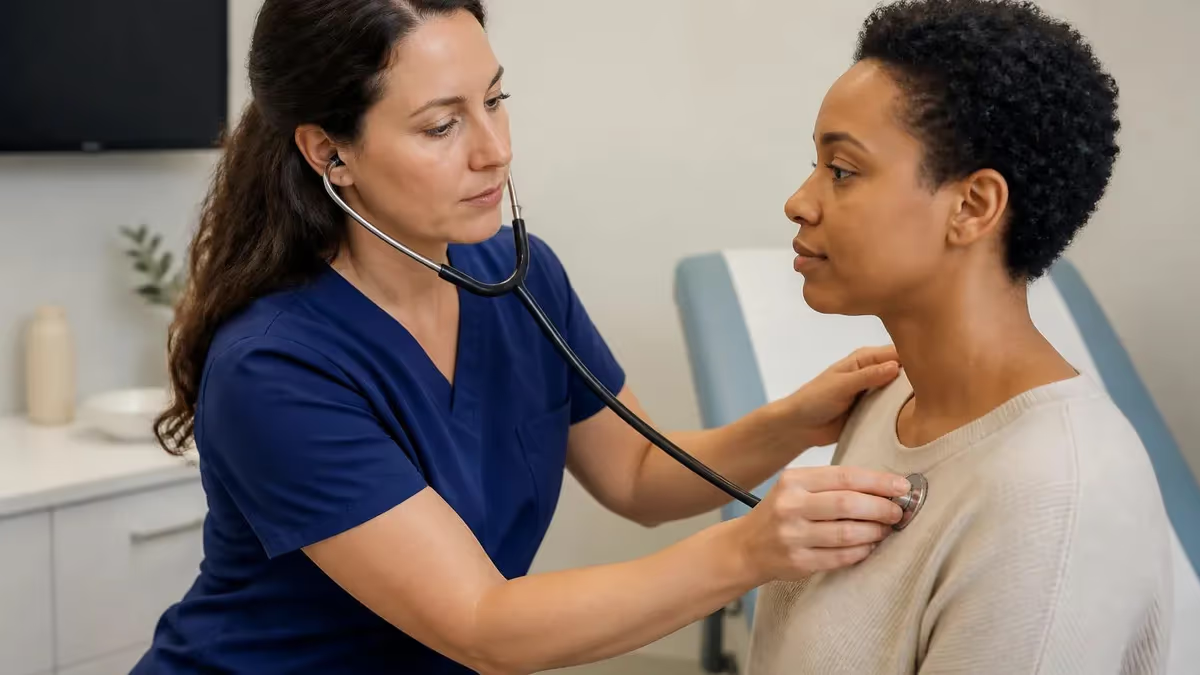
The USF nurse nurse practitioner program at the University of South Florida College of Nursing has become one of the Southeast's most recognized pathways into advanced practice, blending Tampa Bay's high-acuity clinical environment with rigorous didactic coursework and faculty who are active in research, policy, and nurse p. If you are weighing where to apply for your MSN or DNP, USF deserves a careful look — both for its specialty breadth and for its consistent NCLEX-aligned graduate outcomes that translate into strong national board certification pass rates.
USF offers multiple advanced practice tracks under its graduate umbrella, including Family Nurse Practitioner, Adult-adult gerontology acute care nurse practitioner, Adult-Gerontology Primary Care, Pediatric Primary Care, psychiatric mental health nurse practitioner, and nurse practitioner program concentrations. Some are offered as terminal MSN degrees, while others funnel directly into a BSN-to-DNP pathway. Each track aligns with AACN Essentials and NONPF competencies, so coursework maps cleanly to the certification exam blueprints from ANCC and AANPCB.
Beyond curriculum, USF stands out for clinical placement infrastructure. Students rotate through Tampa General Hospital, Moffitt Cancer Center, James A. Haley Veterans' Hospital, and a network of federally qualified health centers across Hillsborough and Pinellas counties. That diversity matters: applicants frequently underestimate how much clinical site quality shapes their preparedness for boards and their first NP job. For a fuller breakdown of how an NP degree fits into your overall career math, see our Nurse Practitioner Degree: Complete Guide to NP Education Path.
This guide walks through every component of the USF NP application — minimum GPA, required prerequisites, recommended RN experience, the timing of the application cycle, tuition for Florida residents versus non-residents, and the structure of clinical hours by specialty. We will also compare USF to peer Florida programs (UF, FSU, FAU) so you can make an evidence-based decision rather than picking based on rankings alone.
USF's program is hybrid by design. Most didactic content is delivered online with synchronous components, but clinical immersions, intensives, and certain skills labs require on-campus attendance in Tampa. That matters if you are applying from out of state — you will need to budget for periodic travel even in tracks marketed as "online." Read the immersion schedule carefully before committing.
Admissions are competitive but not impossible. The College of Nursing typically admits cohorts of 30 to 80 students per track depending on faculty capacity, and the average admitted GPA sits around 3.5. Applicants with two years of acute care RN experience, leadership or charge nurse roles, and clear specialty-aligned essays consistently rise to the top of the pile.
By the end of this article you will know exactly which USF track fits your career goals, what your application timeline should look like, how much the degree will actually cost after fees, and how to position your candidacy if your GPA or experience falls below the published averages. Let's get into the specifics.
USF Nurse Practitioner Program by the Numbers

USF Nurse Practitioner Specialty Tracks
Lifespan primary care covering pediatrics through geriatrics. Offered as both MSN and BSN-to-DNP. Largest cohort at USF with 720+ clinical hours and a focus on chronic disease management in underserved Florida communities.
High-acuity inpatient track preparing graduates for ICU, step-down, and hospitalist roles. Heavy clinical rotation at Tampa General Hospital. Requires 1+ year acute care RN experience for admission, no exceptions.
Lifespan mental health track with strong psychopharmacology emphasis. Rotations include James A. Haley VA, community mental health centers, and integrated primary care. Highly competitive — typically 40 applicants per 20 seats.
Outpatient adult and elder care focused on chronic disease, preventive medicine, and complex polypharmacy. Strong fit for nurses moving from med-surg or telemetry into ambulatory practice.
Highly specialized track for Level III and IV NICU practice. Requires 2 years of NICU RN experience. Smallest cohort but extremely strong placement outcomes statewide.
USF's admissions process is transparent on paper but layered in practice. The minimum stated GPA is 3.0 on the last 60 credit hours of your BSN, but the median admitted student arrives with a 3.5 or higher. If your GPA is below 3.3, you will need to compensate with strong RN experience, leadership credentials, a high-quality personal statement, and ideally a graduate-level course or two (such as advanced statistics or pathophysiology) completed as a non-degree-seeking student to demonstrate academic readiness.
A current, unencumbered RN license is mandatory. Florida licensure is preferred, but USF accepts compact state licenses provided you can obtain a Florida license before clinical rotations begin. Out-of-state applicants from non-compact states should plan for a 6-to-12-week endorsement process — start that paperwork the moment you are admitted, not after orientation.
Clinical experience expectations vary sharply by track. FNP and AGPCNP applicants are typically admitted with 1 to 2 years of RN experience, with primary care, community health, or med-surg backgrounds preferred. AGACNP requires demonstrable acute care experience — applicants from rehab, school nursing, or outpatient clinics are routinely denied regardless of GPA. NNP requires 2 years of NICU experience, and PMHNP strongly prefers psychiatric or behavioral health backgrounds.
Prerequisite coursework includes undergraduate health assessment, pathophysiology, pharmacology, and statistics. If any of these are older than five to seven years, USF may require a refresher or a graduate-level repeat. Letters of recommendation — typically three — should come from a combination of clinical supervisors, BSN faculty, and an APRN or physician who has directly observed your practice. Generic HR-style letters are easy to spot and weaken your application.
The personal statement is where most applicants underperform. USF wants specificity: which patient population, which clinical problem, which underserved community, and why now. Vague essays about "wanting to help people" do not survive committee review. The strongest essays connect a specific patient story to a measurable career goal tied to USF's mission of serving Florida's medically underserved.
An on-campus or virtual interview is required for most tracks. PMHNP, NNP, and AGACNP almost always interview; FNP and AGPCNP sometimes interview only borderline candidates. Interview questions blend behavioral ("tell me about a time you advocated for a patient") with clinical reasoning vignettes appropriate to your prior RN role. Practice with mock scenarios — the difference between a strong and weak interview is preparation, not raw intelligence. For a broader view of how USF compares to other Florida programs, browse our Nurse Practitioner Specialties: Complete 2026 Guide to Every NP Track.
Application deadlines vary by track and entry term. Most tracks open in September with a January 15 deadline for fall admission. Some specialties accept summer or spring starts. Late applications are reviewed only if seats remain after the priority round — competitive applicants always submit by the priority deadline. CASPA-equivalent supplemental documents must reach the College of Nursing within two weeks of your initial application or it will be marked incomplete.
NP Practice Test Questions
Prepare for the NP - Nurse Practitioner exam with our free practice test modules. Each quiz covers key topics to help you pass on your first try.
NP Adult-Gerontology Acute Care Nurse Prac...
NP Exam Questions covering Adult-Gerontology Acute Care Nurse Practitioner. Master NP Test concepts for certification prep.
NP Family Nurse Practitioner
Free NP Practice Test featuring Family Nurse Practitioner. Improve your NP Exam score with mock test prep.
NP Pediatric Nurse Practitioner
NP Mock Exam on Pediatric Nurse Practitioner. NP Study Guide questions to pass on your first try.
NP Case Studies & Practical Application
NP Test Prep for Case Studies & Practical Application. Practice NP Quiz questions and boost your score.
NP Communication & Stakeholder Relations
NP Questions and Answers on Communication & Stakeholder Relations. Free NP practice for exam readiness.
NP Diagnosis & Clinical Decision-Making
NP Mock Test covering NP Diagnosis & Clinical Decision-Making. Online NP Test practice with instant feedback.
NP Patient Education & Health Promotion
Free NP Quiz on NP Patient Education & Health Promotion. NP Exam prep questions with detailed explanations.
NP Pharmacology & Prescribing
NP Practice Questions for NP Pharmacology & Prescribing. Build confidence for your NP certification exam.
NP Professional Standards & Competencies
NP Test Online for Professional Standards & Competencies. Free practice with instant results and feedback.
NP Quality Control & Assurance
NP Study Material on Quality Control & Assurance. Prepare effectively with real exam-style questions.
NP Regulatory Frameworks & Compliance
Free NP Test covering Regulatory Frameworks & Compliance. Practice and track your NP exam readiness.
NP Research & Evidence-Based Practice
NP Exam Questions covering Research & Evidence-Based Practice. Master NP Test concepts for certification prep.
USF Nurse Practitioner Program Tuition & Financial Aid
Florida residents pay approximately $431 per credit hour for graduate nursing coursework at USF as of the 2026 academic year. A typical MSN-NP track runs 45 to 51 credits, putting total tuition between $19,400 and $22,000 before fees. Add roughly $2,500 in technology, clinical placement, malpractice insurance, and certification preparation fees across the program duration.
The BSN-to-DNP pathway adds 30 to 40 additional credits beyond the MSN core, bringing total cost of attendance to roughly $35,000 to $40,000 for in-state students. That is meaningfully lower than comparable private programs in the Southeast, which often exceed $80,000. Residency is determined by Florida statute — establish residency at least 12 months before applying if you are relocating.

USF Nurse Practitioner Program: Pros and Cons
- +Strong board certification pass rates across all NP specialty tracks consistently above national averages
- +Tampa Bay clinical sites including Tampa General, Moffitt Cancer Center, and James A. Haley VA
- +Affordable in-state tuition compared to private and out-of-state competitors in the Southeast
- +Hybrid delivery balances online flexibility with required on-campus clinical immersions
- +Six robust specialty tracks including the rare NNP option not offered at many Florida schools
- +Active faculty research in primary care, mental health, and chronic disease management
- +Strong alumni network across Florida health systems supporting first-job placement
- −Required on-campus immersions create travel burden for out-of-state applicants
- −Out-of-state tuition is roughly 2.5x in-state, making cost prohibitive without residency
- −Highly competitive admissions for PMHNP, NNP, and AGACNP tracks with limited seats
- −Clinical placement is partially student-driven — applicants must help secure preceptors
- −Florida endorsement licensure delays from non-compact states can affect rotation timing
- −Limited evening and weekend synchronous class options for working full-time RNs
- −BSN-to-DNP pathway is lengthy (typically 4 years part-time) compared to terminal MSN
USF Nurse Practitioner Program Application Checklist
- ✓Confirm minimum 3.0 GPA on last 60 BSN credit hours, ideally 3.5 for competitive standing
- ✓Hold current unencumbered RN license in Florida or a compact state with endorsement plan
- ✓Document one to two years of specialty-aligned RN clinical experience with verifiable hours
- ✓Complete prerequisite coursework: health assessment, pathophysiology, pharmacology, and statistics
- ✓Request three strong letters of recommendation from clinical supervisors and BSN faculty
- ✓Draft a specialty-specific personal statement tied to a measurable patient population goal
- ✓Update your CV with leadership roles, charge nurse experience, certifications, and committee work
- ✓Order official transcripts from every post-secondary institution attended, including community colleges
- ✓Submit your USF graduate application and supplemental College of Nursing materials before January 15
- ✓Prepare for a virtual or on-campus interview with mock behavioral and clinical reasoning questions
Apply early in the cycle — not at the deadline
USF reviews applications on a rolling basis even within the priority window. Submitting in October or November rather than mid-January gives the committee more time to engage with your file and frequently results in earlier interview invitations. Late submissions, even those technically within the priority deadline, compete for fewer remaining seats and weaker preceptor matching.
Clinical training is where USF earns its national reputation. The College of Nursing maintains formal affiliation agreements with more than 200 clinical sites across Florida, with the densest network in Hillsborough, Pinellas, Pasco, and Polk counties. That density matters because preceptor competition is the single largest threat to on-time NP graduation nationally — programs with thin clinical networks force students to scramble for placements, delaying graduation by a semester or more.
FNP students complete approximately 720 to 750 supervised clinical hours across primary care settings: family medicine offices, community health centers, urgent care, and select specialty rotations such as women's health and pediatrics. AGACNP students complete a similar hour count but concentrated in inpatient and critical care environments — ICUs, step-down units, hospitalist services, and emergency departments.
PMHNP rotations span outpatient psychiatry, inpatient behavioral health units, addiction medicine, and integrated primary care behavioral health (PCBH) sites. The variety is intentional: graduates leave prepared for the full scope of psychiatric practice rather than only office-based medication management. Pediatric primary care students rotate through community pediatric practices, school-based health, and developmental clinics.
USF uses a hybrid placement model. The College of Nursing's clinical placement office handles the bulk of primary site coordination, but students are expected to identify and propose at least one preceptor from their own professional network. This requirement catches many applicants off guard — start cultivating preceptor relationships during your RN years if you can. A simple email to NPs at your workplace asking about future precepting can pay enormous dividends later.
Preceptors must be board-certified APRNs or physicians with at least one year of np independent practice, and they must complete a USF preceptor onboarding packet. The college pays preceptors a modest honorarium per student per semester, which improves recruitment but does not guarantee placement. Plan to be flexible on location — a 60-mile commute for a strong clinical experience is far more valuable than a nearby placement with a disengaged preceptor.
On-campus immersions occur two to three times per year depending on track, typically lasting two to four days in Tampa. These cover advanced physical assessment skills, suturing, procedural training, simulation lab scenarios, and standardized patient encounters. They are mandatory and non-negotiable — missing an immersion can delay progression by a full semester. Plan your work schedule accordingly and request PTO months in advance.
Capstone or scholarly project requirements differ between the MSN and DNP routes. MSN students complete a synthesis project; DNP students complete a full quality improvement scholarly project, typically tied to a clinical site. The DNP project takes two to three semesters and requires IRB-equivalent approval, faculty mentorship, and a public presentation. Start brainstorming your project topic during the first didactic semester — late starters routinely struggle.

Florida APRN licensure is separate from your RN license and requires national board certification plus a state application. Processing currently takes 6 to 12 weeks. Do not accept a job offer with a start date before your APRN license is reasonably expected to be issued — many graduates lose offers by underestimating this timeline.
USF's NP graduates consistently achieve first-attempt board certification pass rates above 90 percent across most specialties, with several recent cohorts exceeding 95 percent. These figures hold across the ANCC and AANPCB exam boards and across all six specialty tracks. Strong pass rates are not coincidence — they reflect curriculum mapped tightly to certification blueprints, frequent low-stakes formative assessments, and a culture of board prep that begins in the first didactic course rather than the final semester.
Post-graduation employment outcomes mirror the strength of the pass rate data. The College of Nursing reports that more than 95 percent of NP graduates are employed within six months of board certification, with the majority placed in Florida. Common employers include BayCare Health System, Tampa General, AdventHealth, HCA Florida, the Veterans Health Administration, and federally qualified health centers across the Tampa Bay and Orlando metros.
Salaries for USF graduates align with national medians, with FNPs starting around $105,000 to $115,000 in primary care and AGACNPs starting $115,000 to $130,000 in acute care. PMHNPs frequently command higher starting offers — $130,000 to $145,000 in Florida — due to severe national psychiatric workforce shortages. For a detailed look at psychiatric NP compensation, see our Mental Health Nurse Practitioner Salary: 2026 Pay, Bonuses, Setting Breakdowns, and How to Earn More as a PMHNP.
USF maintains an active alumni network through the College of Nursing's professional development office. Alumni mentor current students, refer them for job opportunities, and frequently return as preceptors. The network is dense in Florida and increasingly visible nationally through the Florida Association of Nurse Practitioners (FLANP) and the American Association of Nurse Practitioners (AANP). Attend at least one FLANP conference during your program — networking pays dividends for years.
Florida is currently a reduced-practice state for NPs, meaning some prescriptive authority and practice elements require physician collaboration agreements. Legislative efforts toward full practice authority are ongoing, but the current environment still favors hospital-based and large practice employment over solo or small independent practice. Plan your career trajectory with that regulatory context in mind, especially if independent practice is a long-term goal.
Continuing education and recertification requirements vary by certifying board. ANCC requires 75 contact hours every five years plus an active practice requirement; AANPCB requires 100 contact hours plus 1,000 practice hours every five years. USF offers continuing education programming for alumni at discounted rates — keep that in mind when budgeting your post-graduation professional development.
Doctor of Nursing Practice (DNP) graduates leave with credentials that increasingly matter as the profession debates entry-to-practice requirements. While the MSN is still acceptable for board certification today, the long-term direction across academia and major health systems favors the DNP. If you are early in your career and have the time and financial bandwidth, the BSN-to-DNP pathway may offer better career durability than a terminal MSN.
Practical preparation for the USF NP application begins 12 to 18 months before your intended start date. The single most common preventable mistake is rushing the timeline — applicants who start the process in November for a January 15 deadline almost universally submit weaker materials than those who started in the spring of the prior year. Build a realistic Gantt chart of your application milestones and work backward from the deadline.
Start with your transcripts. Order them from every institution, even community colleges where you took a single prerequisite course a decade ago. USF will catch omissions during verification and your file will be flagged. Send transcripts six weeks before the deadline — they routinely take three to four weeks to arrive and verify, and any errors require a second order cycle.
Next, tackle your personal statement in drafts. Write a rough first draft three months out, set it aside for two weeks, then return with fresh eyes. Share drafts with two to three people: at least one practicing NP in your target specialty and one strong writer who is not in healthcare. The NP catches clinical credibility issues; the writer catches structure and clarity issues. Both perspectives are essential.
Request letters of recommendation early — at least eight weeks before the deadline. Send your recommenders a brief packet: your CV, your draft personal statement, the specific track you are applying to, and three bullet points you would like them to highlight. Strong letters require strong inputs. Generic letters written from scratch the night before submission read as exactly that.
Prepare for the interview as if it were a clinical exam. Practice answering behavioral questions using the STAR framework (situation, task, action, result), and prepare two to three clinical vignette responses drawn from your RN role. Common USF interview questions include: describe a time you advocated for a patient against a physician decision; describe a clinical mistake and what you learned; why this specialty over a related one; and what unique perspective you bring to the cohort.
Plan your finances early. Estimate total cost of attendance — tuition, fees, books, technology, immersion travel, and lost income if you reduce work hours — and build a written budget. Apply for every scholarship for which you are remotely eligible. Even small awards reduce loan principal and accrued interest. For a broader view of NP career economics across geographies, see our Nurse Practitioner Jobs by State: Florida, Texas, California, and Beyond — A Complete 2026 Guide.
Finally, plan for life during the program. NP school is academically demanding and clinically exhausting. Most students reduce RN hours to 24 to 32 per week during didactic semesters and to as low as 12 to 16 during heavy clinical semesters. Discuss expectations with family, partners, and employers months in advance. The students who thrive at USF are the ones who set realistic boundaries early rather than discovering them through burnout midway through.
NP Questions and Answers
Nurse Practitioner Jobs by State: Florida, Texas, California, and Beyond — A Complete 2026 Guide
Mental Health Nurse Practitioner Salary: 2026 Pay, Bonuses, Setting Breakdowns, and How to Earn More as a PMHNP
Nurse Practitioner Specialties: Complete 2026 Guide to Every NP Track
Family Nurse Practitioner: Role, Salary & How to Become One
Nurse Practitioner Degree: Complete Guide to NP Education Path
About the Author
Registered Nurse & Healthcare Educator
Johns Hopkins University School of NursingDr. Sarah Mitchell is a board-certified registered nurse with over 15 years of clinical and academic experience. She completed her PhD in Nursing Science at Johns Hopkins University and has taught NCLEX preparation and clinical skills courses for nursing students across the United States. Her research focuses on evidence-based exam preparation strategies for healthcare certification candidates.