
How to Prepare for the Nursing Entrance Exam: Complete Study Guide 2026 July
Learn how to prepare for the nursing entrance exam with proven strategies, study schedules, and practice tests. 🎯 Boost your score and get into nursing school.
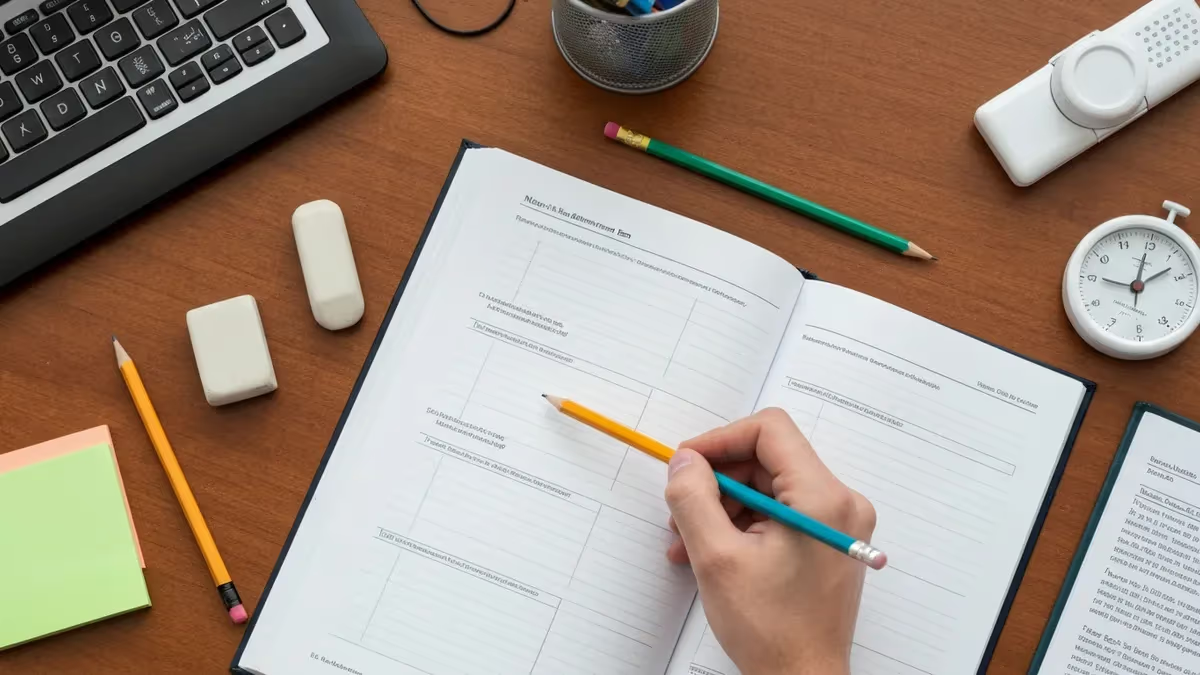
If you are wondering how can I prepare for the nursing entrance exam, you are already ahead of most applicants simply by asking the right question. The nursing entrance exam — whether it is the NLN NEX, the Kaplan Nursing Entrance Exam, or another standardized test required by your school — is a genuine academic hurdle that demands systematic preparation.
Thousands of students apply to competitive nursing programs each year, and a strong exam score can be the single factor that separates an acceptance letter from a waitlist spot. The good news is that with the right approach, these exams are entirely conquerable.
The nursing entrance examination tests knowledge across several domains: mathematics, science (including anatomy, physiology, and chemistry), reading comprehension, and English grammar. Some versions also include a critical thinking section designed to evaluate clinical reasoning before students ever set foot in a hospital. Understanding exactly which exam your target schools require is the essential first step in any preparation plan, because the format, scoring, and content emphasis vary meaningfully between the NLN NEX and the kaplan nursing entrance exam and other proprietary assessments.
Most nursing school entrance exams share a common philosophy: they want to measure whether you have the foundational academic skills to survive a rigorous nursing curriculum. This means a strong performance in high school or college-level science and math is a significant predictor of exam success. However, academic background alone is not enough. Test-taking strategies, time management under pressure, and familiarity with question formats all play important roles in your final score. Students who study strategically — rather than simply reviewing material they already know — consistently outperform those who rely on passive review alone.
One of the most important things to understand early in your preparation is that these exams are not impossibly difficult, but they do reward consistent, structured study over a period of several weeks. Cramming the night before rarely works for standardized tests that measure conceptual understanding rather than rote memorization. Most experts recommend a preparation window of eight to twelve weeks, with study sessions spread across multiple days each week. This distributed practice approach leverages how the human brain consolidates long-term memory, making it far more effective than marathon last-minute sessions.
Practice tests are arguably the single most powerful tool in your preparation toolkit. They serve three distinct functions: diagnostic assessment to reveal your weakest subject areas, simulation of real test-day conditions to reduce anxiety, and active retrieval practice that strengthens memory far better than re-reading notes. Using full-length timed practice exams at least two to three weeks before your test date gives you time to address the weaknesses those exams reveal. The specific practice resources you choose matter, so prioritize materials developed for the exact exam your school requires.
Community and accountability also matter more than most students expect. Study groups, tutors, and online forums where nursing school applicants share strategies can provide motivation, alternative explanations of difficult concepts, and the social pressure that keeps preparation on track. Many students find that teaching a difficult concept to a study partner is one of the best ways to identify gaps in their own understanding. This is the classic protégé effect, and it works particularly well for science topics where misunderstandings tend to compound over time.
This guide will walk you through everything you need to know to build a winning preparation plan: the format and content of the most common nursing entrance exams, a week-by-week study schedule, subject-specific strategies for each tested domain, the best resources available, and practical test-day tips that top scorers swear by. Whether you are sitting for a nursing program entrance test in six weeks or six months, the strategies here will give you a clear, actionable path forward.
Nursing Entrance Exam by the Numbers

Nursing Entrance Exam Format & Structure
| Section | Questions | Time | Weight | Notes |
|---|---|---|---|---|
| Mathematics | 40 | 45 min | 24% | Arithmetic, algebra, dosage calculations |
| Science | 40 | 55 min | 24% | Biology, A&P, chemistry, physics basics |
| Reading Comprehension | 40 | 45 min | 24% | Passages with inference and main-idea questions |
| English / Grammar | 30 | 35 min | 18% | Usage, punctuation, sentence structure |
| Critical Thinking | 20 | 25 min | 10% | NLN NEX specific; reasoning and logic |
| Total | 170 | 3–4 hours | 100% |
Understanding the subject breakdown of the nursing school entrance exam is the foundation of any smart preparation strategy. Rather than treating the exam as a single monolithic challenge, experienced test-takers decompose it into its component parts and assign study time proportional to both the weight of each section and their personal starting proficiency. A student who aces math but struggles with reading comprehension should weight their schedule very differently from someone with strong English skills but rusty science knowledge. Self-assessment before you begin is not optional — it is the prerequisite for an efficient plan.
Mathematics is tested on virtually every nursing entrance test, and the topics are more applied than abstract. Expect arithmetic operations, fractions and decimals, ratios and proportions, basic algebra, and — critically — dosage and solution calculations. These calculation questions are the most clinically relevant portion of the math section, and many nursing programs weight them heavily. If your algebra foundations are shaky, spend the first two weeks of preparation rebuilding them before moving on to more complex problems. Free resources like Khan Academy provide structured algebra review at exactly the right level for this exam.
The science section is where many otherwise strong candidates stumble. Anatomy and physiology, basic chemistry, and sometimes physics fundamentals are all fair game. The depth of knowledge required varies by exam — the NLN NEX goes deeper into A&P than some competing tests — but in general, you should be able to explain how body systems function, define key chemical concepts like pH, atomic structure, and chemical bonding, and apply basic physics principles like pressure and fluid dynamics. Study these topics actively by drawing diagrams, making flashcards, and explaining processes aloud rather than simply reading a textbook.
Reading comprehension on the nursing entrance examination is not a passive skill. It requires active engagement with unfamiliar academic passages, often drawn from scientific or medical contexts. The questions test your ability to identify the main idea, make inferences, determine the author's purpose, and understand vocabulary in context. One of the most effective strategies is to read the questions before reading the passage, so you know what information to look for as you read. Practicing with 10 to 15 passages per week in the weeks leading up to the exam will substantially improve both speed and accuracy.
English and grammar sections are often underestimated by applicants who consider themselves strong writers. However, the questions on nursing program entrance tests target specific grammatical rules — subject-verb agreement, pronoun-antecedent agreement, correct punctuation (especially comma usage and apostrophes), and sentence structure. Many common errors that slip through in casual writing are precisely what these questions target. The most efficient way to prepare is to review the handful of rules that appear most frequently and then practice with targeted exercises rather than trying to memorize every rule in a grammar textbook.
The critical thinking section, featured prominently on the NLN NEX, is distinct from the other sections in that it tests logical reasoning rather than factual knowledge. Questions present scenarios and ask you to evaluate arguments, identify assumptions, or draw the most logical conclusion. The good news is that this section rewards structured thinking more than memorized content, which means a few weeks of deliberate practice with logical reasoning questions can yield significant score improvements. Work through argument evaluation exercises and practice identifying when conclusions are and are not supported by the evidence presented.
Cross-subject integration is a skill many nursing students overlook. Dosage calculation questions, for example, draw on both mathematics and the kind of reading precision required by the English section. A question might give you a clinical scenario in paragraph form and require you to extract the relevant numbers before performing a calculation. Practice reading for precision — identifying the specific numbers, units, and relationships embedded in word problems — and your performance on applied math questions will improve significantly alongside your reading comprehension scores.
Kaplan Nursing Entrance Exam vs. NLN NEX vs. TEAS: Study Plan Comparison
The Kaplan nursing entrance exam (also called the Kaplan Admission Test for nursing) is used by hundreds of nursing programs across the United States. It covers four core areas: reading, writing, math, and science, with each section scored independently and reported alongside a composite score. The Kaplan test emphasizes applied reasoning rather than rote recall, meaning questions often present a short scenario before asking you to identify the best response. Official Kaplan prep books and online question banks are the gold standard for targeted preparation, and many schools publish the minimum Kaplan score they require for admission, giving you a clear target to aim for.
For the kaplan admission test nursing entrance prep, plan at least eight weeks and divide your sessions by subject area. Week one should begin with a full-length diagnostic test from an official Kaplan prep resource — this reveals your baseline and shows exactly which sections need the most attention. From there, alternate between content review (reading textbook chapters or watching instructional videos) and active practice (working through timed question sets). Use spaced repetition for vocabulary and science terms, reviewing flashcards daily in brief five-to-ten-minute sessions rather than long cram sessions that produce diminishing returns.

Self-Study vs. Structured Prep Course: Which Is Right for You?
- +Self-study costs far less — free and low-cost resources cover all tested content effectively
- +You control your schedule and can focus extra time on your weakest subject areas
- +Self-paced learning accommodates students who are working or caring for family
- +Widely available practice tests and official prep books provide structured content without a course fee
- +Building independent study habits now prepares you for the self-directed learning required in nursing school
- +Online communities of applicants share strategies, question explanations, and moral support at no cost
- −Without external accountability, it is easy to procrastinate or skip difficult subject areas
- −Self-diagnosing content gaps requires honest self-assessment that many students find uncomfortable
- −High-quality official prep books can still cost $40–$100, and digital question banks add more expense
- −Students with large science knowledge gaps may need more structured instruction than books alone provide
- −Prep courses include expert tutors who can explain concepts in multiple ways when one explanation does not click
- −Structured courses often include live proctored practice exams that more authentically simulate test-day conditions
Complete Nursing Entrance Exam Preparation Checklist
- ✓Confirm which specific exam your target nursing programs require and obtain the official content outline.
- ✓Take a full-length diagnostic practice test in your first week to establish a baseline score by section.
- ✓Set a realistic target score based on the minimum and competitive score ranges published by each school.
- ✓Build a week-by-week study schedule that allocates the most hours to your lowest-scoring subject areas.
- ✓Gather official prep materials: the publisher's own prep book and question bank are the highest-fidelity resources.
- ✓Review math fundamentals — fractions, ratios, proportions, and basic algebra — before advancing to dosage calculations.
- ✓Study science by body system rather than by textbook chapter; the exam tests integrated physiological understanding.
- ✓Complete at least one timed, full-length practice test per week for the final four weeks before exam day.
- ✓Track every practice question you get wrong and categorize errors as content gaps versus careless mistakes.
- ✓Review grammar rules for subject-verb agreement, pronoun reference, comma splices, and apostrophe use.

Students who take 4+ full-length practice tests score an average of 12–15 percentile points higher than those who take fewer than 2.
Research on standardized test preparation consistently shows that simulated test-taking — not passive review — is the primary driver of score improvement. Taking timed, full-length practice tests under realistic conditions reduces test anxiety, builds pacing instincts, and surfaces content gaps that review sessions alone miss. Build at least one full practice exam per week into your schedule during the final month of preparation.
Finding the right resources is one of the most consequential decisions in your preparation journey for the nursing entrance test. The landscape of prep materials is crowded, and not all resources are created equal. The most reliable materials are those published by the same organizations that create or closely partner with the exam itself.
For the NLN NEX, this means NLN-published practice tests and prep guides. For the Kaplan Nursing Entrance Exam, Kaplan's own prep books and online question bank are the highest-fidelity preparation available. Third-party resources can supplement official materials but should never replace them as your primary study tools.
Online question banks are particularly valuable because they offer immediate feedback on each question, often with detailed explanations of why the correct answer is right and the incorrect answers are wrong. This immediate feedback loop accelerates learning far more than reviewing a static answer key at the end of a practice section. When evaluating an online question bank, look for resources that include hundreds of questions organized by content area, allow you to filter by topic or difficulty, and track your performance over time so you can see whether you are actually improving in your target areas week by week.
Khan Academy remains one of the best free resources for rebuilding mathematics foundations, and its biology and chemistry content is solid enough to cover the basic science concepts tested on most nursing program entrance tests.
For anatomy and physiology specifically, crash course videos on YouTube combined with a college-level A&P textbook (available at most public libraries) provide excellent coverage of the cardiovascular, respiratory, renal, nervous, and endocrine systems that appear most frequently on the science section. Do not underestimate the value of free resources — many students who score in the top quartile used primarily free or low-cost materials paired with disciplined study habits.
Flashcard applications like Anki leverage spaced repetition algorithms to schedule your review of science terms, anatomy definitions, and grammar rules at precisely the intervals that maximize long-term retention. Creating your own Anki deck as you study forces you to actively engage with the material (a process called elaborative encoding), and the resulting deck becomes a personalized review tool that targets exactly your weak spots. Pre-made Anki decks for nursing entrance exam vocabulary and A&P terms are also widely available from the Anki community, though creating your own is typically more effective for retention.
Joining an online study group or forum for nursing school applicants provides benefits that study materials alone cannot replicate. When you see a question type that confuses you, other students in a forum may have encountered the same confusion and developed creative explanations or mnemonics that click where a textbook explanation did not. Allnurses.com and Reddit's r/prenursing community are two well-established spaces where applicants discuss exam preparation strategies, share practice questions, and provide honest assessments of which prep materials are worth the investment. These communities are also valuable sources of information about specific nursing programs' score expectations and application timelines.
Tutoring is worth considering if your diagnostic test reveals large content gaps in foundational math or science — gaps that are large enough that self-study alone would require more time than your test date allows. A good tutor can accelerate remediation in a specific subject by identifying the root cause of your misunderstanding rather than simply re-explaining the same material.
If cost is a concern, peer tutoring through a local college or university STEM tutoring center is often free or very low-cost, and many nursing students who have already passed their entrance exams are willing to mentor applicants through informal tutoring arrangements.
Practice test timing deserves a dedicated strategy beyond simply working through questions. When you take a timed practice section, practice active time monitoring: check your position at the halfway point of the allotted time and adjust your pace accordingly.
If you are behind halfway, spend no more than 90 seconds on any remaining question — choose the best available answer and move on rather than spending five minutes on a single difficult question. The kaplan nursing entrance exam practice test materials specifically coach this pacing strategy, and for good reason: pacing failures are among the most common causes of scores that fall below a student's actual knowledge level.
Many nursing programs have fixed application cycles with hard deadlines for submitting entrance exam scores. Missing the score submission deadline can push your application to the next cycle, delaying your nursing school start by a full year. Confirm your target school's score deadline before you register for the exam, and choose a test date that gives you at least two to three weeks of buffer time in case you need to retest for a higher score.
The final phase of preparation — the two weeks immediately before your exam — should shift decisively from learning new material to consolidating and reinforcing what you already know. This is not the time to read new textbook chapters or discover entirely new topic areas.
Instead, focus your energy on timed practice tests, targeted review of the specific question types and content areas where you made errors in earlier practice sessions, and the kind of mental preparation that prevents test anxiety from undermining a score that your knowledge level actually supports. Treat these final two weeks as exam simulation mode rather than content acquisition mode.
Mental preparation is more practical than it sounds. Test anxiety is a well-documented phenomenon that measurably reduces performance on standardized exams, and it is most effectively countered through familiarity and controlled breathing. Taking three or more full-length practice tests under conditions that mimic the real exam — same time of day, no phone, timed strictly — desensitizes your nervous system to the test-day environment. By the time you sit for the actual exam, the format, pacing, and question style should feel completely familiar. Unfamiliarity is one of the primary drivers of anxiety, and practice eliminates it.
Sleep in the final week before your exam matters more than most students acknowledge. Research on memory consolidation demonstrates that sleep plays an essential role in transferring information from short-term working memory to long-term storage. Pulling late-night study sessions in the days before the exam does not help and actively hurts performance by degrading working memory capacity and attention. Aim for seven to nine hours of sleep each night in the week before your exam, and treat the night before the test as an absolute sleep priority — even if that means stopping your review earlier than you would like.
Nutrition and hydration on test day have measurable effects on cognitive performance. A high-protein breakfast with complex carbohydrates provides sustained mental energy without the blood sugar crash that follows a high-sugar meal. Bring a water bottle if the test center permits it, and stay hydrated throughout the exam.
Avoid heavy caffeine reliance on test day if you do not normally consume caffeine — an unfamiliar stimulant load can increase anxiety and cause the jittery discomfort that makes sustained concentration difficult. If you normally drink coffee, drink your normal amount. If you do not, test day is not the time to start.
Arriving early to the test center is a non-negotiable component of test-day success. Plan to arrive at least 30 minutes before your scheduled start time. This gives you time to check in without rushing, locate the restroom, settle into your seat, and complete any required identification verification procedures. Late arrivals create a cortisol spike that can take 20 to 30 minutes to subside — easily enough to compromise your performance on the first section of the exam. Map your route to the test center the day before, check parking or transit options, and set multiple alarms.
During the exam itself, read every question stem completely before reading the answer choices. A common error is to partially read a question, identify a familiar answer among the choices, and select it before finishing the question — only to discover that the question had a qualifier like "except" or "most likely" that changes the correct answer entirely.
Slow, deliberate reading of each question costs approximately three to five extra seconds per question but prevents the kind of careless errors that are uniquely painful because the student actually knew the correct answer. This is especially important for the science and math sections where precise interpretation of the question is half the battle.
After you complete the exam, resist the urge to spend the waiting period before score release second-guessing your performance. Research on post-exam rumination shows that students consistently overestimate the number of questions they answered incorrectly — anxiety biases memory toward the difficult questions while underweighting the many questions that were answered confidently and correctly.
Use the waiting period productively: begin researching your nursing programs' next steps, prepare your application essays, and gather recommendation letters so you are ready to submit a complete application the moment your scores are available. The nursing school entrance exam is one piece of a complete application, and the strongest applicants treat it as the starting line, not the finish line.
The most effective test-takers approach the nursing entrance exam not as an obstacle to endure but as a skill to develop — and skills improve with deliberate, systematic practice. One of the most powerful practical habits you can build is error logging: keeping a dedicated notebook or spreadsheet where you record every practice question you get wrong, the correct answer, and the specific reason you missed it.
Over time, this log reveals patterns that are invisible when you simply flip through a practice test answer key. You might discover, for example, that you consistently misread questions with double negatives, or that chemistry questions about ionic versus covalent bonding account for a disproportionate share of your science errors.
Time management within each section deserves explicit practice, not just general awareness. Before your first timed practice test, calculate your target time per question for each section based on the number of questions and the allotted time. For a 40-question math section with 45 minutes, you have roughly 67 seconds per question.
Practice working at this pace during your daily study sessions so that the pacing feels natural rather than frantic on exam day. When you encounter a question that will take significantly longer than your target time, make your best guess, mark it (if the test interface allows), and return to it only if time permits after completing the remaining questions.
Subject integration practice — working through questions that combine skills from multiple sections — is an advanced preparation technique that mirrors how the exam actually works. Dosage calculation questions, for example, require reading precision, unit conversion math, and basic clinical knowledge about medication concentrations. Create your own hybrid practice problems: take a reading passage from a science article and write your own comprehension questions about the quantitative information it contains. This kind of creative self-testing builds the flexible cognitive skills that standardized exams ultimately measure and that nursing school will demand of you from day one.
Vocabulary development deserves more attention than most nursing entrance exam prep guides allocate to it. Both the reading comprehension and the English sections assume familiarity with academic and medical vocabulary that many students encounter infrequently in everyday life.
Words like "efficacy," "contraindicated," "pathological," "osmotic," and "hemodynamic" appear in reading passages, and questions about vocabulary in context require you to infer meaning from surrounding text even when the word itself is unfamiliar. The most efficient vocabulary strategy is to read widely in academic and medical domains throughout your preparation period, keeping a running list of unfamiliar words and their definitions that you review weekly.
Staying physically active during your preparation period is a practical tip that is backed by a growing body of cognitive science research. Aerobic exercise has been shown to improve working memory capacity, executive function, and the ability to sustain focused attention — all of which are directly relevant to standardized test performance.
Even 20 to 30 minutes of brisk walking three times per week during your preparation period can measurably improve the cognitive resources you bring to each study session and to the exam itself. Treat exercise not as a luxury that competes with study time but as an investment in the brain performance that your study time is building toward.
The week of the exam, shift your practice test activity from full-length simulations to targeted mini-sessions. Do one 15-question math drill, one 15-question science drill, and a brief grammar review each day rather than full three-hour simulations. This keeps the material fresh without creating fatigue that would undermine your exam-day performance.
Review your error log one final time two days before the exam to refresh your memory of the specific mistakes you have worked hardest to correct, then put the log away. Trust the weeks of preparation you have completed, and approach exam day with the confidence that consistent, structured study always earns.
Finally, remember that the nursing entrance exam score is an important input to your nursing school application, but it is rarely the only input. Strong GPA, meaningful healthcare experience, a compelling personal statement, and enthusiastic recommendation letters all contribute to the admissions picture.
A score that falls slightly short of your target school's competitive range does not automatically foreclose your nursing career — it may mean targeting programs with slightly different thresholds, or retesting after an additional four to six weeks of focused preparation. Many nurses who are now successful in the field did not ace their entrance exams on the first attempt. Persistence and commitment to growth are, ultimately, the most nursing-relevant traits the application process can assess.
NEX Questions and Answers

NLN NEX Exam: Complete Study Guide and Practice Tests

Accelerated Nursing Programs Without Entrance Exam: What You Need to Know

Nursing Entrance Essay: How to Write One That Gets You In

How to Register for the Kaplan Nursing Entrance Exam: Complete Step-by-Step Guide

NEX Practice Test: Nursing Entrance Exam Prep Guide
About the Author
Educational Psychologist & Academic Test Preparation Expert
Columbia University Teachers CollegeDr. Lisa Patel holds a Doctorate in Education from Columbia University Teachers College and has spent 17 years researching standardized test design and academic assessment. She has developed preparation programs for SAT, ACT, GRE, LSAT, UCAT, and numerous professional licensing exams, helping students of all backgrounds achieve their target scores.
Join the Discussion
Connect with other students preparing for this exam. Share tips, ask questions, and get advice from people who have been there.
View discussion (5 replies)