
MSHA Electrical Certification: Requirements & Training Guide 2026 October
Learn what MSHA electrical certification requires for mine electricians — 🟢 training hours, approval process, tasks covered, and how to maintain your
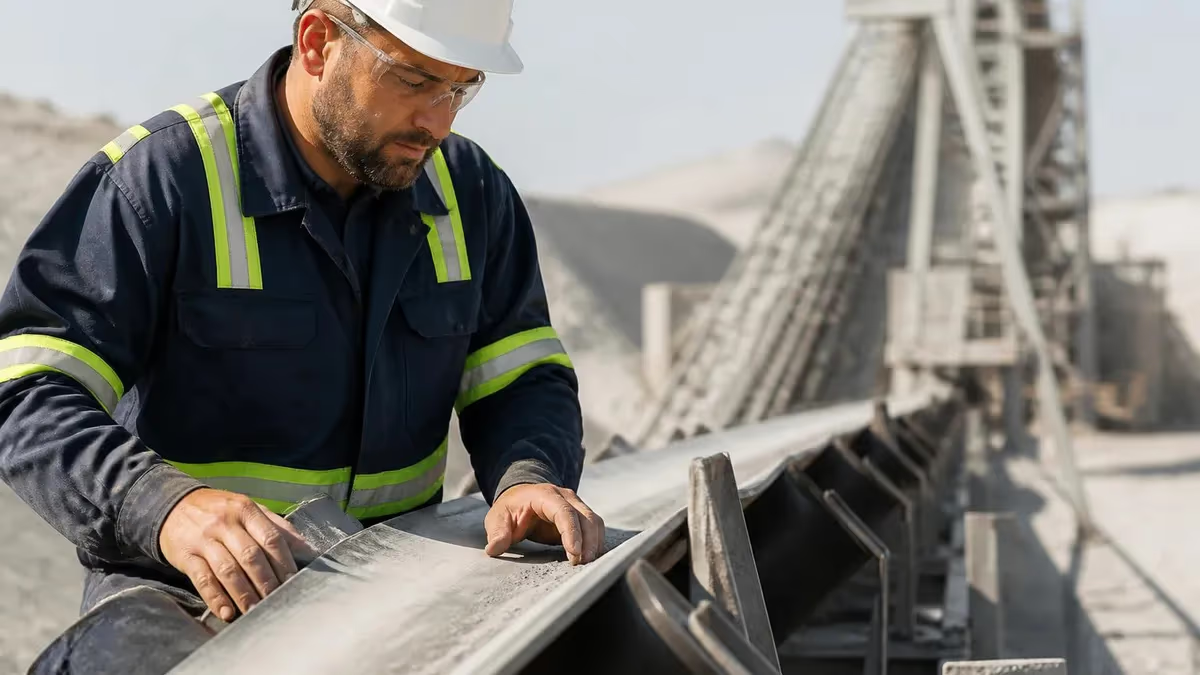
Mining operations run on electricity — from the motors driving conveyors and ventilation fans to the lighting in underground workings and the automated systems controlling haul equipment. That dependence on electrical systems makes mine electrical workers critical to every operation, and it makes their safety training and certification one of the most important regulatory requirements MSHA enforces.
MSHA electrical certification isn't a single national exam or a one-time credential. It's a state-level and MSHA-program combination that governs who can perform electrical work in mines, what training they must complete, and how their competency is verified. Understanding how the system works is essential for anyone working toward certification or managing MSHA compliance at a mining operation.
This guide covers what MSHA electrical certification involves, what federal and state requirements apply, what training programs are approved, and how electricians maintain their credentials over time.
Federal vs. State Electrical Certification in Mining
Mine electrical work is regulated at both the federal and state levels, and the two systems interact. MSHA sets the federal minimum requirements for mine electrical safety under the Federal Mine Safety and Health Act, but many states have their own certification requirements that go above and beyond the federal baseline.
Under MSHA's regulations, electrical work in underground metal and nonmetal mines and in coal mines must be performed by qualified electrical persons. A "qualified electrical person" is defined as someone who has been trained in electrical safety and the specific electrical systems they'll work on. MSHA doesn't issue a single federal "electrician's license" for mines — instead, it requires that mines have documented training and qualification programs and that competent persons verify electrical workers' qualifications.
States with significant mining activity often have their own mine electrician certification programs. States like Kentucky, Virginia, West Virginia, Colorado, and Utah have state-administered mine electrician certification exams and licensing requirements. If you're working in one of these states, you'll need to satisfy both the MSHA-required training and the state licensing process.
Always check the specific requirements for the state and mine type where you'll be working. Requirements differ for underground coal mines, surface coal mines, underground metal/nonmetal mines, and surface metal/nonmetal operations.
MSHA Electrical Training Requirements
MSHA regulations (30 CFR Parts 48, 77, and 56/57 depending on mine type) mandate that mine workers performing electrical tasks receive task training before performing those tasks independently. For electrical work specifically, this training is typically more comprehensive than general new miner training.
Key training areas for mine electrical work include:
- Electrical hazard recognition — Identifying energized circuits, shock hazards, arc flash potential, and environmental factors (moisture, dust, gases) that affect electrical safety underground
- Lockout/tagout procedures — MSHA and mine-specific LOTO protocols for de-energizing, isolating, and verifying equipment before maintenance begins
- Mine electrical system fundamentals — Power distribution systems specific to mining, including high-voltage transmission, trailing cables, permissible equipment requirements, and grounding
- Permissible electrical equipment — Requirements for intrinsically safe and explosion-proof equipment in gassy underground mines, where non-permissible equipment could ignite methane or coal dust
- Circuit protection and overcurrent devices — Fuse and breaker sizing, ground fault protection, and the grounding requirements in underground applications
- Emergency response — Responding to electrical fires, electrical injuries, and arc flash incidents in mine environments
Task training records must be maintained by the mine operator and are subject to MSHA inspection. If an MSHA inspector asks about the qualifications of an electrician who worked on a circuit, the operator needs to produce documented evidence of that person's training.
State Mine Electrician Certification Programs
In states with formal mine electrician certification programs, the process typically involves a combination of documented experience, written examination, and sometimes practical testing.
The general pathway looks like this:
Experience requirement — Most state programs require a minimum number of hours of documented electrical work experience in mining before you're eligible to test. Requirements vary but commonly range from 1–3 years of mine electrical experience or equivalent electrical journeyman experience. Some programs have tiered certifications (e.g., Fire Boss, Mine Foreman Electrician) with different experience thresholds.
Application and documentation — You'll submit an application to the state mining agency (in Kentucky this is the Mine Safety Review Commission; in Virginia it's the Division of Mines; etc.) documenting your experience with employer verification.
Written examination — The exam typically covers the mine safety regulations applicable to your state, electrical safety standards, and technical knowledge of mining electrical systems. State-specific regulations (the state's mine safety act and its implementing regulations) are heavily tested alongside federal MSHA standards.
Certificate issuance and renewal — Certificates are issued for a fixed period (typically 3–5 years depending on the state) and must be renewed through continuing education or re-examination. Some states require documentation of ongoing training to renew.
MSHA Part 48 Training and Annual Refresher Requirements
Under MSHA Part 48 (training for underground mines) and comparable sections for surface mines, all mine workers — including electrical workers — must complete annual refresher training. This 8-hour annual refresher covers health and safety topics relevant to the mine and workforce, and it's a continuous requirement throughout a miner's career, not a one-time certification.
For electrical workers specifically, annual refresher training is an opportunity to reinforce electrical safety procedures, update workers on any regulatory changes or new mine-specific hazards, and review incidents (both from the specific mine and from MSHA investigation reports) that involve electrical causes.
MSHA publishes investigation reports on serious and fatal accidents, including electrical incidents. These reports are valuable training resources because they describe exactly what went wrong and what safeguards failed. Smart training programs incorporate recent MSHA investigation findings to keep the content grounded in real hazards.

High-Voltage and Underground Electrical Hazards
Mining environments present electrical hazards that don't exist in typical industrial settings. Understanding these hazards is what separates a mine-qualified electrician from a general industrial electrician.
Trailing cables are one of the most distinctive and hazardous aspects of underground mining electrical systems. These flexible power cables supply electricity to mobile equipment — continuous miners, shuttle cars, scoops — and must withstand physical abuse from equipment movement, water, and ground conditions. Damaged trailing cables are a leading cause of electrical incidents in underground coal mines. MSHA regulations prescribe specific protection, repair, and testing requirements for trailing cables.
High-voltage distribution in underground mines often operates at voltages that would not be permitted in surface industrial applications — particularly in metal mines, where voltages up to 7,200V are used. Working safely around high-voltage underground distribution requires strict adherence to approach distances, qualified worker requirements, and LOTO procedures.
Water and electricity combine dangerously in many underground environments. Wet conditions lower the resistance of the ground path and dramatically increase shock risk. MSHA regulations require ground fault protection specifically because the wet, conductive environment of underground mines makes ground faults more likely and more deadly.
Arc flash hazards in mining are underappreciated compared to surface industrial settings, but they're real. When working on or near energized mine electrical equipment, arc flash energy can cause severe burns. A proper arc flash hazard assessment and appropriate PPE selection — particularly arc-rated face protection and clothing — are required for energized electrical work.
Preparing for State Mine Electrician Exams
State mine electrician exams are written tests that assess your knowledge of applicable state and federal mine safety regulations, plus technical electrical knowledge. The best preparation combines study of the specific regulations for your state and mine type with solid grounding in electrical principles and mine electrical systems.
Key areas to study for most state exams include:
- MSHA standards for your mine type (underground coal, surface coal, underground M/NM, or surface M/NM)
- State mine safety act and regulations
- Electrical safety standards specific to mining (grounding, trailing cables, permissible equipment)
- Lockout/tagout procedures
- Emergency response procedures for electrical incidents
The MSHA practice tests here cover the electrical safety, inspection standards, and hazardous materials content that appear on both MSHA-required training assessments and state certification exams. Working through these questions helps you apply the regulations to real scenarios — which is exactly the kind of reasoning the exams test.
Mine electrical certification is about more than passing an exam — it's about having the knowledge to work safely in one of the most hazardous electrical environments in any industry. The regulations exist because people have died from preventable electrical incidents in mines. Understanding them deeply, not just well enough to pass, is the standard that protects you and everyone working around you.
- ✓Confirm your exam appointment and location
- ✓Bring required identification documents
- ✓Arrive 30 minutes early to check in
- ✓Read each question carefully before answering
- ✓Flag difficult questions and return to them later
- ✓Manage your time — don't spend too long on one question
- ✓Review flagged questions before submitting
About the Author

Educational Psychologist & Academic Test Preparation Expert
Columbia University Teachers CollegeDr. Lisa Patel holds a Doctorate in Education from Columbia University Teachers College and has spent 17 years researching standardized test design and academic assessment. She has developed preparation programs for SAT, ACT, GRE, LSAT, UCAT, and numerous professional licensing exams, helping students of all backgrounds achieve their target scores.
Join the Discussion
Connect with other students preparing for this exam. Share tips, ask questions, and get advice from people who have been there.
View discussion (8 replies)