
MSF.com Guide 2026 October: MSF Course Cost, Practice Tests & Written Test Prep
📗 Everything about msf.com: MSF course cost, MSF practice test, MSF written test tips, and free prep questions for new riders in 2026 October.

The Motorcycle Safety Foundation's official website at msf.com is the starting point for every new rider who wants to get licensed safely and affordably in the United States. Whether you're researching the MSF course cost before signing up, looking for an MSF practice test to sharpen your knowledge, or trying to understand exactly what the MSF written test covers, this guide walks you through everything you need to know in plain language so you can prepare with confidence from day one.
Understanding the MSF course cost upfront helps riders plan their budget accurately. Nationally, the Basic RiderCourse (BRC) typically ranges from $150 to $350 depending on your state, the training provider, and whether your state subsidizes the program. Some states — including California, Iowa, and Oregon — offer heavily discounted or even free training through government-funded motorcycle safety programs, so the out-of-pocket MSF class cost can vary dramatically from one zip code to the next.
The MSF test itself is divided into two distinct evaluations: a written knowledge component and an on-cycle riding skills evaluation. The MSF written test covers traffic laws, motorcycle controls, hazard identification, and safe riding strategies. Most students find the knowledge portion manageable if they study the MSF Motorcycle Operator Manual (MOM) beforehand, but arriving without any preparation is a common reason new riders struggle during the classroom session.
An MSF practice test is one of the single most effective tools you can use before class. Working through realistic multiple-choice questions mirrors the format of the actual MSF written test, helps you identify weak spots in your knowledge, and reduces test-day anxiety significantly. Research consistently shows that active recall through practice questions produces better long-term retention than passive reading alone, which is why seasoned instructors recommend doing at least two or three full practice runs before you walk into the classroom.
The cost of MSF course enrollment usually covers both the classroom instruction and the range riding sessions, so you are not paying separately for the written and skills portions. Most BRC programs run across two days — roughly three to five hours of classroom time followed by five to seven hours on the practice range. Some providers now offer an e-course option where you complete the classroom module online at home before attending the range days, which can cut total in-person time and may reduce the overall MSF class cost at certain sites.
Riders who successfully complete the full MSF course — including passing the MSF written test and the on-cycle skills evaluation — typically receive a completion card. In most states this card waives the DMV riding skills test requirement entirely and may also earn you a discount on motorcycle insurance premiums, sometimes as much as 10 to 15 percent. Those financial benefits mean the MSF course often pays for itself within the first year of ownership for regular commuters and weekend riders alike.
This guide covers every angle of the MSF experience: course structure, costs by state, what to expect on the MSF course written test, how to use practice tests strategically, and what happens after you earn your completion card. Use the table of contents below to jump directly to the section most relevant to where you are in your rider journey.
MSF Course by the Numbers
Key Facts at a Glance
| Item | Value | Details |
|---|---|---|
| Typical MSF Course Cost | $150–$350 | Varies by state & provider |
| MSF Written Test Questions | 30+ | Knowledge exam in classroom |
| Total Course Length | 15–20 hrs | Classroom + range riding |

MSF Course Cost Breakdown by State Category
States like California (through the CHP OTS program) and Iowa fund training so heavily that eligible riders pay little to nothing out of pocket. Always check your state DMV website first before assuming the national average applies to you.
Many states offer a rebate or voucher system — you pay full price upfront ($200–$300) and receive a reimbursement of $50–$150 after course completion. Texas and Florida operate similar incentive structures through their traffic safety offices.
In states without public funding, MSF class cost is set by private training providers. Expect to pay $250–$350 for a standard BRC. Community colleges often charge less than independent providers, so compare at least two local options before booking.
Active-duty military, veterans, and members of the AMA or other riding clubs can often access discounted MSF course rates. Some employers with fleet or commuter programs also negotiate group pricing for employees who commute by motorcycle.
The MSF course written test is a formal knowledge examination conducted in the classroom portion of the Basic RiderCourse. It is based directly on the content in the MSF Motorcycle Operator Manual, a free publication you can download from the MSF website or pick up at many DMV offices. The manual covers motorcycle controls, braking techniques, cornering dynamics, hazard perception, protective gear, and rules of the road specifically as they apply to two-wheeled vehicles. Instructors strongly recommend reading the entire manual before your first class day rather than trying to absorb it during lecture alone.
Typically, the MSF written test consists of between 25 and 50 multiple-choice questions depending on the provider and state requirements. Questions are designed to test practical understanding rather than rote memorization. For example, you will not simply be asked to define countersteering — you will be asked what a rider should do when they enter a corner too fast, which requires you to apply the concept correctly. This applied format is exactly why MSF practice tests that mirror the question style are so valuable for preparation.
A passing score on the MSF course written test is generally 75 percent or higher, though some programs require 80 percent. If you do not pass on the first attempt, most providers allow one retake either immediately or on the second day before range sessions begin. Failing the written component does not automatically mean you cannot continue with the course — your instructor will typically review the answers with you and help you understand what you missed — but you must pass before you can be formally certified.
The MSF written test is not timed under pressure the way a DMV exam is. You will have ample time to read each question carefully, and the relaxed classroom environment is deliberately structured to reduce stress. That said, riders who come in underprepared often find that the questions are more nuanced than expected. Conceptual topics like sight lines, buffer zones, and the effects of alcohol on balance and reaction time tend to trip up first-timers who skimmed the manual rather than studying it thoroughly.
Topics you can almost guarantee will appear on the MSF course written test include proper lane positioning, the T-CLOCS pre-ride inspection checklist (Tires, Controls, Lights, Oil, Chassis, and Stands), correct braking technique, the SEE (Search, Evaluate, Execute) decision-making strategy, and how to handle road hazards like gravel, sand, and railroad tracks. Each of these areas corresponds directly to range exercises you will practice on the motorcycle, so your written knowledge reinforces the physical skills you are building simultaneously.
Riders who struggle with the written portion almost always admit they skipped the Motorcycle Operator Manual. The good news is that the manual is readable in two to three hours if you sit down and focus. Combine that reading with a focused session of MSF practice test questions the evening before class and you will arrive at the test with a strong conceptual foundation. Instructors notice the difference immediately — students who prepared ask better questions, progress faster on the range, and earn their completion card with noticeably less frustration than those who showed up cold.
It is also worth noting that even after you pass the MSF written test and receive your completion card, some states still require you to pass a separate DMV written knowledge exam to obtain your motorcycle endorsement. California, for instance, requires a DMV motorcycle knowledge test regardless of BRC completion. Always verify your specific state's endorsement requirements on the DMV website so you know exactly what the MSF course covers and what additional steps remain on your path to a fully endorsed license.
MSF Practice Test Strategies That Actually Work
Simulating test conditions during your MSF practice test sessions builds both speed and confidence. Set a timer for 30 minutes and attempt a full 30-question set without pausing or looking up answers. This trains your brain to retrieve information under mild pressure and reveals which topics still feel uncertain. Reviewing your incorrect answers immediately afterward — while the reasoning is fresh — is far more effective than simply re-reading the question later in the week.
After your first timed run, focus your next study session entirely on the topic categories where you missed the most questions. If braking distance questions tripped you up, go back to that chapter in the Motorcycle Operator Manual and re-read it before doing another targeted 10-question set on the same topic. This targeted iteration approach closes knowledge gaps faster than generalized re-reading and dramatically improves your score on the actual MSF written test.

Is the MSF Course Worth the Cost?
- +Structured training accelerates skill development far faster than self-teaching on public roads
- +Passing the course typically waives the DMV riding skills test in most US states
- +Completion card often earns 10–15% motorcycle insurance discount that offsets the MSF course cost within one year
- +Professional instructors identify and correct dangerous habits before they become ingrained
- +Range environment lets you practice emergency braking and swerving without real traffic risk
- +The MSF Motorcycle Operator Manual and study materials are included in the course fee
- −MSF class cost of $150–$350 can feel steep for riders on tight budgets despite long-term savings
- −Course schedules at popular sites fill up weeks in advance, requiring early planning
- −Range time on small training bikes may not directly transfer to the larger bike you plan to ride
- −Weather-dependent range sessions can be uncomfortable or rescheduled in bad conditions
- −The classroom MSF written test covers theory that some experienced riders find redundant if they already have a car license
- −Some states still require a separate DMV written test for the motorcycle endorsement even after BRC completion
MSF Course Pre-Class Preparation Checklist
- ✓Download and read the full MSF Motorcycle Operator Manual at least two days before class
- ✓Complete at least two full MSF practice test sets and review every wrong answer
- ✓Verify your state's specific endorsement requirements on the DMV website before registration
- ✓Confirm the MSF course cost and accepted payment methods with your training provider
- ✓Bring a valid state-issued ID or driver's license to the first day of class
- ✓Wear long pants, long-sleeved shirt or jacket, and sturdy over-the-ankle boots on range days
- ✓Bring DOT-approved helmet and gloves — providers may loan equipment but supply is not guaranteed
- ✓Arrive at least 15 minutes early to complete registration paperwork without stress
- ✓Bring water, snacks, and sunscreen for full-day outdoor range sessions
- ✓Review the T-CLOCS pre-ride inspection process the night before to recognize it instantly in class
Read the Manual + Do Practice Tests — Nothing Else Comes Close
Students who read the Motorcycle Operator Manual once and complete at least two full MSF practice test sessions pass the MSF written test at dramatically higher rates than those who rely on classroom listening alone. The combination of reading for comprehension and active recall through practice questions is the most time-efficient preparation strategy available, and it takes less than four hours total.
The skills evaluation is the second major component of the MSF course and the one that makes many new riders nervous. Unlike the MSF written test, which is a static pen-and-paper exercise, the skills evaluation requires you to demonstrate specific maneuvers on a small motorcycle in a controlled range environment.
Your instructor will observe you performing exercises like slow-speed balance, quick stops from 20 mph, swerving around obstacles, and cornering through a marked course. Each exercise has defined criteria for a passing performance, and points are deducted for common mistakes such as putting a foot down, going too fast, or missing a cone.
The skills evaluation is not meant to test expert riding — it is designed to confirm that you have absorbed the fundamentals taught during the range sessions. Most participants who have actively engaged during training pass without serious issues. The exercises are performed at low speeds on a private range with no traffic, no pedestrians, and patient instructors watching for safety. The atmosphere is supportive rather than competitive, and instructors will coach you through any exercise you struggle with before the final evaluation begins.
Emergency braking is frequently the most challenging exercise for first-time riders. The quick-stop exercise requires accelerating to a set speed and then braking to a full stop within a marked distance using proper front-and-rear brake coordination. Students who grip too tightly, brake too abruptly, or forget to apply both brakes simultaneously often fall short of the stopping distance requirement. The best way to prepare mentally is to practice brake application technique during every range session and visualize the process before the evaluation begins.
Cornering and low-speed maneuverability are the other areas where students accumulate the most penalty points. The serpentine and U-turn exercises demand precise throttle control, proper body position, and smooth clutch operation at walking pace. Riders who rush or who have not internalized the look-lean-press-roll sequence during range sessions tend to run wide or drop a foot on these exercises. Repeating the maneuvers deliberately during practice sessions, rather than just going through the motions, is what builds the muscle memory needed on evaluation day.
Once you pass both the MSF written test and the skills evaluation, you receive an MSF completion card — a wallet-sized certificate that documents your successful course completion. This card is your primary documentation for DMV endorsement waivers, insurance discounts, and in some states, points reduction on your driving record. Keep it in a safe place: losing your completion card is more inconvenient than it sounds because replacement card processes vary by provider and can take several weeks.
Insurance companies that recognize MSF completion typically require you to submit your completion card number or a copy of the card when you apply for the discount. Major insurers including Progressive, Geico, and Allstate all have published MSF discount programs, though the exact percentage varies by state and policy type. For a rider paying $800 per year in motorcycle insurance, even a 10 percent discount saves $80 annually — enough to cover roughly a quarter of the original MSF class cost within the first twelve months of coverage.
Riders who do not pass the skills evaluation on their first attempt are not automatically disqualified. Many providers allow you to retake the evaluation within a set timeframe, often at no additional charge. If you need a retake, ask your instructor for specific feedback immediately after the evaluation and take notes. Knowing exactly which exercises cost you points and why is far more actionable than a vague sense that you did not perform well. Use that feedback to focus your practice before the retake so each repetition targets your actual weak points.

Passing the MSF course does NOT automatically give you a motorcycle endorsement in every state. While most states waive the DMV skills test for BRC graduates, some still require a separate written knowledge exam at the DMV. California requires a DMV motorcycle knowledge test regardless of course completion. Always check your specific state DMV website to confirm exactly what steps remain after you receive your MSF completion card.
After earning your MSF completion card, the immediate next step is visiting your state DMV to apply for the motorcycle endorsement or a separate motorcycle license, depending on your state's system. In most states, you present your completion card at the DMV counter, pay an endorsement fee (typically $5 to $35 depending on the state), and the endorsement is added to your existing driver's license. If your state still requires a DMV written test, schedule that appointment as soon as possible while your MSF course knowledge is still fresh and your test preparation habits are still active.
Gear upgrades are another immediate priority after course completion. The MSF course allows you to ride in street clothes on the training range, but real-world riding demands proper protective equipment. At minimum, invest in a quality DOT or ECE-certified helmet, a riding jacket with CE-rated armor at the shoulders and elbows, riding gloves, and boots that cover the ankle. The MSF course cost is a one-time expense, but protective gear is an ongoing investment in your physical safety that pays dividends every time you avoid a road rash injury.
Many new graduates underestimate how much skill development continues after the MSF course ends. The range exercises develop foundational competencies, but real traffic introduces variables that no training range can fully replicate — merging vehicles, poor road surfaces, distracted drivers, and night riding conditions. Plan to spend your first 500 miles on the bike in low-risk environments: quiet roads, daylight conditions, low speeds, and short trips. Resist the temptation to immediately tackle highway riding or long-distance trips until your basic controls feel completely automatic.
The MSF offers additional training beyond the Basic RiderCourse for riders who want to continue developing after their initial certification. The Advanced RiderCourse (ARC) targets licensed riders who want to refine cornering technique, braking precision, and emergency maneuver proficiency. There are also specialized courses for riders transitioning to larger displacement bikes, cruisers, scooters, and three-wheeled vehicles. Investing in continued education significantly reduces your statistical risk — experienced riders who take advanced training have meaningfully lower crash rates than those who stop at the BRC.
Joining a local riding group or club is one of the most underrated post-MSF resources available to new riders. Riding with experienced mentors in a structured group teaches traffic navigation, formation riding etiquette, and hazard identification through direct observation rather than classroom description. Many experienced riders are genuinely enthusiastic about mentoring newcomers, and the riding community tends to be welcoming to anyone who approaches with genuine curiosity and a willingness to learn rather than ego.
Ongoing practice with MSF-style exercises — particularly slow-speed maneuvers and emergency braking — is highly recommended even after you are fully licensed and comfortable in traffic. Many instructors suggest setting up informal cone drills in an empty parking lot once a month to maintain the precision skills developed during training. Braking distances, cornering lines, and clutch control are perishable skills that degrade if not regularly practiced, and the consequences of degraded emergency skills in real traffic are far more serious than the mild inconvenience of a monthly parking lot session.
Finally, use the resources available at msf.com beyond just the initial course registration. The MSF website publishes rider statistics, safety research, gear guides, and state-by-state resource directories that are genuinely useful throughout your riding life. Continuing to engage with the MSF's educational materials — not just completing the BRC and moving on — reflects the mindset of riders who statistically have the best long-term safety records on the road.
Building a strong study plan for the MSF written test does not require weeks of preparation — most riders can achieve a confident passing score with four to six hours of focused effort spread over two or three days before class. The key is structured, active study rather than passive reading.
Begin by downloading the MSF Motorcycle Operator Manual and reading it cover to cover in a single sitting if possible. On a first read, do not worry about memorizing details — focus on understanding the core concepts: how motorcycles respond to rider inputs, how traffic hazards differ for motorcycles versus cars, and why the SEE strategy is the foundation of all defensive riding decisions.
After your first manual read, take an MSF practice test immediately without reviewing any notes. Your first practice test score is diagnostic information: it shows you exactly where your knowledge gaps are before you start targeted study. Most riders who read the manual once will score somewhere between 60 and 80 percent on their first cold practice test, which is enough to identify the specific chapters that need more attention. Treat wrong answers as a study roadmap rather than a discouraging result.
For topics where you scored below 70 percent, go back to the relevant chapter in the Motorcycle Operator Manual and re-read it carefully. Then generate or find five to ten additional practice questions specifically on that topic before moving forward. This topic-by-topic remediation approach is far more efficient than re-reading the entire manual from scratch. By the time you have worked through your weak areas with targeted practice questions, your overall practice test score should improve significantly and your confidence in the actual classroom test will be noticeably higher.
On the day of class, the written test is typically administered in the morning during the classroom session. You will receive a printed or digital test form, read each question carefully, and select the best answer from multiple choices.
If you are unsure about a question, use process of elimination: identify the answer choices that are clearly wrong based on what you have learned and narrow your selection to the most reasonable remaining option. The concepts tested on the MSF written test are internally consistent — if an answer contradicts a principle you read in the manual, it is almost certainly wrong.
After the written test is graded, your instructor will review the most commonly missed questions with the entire class before moving to the range. Pay close attention to this review even if you passed — understanding why wrong answers are wrong deepens your conceptual understanding in ways that will serve you on the motorcycle. The knowledge tested on the MSF written test is not abstract theory — it maps directly to decisions you will make in traffic every single time you ride, and each concept you truly understand rather than just memorize makes you a more capable and safer rider.
Riders who struggle most with the MSF written test typically fall into two categories: those who did not read the Motorcycle Operator Manual at all and those who read it but did not engage actively with the material. Active reading means pausing after each section to recall the main point in your own words, noting terms or concepts that feel unfamiliar, and forming a question about anything that is not immediately clear. This metacognitive habit transforms passive reading into genuine learning and it costs no extra time — just a slightly different mental posture as you work through each chapter.
The combined investment of reading the manual, using MSF practice tests strategically, and reviewing your weak areas thoroughly will leave you thoroughly prepared for the MSF course written test. The standard passing score of 75 to 80 percent is well within reach for anyone who puts in four to six hours of quality preparation. Remember that the goal is not just to pass the test — it is to build the knowledge foundation that keeps you safe on every ride for years to come, which makes the preparation effort meaningful far beyond the classroom.
Sample MSF - Motorcycle Safety Foundation Practice Questions
Try these questions from our free MSF - Motorcycle Safety Foundation practice tests. The correct answer and an explanation follow each question.
What is the best way to test your brakes after riding through a large puddle?
- A. Immediately apply both brakes hard to verify they work
- B. Gently apply both brakes while in a straight line at low speed
- C. Wait until the brakes dry naturally without testing them
- D. Pump the brakes rapidly 10 times to restore normal function
Answer: B. Gently apply both brakes while in a straight line at low speed
Gently apply brakes in a straight line at low speed to check function and help dry the pads and rotors without causing a skid.
The best course of action to stop your motorcycle if it begins to wobble is to
- A. put the front brake on.
- B. quicken to escape the sway.
- C. engage the back brake.
- D. gradually cut off the throttle.
Answer: D. gradually cut off the throttle.
The best approach to halt a wobbling motorcycle is to gently close the throttle. It may get worse if you try to speed out of the wobble or apply the brakes.
If a rider feels drowsy during a long trip, what is the MSF's recommended course of action?
- A. Increase speed to stay stimulated and alert
- B. Drink an energy drink and continue riding
- C. Pull off the road safely and rest before continuing
- D. Open the visor for fresh air and maintain current speed
Answer: C. Pull off the road safely and rest before continuing
The only safe response to drowsiness while riding is to stop, rest, and recover — no stimulant or technique substitutes for genuine sleep.
What technique is used to initiate a controlled lean when entering a curve at speed?
- A. Body lean only, without handlebar input
- B. Counter-steering — pressing on the grip in the direction of the turn
- C. Leaning the upper body opposite to the turn
- D. Applying the rear brake to swing the tail outward
Answer: B. Counter-steering — pressing on the grip in the direction of the turn
At speeds above about 12 mph, counter-steering — pressing forward on the inside grip — is the primary mechanism for initiating a lean.
Take the full MSF - Motorcycle Safety Foundation practice test
MSF Questions and Answers

MSF Course 2026–2026 — Motorcycle Safety Foundation Basic RiderCourse Guide

MSF Course California 2026: Complete Training Guide, Costs & Written Test Prep
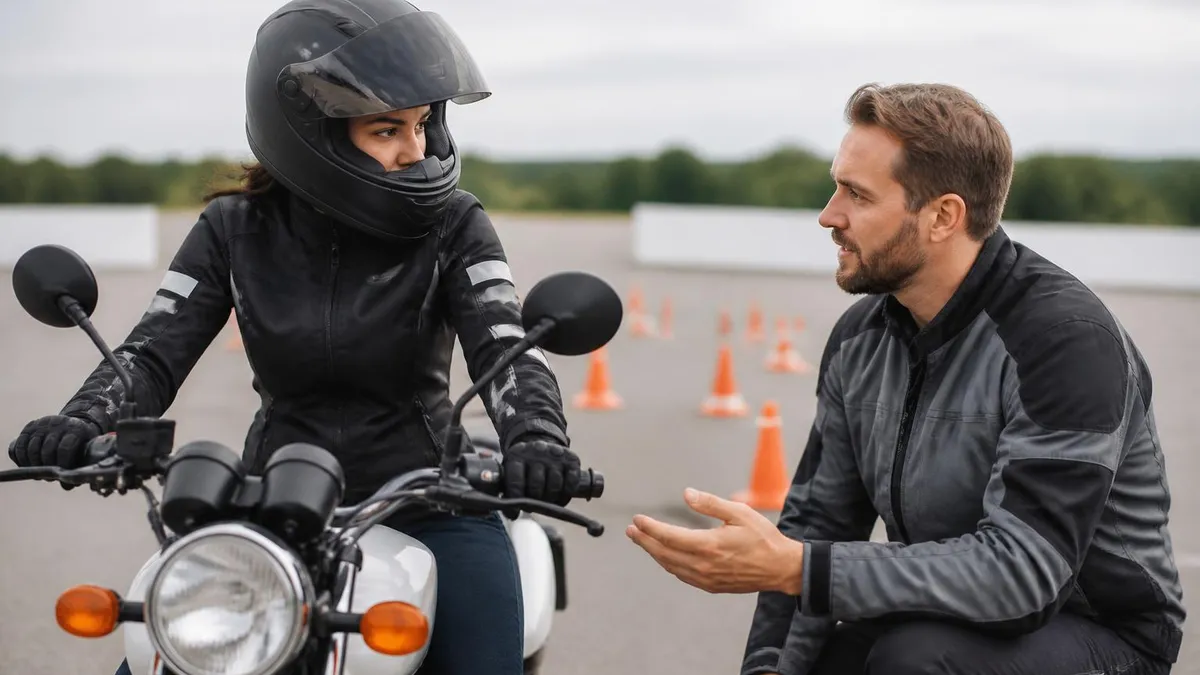
MSF Motorcycle Course: Complete 2026 Training Guide & Test Prep
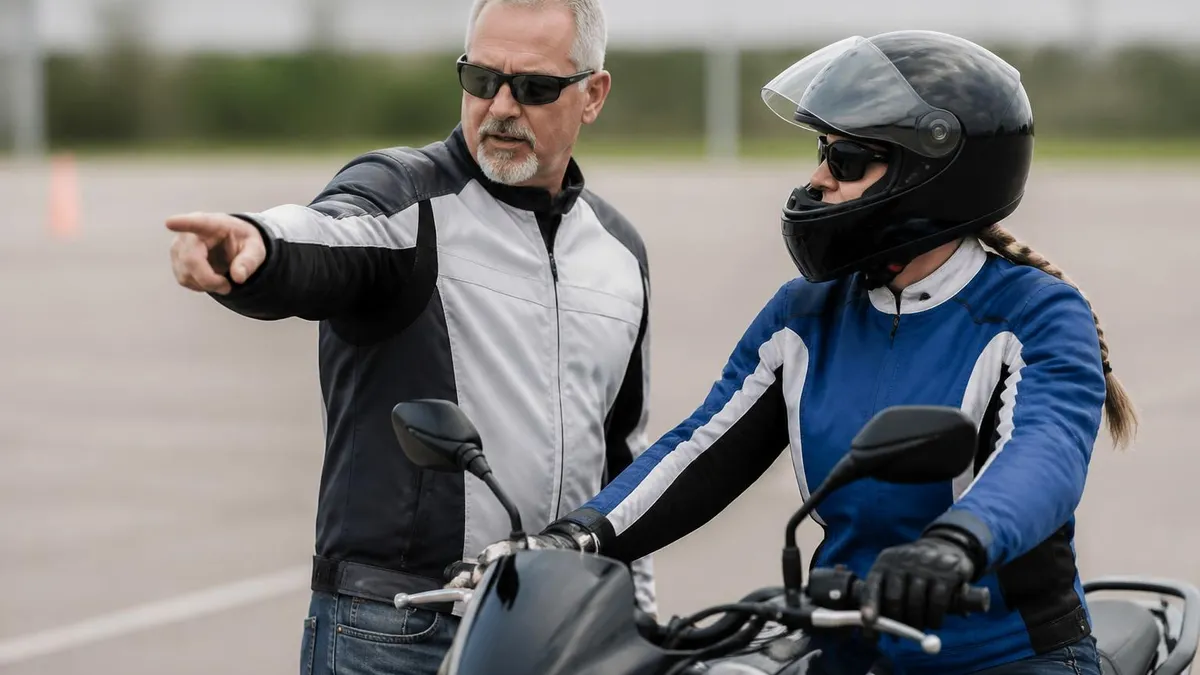
Cheap MSF Course Near Me: 2026 Guide to Affordable Motorcycle Safety Training

MSF Practice Test 2026 — Free Online Questions for the MSF Written Test
About the Author

Business Consultant & Professional Certification Advisor
Wharton School, University of PennsylvaniaKatherine Lee earned her MBA from the Wharton School at the University of Pennsylvania and holds CPA, PHR, and PMP certifications. With a background spanning corporate finance, human resources, and project management, she has coached professionals preparing for CPA, CMA, PHR/SPHR, PMP, and financial services licensing exams.