
Is MRI Covered by Insurance? Coverage, Costs, and How to Get Approved
🆕 Is MRI covered by insurance? Yes for medically necessary scans with prior auth. See typical 60-80% in-network coverage, Medicare 80% rule, costs.
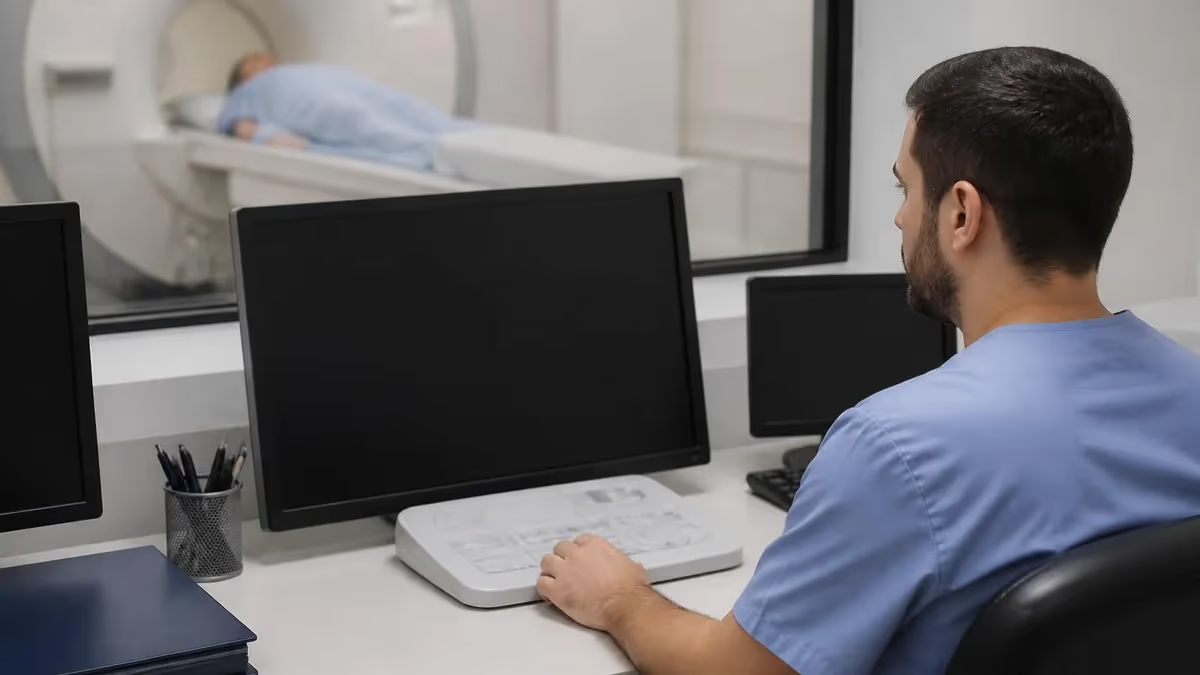
If your doctor just ordered an imaging study and you are asking, is MRI covered by insurance, the short answer is yes for most medically necessary scans, but the details determine whether you pay $50 or $5,000. Magnetic resonance imaging is one of the most expensive routine outpatient procedures in American healthcare, with sticker prices ranging from $400 at a freestanding imaging center to more than $12,000 at a hospital outpatient department. Coverage rules, deductibles, copays, and prior authorization requirements all influence your final bill.
Nearly every commercial insurance carrier, Medicare Part B, Medicaid, TRICARE, and Veterans Affairs plans cover MRI scans when they meet medical necessity standards. The catch is that medical necessity is defined by your insurer, not your doctor, and many plans require a prior authorization decision before the scan is performed. Without that approval, even a perfectly justified scan can be denied, leaving you responsible for the full billed charge plus any facility fees.
The financial impact of MRI coverage is more than academic. According to a 2024 RAND Corporation analysis, private insurance plans pay hospitals an average of 2.7 times what Medicare pays for the identical MRI study. That means the same brain MRI you might get on a Monday at an in-network outpatient center for $600 could cost $2,400 on a Tuesday in a hospital outpatient department even though the images and radiologist read are identical. Knowing your coverage details before the scan is scheduled is the single best way to control cost.
This guide walks through how MRI coverage works across major insurance categories, what prior authorization really means, why in-network versus out-of-network matters so much, how high-deductible health plans change the math, and how to appeal a denial. We will also cover the role of secondary insurance, how to read your Explanation of Benefits, and practical strategies to lower your out-of-pocket cost without sacrificing diagnostic quality. Before booking your appointment, it helps to understand MRI with and without contrast because contrast studies are billed at higher rates and may require additional authorization.
One important distinction: coverage is not the same as affordability. A plan can technically cover an MRI while still leaving you with a four-figure bill because of an unmet deductible, coinsurance percentages, or out-of-network balance billing. Roughly 31 percent of insured Americans report skipping or delaying recommended imaging due to cost concerns, according to a 2025 Kaiser Family Foundation survey. Understanding the structure of your plan is what turns coverage into actual financial protection.
Finally, MRI is rarely an emergency procedure outside of stroke and trauma protocols. Most outpatient MRIs are scheduled, which gives you time to verify benefits, shop pricing, and resolve authorization issues. Use that scheduling window. Patients who call their insurer before the scan pay an average of 27 percent less than patients who simply show up and receive a bill weeks later. The pages that follow give you the exact playbook to do that.
Whether you have a Marketplace plan, employer-sponsored insurance, traditional Medicare, Medicare Advantage, Medicaid, or no insurance at all, there is a path to a fair MRI price. Let us break down the rules carrier by carrier and scenario by scenario.
MRI Coverage and Cost by the Numbers

MRI Coverage by Insurance Type
Most PPO, HMO, and EPO plans cover medically necessary MRI after deductible. Expect 10-30% coinsurance and a prior authorization requirement for advanced imaging through a radiology benefits manager like eviCore or Carelon.
Covers 80% of the Medicare-approved amount for outpatient MRI after the annual Part B deductible. You pay 20% coinsurance, which a Medigap or supplement plan can absorb. No prior authorization for traditional Medicare in most cases.
Coverage matches traditional Medicare benefits but almost always requires prior authorization. Copays are typically $50-$300 per MRI depending on plan tier. Network restrictions apply and out-of-network MRIs may be denied entirely.
Covers MRI when ordered by a participating provider and deemed medically necessary. Cost to the patient is usually $0 to $5. Coverage rules and prior authorization protocols vary significantly by state.
Cover MRI as an essential health benefit under diagnostic imaging. Bronze plans typically apply full deductible first. Silver, Gold, and Platinum plans may use copays. All plans must allow internal and external appeals.
The price of an MRI varies more than almost any other routine medical procedure in the United States. According to 2025 data from the Health Care Cost Institute, the national median commercial price for an outpatient MRI is $1,325, but the range from the 10th to the 90th percentile spans $370 to $4,200 depending on body part, contrast use, facility type, and geographic market. Your insurance plan determines which slice of that range you actually pay, and the cost-sharing structure is the lever you can negotiate.
Most commercial insurance plans apply a three-step formula. First, you pay 100 percent of the negotiated rate until your annual deductible is met. Second, after the deductible, you pay a coinsurance percentage, typically 10 to 30 percent of the allowed amount. Third, once your out-of-pocket maximum is hit, the plan pays 100 percent of covered services for the rest of the plan year. If your deductible is high and your year is young, even a fully covered MRI can produce a bill of $1,000 or more before coinsurance ever applies.
Copay-based plans work differently. Instead of percentages, you pay a flat dollar amount, often $150 to $500, for the MRI itself. Copays usually apply after the deductible on bronze and silver plans but may apply from the first dollar on gold, platinum, and richer employer plans. Read your Summary of Benefits and Coverage carefully: the line you want is labeled diagnostic imaging or advanced imaging, not basic X-ray, which is billed at a much lower rate.
Facility fees can double or triple your total bill even when the technical and professional MRI charges are reasonable. Hospital outpatient departments add a facility fee that freestanding imaging centers do not. A 2025 Peterson-KFF study found that hospital outpatient MRIs cost private insurers an average of $1,950 per scan compared with $720 at independent imaging centers for identical CPT codes. Many insurers maintain steerage programs that waive copays or coinsurance when you choose a designated low-cost facility, so always check your plan portal before scheduling.
Contrast-enhanced MRIs cost more than non-contrast studies. Gadolinium contrast adds $150 to $450 to the technical fee and may trigger a separate prior authorization requirement. If your doctor ordered MRI with and without contrast, you are technically getting two studies sequenced together and the bill reflects that. Some plans cover only one phase unless the radiologist or ordering physician documents specific medical necessity. Reading MRI medical abbreviation shorthand on your order helps you confirm whether the scan is with, without, or both.
Out-of-network MRIs are a financial trap. Even if your plan offers out-of-network coverage, the allowed amount is set by the insurer, not the provider, which means balance billing for the difference is legal in most states for non-emergency outpatient imaging. The federal No Surprises Act protects you from surprise out-of-network bills at in-network hospitals, but a standalone out-of-network MRI center is not covered by that law. Verify network status with your insurer using the National Provider Identifier of the imaging center, not just its name.
Finally, watch for the professional and technical fee split. Your MRI bill is usually two charges: one from the imaging facility for the scan itself and one from the radiologist who interpreted the images. These may come from different entities, and either one can be out of network even when the other is in network. Ask the scheduler to confirm that both the facility and the reading radiologist participate in your plan before you agree to the appointment.
MRI Practice Test Questions
Prepare for the MRI - Magnetic Resonance Imaging exam with our free practice test modules. Each quiz covers key topics to help you pass on your first try.
MRI Knowledge
MRI Exam Questions covering Knowledge. Master MRI Test concepts for certification prep.
MRI Physics
Free MRI Practice Test featuring Physics. Improve your MRI Exam score with mock test prep.
MRI Anatomy and Pathology
MRI Test Prep for MRI Anatomy and Pathology. Practice MRI Quiz questions and boost your score.
MRI Anatomy and Positioning
MRI Questions and Answers on MRI Anatomy and Positioning. Free MRI practice for exam readiness.
MRI Contrast Agents
Free MRI Quiz on MRI Contrast Agents. MRI Exam prep questions with detailed explanations.
MRI Patient Care and Positioning
MRI Practice Questions for MRI Patient Care and Positioning. Build confidence for your MRI certification exam.
How Prior Authorization for MRI Coverage Works
Prior authorization is the formal review your insurance plan performs before agreeing to pay for advanced imaging. Roughly 82 percent of commercial plans and nearly all Medicare Advantage plans require prior authorization for MRI. The review checks whether the ordered study meets evidence-based criteria such as the American College of Radiology Appropriateness Criteria. Without an approval number on file, the claim is denied even after the scan is performed.
Your ordering physician submits the request, often through a radiology benefits manager like eviCore, Carelon, or AIM. The reviewer evaluates the diagnosis code, clinical history, prior imaging, and whether conservative treatment was attempted when appropriate. Approvals are typically valid for 60 to 90 days. Knowing this timeline lets you schedule the scan promptly so the authorization does not expire and require resubmission.
In-Network vs Out-of-Network MRI Facilities
- +Negotiated rates lower the allowed amount by 40-70 percent compared with billed charges
- +Coinsurance applies to the smaller allowed amount, reducing your share of the bill
- +No balance billing for the difference between billed charges and what the insurer pays
- +Prior authorization is processed more smoothly when the facility is contracted
- +Both the facility and the reading radiologist are typically in network as a package
- +Out-of-pocket maximum protections fully apply to in-network services
- +Plan steerage programs may waive your copay if you use a preferred low-cost provider
- −Out-of-network facilities can balance bill you for the full difference between charge and allowed amount
- −Out-of-network deductibles and out-of-pocket maximums are usually much higher and separate from in-network
- −Coinsurance percentages are often double for out-of-network care, sometimes 40-50 percent
- −Prior authorization may be denied automatically when the facility is non-contracted
- −Radiologist reads may not transfer easily to in-network specialists for follow-up
- −Surprise billing protections under the No Surprises Act do not cover standalone outpatient MRI centers
- −Negotiating a single-case agreement for out-of-network coverage can take weeks and is not guaranteed
Pre-Scan Insurance Coverage Checklist
- ✓Call the member services number on your insurance card and ask if MRI is a covered benefit under your plan
- ✓Verify whether your plan requires prior authorization for the specific CPT code your doctor ordered
- ✓Confirm the imaging facility is in network using its National Provider Identifier, not just its business name
- ✓Ask whether the reading radiologist group is also in network with your plan
- ✓Check your remaining deductible and out-of-pocket maximum for the current plan year
- ✓Request a written cost estimate from the facility including technical, professional, and facility fees
- ✓Compare the estimate to the Medicare reimbursement rate for the same CPT code as a sanity check
- ✓Confirm the prior authorization approval number is on file before the scan date
- ✓Bring your insurance card, photo ID, physician order, and authorization number to the appointment
- ✓Ask if the facility offers a prompt-pay discount or financial assistance program if you have high cost sharing
Always call ahead and confirm three things
Before scheduling any MRI, confirm in writing: (1) the facility and radiologist are both in network, (2) prior authorization is approved with a reference number, and (3) the all-in cash price if you have a high-deductible plan. Patients who complete these three steps pay 27 percent less on average than patients who simply show up at the facility their doctor recommended. Ten minutes on the phone routinely saves $500 or more.
MRI claim denials are common, frustrating, and surprisingly reversible. According to a 2025 KFF analysis of Marketplace plans, roughly 17 percent of in-network MRI claims are denied on first submission and another 8 percent are denied for out-of-network reasons. The good news is that fewer than 1 percent of denied claims are ever appealed by patients, even though appeals succeed at a rate exceeding 50 percent when properly documented. Understanding the denial reason codes on your Explanation of Benefits is the starting point.
The most frequent denial reason is medical necessity not established. This usually means the insurer's reviewer did not see documentation of conservative treatment, prior imaging, or symptoms severe enough to justify advanced imaging. The fix is to have your ordering physician submit a letter of medical necessity that explicitly addresses the insurer's clinical criteria. Reference the American College of Radiology Appropriateness Criteria score for your diagnosis and include any relevant guidelines from specialty societies.
The second most common denial is missing prior authorization. If the scan was already performed without authorization, you can request retroactive authorization, which is allowed in many states and under most plan contracts when the request is filed within 14 days of the service. Hospitals and imaging centers will sometimes pursue this on your behalf, but it is your right to file directly. Include the order date, scan date, and a clinical summary from your physician.
Out-of-network denials are trickier. If your in-network facility used an out-of-network reading radiologist, you may be protected by the federal No Surprises Act, but only in certain hospital and emergency settings. For standalone imaging centers, your protection depends on your state. Twenty-eight states currently have surprise-billing laws that extend to outpatient imaging. Contact your state insurance department to learn what applies in your jurisdiction.
Coding errors cause an estimated 14 percent of MRI denials. The CPT code billed must match what was authorized. If your authorization specified CPT 70553 (brain MRI with and without contrast) but the facility billed 70551 (without contrast only), the claim is denied even though the scan was performed correctly. Request a corrected claim from the facility's billing office before filing an appeal.
Document everything during an appeal. Keep copies of the original order, the authorization request and decision, the scan report, the EOB, and any correspondence. Insurers have 30 days to decide standard internal appeals and 60 days for retrospective appeals. If the internal appeal is denied, you have 4 months in most states to request an external independent review, which is decided by a third-party physician with no financial ties to the insurer.
If you feel overwhelmed, free help is available. Every state has a consumer assistance program funded under the Affordable Care Act, and nonprofits like the Patient Advocate Foundation offer free case management for insurance disputes. The Centers for Medicare and Medicaid Services also run a Marketplace call center that can connect Marketplace enrollees to appeal resources. Persistence pays: the GAO found that patients who pursue all three levels of appeal succeed in overturning denials 71 percent of the time on imaging-related claims.

Even at an in-network imaging facility, the radiologist who reads your scan may be out of network. Always ask the scheduler to confirm both the facility and the reading group participate in your plan. If a surprise bill arrives anyway, file a No Surprises Act complaint at cms.gov/nosurprises within 120 days. The federal Independent Dispute Resolution process can erase or substantially reduce balance bills you should never have received in the first place.
Lowering your MRI bill starts with knowing the cash price of the procedure at multiple local facilities. Federal hospital price transparency rules require every hospital to publish a machine-readable file of negotiated rates and cash prices. Tools like Turquoise Health, Sidecar Health, and the CMS Procedure Price Lookup let you compare those rates without manually parsing 10,000-line spreadsheets. The cash price at a freestanding center is often lower than your in-network coinsurance share at a hospital, especially under high-deductible plans.
Health savings accounts and flexible spending accounts both allow tax-advantaged spending on MRI. An HSA-eligible high-deductible plan combined with a fully funded HSA effectively converts your MRI from a post-tax expense to a pre-tax one, saving 22 to 37 percent depending on your marginal tax bracket. Even if the cash price feels steep, paying with HSA dollars reduces the effective cost meaningfully. Save every receipt and EOB for tax documentation.
Negotiating directly with the facility works more often than patients expect. About 65 percent of imaging centers will offer a prompt-pay discount of 10 to 40 percent if you pay the full bill within 30 days. Hospitals are required to offer financial assistance to patients below specific income thresholds, often 200 to 400 percent of the federal poverty line, and many extend partial assistance well beyond that. Ask for the financial assistance application before you receive the scan, not after.
Consider whether you actually need the scan in the location your doctor's office defaults to. Doctor's offices often schedule MRI at the affiliated hospital out of convenience, not because it is the right facility for you. Politely ask your physician to send the order to a specific lower-cost imaging center instead.
Most practices are willing to do this once you make the request. Pairing a low-cost facility with a quality radiologist read keeps clinical outcomes equivalent at a fraction of the cost. If you need help locating one, this guide on MRI scan near me walks through how to find and vet local options.
Telehealth second opinions can prevent unnecessary scans entirely. Roughly 25 percent of advanced imaging is considered low-value care by the Choosing Wisely initiative, meaning it is unlikely to change clinical management. If you are uncertain whether your MRI is truly indicated, a second-opinion consult, often $50 to $150, may save you thousands in deductible spend and contrast exposure. Insurers do not penalize you for getting a second opinion before the scan is performed.
For uninsured patients, direct-pay MRI markets have grown substantially. Companies like MDsave, SaveOnMedical, and Sesame offer pre-negotiated bundled rates that include facility, radiologist, and report, sometimes for less than $500 total. These platforms work especially well for non-contrast extremity, lumbar, or cervical MRIs. Always confirm the bundle covers both technical and professional components so you do not receive a surprise read fee later.
Finally, time your scan strategically. If you have a high-deductible plan and have already met your deductible from earlier medical care this year, scheduling the MRI before December 31 maximizes the value of that already-spent deductible. Conversely, if your deductible is barely touched and the scan is not urgent, waiting until January may be wise so that the spending counts toward two plan years' out-of-pocket maximums combined with other expected care.
Beyond the basic insurance mechanics, a handful of practical habits will keep your MRI experience on track financially and clinically. Start a simple paper or digital folder for every scan you have: physician order, authorization confirmation, scan date and CPT codes, EOB, and patient statement. Cross-referencing these documents takes minutes and reveals billing errors that you would never catch from a statement alone. Patients who maintain documentation correct billing mistakes worth an average of $340 per scan, per a 2024 Healthcare Bluebook audit.
If you are managing a chronic condition that requires recurring MRI, such as multiple sclerosis, oncology surveillance, or musculoskeletal monitoring, ask your specialist for a standing order valid for the calendar year. Standing orders often qualify for bulk pre-authorization, which reduces administrative friction and lets you book scans on short notice without re-running the authorization process every visit. Confirm your plan accepts standing-order authorization before relying on this approach.
For Medicare beneficiaries, the difference between traditional Medicare with Medigap and Medicare Advantage can be thousands of dollars over a multi-MRI year. Traditional Medicare with a Plan G Medigap pays 100 percent of Part B coinsurance after a small deductible, which means most beneficiaries pay $0 out of pocket for MRI. Medicare Advantage plans charge per-scan copays that add up quickly if you have several scans annually. Run the math during open enrollment if MRI is part of your care plan.
Be cautious about open MRI versus closed MRI cost differences. Open MRIs use lower field strengths, often 0.3 to 0.7 Tesla, compared with the 1.5 or 3 Tesla closed magnets that produce diagnostic-quality images for most clinical questions. Some plans cover open MRI only when claustrophobia or weight limits make a closed scan impossible. If you choose open MRI for comfort alone, you may receive a denial. Discuss alternatives like wide-bore 3T scanners that offer space without sacrificing field strength.
Workers' compensation and personal injury cases bypass standard insurance entirely. If your MRI is being ordered after a workplace injury or motor vehicle accident, the carrier handling the claim pays directly and you owe nothing out of pocket, but only if the scan is documented as related to the covered injury. Make sure your physician's order explicitly references the injury date and mechanism. Otherwise, the claim may be routed to your health insurance and you will face cost sharing.
If you are between jobs and uninsured during your MRI need, look into Health Insurance Marketplace special enrollment periods and short-term medical plans cautiously. Short-term plans often exclude advanced imaging or impose internal caps that leave you exposed. A bronze Marketplace plan with the Advanced Premium Tax Credit is almost always a better choice if you qualify, even for a single month of coverage during an active diagnostic workup. The historical context of how imaging access has evolved is summarized in this overview of the history of MRI.
Finally, plan the post-scan workflow. Request that the radiology report be sent both to your ordering physician and directly to you via the patient portal. Review the impression section yourself before your follow-up. If the report mentions unexpected findings, request a copy of the actual DICOM images on disc or via cloud transfer so any specialist you consult can view the source data, not just the report. This step is free, takes one phone call, and prevents repeat MRI orders down the road.
MRI Questions and Answers




About the Author

Medical Laboratory Scientist & Clinical Certification Expert
Johns Hopkins UniversityDr. Sandra Kim holds a PhD in Clinical Laboratory Science from Johns Hopkins University and is certified as a Medical Technologist (MT) and Medical Laboratory Scientist (MLS) through ASCP. With 16 years of clinical laboratory experience spanning hematology, microbiology, and molecular diagnostics, she prepares candidates for ASCP board exams, MLT, MLS, and specialist certification tests.
Join the Discussion
Connect with other students preparing for this exam. Share tips, ask questions, and get advice from people who have been there.
View discussion (8 replies)