
How Long After MEPS Do You Go to Basic Training? 2026 October
⏳ Learn the exact timeline from MEPS to basic training, what happens between swearing in and ship date, and how to prepare for your report date.
How Long After MEPS Do You Go to Basic Training?
You've cleared medical, aced the ASVAB, and sworn the oath — now you're wondering how long you'll be sitting around before the real thing starts. The honest answer: it depends on your branch, your job, and how your recruiter works the system. That said, most recruits ship out anywhere from two weeks to six months after visiting MEPS.
This guide breaks down the complete timeline, explains why delays happen, and tells you exactly what to do while you wait.
The MEPS to Basic Training Timeline — Step by Step
Think of the path from MEPS military processing to basic training as a series of checkpoints rather than one straight line. Here's what typically happens after you leave the station:
Step 1: The Oath of Enlistment
Right after your medical exam and job selection, you raise your right hand and take the oath. Some recruits swear in during their very first MEPS visit; others return on a separate "swear-in" day. Either way, this is the moment you officially enter the Delayed Entry Program — better known as the DEP.
Step 2: The Delayed Entry Program (DEP)
DEP is a holding program that lets the military lock in recruits before open training slots exist. You're technically enlisted but haven't shipped yet. Most recruits spend between 30 days and 365 days in DEP, though the average hovers around 3 to 4 months. If you negotiated a guaranteed ship date up front — which your recruiter can sometimes arrange — you could be out the door in as little as two weeks.
Step 3: Getting Your Ship Date
Your recruiter calls Military Entrance Processing Command (MEPCOM) to find open training seats. Your ship date is dictated by:
- Your chosen Military Occupational Specialty (MOS or rate)
- Available basic training capacity at the specific post or base
- Your branch's current manning levels
- Any waivers that need processing before you can ship
High-demand jobs sometimes get ship dates within weeks. Specialized technical roles — cyber, intelligence, certain aviation pipelines — can stretch the wait close to a year because training pipelines are tightly capacity-controlled.
Step 4: Pre-Ship Medical Re-Check
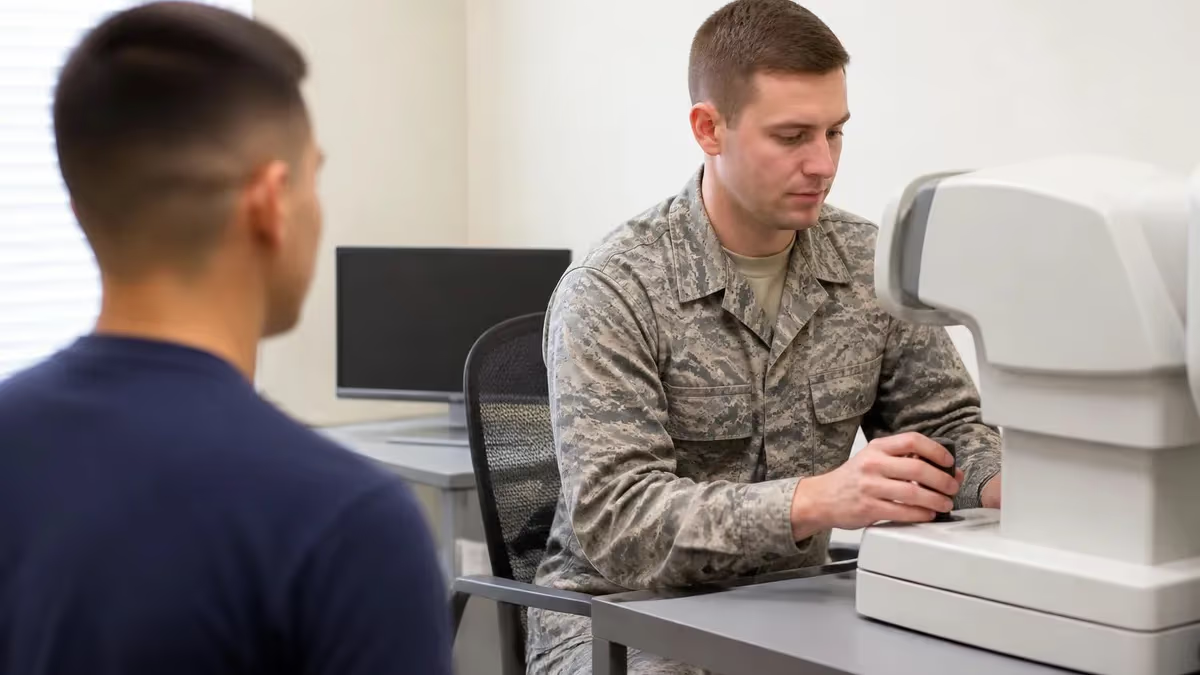
About 72 hours before your ship date, you'll typically return to MEPS or report to a Military Entrance and Processing Station liaison for a quick records review and sometimes a physical re-screen. This isn't another full-day event — it's mostly a paperwork and vitals check. However, if anything has changed medically since your original exam (injury, new prescription, weight change outside standards), it can delay shipment.
Step 5: Ship Day
You report to a centralized location — often a hotel near the MEPS — where you'll meet other recruits heading to the same installation. You fly or bus to your basic training location, arrive late at night, and step off into the receiving process. Technically, you haven't started "basic" quite yet; you're in the in-processing phase, which lasts 1–3 days before you join a training company.
How Long Is the Wait for Each Branch?
Each branch handles its DEP pipeline differently. Here's a realistic breakdown:
Army: Ship dates range from 2 weeks to 12 months. Infantry, combat arms, and high-need MOS slots fill quickly — sometimes same month. Technical MOS jobs with long school pipelines often delay shipment because Advanced Individual Training (AIT) scheduling backs up.
Navy: Typically 3 to 9 months. Navy rates (jobs) with high-school pipeline demand, like nuclear field ratings, frequently have long waits due to limited school capacity.
Marine Corps: The Corps operates differently — many recruits are kept in DEP 3 to 6 months as a deliberate preparation window. Recruiters often use this time to run pool functions, physical fitness training, and leadership check-ins.
Air Force: Historically has the longest DEP waits — sometimes up to 12 months or more — because it's the most selective branch and has fewer basic training slots relative to applicants. That said, the Air Force periodically opens accelerated ship windows when manning shortfalls appear.
Coast Guard: Expect 3 to 9 months. It's the smallest branch, has just one basic training location (Cape May, NJ), and accepts fewer recruits per cycle.
Space Force: Because it's the newest and smallest branch, Space Force pipelines vary widely. Many recruits wait 4 to 8 months and then attend a joint BMT at Lackland AFB alongside Air Force trainees.
What Can Speed Up or Slow Down Your Timeline?
Several factors are directly within your control — or at least worth understanding so you can have a real conversation with your recruiter.
Factors That Speed Things Up
Choosing a high-demand job is the single biggest accelerator. If you're flexible on your MOS or rate, you can often ship within weeks. Recruits who score high on the ASVAB and can qualify for multiple jobs have more use to negotiate an early ship date.
Maintaining your weight and physical fitness matters too. Recruits who drift out of body composition standards after their MEPS visit can get pulled from their ship date and rescheduled — sometimes months later. Show up at ship day at or below your initial weight and you'll have no issues.
Factors That Slow Things Down
Medical waivers are the most common delay. If your original MEPS exam flagged a condition that required additional documentation or specialist review, that waiver process can run 30 to 90 days on its own. Security clearance requirements for certain jobs add another layer — even before you attend training, the pre-processing for a clearance investigation can stretch timelines considerably.
Limited training capacity is entirely out of your hands. Basic training installations run on tight class schedules. If you're assigned to a job with one starting class per quarter, you're waiting for the next cycle.
Staying Productive During DEP
The gap between MEPS and basic training isn't dead time — treat it as an investment period. Here's what actually moves the needle:
- Run more than you think you need to. The Physical Fitness Test (or its branch equivalent) happens early in basic training. Showing up already in shape means you spend mental energy learning rather than surviving.
- Study your general orders, rank structure, and phonetic alphabet. Recruits who show up knowing these fundamentals make a strong first impression.
- Attend DEP pool functions if your recruiter offers them. These are low-key group sessions where you train with other recruits and get questions answered.
- Sort out your finances and personal obligations. Cancel leases, set up power of attorney if needed, close unnecessary accounts. Basic training is not the place to be worrying about whether your car payment went through.

Can You Quit DEP Before Shipping?
Technically, yes — but it's not as simple as just not showing up. DEP is a legal contract. If you want to discharge from it before shipping, you submit a DEP discharge request to your recruiter, who forwards it up the chain. Most discharges are granted, especially for legitimate reasons like a qualifying hardship. However, if you simply ghost your recruiter or don't show on ship day, you're listed as a deserter by paperwork even though no criminal charges typically follow for pre-ship DEP. It does close the door on enlisting again for a minimum of two years and creates a permanent record that follows you through any future government employment checks.
The smarter move: communicate early. Recruiters deal with cold feet all the time — if your circumstances have genuinely changed, a conversation is always better than a no-show.
What Happens If You Miss Your Ship Date?
Life happens — illness, a family emergency, a car accident on the way to the hotel. Missing a ship date isn't automatically the end of your enlistment. You should contact your recruiter immediately. In most cases, you'll be rescheduled for the next available class, which could be days or weeks out depending on the training pipeline. If the reason is medical, you may need to return to MEPS for re-evaluation before you're cleared again.
Patterns of missing ship dates or no-showing without notice are treated more seriously and can result in a formal DEP discharge with a note that you're ineligible to re-enlist.
MEPS to Basic Training: The Full Picture
Most recruits spend more time in DEP than they expect — and that's fine. Use every week of it to get faster, stronger, and better prepared. When you finally step off that bus at Fort Jackson or Parris Island or Lackland, the waiting will feel like the easy part. The recruits who show up physically ready and mentally organized are the ones who lead their flight, platoon, or company by week three.
Want to keep sharpening your knowledge before you ship? The meps asvab is a solid starting point, and our MEPS practice test covers the kinds of questions you can expect during the full processing day. The more you know about the process, the less intimidating it is.
Sample MEPS - Military Entrance Processing Stations Practice Questions
Try these questions from our free MEPS - Military Entrance Processing Stations practice tests. The correct answer and an explanation follow each question.
How does the military handle a recruit who tests positive for drugs during basic training (after enlisting at MEPS)?
- A. They are sent back to MEPS for re-evaluation
- B. They may be subject to non-judicial punishment (Article 15) and/or separation from service
- C. They are promoted to learn from the experience
- D. They are transferred to a different unit
Answer: B. They may be subject to non-judicial punishment (Article 15) and/or separation from service
A positive drug test after enlisting and entering service can result in Article 15 non-judicial punishment, separation (discharge), and/or criminal prosecution under the Uniform Code of Military Justice (UCMJ).
How long can a recruit remain in the Delayed Entry Program before shipping to basic training?
- A. 30 days maximum
- B. 6 months maximum
- C. Up to 365 days
- D. Up to 18 months
Answer: C. Up to 365 days
Most branches allow recruits to remain in the DEP for up to one year (365 days) before they must ship to basic training.
During the final 'shipper inspection' on the day an applicant is scheduled to depart for basic training, what is a primary focus of the MEPS staff?
- A. Conducting a final interview to gauge the applicant's motivation and morale.
- B. Re-administering the ASVAB to ensure the applicant's scores have not changed.
- C. Reviewing the applicant's social media accounts for any new disqualifying activity.
- D. Verifying the applicant's weight is still within standards and checking for any new injuries, tattoos, or illnesses.
Answer: D. Verifying the applicant's weight is still within standards and checking for any new injuries, tattoos, or illnesses.
The shipper inspection is a final quality control check to ensure the applicant is still fully qualified on the day they are set to leave. This includes a weight check, a visual inspection for any new or undisclosed conditions like injuries or tattoos, and a direct inquiry about their current health.
How long can a recruit typically remain in the Delayed Entry Program before reporting to basic training?
- A. Up to 30 days
- B. Up to 6 months
- C. Up to 12 months
- D. Up to 24 months
Answer: C. Up to 12 months
Recruits can remain in the DEP for up to 12 months (365 days) before they must report to basic training.
Take the full MEPS - Military Entrance Processing Stations practice test
Ready to Test Your MEPS Knowledge?
Understanding what MEPS means and how the process works puts you ahead of most recruits who walk in cold. If you want to make the most of your DEP period, start with our practice materials — they're built around the real content areas tested and reviewed at the station.
Use the time you have now. Every week in DEP is a week you could be getting faster on the run, more confident under pressure, and better prepared for the structure of military life. The recruits who take DEP seriously are almost always the ones who thrive in basic training.
About the Author
Retired Military Officer & Armed Forces Test Preparation Specialist
United States Army War CollegeColonel Steven Harris (Ret.) served 28 years in the US Army, earning a Master of Arts in Military Science from the Army War College and a Bachelor of Science in Criminal Justice. He has coached thousands of military enlistment and officer candidate program applicants through the ASVAB, AFQT, AFCT, OAR, and officer selection assessment processes across all military branches.
Join the Discussion
Connect with other students preparing for this exam. Share tips, ask questions, and get advice from people who have been there.
View discussion (8 replies)