
MEPS ASVAB Test: What to Expect and How to Prepare 2026 October
📝 Find out how the MEPS ASVAB test works, what scores you need for military jobs, and how to prepare with practice tests and study tips.
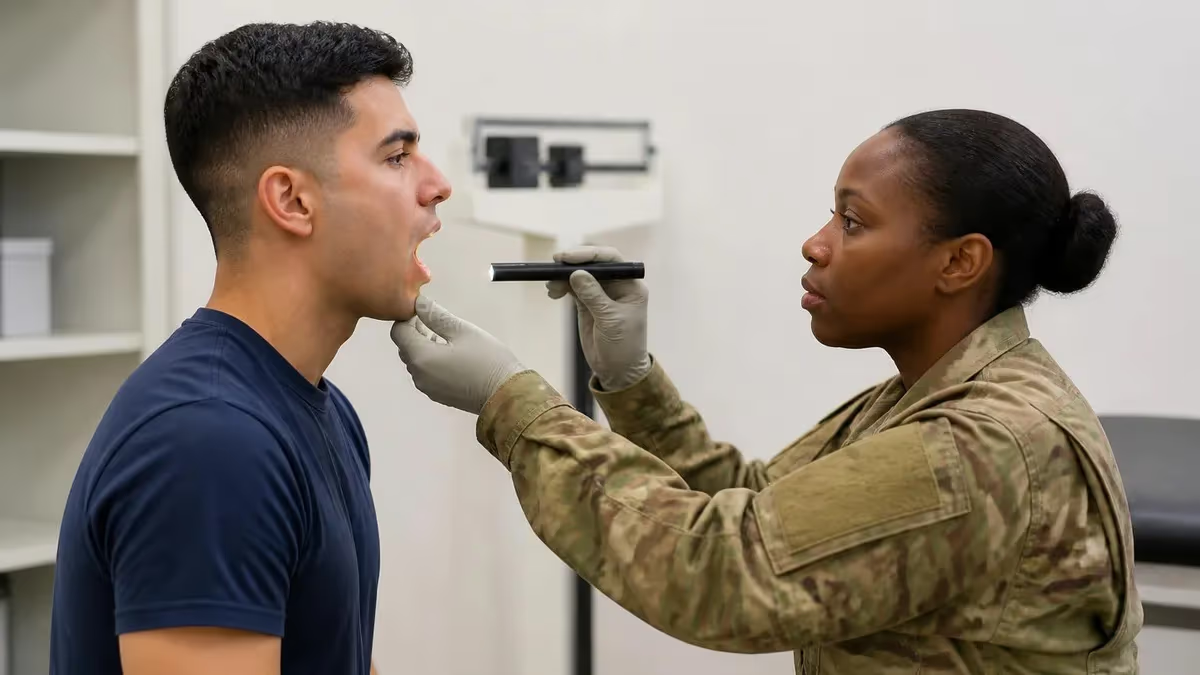
The ASVAB test at MEPS isn't like most tests you've taken. There's no rubric that tells you what grade you'll get. Instead, your scores determine which military jobs you're eligible for — and in some branches, whether you can enlist at all. That makes it one of the highest-stakes assessments in the military entry process, even though it doesn't look like a traditional pass/fail exam.
Understanding how the MEPS ASVAB test works — what it measures, how scores are calculated, and what scores mean for your career options — is the first step toward a smart preparation strategy. This guide covers all of that, plus what to expect when you sit down at a MEPS testing station.
Quick clarification on terminology: ASVAB stands for Armed Services Vocational Aptitude Battery. It's administered both at MEPS (Military Entrance Processing Stations) and at certain high schools and career centers through a program called the Student Testing Program. The MEPS version is the one that counts for enlistment purposes — it's the official, proctored version that your branch uses to determine eligibility and job qualification.
What the MEPS ASVAB Tests
The ASVAB is a multi-section aptitude battery — not a test of military knowledge, but of general academic and occupational aptitudes. It's designed to predict how well you'll learn and perform in different job categories. The full ASVAB has 10 subtests:
- General Science (GS) — Physical, earth, space, and biological sciences
- Arithmetic Reasoning (AR) — Word problems involving basic math operations
- Word Knowledge (WK) — Vocabulary, synonyms, and context-based word meaning
- Paragraph Comprehension (PC) — Reading passages and answering questions
- Mathematics Knowledge (MK) — Algebra, geometry, and number theory concepts
- Electronics Information (EI) — Electrical concepts, circuits, and terminology
- Auto & Shop Information (AS) — Automotive systems and basic shop tools
- Mechanical Comprehension (MC) — Principles of mechanics, force, and motion
- Assembling Objects (AO) — Spatial reasoning and pattern recognition
- Verbal Expression (VE) — A composite score combining WK and PC
At MEPS, the ASVAB is computer-based through a platform called CAT-ASVAB (Computerized Adaptive Testing). This means the difficulty of questions adjusts based on your responses — you'll get harder questions when you answer correctly and easier ones when you don't. You won't see a set list of questions in advance; the test adapts in real time.
The AFQT Score: The Number That Matters Most
Your overall ASVAB performance is expressed through multiple score types, but the most important one for enlistment eligibility is the Armed Forces Qualification Test (AFQT) score. This is a percentile score derived from four subtests: Arithmetic Reasoning, Math Knowledge, Word Knowledge, and Paragraph Comprehension.
Your AFQT score tells you how you performed compared to a nationally representative sample of people aged 18–23. An AFQT score of 50, for example, means you scored higher than 50% of that reference group. It's not a percentage of questions answered correctly — it's a percentile.
Each branch has a minimum AFQT score for enlistment:
- Army — Minimum 31 (waiver may reduce to 26)
- Navy — Minimum 35
- Marine Corps — Minimum 32
- Air Force — Minimum 36
- Coast Guard — Minimum 40
- Space Force — Minimum 36
Meeting the minimum only gets you through the door. For competitive enlistment and access to higher-skilled jobs, you want to score well above the minimum.
Line Scores and Military Job Qualification
Beyond the AFQT, individual job eligibility is determined by "line scores" — composite scores calculated from different combinations of ASVAB subtests. Each branch uses its own line score formulas, and each military occupational specialty (MOS/rate/AFSC) has minimum line score requirements.
For example, Army jobs are sorted into categories like Clerical (CL), Combat (CO), Electronics (EL), Field Artillery (FA), General Technical (GT), Mechanical Maintenance (MM), Operators and Food (OF), Surveillance and Communications (SC), and Skilled Technical (ST). Each category has its own composite formula.
Want to be a Combat Engineer in the Army? You'll need to meet the Combat line score minimum. Want to work in Army intelligence or signals? You'll likely need strong Electronics and General Technical line scores. The specific job you're interested in has specific score requirements — looking those up before the exam helps you understand which subtests to prioritize in your preparation.
What Happens at MEPS Testing Day
Most applicants take the ASVAB either the day before or the morning of their full MEPS processing day. If you're staying overnight at a MEPS-contracted hotel, testing typically happens early the following morning.
You'll be seated at a computer terminal in a quiet testing room. No food, no phones, no reference materials. The proctor will walk you through the instructions before you begin.
CAT-ASVAB is untimed per question — you move through the subtests at your own pace within the overall time constraints for each section. You can't go back to change previous answers within a subtest (another feature of adaptive testing). Read each question carefully before answering.
The full ASVAB typically takes 1.5 to 3 hours to complete, depending on your pace. After testing, you'll usually know your AFQT score the same day — MEPS counselors often share results as part of the job selection and counseling process that follows.
Retaking the ASVAB at MEPS
If your AFQT score doesn't meet the minimum for your desired branch, or if you want to improve your line scores for specific jobs, you can retake the ASVAB — but there are mandatory waiting periods.
- First retest: At least 1 calendar month after the initial test
- Second retest: At least 1 calendar month after the first retest
- Subsequent retests: At least 6 months between attempts
There's no limit on the total number of times you can take the ASVAB, but branches can set their own policies on how many retests they'll accept within a certain timeframe. Talk to your recruiter about your branch's specific policies before planning a retest.
One important note: you must use the score from your most recent ASVAB attempt. You can't choose to use a previous higher score if your most recent test comes in lower. So don't rush to retest if you're not confident you'll improve.

Sample MEPS - Military Entrance Processing Stations Practice Questions
Try these questions from our free MEPS - Military Entrance Processing Stations practice tests. The correct answer and an explanation follow each question.
An applicant fails the initial hearing test at MEPS. The test showed a hearing threshold level greater than 30 decibels (dB) at 1,000 and 2,000 Hz in one ear. According to DoD standards, what is the status of this applicant?
- A. Automatically qualified, as hearing standards are flexible.
- B. Medically disqualified, as this exceeds the allowable threshold for those frequencies.
- C. Required to purchase and use a hearing aid during military service.
- D. Eligible only for administrative or desk-based job specialties.
Answer: B. Medically disqualified, as this exceeds the allowable threshold for those frequencies.
Department of Defense standards for enlistment specify that an applicant's hearing threshold level in each ear cannot be greater than 30 decibels (dB) on average for the frequencies of 500, 1000, and 2000 Hz, with no single level greater than 35 dB. Failing to meet this standard results in a medical disqualification, which may or may not be waiverable depending on the severity and cause.
An applicant at MEPS takes the Computerized Adaptive Test (CAT-ASVAB). During the Mathematics Knowledge subtest, they answer the first few questions correctly. What will the testing system most likely do next?
- A. Present the applicant with progressively more difficult questions.
- B. End the subtest early because proficiency has been demonstrated.
- C. Administer a set of randomly selected questions to verify the score.
- D. Switch to an easier set of questions to establish a baseline.
Answer: A. Present the applicant with progressively more difficult questions.
The CAT-ASVAB is an adaptive test, meaning it adjusts the difficulty of questions based on the test-taker's performance. If an applicant answers questions correctly, the system will present them with more challenging questions to accurately gauge their maximum aptitude level.
An applicant at a MEPS facility is disruptive and openly discussing specific ASVAB test questions with others in the waiting area. What is the most appropriate immediate action for the Test Administrator to take?
- A. Allow the applicant to take the test but make a note of the behavior.
- B. Issue a verbal warning and move the applicant to a different seating area.
- C. Confiscate the applicant's testing materials and cancel their test session.
- D. Report the incident to the MEPS Commander and security, as this is a serious breach of test security.
Answer: D. Report the incident to the MEPS Commander and security, as this is a serious breach of test security.
Discussing specific test questions is a severe breach of test security. MEPS personnel must take immediate action to stop the compromise, which includes reporting it to the command and security for appropriate handling.
What is the trick to help pass the depth perception test at MEPS?
- A. Cross your eyes and relax them
- B. Take a break and come back later
- C. Close your eyes and count to 10
- D. Focus on one circle and ignore the rest
Answer: A. Cross your eyes and relax them
Try to stay relaxed and avoid unnecessary stress or tension during the test. A calm and focused mindset can help you perform at your best.
Take the full MEPS - Military Entrance Processing Stations practice test
How to Prepare for the MEPS ASVAB
Most military recruiters will tell you that you can't really study for the ASVAB. That's not quite right — it's more accurate to say that you can't cram for it the night before. The ASVAB tests aptitudes developed over years of learning. But consistent, structured preparation over weeks or months can meaningfully improve your scores, especially in areas where you have genuine knowledge gaps.
Here's what actually works:
Start with a practice test to identify weak areas. Don't study everything equally. Take a full-length practice ASVAB, review your results by subtest, and focus your preparation on the sections where your scores are lowest — especially if those sections feed into the line scores for jobs you want.
Prioritize the AFQT sections. Arithmetic Reasoning, Math Knowledge, Word Knowledge, and Paragraph Comprehension contribute directly to your AFQT score. If enlistment eligibility is your primary concern, these four subtests deserve the most study time.
Build vocabulary systematically. Word Knowledge is one of the most improvable subtests. Flashcard apps, GRE vocabulary lists, and reading varied texts all help. Aim to add 10–15 new words to your active vocabulary per day in the weeks before your test.
Review math fundamentals. Both Arithmetic Reasoning and Mathematics Knowledge require solid arithmetic, algebra, and geometry. Khan Academy is a free, high-quality resource for reviewing these concepts. Work through practice problems — not just theory — to build speed and accuracy.
Practice under timed conditions. The CAT-ASVAB won't give you unlimited time. Build the habit of working through practice questions quickly and accurately by timing yourself during study sessions.
The ASVAB at MEPS practice tests here are structured to help you work through all ten subtests with the level of rigor the real exam demands. Use them regularly, review every explanation on questions you miss, and track your progress over time. That's the preparation pattern that translates to real score improvement.
- ✓Confirm your exam appointment and location
- ✓Bring required identification documents
- ✓Arrive 30 minutes early to check in
- ✓Read each question carefully before answering
- ✓Flag difficult questions and return to them later
- ✓Manage your time — don't spend too long on one question
- ✓Review flagged questions before submitting
About the Author
Retired Military Officer & Armed Forces Test Preparation Specialist
United States Army War CollegeColonel Steven Harris (Ret.) served 28 years in the US Army, earning a Master of Arts in Military Science from the Army War College and a Bachelor of Science in Criminal Justice. He has coached thousands of military enlistment and officer candidate program applicants through the ASVAB, AFQT, AFCT, OAR, and officer selection assessment processes across all military branches.
Join the Discussion
Connect with other students preparing for this exam. Share tips, ask questions, and get advice from people who have been there.
View discussion (8 replies)