
Mensa Test Questions: Complete Study Guide to IQ Practice Questions (2026 June)
Master mensa test questions with our complete study guide. Covers question types, strategies, and free practice tests to help you qualify for Mensa. ✍🏼
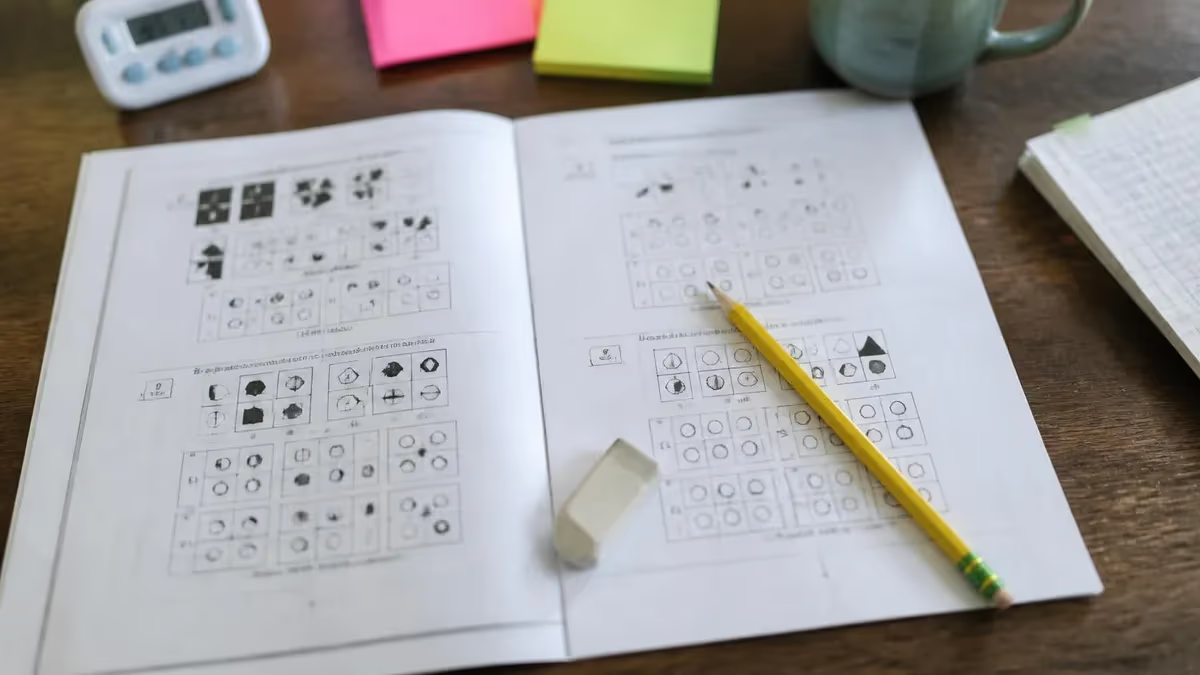
If you are serious about qualifying for one of the world's most exclusive high-IQ societies, understanding mensa test questions is your most important first step. Mensa accepts only the top 2% of the population based on standardized intelligence testing, and the questions you will encounter are carefully designed to measure abstract reasoning, pattern recognition, spatial visualization, verbal comprehension, and numerical ability.
Knowing what to expect — and more importantly, how to practice strategically — can meaningfully improve your performance on test day. This guide breaks down every major question type, explains the reasoning strategies that separate top scorers from average test-takers, and connects you to free practice resources so you can begin preparing right now.
Many first-time applicants are surprised to learn that Mensa does not administer one single proprietary test. Instead, the organization accepts scores from more than 200 approved standardized tests, including the Mensa Admission Test and the Mensa Wonderlic. If you want to understand mensa test questions in full context — including score thresholds and accepted tests — that resource covers everything you need.
What all accepted tests share is a heavy reliance on non-verbal and quantitative reasoning, which means language background gives relatively little advantage. The playing field is more level than many people assume, and dedicated preparation genuinely pays off when you approach it systematically.
Before diving into question types, it helps to calibrate your expectations with honest data. The Mensa cutoff sits at the 98th percentile, which translates to an IQ score of approximately 130 on most standardized scales. That threshold sounds intimidating, but the relevant comparison is not the general population — it is how you perform relative to other motivated test-takers who also showed up prepared. A structured study plan that targets your specific weak areas, combined with timed practice under realistic conditions, produces measurable gains for the vast majority of candidates who put in consistent effort over six to twelve weeks.
The most common question categories you will encounter on Mensa-style assessments include matrix reasoning (completing a visual pattern in a grid), number series completion (identifying the rule governing a numerical sequence), verbal analogies (finding the relationship between word pairs), spatial rotation (mentally rotating three-dimensional objects), and logical deduction (drawing valid conclusions from stated premises). Each of these categories rewards a different cognitive skill, which means your preparation strategy should be deliberately varied rather than drilling only the question type you find easiest. The sections below walk through each category in practical detail.
One critical insight that experienced test coaches emphasize is the role of time management. Mensa tests are almost always timed, and the questions escalate in difficulty as you progress. Many candidates lose valuable points not because they lack the reasoning ability to solve harder questions, but because they spend too long on mid-level problems and run out of time before reaching questions they could have answered correctly with a few extra seconds. Learning to make quick, confident decisions — including strategic skipping — is as important as learning the underlying reasoning patterns themselves.
This guide is structured to give you both conceptual understanding and actionable practice. You will find sections covering question-type breakdowns, a study schedule, strategy tips organized by cognitive skill, common mistakes to avoid, and a curated set of free practice tests aligned with the actual Mensa admission experience. Whether you are brand new to IQ testing or have already taken a practice test and want to improve your score, the resources assembled here are designed to move you closer to that 98th-percentile threshold with every study session you complete.
Mensa Test Questions by the Numbers

6-Week Mensa Test Questions Study Schedule
- ▸Take a full-length timed practice test to establish your baseline score
- ▸Review all question categories: matrix, number series, analogies, spatial, logic
- ▸Identify your two weakest question types from baseline results
- ▸Read introductory guides on IQ test structure and scoring
- ▸Complete 50 matrix reasoning problems daily with timed conditions
- ▸Study the 12 most common visual transformation rules
- ▸Practice identifying symmetry, rotation, and shading patterns
- ▸Review missed problems and catalog your error patterns
- ▸Drill arithmetic, geometric, and Fibonacci-style sequences
- ▸Practice alternating sequences and multi-rule number patterns
- ▸Complete applied math word problems under timed conditions
- ▸Work on mental arithmetic speed with daily calculation drills
- ▸Complete 30 verbal analogy problems daily
- ▸Study common relationship categories: part-to-whole, cause-effect, synonym-antonym
- ▸Practice syllogism and deductive logic problems
- ▸Build vocabulary in science, law, and classical domains
- ▸Complete mental rotation and 3D folding problems daily
- ▸Practice paper-folding, cube-net, and cross-section questions
- ▸Take two mixed-format timed practice tests
- ▸Focus on improving time management across all question types
- ▸Take three full-length practice tests under strict timing
- ▸Review all question types where accuracy is below 80%
- ▸Practice your skip-and-return strategy for time pressure
- ▸Rest and maintain normal sleep schedule the week before the actual test
Understanding the reasoning strategies behind each Mensa question type is what separates candidates who plateau from those who break through to the 98th percentile. Matrix reasoning questions — the visual grids where you must identify the missing piece — respond extremely well to a systematic scanning approach.
Rather than staring at the whole grid and waiting for an insight to arrive, train yourself to examine one feature at a time: first shapes, then shading, then size, then position. This methodical approach prevents the cognitive overload that causes careless errors and ensures you identify the correct transformation rule even when the pattern is embedded in multiple overlapping changes.
Number series questions test your ability to identify the mathematical rule that generates a sequence and apply it to predict the next term. The most common underlying rules are arithmetic progressions (constant addition or subtraction), geometric progressions (constant multiplication or division), prime number sequences, square or cube sequences, and Fibonacci-style patterns where each term is the sum of the two preceding terms.
More advanced questions combine two interleaved sequences — for example, alternating between odd-indexed and even-indexed terms that each follow their own rule. When a sequence does not immediately resolve with a single rule, split it into odd and even positions and analyze each sub-sequence separately before looking for a combined pattern.
Verbal analogy questions, which appear frequently on the Mensa Admission Test and related assessments, require you to identify the semantic relationship between a pair of words and then find a second pair that shares the identical relationship.
The most reliable strategy is to construct a precise sentence that defines the relationship — for example, "A rudder controls the direction of a ship" — and then test each answer choice by substituting the new words into the same sentence structure. Candidates who jump to answers based on loose thematic similarity rather than precise relational logic consistently pick wrong answers on harder analogy questions where multiple choices seem related on the surface.
Spatial visualization questions measure your ability to mentally manipulate two-dimensional and three-dimensional objects. These include mental rotation (choosing which rotated version matches a target object), paper folding (predicting which hole pattern results from folding and punching a sheet), cube nets (determining which flat layout folds into a specific cube), and cross-sections (identifying the shape produced by slicing a 3D object at a given angle). The most effective training for spatial questions is not purely cognitive — physical manipulation helps significantly.
Use real folded paper, physical cubes, or spatial reasoning apps that provide interactive 3D models to build the mental imagery skills that transfer directly to the test.
Logical deduction questions present a set of premises and ask you to identify a conclusion that must be true, could be true, or cannot be true. The key discipline here is to work strictly from what the premises state, not from real-world knowledge or plausible assumptions.
A classic error is adding unstated assumptions — for instance, assuming that because all A are B and all B are C, then all C must be A, which is a logical fallacy (the converse error). Drawing simple Venn diagrams for set-relationship problems and truth tables for propositional logic problems provides the external scaffolding that prevents working-memory overload during reasoning under time pressure.
Critical thinking questions on Mensa tests often take the form of argument evaluation tasks: identifying assumptions, spotting logical flaws, or assessing the strength of evidence supporting a conclusion. To understand more about what is the mensa admission process and how these reasoning skills factor into qualification, reviewing the full IQ challenge overview is a worthwhile complement to your question-type practice.
The underlying skill for argument evaluation is distinguishing between what is stated, what is implied, and what is assumed — three categories that candidates frequently conflate under time pressure, leading to avoidable errors on questions that are actually quite straightforward once the logical structure is made explicit.
Applied mathematics and word problems appear on several Mensa-accepted tests and require translating a verbal description into a mathematical equation, solving it, and interpreting the result in context. The most common subtypes involve rate-time-distance relationships, percentage calculations, probability, ratio and proportion, and basic combinatorics.
These questions reward candidates who can rapidly identify the relevant variables, ignore irrelevant details embedded in the narrative, and set up clean equations without being distracted by the story framing. Practicing with a deliberate focus on translation speed — moving from words to equations in under thirty seconds — produces the most significant gains for candidates who find word problems disproportionately time-consuming.
What Is Mensa: Test Format, Scoring, and Eligibility
The Mensa Admission Test consists of two separate timed subtests, each taking approximately 30 minutes, for a total supervised session of about two hours including instructions and breaks. One subtest focuses on culture-fair, non-verbal reasoning using matrix and pattern questions, while the second subtest emphasizes vocabulary, verbal analogies, and logical relationships expressed through language. Both subtests are scored and combined to produce a single composite result that is compared against the Mensa qualifying threshold at the 98th percentile. Candidates may also qualify by submitting prior scores from over 200 approved standardized intelligence tests, including the WAIS, Stanford-Binet, and Wonderlic.
The Mensa Wonderlic variant, often used for online prescreening, presents 50 questions in 12 minutes — roughly 14 seconds per question — making time management the defining challenge. Questions escalate sharply in difficulty, with the final third being genuinely hard even for high-ability candidates. A qualifying score on the Wonderlic requires approximately 35 out of 50 correct, though the exact threshold varies slightly by version and norming year. Understanding the format thoroughly before test day eliminates surprise and allows you to allocate your cognitive resources intentionally rather than reactively.

Pros and Cons of Preparing for Mensa Test Questions
- +Structured practice produces measurable IQ score gains over 6-12 weeks
- +Free and low-cost practice resources make preparation accessible to everyone
- +Understanding question types reduces test anxiety and builds confidence
- +Skills developed transfer to academic, professional, and problem-solving contexts
- +Timed practice improves speed on all cognitive tasks, not just IQ tests
- +Qualifying for Mensa opens access to a global network of high-IQ peers and events
- −Preparation time commitment is significant — 8-11 hours per week for six weeks
- −Test anxiety can undermine performance even after thorough preparation
- −Some cognitive skills (especially spatial reasoning) improve slowly and require patience
- −Supervised Mensa tests require in-person attendance at a testing site
- −The $40 application fee for the Mensa Admission Test is non-refundable
- −A single qualifying score is required — there is no partial credit or borderline admission
Mensa Test Questions Preparation Checklist
- ✓Take a baseline timed practice test and record your score by question category.
- ✓Identify your two weakest question types and dedicate 40% of study time to them.
- ✓Complete at least 200 matrix reasoning problems across varied difficulty levels.
- ✓Practice number series under timed conditions using both simple and interleaved sequences.
- ✓Study the 12 core visual transformation rules for pattern recognition questions.
- ✓Complete 100 verbal analogy problems and catalog the relationship types you miss most.
- ✓Use physical manipulation tools (folded paper, cubes) to develop spatial visualization skills.
- ✓Practice timed full-length tests at least three times in the two weeks before your test date.
- ✓Develop and rehearse a skip-and-return strategy for questions that stall you mid-test.
- ✓Review every missed practice question to understand the correct reasoning path, not just the answer.

The 98th Percentile Is Closer Than You Think
Research on IQ test preparation consistently shows that targeted practice on specific question types produces score gains of 5-15 IQ points for candidates who study systematically for 6-12 weeks. Since the Mensa threshold of 130 sits approximately two standard deviations above the mean, candidates who start near 115-120 on their baseline are well within reach of qualifying with focused, strategic preparation. The single biggest predictor of improvement is consistent daily practice — not hours spent, but frequency of exposure to varied question types under realistic timed conditions.
One of the most common and costly mistakes candidates make when preparing for Mensa test questions is practicing exclusively under untimed or self-paced conditions. The cognitive experience of solving a matrix reasoning problem when you have unlimited time is fundamentally different from solving the same problem with a countdown clock visible.
Time pressure activates a mild stress response that narrows working memory bandwidth, which means reasoning strategies that work effortlessly during relaxed practice may fail under real test conditions unless they have been rehearsed specifically under time constraints. Always conduct at least 60% of your practice sessions with a timer running and a target pace that matches or exceeds the actual test format you will face.
A second critical mistake is failing to review errors analytically. Many candidates check their answers, note what they got wrong, and move on — but this approach produces very little improvement over time. The productive review process requires identifying the specific reasoning step where you went wrong: Did you misread the question? Did you identify the wrong transformation rule? Did you fall for a distractor that shared surface features with the correct answer? Each of these error types requires a different corrective strategy, and conflating them leads to unfocused remediation that fails to close the actual gap in your reasoning.
Over-relying on educated guessing is another trap that derails otherwise well-prepared candidates. Mensa-style tests typically do not apply a penalty for wrong answers, which makes guessing from a reduced answer set a valid strategy when you have genuinely eliminated two or more options.
However, candidates who default to guessing as their primary coping mechanism for hard questions fail to develop the tolerance for ambiguity and the partial-information reasoning skills that distinguish top-percentile performers. When you encounter a difficult problem, spending thirty seconds on partial analysis before guessing is almost always worth the investment — you will often eliminate one or two wrong choices and shift the probability of a correct guess significantly in your favor.
Neglecting the verbal components of Mensa preparation is a widespread oversight among candidates who assume the test is purely mathematical. Verbal analogies, verbal classification, and reading comprehension questions appear on multiple Mensa-accepted tests and can account for a substantial share of your composite score. Building a broad working vocabulary — particularly in scientific, legal, and classical domains where analogy questions frequently draw their vocabulary — pays consistent dividends across multiple question types. Candidates who invest three hours per week in targeted vocabulary development during their preparation period consistently outperform those who ignore the verbal dimension entirely.
Ignoring the cognitive fatigue factor leads many candidates to underperform on the back half of their practice tests. IQ tests require sustained high-intensity concentration for periods that exceed most people's typical attention span for demanding cognitive work.
The questions at the end of a timed test are where preparation advantages are won and lost — a well-rested, mentally conditioned candidate will maintain performance through the final minutes, while an unprepared candidate will experience a noticeable accuracy drop as fatigue sets in. Building your mental endurance by completing full-length tests rather than exclusively short drill sessions is a non-negotiable part of serious Mensa preparation.
Many candidates also underestimate the value of sleep and physical state on test day. A single night of poor sleep has been shown in cognitive psychology research to produce temporary IQ score reductions of 5-10 points in controlled studies — nearly comparable to removing weeks of preparation gains in a single evening.
The week before your scheduled Mensa test should prioritize consistent sleep, moderate physical activity, and avoidance of stimulants that disrupt sleep architecture. Arrive at the testing center early, eat a balanced meal beforehand, and spend the final thirty minutes doing light breathing exercises rather than cramming — your brain performs best when it enters the test calm, alert, and well-fueled rather than anxious and over-stimulated.
Finally, many candidates make the strategic error of applying for the official Mensa test without first obtaining a baseline score from a well-validated free practice instrument. Taking the official test without prior experience of timed, high-stakes testing is unnecessarily expensive and stressful, given that the $40 application fee is non-refundable.
Use free practice tests to establish your readiness, hit a consistent score above the 98th percentile equivalent on at least three separate timed practice sessions, and only then schedule your supervised test appointment. This sequencing maximizes your probability of qualifying on your first attempt and eliminates the financial and emotional cost of repeated testing.
Mensa Admission Tests are offered at supervised testing sites on a scheduled basis — not on-demand. Registration for most testing sessions closes 48-72 hours before the scheduled date, and popular urban testing sites often fill weeks in advance. If you have a target qualification date in mind, register early and treat the test date as a hard deadline that structures your six-week preparation schedule rather than a flexible target you can reschedule indefinitely.
Test day execution requires as much deliberate preparation as the cognitive content itself. Candidates who walk into the Mensa testing center without a clear time-management strategy often discover too late that they have spent half their allotted time on the first third of questions.
Before the test begins, calculate your per-question time budget: for a 50-question test with 30 minutes available, your average pace is 36 seconds per question. That does not mean every question should take 36 seconds — easy questions should take 10-15 seconds to preserve time for harder problems — but having the number in your head creates an internal clock that prevents catastrophic time misallocation.
The skip-and-return strategy is one of the highest-leverage tactical decisions you can make during the test. When you encounter a question that does not resolve within 45 seconds, mark it clearly and move on. Your brain will continue processing it subconsciously while you work on other questions, and when you return — if time permits — you will often find that the answer has clarified.
More importantly, moving forward ensures that you do not leave easy questions unanswered simply because you became stuck on a hard one. On a 50-question test, leaving five hard questions blank because you spent too long on three is a far worse outcome than skipping eight hard questions and scoring perfectly on the remaining 42.
Answer all questions before time is called, even if you have not worked every problem. Since most Mensa tests do not penalize for wrong answers, an educated guess is always better than a blank. When guessing, eliminate obviously wrong choices first — even eliminating one wrong answer from four options raises your expected score on that question from 25% to 33%. If you can eliminate two choices, your expected score jumps to 50%. Strategic elimination is not the same as random guessing, and the difference compounds meaningfully across ten or more questions where you need to guess.
Mental state management during the test itself is a skill that most preparation programs underemphasize. When a difficult question triggers frustration or anxiety, the physiological stress response reduces working memory capacity in real time — the opposite of what you need. Develop a short reset routine for these moments: a single slow breath, a deliberate decision to skip the question, and a mental refocusing statement such as "next question." This routine should be practiced during your timed preparation sessions so that it is automatic on test day rather than something you are inventing under pressure for the first time.
After completing the test, do not attempt to estimate your score based on how many questions felt easy versus difficult. IQ test difficulty is calibrated relative to population performance, not to your subjective experience — questions that feel easy may be genuinely easy, or they may be hard questions that you happened to have the right schema for. Candidates who catastrophize during the waiting period based on subjective difficulty ratings consistently misjudge their actual performance. Wait for the official results, which American Mensa typically delivers within two weeks of the supervised testing session.
If you do not qualify on your first attempt, understand that Mensa allows retesting under specific conditions. American Mensa permits applicants to retake the supervised Mensa Admission Test once per lifetime — so your second attempt must be your best attempt.
Many candidates who initially fall just below the qualifying threshold find that a second preparation cycle of four to six weeks, focused specifically on the question types that cost them the most points on the first attempt, is sufficient to clear the threshold. Use score reports and practice test data analytically rather than emotionally, and approach the second preparation cycle with the same systematic discipline as the first.
For candidates who prefer not to take the supervised test, remember that prior qualifying scores from over 200 standardized instruments are accepted. If you have historical WAIS, Stanford-Binet, or other approved test records showing a score at or above the 98th percentile, you may qualify without taking any additional test.
Contact American Mensa directly to verify whether your prior test score and administration date fall within the accepted parameters. This path is often overlooked by candidates who assume they must take the Mensa-specific test, when in reality a score they already hold from a previous evaluation may be sufficient for immediate membership.
Building a long-term practice habit is the single most reliable path to a qualifying Mensa score, and the structure of that habit matters as much as the total hours invested. Cognitive psychology research on skill acquisition consistently shows that distributed practice — short, frequent sessions spread across multiple days — produces better retention and transfer than massed practice sessions of the same total duration.
Aim for daily practice sessions of 45 to 60 minutes rather than occasional three-hour marathon sessions. The daily exposure keeps reasoning patterns active in working memory and allows you to track incremental progress week by week, which provides the motivational feedback that sustains effort over a six-week preparation period.
Vary your practice content deliberately to prevent adaptation effects. When you solve the same type of matrix reasoning problem repeatedly from the same source, your brain begins recognizing specific patterns from that source rather than developing the general reasoning schema that transfers to novel problems. Use at least three different practice sources — different websites, books, or apps — and rotate between them across your study sessions. Novelty is cognitively demanding in exactly the right way: it forces genuine reasoning rather than pattern matching from memory, which is the skill the actual Mensa test measures and rewards.
Track your performance quantitatively across practice sessions using a simple spreadsheet or notebook. Record your accuracy rate and average time per question for each question type, and update these figures after every session. The data will reveal improvement trends that are invisible to subjective assessment, help you identify plateaus that require a change in strategy, and give you objective evidence of readiness when your scores consistently exceed the qualifying threshold on multiple separate timed tests.
Candidates who track their performance quantitatively outperform those who rely on subjective confidence assessments by a significant margin, largely because the data prevents both overconfidence and under-preparation.
Find a practice partner or accountability group if self-directed study is difficult to sustain. Many local Mensa chapters offer informal study groups for prospective members, and online forums dedicated to high-IQ testing provide communities of candidates who share practice questions, strategies, and encouragement.
Explaining your reasoning to another person — even a friend who is not preparing for Mensa — is one of the most powerful learning techniques available, because it forces you to articulate the reasoning steps explicitly rather than relying on intuition. The gaps that appear when you try to explain a solution out loud are precisely the gaps that will cost you points under test conditions.
On the two days immediately before your test, shift from active problem-solving to light review only. Attempting to cram new content in the 48 hours before the test increases anxiety without meaningfully improving performance on novel test items.
Instead, review your notes on question-type strategies, do a brief 15-minute warm-up session the morning before the test to activate your reasoning schemas, and focus the rest of your energy on rest, nutrition, and mental preparation. The goal of these final two days is to arrive at the testing center in a peak cognitive state, not to acquire new knowledge at the last minute.
Remember that Mensa membership, while rewarding, is ultimately a means rather than an end. The cognitive skills you develop during serious preparation — pattern recognition, logical deduction, spatial reasoning, and verbal precision — are genuinely valuable in professional and academic contexts independent of whether you ultimately qualify for Mensa.
Candidates who approach preparation with intrinsic curiosity about how their mind works, rather than purely extrinsic motivation to earn a membership card, tend to both prepare more effectively and report greater satisfaction with the process regardless of the outcome. The journey of rigorous cognitive preparation is its own reward, and the Mensa qualification, when it comes, is a confirmation of abilities that were being developed all along.
With consistent effort, a systematic study plan, and the right practice resources, the 98th percentile is an achievable target for motivated candidates who start their preparation with honest self-assessment and maintain disciplined daily practice through the full preparation period. Use the free practice tests available through this site, apply the reasoning strategies outlined in this guide, and approach your official test with the quiet confidence that comes from knowing exactly what to expect and having prepared methodically for every question type you will face. The test is challenging by design — but it is a challenge you can meet.
Mensa Questions and Answers

Mensa IQ Challenge: Complete Guide to the Free Online Test (2026)
Complete Guide to Mensa IQ Requirement: Test, Score & Qualification
Mensa Practice Test Video Answers

Mensa High-IQ Society: What It Is, How to Join, and Why It Matters

Famous Celebrity Mensa Members: The Complete 2026 Guide to High-IQ Stars
About the Author
Educational Psychologist & Academic Test Preparation Expert
Columbia University Teachers CollegeDr. Lisa Patel holds a Doctorate in Education from Columbia University Teachers College and has spent 17 years researching standardized test design and academic assessment. She has developed preparation programs for SAT, ACT, GRE, LSAT, UCAT, and numerous professional licensing exams, helping students of all backgrounds achieve their target scores.