
Massachusetts RMV Permit Practice Test: Your Complete Study Guide 2026 October
Boost your Massachusetts RMV Permit exam score with practice 🎯 questions and detailed answer explanations. Track progress with instant feedback.
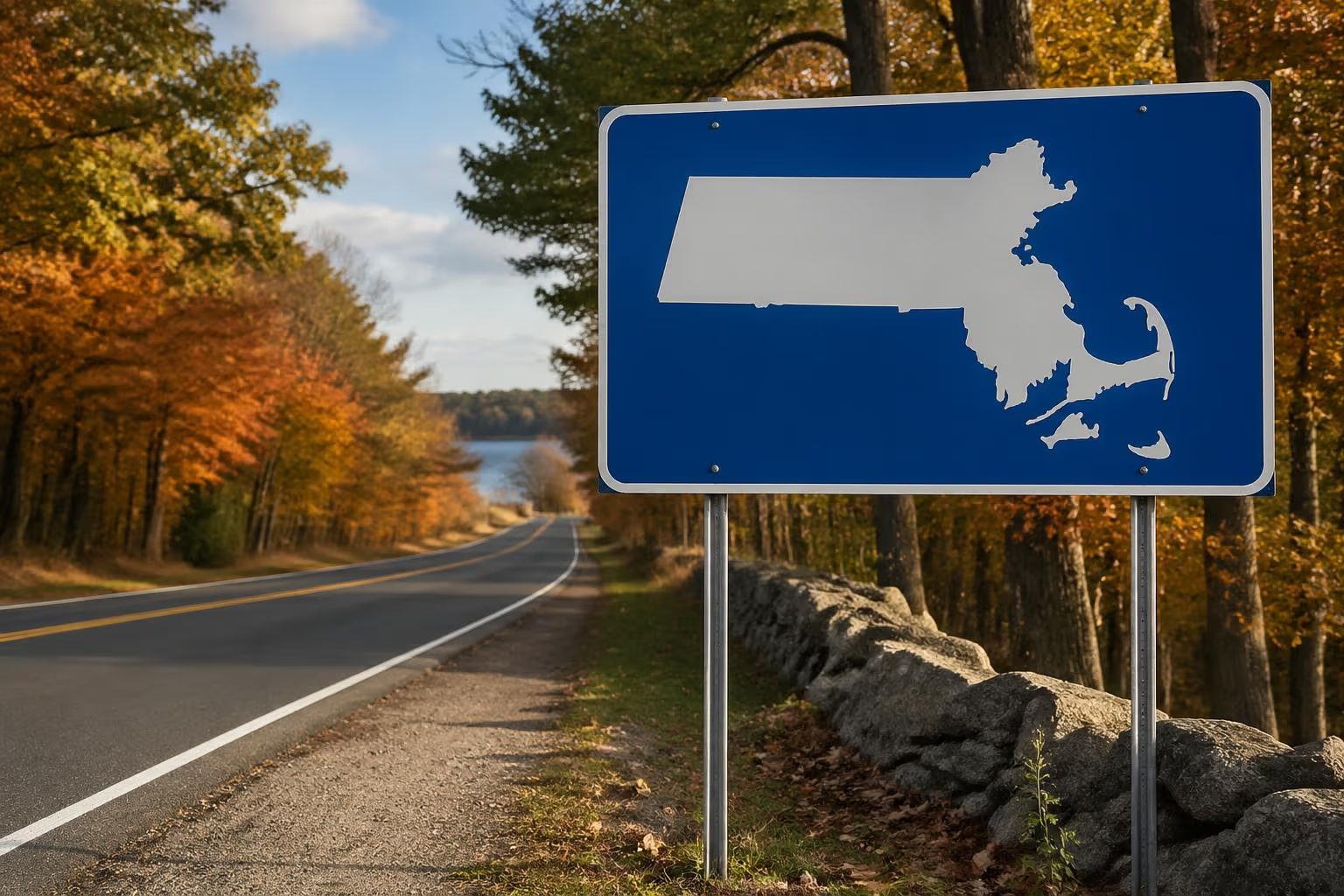
This mass RMV permit practice test complete guide covers everything you need to pass the Massachusetts written knowledge exam on your first attempt. The test stands between you and your learner's permit -- fail it and you wait seven days to try again. Pass it and you unlock six months of supervised driving before your road test. With 25 questions and a 72% pass threshold, preparation isn't optional.
Massachusetts residents search for everything from mass lottery results to RMV appointment availability, but the permit test is the one thing you can't buy your way through. You either know the material or you don't. The road signs section alone -- 10 questions scored separately -- catches unprepared test-takers who assumed they'd recognize signs from driving experience. Recognizing isn't the same as knowing what action each sign requires.
Whether you're 16 and applying for your first junior operator's permit or you're an adult transferring from another state, the written test is identical. This guide breaks down the test format, covers the three main content areas, walks you through a proven study strategy, and gives you access to free practice tests that mirror the actual RMV exam. You'll also find mass cash tips for saving money on your prep -- every resource here is free. No paid courses required.

The Massachusetts RMV written test covers three areas: traffic laws, road signs, and safe driving practices. Understanding this breakdown changes how you study. Most people spend all their time on traffic laws and ignore signs -- then fail the signs section, which is scored separately. You need 7 out of 10 correct on signs alone. Miss four signs and you fail the entire test, even if you ace everything else. Think of the mass cash value of passing first time -- no repeat fees, no wasted trips.
The test pulls questions from the official Massachusetts Driver's Manual, a 113-page document available free at any RMV service center or online. Every number in that manual is fair game. Default speed limits by zone type. BAC limits by age group. Following distances. School bus stopping distances. These aren't daily mass readings you can skip -- they're specific figures that appear verbatim on the test, and guessing won't save you.
You take the test on a digital touchscreen terminal at any RMV service center. Questions are randomly drawn from a larger bank, so your test won't match your friend's test. No time limit per question, but the session itself has a cap. If you fail, you wait seven days. After three failures, additional requirements kick in -- potentially including a driver education course before you can try again.
Massachusetts-specific driving laws separate this test from other states' exams. The default speed limit in business and residential districts is 30 mph -- not 25 as in many other states. Whether you're checking daily mass readings of traffic statistics or studying permit test prep, that 30 mph number shows up constantly. School zones drop to 20 mph when children are present. Open rural highways default to 50 mph unless posted otherwise. The mass state lottery of test questions means you might get any combination, but speed limits appear on nearly every version.
Right-of-way rules generate the most wrong answers. At four-way stops, the first driver to arrive goes first. Simultaneous arrival? The driver on the right proceeds first. T-intersections give right-of-way to the through road. Left turns always yield to oncoming traffic and pedestrians. Emergency vehicles with active lights and sirens require you to pull right and stop completely until they pass. These scenarios account for 3-5 questions on most test versions.
Massachusetts also has state-specific rules about headlights. You must use headlights whenever wipers are running continuously -- not just at night. That rule catches people who moved from states without this requirement. Cell phone use while driving requires hands-free operation. Mass unemployment in understanding these nuances is what drives first-attempt failure rates above 30% statewide. Don't contribute to that statistic.
Massachusetts Driving Laws Quick Reference
School zones: 20 mph when children are present. Business/residential districts: 30 mph unless posted. Rural highways: 50 mph unless posted. Limited access highways: varies (typically 65 mph). Construction zones: posted speed with doubled fines. The test expects you to know defaults when no sign is posted.
The road signs section deserves its own study block because it's scored independently. Mass deportation of test-takers from the RMV happens when they neglect this section -- figuratively speaking, of course. Ten sign questions. Seven correct minimum. The RMV tests both recognition (what does this sign mean?) and behavioral response (what should you do when you see it?). That second type is harder. You might know a yellow diamond with a pedestrian silhouette means "pedestrian crossing," but the test asks what action you should take.
Sign shapes carry meaning independent of color. Octagons always mean stop. Inverted triangles mean yield. Pentagons indicate school zones. Pennants mark no-passing zones. Diamonds warn of hazards ahead. Rectangles provide regulatory information or directions. The mass health connector between shape and meaning is your fastest path to memorizing signs -- learn the shape system first, then layer in colors and specific symbols.
Flashcard apps work well for signs because you need automatic recall, not analytical thinking. When you see a yellow pentagon, "school zone advance warning" should be instant. No hesitation. Practice 30 minutes daily for the week before your test, focusing exclusively on signs. Print the signs reference guide from the RMV website and tape it somewhere you'll see it repeatedly -- your bathroom mirror, your desk, your dashboard.
Your study strategy should span two weeks minimum. Week one: read the entire Driver's Manual. Not skim. Read. Every chapter contains testable material. The chapter on sharing the road? Two to three test questions hide there. The chapter on special driving conditions? Same thing. Think of it like checking a mass air flow sensor in your car -- you can't diagnose problems without understanding how the system works. Similarly, you can't pass the test without understanding the underlying rules, not just memorized answers.
Week two: targeted practice. Take a full 25-question practice test daily. After each test, review every wrong answer immediately. Don't move forward until you understand why you missed each question. If you're consistently missing right-of-way questions, go back to that chapter. If signs are your weak spot, add dedicated sign-only flashcard sessions. Like how mass mutual funds compound over time, your knowledge compounds with each review cycle -- early investment pays off at the testing terminal.
The day before the test, don't cram. Review your weakest areas for 30 minutes, then stop. Get a full night's sleep. Arrive at the RMV 15 minutes early with all your documents ready. At the terminal, read each question completely before answering. Wrong answers on the permit test are designed to look almost correct -- they catch people who read too fast.
Massachusetts Permit Test: Advantages and Challenges
- +No time limit per question lets you think through tricky scenarios carefully
- +Free practice tests available online mirror the actual RMV test format exactly
- +The Driver's Manual covers all testable content -- no surprise material from outside sources
- +Digital touchscreen format is intuitive and easier than paper-based tests
- +Temporary permit issued same day if you pass -- no waiting for mail delivery
- +Only 72% pass threshold means you can miss 7 questions and still pass
- −Road signs section scored separately -- failing signs fails the entire test regardless of overall score
- −Seven-day waiting period after failure delays your driving timeline significantly
- −Maximum three attempts before additional requirements like driver education courses
- −Questions are randomly selected so you can't predict which topics will appear
- −Massachusetts-specific rules differ from other states and catch transfer applicants
- −RMV appointment wait times can stretch weeks during peak seasons
So what is mass in the context of driving physics? It's the weight of your vehicle, and it directly affects stopping distance, braking force, and collision impact. The permit test includes questions about following distance that tie into vehicle mass -- heavier vehicles need longer stopping distances. The law of conservation of mass applies to driving too: the energy in a moving vehicle doesn't disappear when you hit the brakes. It converts to heat through friction. Understanding this physics makes safe driving questions intuitive rather than memorized.
Following distance rules in Massachusetts use the 3-second rule as a minimum. In rain, extend to 4 seconds. In snow or ice, extend to 8 seconds or more. The test asks about these specific intervals. Tailgating violations carry fines and points on your license. Large vehicles like trucks carry more mass and need more space -- the test covers this too, asking how much additional following distance you should allow behind commercial vehicles.
Skid recovery and tire blowout procedures also appear on the test. If your car enters a skid, steer into the direction of the skid without braking hard. For a blowout, grip the steering wheel firmly, ease off the gas gradually, and pull to the side of the road. Don't slam the brakes. These scenarios test your understanding of vehicle dynamics, not just rule memorization.
RMV Permit Test Day Checklist
- ✓Confirm your RMV appointment date, time, and location (book at mass.gov/rmv)
- ✓Gather proof of identity: birth certificate or valid passport
- ✓Bring Social Security card or proof of ineligibility letter
- ✓Prepare two proofs of Massachusetts residency (utility bills, bank statements within 60 days)
- ✓Have $30 permit fee ready (check accepted payment methods at your location)
- ✓Review road signs for 30 minutes the evening before -- focus on behavioral responses
- ✓Get a full night's sleep -- don't cram the morning of the test
- ✓Arrive 15 minutes early to complete paperwork without rushing
- ✓Read each test question completely before selecting your answer
- ✓Check your road signs score separately after completing the test
Resources for Massachusetts permit test preparation are widely available, and the best ones are free. The mass gainer in your study toolkit should be the official Driver's Manual -- it's the source document for every test question. Download it from mass.gov/rmv or pick up a printed copy at any service center. Western mass news outlets sometimes cover RMV policy changes that affect the test, but the manual itself is your ground truth.
Online practice tests are your second essential resource. Look for tests that mirror the actual RMV format: 25 questions, randomized order, separate road signs scoring. Take at least five full-length practice tests before scheduling your official exam. You should consistently score 85% or higher before booking your appointment. If you're hovering around 75%, you're too close to the pass line -- mass unemployment of your study time into weak areas needs to happen before you risk a real attempt.
The RMV website itself offers a practice knowledge test. It's shorter than the real thing but uses questions from the same bank. Flashcard apps cover road signs effectively. YouTube has walkthrough videos of common test questions. None of these cost money. The $30 permit fee is your only expense if you pass first time -- and that fee covers both the written test and your temporary permit.
The mass definition of a qualified driver in Massachusetts includes both knowledge and practical skill. Passing the written test proves knowledge. The 40 hours of supervised driving -- including 10 at night -- proves skill. You can't skip either step. The mass general patient gateway to getting your full license runs through both checkpoints, and the written test comes first. Think of it as the screening process that determines whether you're ready to get behind the wheel with a supervisor.
For applicants under 18, the junior operator restrictions add another layer. No driving between midnight and 5 AM. No more than one passenger under 18 who isn't a family member during your first six months. Violate these restrictions and you lose your permit or license -- the RMV doesn't issue warnings for JOL violations. Adults 18 and older face fewer restrictions after licensing but still must complete the same written test and supervised driving hours.
Your permit is valid for two years from the date of issue. If you don't pass your road test within that window, you start over -- new application, new written test, new fee. Road test wait times at busy Massachusetts RMV locations can stretch to 2-3 months, so book your road test appointment early. Don't let your permit expire because you waited too long to schedule.
If you fail the Massachusetts RMV written test three times, you may be required to complete a driver education course before additional attempts are allowed. Each failure requires a 7-day waiting period. The $30 permit fee applies each time. Pass on your first attempt by scoring 85%+ on practice tests before booking your real test appointment.
Managing your mass unemployment login to the RMV's online scheduling system is straightforward once you create an account. The mass.gov/rmv portal handles appointment booking, document checklists, and practice test access. Create your account before test day so you're familiar with the system. Atomic mass -- the fundamental building block of chemistry -- has nothing to do with driving tests, but the concept of building blocks applies perfectly to your preparation. Each chapter of the Driver's Manual is a building block. Skip one and your foundation has gaps.
After you pass the written test, you leave the RMV with a temporary paper permit valid for 60 days while your plastic card ships by mail. Start supervised driving immediately. The 40-hour requirement takes most people 6-8 weeks to complete with regular practice sessions. Log your hours -- the road test examiner may ask to see your driving log. Massachusetts doesn't require a formal log format, but dates, times, and conditions help demonstrate compliance.
Your supervised driver must be at least 21 years old, hold a valid Massachusetts license, and sit in the front passenger seat at all times. They can't be impaired or distracted. Their job is to intervene if needed, not to check their phone. Take your supervised driving seriously -- it's not a formality. The skills you build during those 40 hours directly determine whether you pass the road test.
MASS Practice Test Questions
Prepare for the MASS - Test exam with our free practice test modules. Each quiz covers key topics to help you pass on your first try.
MASS Test Dig Safe Regulations
MASS Exam Questions covering Test Dig Safe Regulations. Master MASS Test concepts for certification prep.
MASS Test Equipment Components and Inspection
Free MASS Practice Test featuring Test Equipment Components and Inspection. Improve your MASS Exam score with mock test prep.
MASS Test Load Charts and Capacity
MASS Mock Exam on Test Load Charts and Capacity. MASS Study Guide questions to pass on your first try.
MASS Test MA Laws and Regulations
MASS Test Prep for Test MA Laws and Regulations. Practice MASS Quiz questions and boost your score.
MASS Test Safe Operating Procedures
MASS Questions and Answers on Test Safe Operating Procedures. Free MASS practice for exam readiness.
MASS Test Standard Hand Signals
MASS Mock Test covering Test Standard Hand Signals. Online MASS Test practice with instant feedback.
MASS Aptitude Test
Free MASS Quiz on Aptitude Test. MASS Exam prep questions with detailed explanations.
MASS Test Rigging and Slings
MASS Practice Questions for MASS Test Rigging and Slings. Build confidence for your MASS certification exam.
MASS Mechanical Concepts
MASS Study Material on Mechanical Concepts. Prepare effectively with real exam-style questions.
MASS Test Assembling Objects
Free MASS Test covering Test Assembling Objects. Practice and track your MASS exam readiness.
MASS Test Mathematical Usage
MASS Exam Questions covering Test Mathematical Usage. Master MASS Test concepts for certification prep.
MASS Test Mechanical Concepts
Free MASS Practice Test featuring Test Mechanical Concepts. Improve your MASS Exam score with mock test prep.
MASS Test Power Plant Safety
MASS Mock Exam on Test Power Plant Safety. MASS Study Guide questions to pass on your first try.
The cast of midnight mass might keep you up late binge-watching, but don't sacrifice sleep the night before your test. Fatigue impairs decision-making -- and the permit test is essentially a 25-question decision-making exercise. Your brain processes and retrieves information better after proper rest. Study your weakest material for 30 minutes the evening before, then close the book. En masse, the test-takers who fail share one common trait: they crammed instead of preparing systematically over time.
Massachusetts updates its Driver's Manual periodically to reflect new laws and regulations. Make sure you're studying the current edition -- an outdated manual could teach you rules that have changed. The RMV website always has the latest version. New laws about cell phone use, school zone speed limits, or OUI penalties can take a full year to filter into all study guides, so the official manual is your safest bet for current information.
One final note on test strategy: the RMV's wrong answers are designed to look almost correct. They'll offer "25 mph" as a residential speed limit option when the answer is 30 mph. They'll describe a yield sign as a diamond instead of an inverted triangle. Read every option fully before selecting your answer. Quick selections based on partial reading are the number one cause of preventable wrong answers. Take your time. There's no prize for finishing fast -- just for finishing right.
MASS Questions and Answers




About the Author

Registered Nurse & Healthcare Educator
Johns Hopkins University School of NursingDr. Sarah Mitchell is a board-certified registered nurse with over 15 years of clinical and academic experience. She completed her PhD in Nursing Science at Johns Hopkins University and has taught NCLEX preparation and clinical skills courses for nursing students across the United States. Her research focuses on evidence-based exam preparation strategies for healthcare certification candidates.
Join the Discussion
Connect with other students preparing for this exam. Share tips, ask questions, and get advice from people who have been there.
View discussion (4 replies)