
LPN Programs 2026 October — Find Schools, Compare Costs, and Meet Requirements
Boost your LPN Programs 2026 October exam score with practice questions and detailed answer explanations. Track progress with instant feedback. 💯
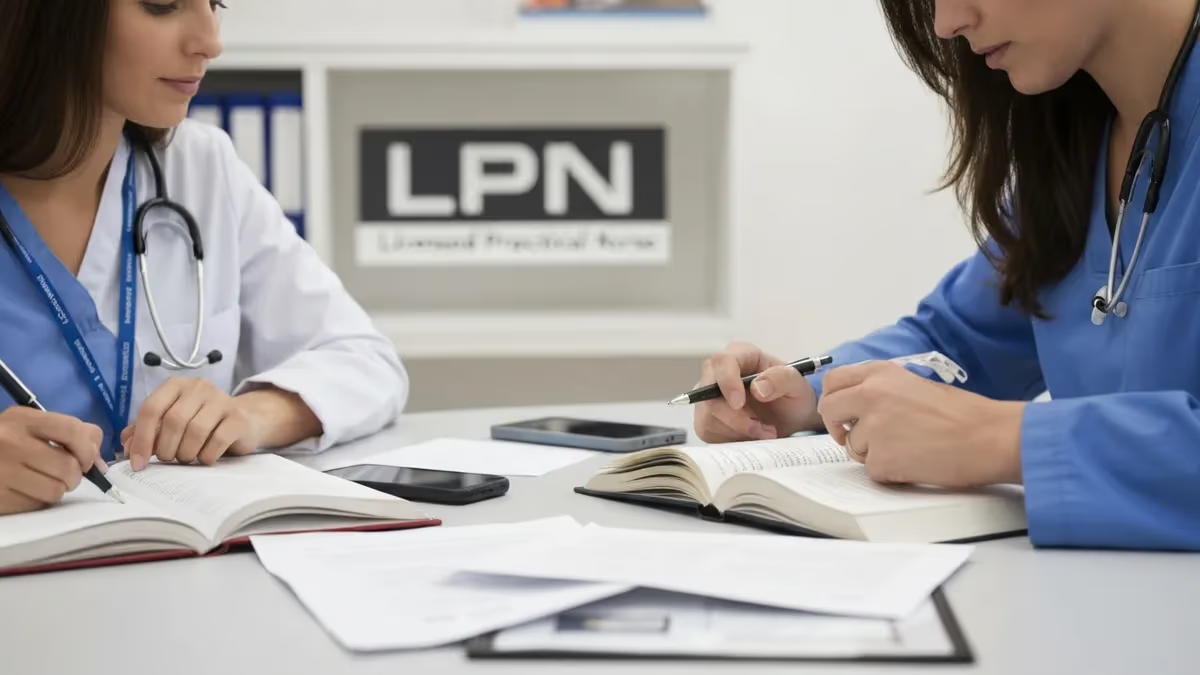
LPN programs prepare you for a rewarding career in practical nursing — and they don't take four years. Most programs run 12 to 18 months, blending classroom theory with hands-on clinical rotations at hospitals, long-term care centers, and outpatient clinics. Whether you're switching careers at 35 or starting fresh out of high school, an LPN program puts you on a direct path to patient care. The demand for licensed practical nurses keeps growing, fueled by an aging population and a national shortage of bedside staff.
Searching for LPN programs near me? You've got more options than you might think. Community colleges, vocational schools, and private nursing academies all offer state-approved tracks. Some programs operate year-round with rolling admissions, so you won't wait six months just to start. Online LPN programs have exploded in popularity too — they let you tackle pharmacology, nutrition, and medical-surgical theory from home while completing clinical hours locally. Cost varies wildly, from $4,000 at a community college to $30,000 at private institutions, so comparing price tags is worth your time.
Before you enroll, check a program's accreditation status and NCLEX-PN pass rate. These two numbers tell you more than any glossy brochure. Programs accredited by ACEN or CCNE meet national standards, and a pass rate above 80% signals strong instruction. You'll also want to verify that your state board of nursing recognizes the school — otherwise, you can't sit for the licensing exam. This guide breaks down everything from program types and costs to bridge pathways that take you from LPN to RN and beyond.

If you've typed "LPN programs near me" into a search bar, you already know results flood in fast. The trick is narrowing them down. Start with your state nursing board's approved program list — it filters out unaccredited schools immediately. From there, compare tuition, clinical placement sites, and class schedules. Evening and weekend cohorts exist for students who can't quit their day jobs. Some schools even offer childcare assistance or transportation stipends.
Online LPN programs deserve a closer look. They're not fully remote — you'll still complete 400 to 800 clinical hours in person — but the flexibility is real. LPN programs near me that offer hybrid formats let you watch recorded lectures at midnight or study between shifts. Schools like Excelsior College, Unitek College, and Concorde Career Institute run well-regarded online tracks. Just verify that the program holds ACEN accreditation and operates in your state.
Community colleges remain the most affordable option. Tuition often falls below $10,000 for the full program, and financial aid covers a big chunk. Private vocational schools charge more but sometimes guarantee clinical placements and smaller class sizes. Military-affiliated programs through the GI Bill can cover costs entirely. Don't overlook employer-sponsored tuition — many hospitals and nursing homes pay for LPN training in exchange for a work commitment after graduation.
LPN to RN bridge programs exist because practical nurses often want more. More responsibility, more autonomy, more pay. These programs give you advanced standing — credit for your LPN coursework and clinical hours — so you're not starting from scratch. Most LPN to RN bridge programs take 12 to 18 months and award an associate degree in nursing (ADN). Some lead directly to a BSN. Either way, you'll sit for the NCLEX-RN instead of the NCLEX-PN.
The format matters. LPN online programs for bridge students are widely available now. You can keep working as an LPN while completing RN coursework through evening or weekend classes. Clinical requirements still apply, but many schools coordinate placements at your current employer's facility. That's a huge perk — you're already familiar with the workflows, the charting system, and the patient population.
Eligibility for LPN to RN bridge programs usually requires an active, unencumbered LPN license, at least one year of clinical experience, and prerequisite courses like anatomy and microbiology. GPA requirements vary, but most programs want a 2.5 or higher. Competitive programs — especially at state universities — may ask for a 3.0. Application deadlines cluster around spring and fall semesters, so plan accordingly. If you don't get in on the first try, retake a prerequisite to boost your GPA and reapply.
Types of LPN Programs Compared
Community college LPN programs are the most budget-friendly path. Tuition averages $4,000 to $12,000. Programs run 12 to 16 months and include general education courses alongside nursing classes. Clinical sites vary — expect rotations at hospitals, skilled nursing facilities, and public health clinics. Financial aid, Pell Grants, and state workforce development scholarships apply. Class sizes tend to be larger (30-40 students), but instructors hold MSN or DNP credentials.
LPN to RN programs aren't the only advancement track worth knowing. LPN programs online now include specialized certificates in IV therapy, wound care, and gerontology. These add-ons take a few weeks and make you more marketable. Employers notice when an LPN can start IVs or manage complex wound dressings without waiting for an RN to supervise. In states like Texas and California, IV certification is practically required for hospital-based LPN positions.
The curriculum inside any solid LPN program covers fundamentals of nursing, pharmacology, medical-surgical care, pediatrics, obstetrics, and mental health. Clinical hours typically account for about half the program. You'll rotate through different units — geriatrics one month, maternity the next — building skills across patient populations. Simulation labs supplement bedside hours with mannequin-based scenarios covering cardiac arrest, medication errors, and emergency triage.
After finishing your LPN program, you take the NCLEX-PN. This computerized adaptive test adjusts difficulty based on your answers. Minimum is 85 questions; maximum is 150. Most candidates finish in about two hours. Your state board processes results within 48 hours, and you'll receive your license number via email. From there, you can apply for jobs immediately — or start looking into LPN to RN programs if you want to keep climbing.
LPN programs in NYC draw thousands of applicants every year. The city's density of hospitals, clinics, and long-term care facilities creates strong demand for practical nurses. Programs at LaGuardia Community College, CUNY schools, and private institutions like ASA College fill quickly. Tuition at CUNY campuses runs around $5,000 to $8,000 — a fraction of what private schools charge. Clinical rotations happen at New York-Presbyterian, Mount Sinai affiliates, and city-run nursing homes.
Online LPN to RN programs make the transition easier for nurses who can't relocate or take time off work. Schools like Western Governors University (WGU), Capella, and Excelsior College deliver accredited RN coursework in a flex-paced online format. You log in when it works for you. Clinical requirements are coordinated through local partnerships, so you won't fly across the country for a skills lab. Tuition at WGU runs about $9,500 per year — flat rate regardless of how many courses you complete per term.
Location matters for more than convenience. States set their own LPN scope of practice, so the skills you're allowed to perform differ based on where you're licensed. In some states, LPNs can administer IV medications; in others, they can't. Compact license states let you practice across state lines with a single credential. If you plan to move after graduation, choose a program in a compact state or budget time and money for license endorsement applications.
Pros and Cons of LPN Programs
- +Short training time — most programs finish in 12-18 months
- +Lower tuition than RN or BSN programs, often under $15,000
- +High demand across hospitals, clinics, and long-term care settings
- +Clear bridge pathways to RN and BSN for career advancement
- +Flexible scheduling with evening, weekend, and hybrid options
- +Immediate employment eligibility after passing the NCLEX-PN
- −Narrower scope of practice compared to RNs in most states
- −Lower average salary than registered nurses ($59K vs $86K)
- −Limited advancement without additional bridge education
- −Clinical hours are intensive and can't be completed fully online
- −Some employers prefer hiring RNs over LPNs for hospital roles
- −License endorsement required if relocating to a non-compact state
Pros and Cons at a Glance
| Pros | Cons |
|---|---|
| High demand across hospitals, clinics, and long-term care settings | Narrower scope of practice compared to RNs in most states |
| Clear bridge pathways to RN and BSN for career advancement | Limited advancement without additional bridge education |
| Flexible scheduling with evening, weekend, and hybrid options | Clinical hours are intensive and can't be completed fully online |
| Immediate employment eligibility after passing the NCLEX-PN | Some employers prefer hiring RNs over LPNs for hospital roles |
LPN to RN online programs have grown rapidly since 2020. Schools realized that nurses — already working full-time — need flexible formats. The coursework translates well to asynchronous delivery. Pathophysiology, health assessment, and evidence-based practice lectures work fine as recorded videos and interactive modules. The challenge is clinicals, but most programs pair you with a preceptor at your current workplace or a nearby facility.
LPN to BSN programs deserve attention if you're thinking long-term. A bachelor's degree opens doors that an associate degree doesn't — nurse management, school nursing, public health positions, and military nursing commissions all require a BSN. Programs at Florida Atlantic, Indiana State, and Chamberlain University accept LPN credits and place you on a 24 to 36 month track. Some hospitals now require BSN-prepared nurses for bedside roles, following the "80% by 2030" initiative pushed by the Institute of Medicine.
Financial planning for any LPN advancement program matters. Federal student aid (FAFSA) covers most accredited programs. Nurse Corps Loan Repayment pays up to 85% of qualifying nursing loans in exchange for two years at a critical shortage facility. State-specific grants — like New York's HCAP or California's SNAPLE — target LPNs pursuing RN education. Employer tuition reimbursement programs remain underused; check with your HR department before paying out of pocket.
LPN Program Enrollment Checklist
- ✓Verify the program holds ACEN or CCNE accreditation
- ✓Confirm your state board of nursing approves the school
- ✓Check the program's NCLEX-PN pass rate (aim for 80%+)
- ✓Complete prerequisite courses: anatomy, biology, math
- ✓Pass the entrance exam (TEAS, HESI, or school-specific test)
- ✓Submit official high school or GED transcripts
- ✓Complete a criminal background check and drug screen
- ✓Provide current immunization records (Hep B, MMR, flu, COVID)
- ✓Obtain CPR/BLS certification (American Heart Association preferred)
- ✓Arrange financial aid: FAFSA, scholarships, employer reimbursement
LPN nursing programs in NYC operate on a competitive admissions cycle. CUNY schools — including Hostos, Bronx, and LaGuardia Community Colleges — receive three to five times more applications than seats available. To stand out, keep your prerequisite GPA above 3.0, score well on the TEAS exam, and write a personal statement that shows genuine commitment to patient care. Previous healthcare experience (CNA, medical assistant, phlebotomy) strengthens your application significantly.
Accelerated LPN programs condense the standard 12-month curriculum into 8 or 9 months. They're intense. Expect full-time classes five days a week, evening study sessions, and clinical rotations that begin within the first few weeks. These programs suit students without work or family obligations that limit study time. Schools like Galen College of Nursing and National American University offer accelerated tracks at multiple campuses nationwide.
Be realistic about the workload. Accelerated doesn't mean easier — it means faster. You'll cover the same material in fewer weeks. Students report studying 30 to 40 hours per week outside of class. Attrition rates in accelerated tracks run higher than traditional programs, so ask the admissions office for completion statistics. If you thrive under pressure and learn quickly, an accelerated LPN program is a smart choice. If you need a slower pace, a 14-month traditional track won't hold you back career-wise.
LPN to RN bridge programs online combine flexibility with credential advancement. You don't need to pause your career or relocate. Schools like Excelsior College and WGU let you progress through modules at your own speed — finish early and you save on tuition. Clinical preceptorships are arranged near your home, and many programs accept your current LPN workplace as a clinical site. It's a practical setup for nurses already juggling shifts and family.
LPN nursing programs in CT (Connecticut) maintain high standards. The state requires programs to meet a minimum 80% NCLEX-PN pass rate to keep their approval. Schools like Capital Community College and Porter and Chester Institute offer well-regarded tracks. Connecticut LPN salaries rank among the highest in the country — averaging $62,000 — which helps offset the state's higher cost of living. Clinical rotations happen at Hartford Hospital, Yale-New Haven affiliates, and community health centers throughout the state.
Clinical placement is one area where you'll have limited control. Most programs assign rotation sites based on availability and geographic proximity. You might request a specialty unit — ICU, labor and delivery, pediatrics — but there's no guarantee. What you can control is how prepared you arrive on the first day. Review patient assessment skills, practice medication calculations, and brush up on medical terminology before your rotation starts. Instructors notice the students who come ready.
Some schools advertise LPN programs without proper accreditation. Graduates of unaccredited programs may be unable to sit for the NCLEX-PN in their state. Always verify accreditation through ACEN (acenursing.org) or your state board of nursing before enrolling. If a school can't provide its accreditation status in writing, walk away.
Looking for online LPN programs near me? Geography still matters even with hybrid formats. Your clinical sites need to be within driving distance — nobody wants a 90-minute commute after a 10-hour theory day. Many online programs partner with healthcare facilities in major metro areas, but rural students should confirm clinical availability before enrolling. Schools like Herzing University and Concorde Career Institute maintain extensive clinical partner networks across multiple states.
LPN programs in CT are particularly appealing because Connecticut participates in the Nurse Licensure Compact (NLC). An NLC license lets you practice in 40+ states without applying for individual endorsements. If you graduate from a Connecticut program and plan to move to a compact state, you're covered. Non-compact states like California, New York, and Illinois require separate license applications — budget an extra $200 to $400 and 4-8 weeks for processing.
Cost comparison is where most students stall. Here's a quick framework: community colleges under $10K, vocational schools $15K-$25K, private universities $25K-$40K. But sticker price isn't final cost. Subtract Pell Grants ($7,395 max), state grants, and scholarships. Factor in books ($500-$1,000), uniforms ($200-$400), clinical supplies ($300), and exam fees ($200 for NCLEX-PN). Total out-of-pocket at a community college can be under $3,000 after aid. Run the numbers before committing to a pricier school.
LPN Practice Test Questions
Prepare for the LPN - Licensed Practical Nurse exam with our free practice test modules. Each quiz covers key topics to help you pass on your first try.
LPN Licensed Practical Nurse MCQ
LPN Exam Questions covering Licensed Practical Nurse MCQ. Master LPN Test concepts for certification prep.
LPN Licensed Practical Nurse-PN
Free LPN Practice Test featuring Licensed Practical Nurse-PN. Improve your LPN Exam score with mock test prep.
LPN Licensed Practical Nurse
LPN Mock Exam on Licensed Practical Nurse. LPN Study Guide questions to pass on your first try.
LPN Licensed Practical Nurse-RN
LPN Test Prep for Licensed Practical Nurse-RN. Practice LPN Quiz questions and boost your score.
LPN Licensed Practical Nurse Ultimate
LPN Questions and Answers on Licensed Practical Nurse Ultimate. Free LPN practice for exam readiness.
LPN Delegation and Supervision for UAP
LPN Mock Test covering Delegation and Supervision for UAP. Online LPN Test practice with instant feedback.
LPN Diabetes Care: Glucose and Insulin
Free LPN Quiz on Diabetes Care: Glucose and Insulin. LPN Exam prep questions with detailed explanations.
LPN Interpreting Lab Values and Nursing Ac...
LPN Practice Questions for Interpreting Lab Values and Nursing Actions. Build confidence for your LPN certification exam.
LPN: Pharmacological Therapies
LPN Test Online for LPN: Pharmacological Therapies. Free practice with instant results and feedback.
LPN Standard Precautions and Transmission-...
LPN Study Material on Standard Precautions and Transmission-Based Precautions. Prepare effectively with real exam-style questions.
LPN Therapeutic Diets and Enteral Feedings
Free LPN Test covering Therapeutic Diets and Enteral Feedings. Practice and track your LPN exam readiness.
LPN Wound Care and Pressure Injury Staging
LPN Exam Questions covering Wound Care and Pressure Injury Staging. Master LPN Test concepts for certification prep.
LPN online programs near me — that search query has tripled since 2020. The pandemic proved that nursing education could adapt to digital delivery without sacrificing quality. Programs that earned ACEN accreditation in hybrid format maintained NCLEX-PN pass rates on par with traditional classroom programs. Students report higher satisfaction with the flexibility, though they emphasize that self-discipline is essential. Without a fixed class schedule, procrastination creeps in fast.
LPN programs in Chicago serve one of the largest healthcare markets in the Midwest. The city's hospitals — Rush, Northwestern Memorial, University of Chicago Medicine — employ thousands of LPNs and regularly partner with local schools for clinical placements. Programs at Malcolm X College (part of the City Colleges of Chicago system) charge some of the lowest tuition in the country. Illinois also participates in the NLC, giving graduates multistate practice privileges.
Your choice of LPN program shapes the first chapter of your nursing career — but it doesn't write the whole book. Graduates who pass the NCLEX-PN enter a field with strong job security, decent starting pay, and multiple advancement pathways. LPN to RN bridge programs, specialty certifications, and BSN tracks all remain open to you. The best time to start? Now. Research three programs this week, attend an info session, and file your FAFSA. Every day you delay is a day someone else fills the seat you wanted.
Sample LPN - Licensed Practical Nurse Practice Questions
Try these questions from our free LPN - Licensed Practical Nurse practice tests. The correct answer and an explanation follow each question.
A 5-year-old girl with a fever, chills, and trouble walking is taken to the emergency room by her grandmother. The nurse makes an effort to undress the infant but finds it difficult. The nurse also discovered bruising near the vaginal region after conducting a thorough examination. Which of the following should the nurse start with?
- A. Inform the law enforcement for a possible child abuse
- B. Record all the findings
- C. Collect the clothing and underwear of the child
- D. Provide privacy and disregard the behavior of the child
Answer: A. Inform the law enforcement for a possible child abuse
The nurse's immediate priority is the child's safety. Bruising near the vaginal region, difficulty undressing, and the child's age are strong indicators of potential child abuse, specifically sexual abuse. Nurses are mandated reporters and have a legal and ethical obligation to report suspected abuse to law enforcement or child protective services to ensure the child's protection.
Several weeks after a stroke, a patient has urinary incontinence resulting from an impaired awareness of bladder fullness. For an effective bladder training program, which nursing intervention will be best to include in the plan of care?
- A. Limit fluid intake to 1200 mL daily to reduce urine volume
- B. Perform intermittent catheterization after each voiding to check for residual urine
- C. Use an external "condom" catheter to protect the skin and prevent embarrassment
- D. Assist the patient onto the bedside commode every 2 hours
Answer: D. Assist the patient onto the bedside commode every 2 hours
For a patient with impaired awareness of bladder fullness, a scheduled toileting program is crucial for effective bladder training. Assisting the patient to the bedside commode every 2 hours helps establish a routine, prevents incontinence, and ensures regular bladder emptying. This intervention helps retrain the bladder and improve continence by proactively managing voiding times.
Which of the following blood glucose values meets the ADA diagnostic criteria for diabetes mellitus?
- A. Fasting plasma glucose ≥ 126 mg/dL on two separate occasions
- B. Random blood glucose of 140 mg/dL without symptoms
- C. Fasting plasma glucose of 110 mg/dL
- D. 2-hour OGTT glucose of 130 mg/dL
Answer: A. Fasting plasma glucose ≥ 126 mg/dL on two separate occasions
The ADA requires a fasting plasma glucose ≥126 mg/dL confirmed on two separate occasions (or once with symptoms) to diagnose diabetes.
Which precaution type uses a negative-pressure room as a requirement?
- A. Standard precautions
- B. Contact precautions
- C. Droplet precautions
- D. Airborne precautions
Answer: D. Airborne precautions
Airborne precautions require a negative-pressure room (AIIR — Airborne Infection Isolation Room) to prevent airborne pathogens from escaping into the corridor.
LPN Questions and Answers
About the Author

Attorney & Bar Exam Preparation Specialist
Yale Law SchoolJames R. Hargrove is a practicing attorney and legal educator with a Juris Doctor from Yale Law School and an LLM in Constitutional Law. With over a decade of experience coaching bar exam candidates across multiple jurisdictions, he specializes in MBE strategy, state-specific essay preparation, and multistate performance test techniques.