
Los Angeles Police Department Divisions and Stations: Every Area Office Mapped
🗨️ LAPD divisions and stations: all 21 patrol areas across Central, South, West, and Valley bureaus. Addresses, jurisdictions, and division HQ map.
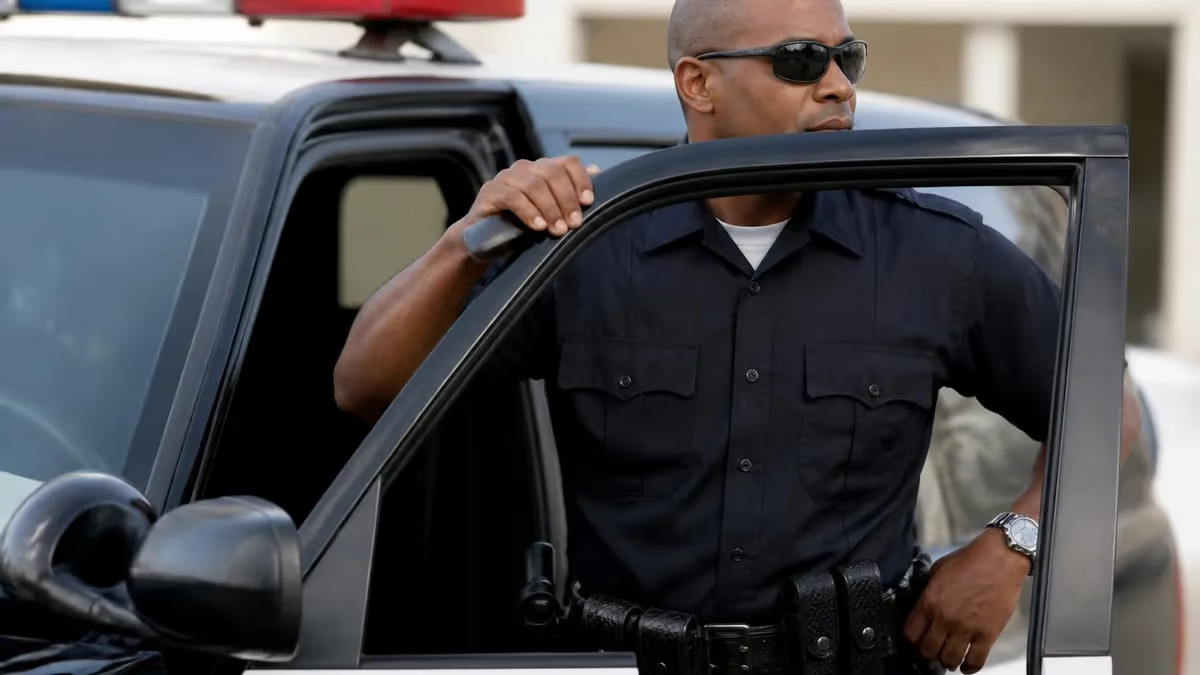
The Los Angeles Police Department doesn't really work as one big station. It works as a sprawl of 21 neighborhood offices — called Area stations — each running its own patrol shifts, detectives, and community programs across a slice of the city. Knowing which station covers your block, where to file a report in person, or where a particular division actually sits matters more than most people realize. Especially if you've just been told to "come down to the station" and you're not sure which one.
Here's the short version. LAPD splits the city into four geographic bureaus: Central, South, West, and Valley. Each bureau holds several Area divisions, and each Area runs out of its own community police station. So when somebody mentions "Rampart Division" or "Pacific Division," they mean both the patrol geography and the building it dispatches from. The names get reused a lot — there's a Rampart Division, a Rampart Station, and a Rampart housing development that all sit within a few blocks of each other in Westlake. Confusing the first time.
Below we map out every Area station, who they cover, where they sit, and which bureau they report up through. We'll also cover the four Traffic Divisions (they sit one organizational rung above the Area stations and only handle vehicle collisions and DUI work), and the difference between an Area station and a satellite reporting site. If you're trying to figure out where to walk in with a stolen-bike report, jump straight to the checklist further down. If you're researching how the department actually carves up the city for patrol response, read the bureau breakdown first.
One more orientation point before we start. The geographic divisions are not the same thing as specialized divisions. Detective Bureau, Counter-Terrorism, LAPD SWAT, Air Support, K-9, and Metropolitan Division all operate citywide and don't have a neighborhood boundary. When someone says "Hollywood Division" they mean an Area patrol division. When someone says "Robbery-Homicide Division" they mean a specialized unit working out of the LAPD headquarters downtown. Different beasts, same department.

LAPD Geographic Coverage at a Glance
Start with the bureau layer because everything else hangs off it. LAPD organizes its patrol divisions under four geographic bureaus, and each bureau is led by a deputy chief. The bureaus matter for command-and-control but they don't have public-facing stations of their own — when you walk in to file a report, you always end up at an Area station, never at "bureau headquarters." The bureau structure shows up most often in news coverage and command staff briefings.
Central Bureau covers downtown plus the eastern edge of the city — five Area divisions stretching from Hollenbeck in Boyle Heights west through Central, Newton, and Rampart, and north up into Northeast.
South Bureau handles, predictably, the southern third — four divisions: Southwest, 77th Street, Southeast, and Harbor (which reaches all the way down to San Pedro and the port). West Bureau covers the wealthier and more touristed western corridor, the four divisions being Olympic, Wilshire, West Los Angeles, Pacific, and Hollywood (yes, Hollywood is West Bureau organizationally even though geographically it sits closer to central LA). And Valley Bureau, the largest by land area, covers everything north of the Santa Monica Mountains: West Valley, Van Nuys, North Hollywood, Foothill, Devonshire, Mission, and Topanga.
Add those up and you get 21 Area divisions. The numbers shift slightly depending on whether you count the Olympic Division separately (it was carved out of Wilshire in 2009) and whether you count the Topanga Division (split from West Valley around the same time). Most current LAPD organizational charts list 21 areas, and that's the number we'll use throughout. Each Area runs its own watch schedule, holds its own community meetings, and has its own dedicated LAPD officer roster, captain, and senior lead officers covering specific neighborhoods within the Area.
A common point of confusion: "division" and "station" aren't perfectly interchangeable in LAPD parlance, even though most people use them that way. Division is the organizational unit (the patrol command). Station is the physical building.
Most divisions have exactly one station, but a few operate satellite reporting sites — small offices where you can drop off paperwork or talk to a desk officer but where no patrol cars are based. Hollywood Division, for instance, has its main station on Wilcox plus a small storefront on Sunset for tourist-area complaints. When in doubt, the main Area station is the place you want.
Use the LAPD's reverse lookup. The department maintains a free "Find Your Area" tool at lapdonline.org that takes a street address and returns the Area division, the senior lead officer for that beat, and the station address. You can also call the citywide non-emergency line at 1-877-275-5273 and they'll route you. For minor incidents — stolen plates, vandalism, lost property — you don't have to go to your home Area station. Any LAPD station will take the report and forward it to the correct division. For serious crimes already reported via 911, detectives from the responding Area division will follow up directly.
Time to walk through the divisions that get searched most often. Below is a card view of nine of the highest-profile Area stations — the ones that show up in news coverage, tourist guides, and Google queries the most. Each card lists the bureau, the rough jurisdiction, and the address. We'll get into the rest of the divisions in the tabbed view further down.
Notice how the cards cluster: the West Bureau divisions sit on prime real estate (Hollywood, West LA, Pacific, Wilshire), the Central Bureau handles the densest urban core (Rampart, Central, Northeast), and the Valley Bureau covers the suburban sprawl north of the mountains (North Hollywood, Mission, Topanga, Foothill). The Harbor Division in San Pedro is its own thing — geographically isolated from the rest of South Bureau because of the way the City of Los Angeles slings a thin corridor down through Wilmington to reach the port.
Spotlight: Most-Searched LAPD Divisions
Westlake, Pico-Union, and Echo Park. One of the densest patrol areas in the city.
- ▸Bureau: Central
- ▸Station address: 1401 W 6th Street, LA 90017
- ▸Neighborhoods: Westlake, Pico-Union, Echo Park, Silver Lake western edge
- ▸Notable: Site of the late-1990s Rampart Scandal that reshaped oversight
Hollywood Boulevard, Sunset Strip eastern stretch, and the tourist core.
- ▸Bureau: West
- ▸Station address: 1358 N Wilcox Avenue, LA 90028
- ▸Neighborhoods: Hollywood, Los Feliz, parts of East Hollywood
- ▸Notable: Handles entertainment-industry complaints and Walk of Fame issues
Mid-City corridor from Western to La Brea, including Miracle Mile and Koreatown south.
- ▸Bureau: West
- ▸Station address: 4861 W Venice Boulevard, LA 90019
- ▸Neighborhoods: Mid-Wilshire, Miracle Mile, Hancock Park, Carthay
- ▸Notable: Headquarters for the Wilshire patrol Area; covers LACMA
Westside coverage from Beverly Hills border west to Pacific Division line.
- ▸Bureau: West
- ▸Station address: 1574 Butler Avenue, LA 90025
- ▸Neighborhoods: West LA, Westwood, Sawtelle, Mar Vista, Brentwood
- ▸Notable: Patrols UCLA-adjacent neighborhoods and the Federal Building corridor
Coastal communities from Venice north to Palms, including LAX-adjacent areas.
- ▸Bureau: West
- ▸Station address: 12312 Culver Boulevard, LA 90066
- ▸Neighborhoods: Venice, Mar Vista, Del Rey, Playa Vista, Playa del Rey, Westchester
- ▸Notable: Beach-patrol coverage and the largest patrol Area by square mileage in West Bureau
San Pedro, Wilmington, Harbor Gateway, and the Port of Los Angeles.
- ▸Bureau: South
- ▸Station address: 2175 John S Gibson Boulevard, San Pedro 90731
- ▸Neighborhoods: San Pedro, Wilmington, Harbor City, Harbor Gateway
- ▸Notable: Geographically detached from the rest of South Bureau by the harbor corridor
Northeast Valley including Sun Valley, Pacoima, and Lake View Terrace.
- ▸Bureau: Valley
- ▸Station address: 12760 Osborne Street, Pacoima 91331
- ▸Neighborhoods: Sun Valley, Pacoima, Lake View Terrace, Sylmar, Tujunga
- ▸Notable: Covers some of the longest patrol routes in the city
Central San Fernando Valley anchor; covers NoHo and Studio City eastern edge.
- ▸Bureau: Valley
- ▸Station address: 11640 Burbank Boulevard, North Hollywood 91601
- ▸Neighborhoods: North Hollywood, Valley Village, Studio City east, Toluca Lake portion
- ▸Notable: Site of the 1997 North Hollywood shootout; major training touchstone
Northernmost Valley division. Panorama City, Mission Hills, North Hills.
- ▸Bureau: Valley
- ▸Station address: 11121 N Sepulveda Boulevard, Mission Hills 91345
- ▸Neighborhoods: Panorama City, Mission Hills, North Hills, Granada Hills southern edge
- ▸Notable: Opened in 2005 to relieve Foothill and Devonshire workloads

Those nine cover the divisions you'll see most often in headlines and Google searches. But there are 12 more, and skipping them would leave gaps. Let's run through the rest by bureau, and we'll add a bit of practical detail to each — what they cover, which neighborhoods, and any quirks worth knowing. Bookmark this section. The tabbed view below is the easiest way to compare divisions side by side.
One thing to watch for as you scan: a few of the divisions have nearly identical names but cover very different parts of the city. Northeast Division (Atwater, Highland Park, Eagle Rock) is a Central Bureau patrol Area. West Valley Division is a Valley Bureau patrol Area covering Reseda and Tarzana. West Los Angeles Division is a West Bureau patrol Area covering Westwood, Sawtelle, and Brentwood. Each starts with "West" or "Northeast" but means something completely different. When in doubt, lead with the bureau name to avoid confusion.
Every Division by Bureau
Central Division covers downtown LA — Civic Center, Financial District, Skid Row, Bunker Hill. Station: 251 E 6th Street, LA 90014. Handles the densest pedestrian traffic in the city.
Newton Division covers South Central LA's eastern half — Florence, Vernon-area neighborhoods, parts of Downtown's southern edge. Station: 3400 S Central Avenue, LA 90011. Old nickname "Shootin' Newton."
Hollenbeck Division covers Boyle Heights, Lincoln Heights, El Sereno, and the eastside neighborhoods east of the LA River. Station: 2111 E 1st Street, LA 90033.
Northeast Division covers Atwater Village, Eagle Rock, Glassell Park, Highland Park, Cypress Park, Mount Washington, Echo Park's eastern edge, and Silver Lake. Station: 3353 San Fernando Road, LA 90065. Don't confuse with West Valley.
Rampart Division covers Westlake, Pico-Union, Filipinotown, and parts of Echo Park. Station: 1401 W 6th Street, LA 90017. Highest-density patrol Area in the system.
Now to the part nobody puts in a brochure. Walking into a station unannounced is fine for routine stuff but it'll cost you time. Front desks at most Area stations are staffed but they triage walk-ins behind anything in progress. Sunday afternoons and Tuesday mornings tend to have the shortest waits at most stations. Friday and Saturday nights, you're better off calling the non-emergency line and waiting for a phone response.
Some incident types must be reported in person at any Area station — vehicle thefts that have already been recovered, late-reported property crimes, lost or stolen plates, and certain identity-theft cases. Others can be reported online: vandalism without a suspect, theft from vehicle without a suspect, lost property, and hit-and-run incidents under $1,000 in damage. The alert below covers the most common mistakes people make when picking where to go.
Don't drive to LAPD headquarters for an Area-level report. The Police Administration Building downtown is for the Chief's office, Robbery-Homicide Division, Internal Affairs, and a handful of specialized units. Regular crime reports filed there get rerouted to the appropriate Area station — which adds days, not minutes, to your timeline. Always go to the Area station that covers the location where the crime happened, not where you live or work.
Don't call 911 to ask which station is yours. Use the non-emergency line at 1-877-275-5273 or the LAPD's online "Find Your Area" tool. 911 dispatchers are for crimes in progress, imminent threats, or life-safety calls. Routing questions overwhelm the line and bump real emergencies down the queue.
Beyond the 21 Area divisions, LAPD also runs four Traffic Divisions that overlay the geographic bureaus. These don't take crime reports — they handle vehicle collisions, DUI investigations, hit-and-run follow-up, and traffic-related fatalities. If you've been told a Traffic detective will follow up on your accident, the case has been routed to one of these four divisions based on where the collision happened.
Central Traffic Division covers Central Bureau geography. South Traffic Division covers South Bureau. West Traffic Division covers West Bureau. Valley Traffic Division covers Valley Bureau. Each is led by a captain who reports up through the geographic bureau's deputy chief. Traffic detectives are full sworn officers — the same training, the same authority — they just specialize in collision reconstruction, DUI prosecution support, and traffic-fatality investigation. The checklist below covers what you should do at the station regardless of which division you're visiting.

Visiting an LAPD Station — What to Bring and Expect
- ✓Government-issued photo ID (driver's license, passport, or state ID card)
- ✓Any case number you already have (DR number from a prior report)
- ✓Documentation of the incident — photos, receipts, serial numbers, screenshots
- ✓Names and contact info for any witnesses you can identify
- ✓Insurance information if the matter involves a vehicle or property loss
- ✓Patience — Friday and Saturday nights are slowest at most Area stations
- ✓Cash or check for any fingerprint, livescan, or report-copy fees that apply
- ✓If filing a follow-up, the original report's date, location, and incident type
- ✓For domestic-related reports, a safe phone number and current address
- ✓For property crimes, a list of stolen items with estimated values and serials
- ✓Note that some stations have separate desks for traffic vs general reports
- ✓Plan to be there 30-90 minutes for a routine report on a normal weekday
People often ask whether one division is "better" than another, or which station gets the fastest response. The honest answer is that responsiveness depends on the call type, time of day, and the staffing of the watch on duty when you call — not on the division itself. That said, the Area divisions do differ in their pace, geography, and the kinds of work they're known for. Below we lay out a frank pros-and-cons look at what working or living within different Area divisions actually looks like.
If you're researching LAPD jobs or thinking about which division to request after graduating from the academy, this section is for you. New officers don't usually get to pick their first assignment, but lateral hires and post-probation transfers sometimes do. The trade-offs are real: high-volume divisions give you reps and resume-building experience fast, but they grind you. Lower-volume divisions are calmer and more community-focused but rep counts on serious calls run lower.
Division Workload Trade-offs
- +High-volume divisions (Rampart, 77th, Newton) build experience and resume credentials fast
- +Specialized divisions (Hollywood, Pacific) handle high-profile cases that draw media training
- +West Bureau divisions tend to have better community-relations infrastructure
- +Valley Bureau divisions cover larger geographies with more solo-patrol experience
- +Smaller divisions (Mission, Olympic) let you know your beat partners and command staff well
- +Harbor Division offers unique maritime and port-security exposure not available elsewhere
- −High-call-volume divisions burn out new officers faster — turnover at 77th and Newton runs high
- −Hollywood and Pacific deal with massive tourist-related complaint loads year-round
- −Geographic isolation at Harbor means slow backup response from neighboring divisions
- −Newer divisions (Olympic, Topanga, Mission) have less established mentorship pipelines
- −Wealthy West Bureau areas attract more civil liability cases and complaint scrutiny
- −Valley Bureau patrol routes can run 20+ miles between call locations — long windshield time
Pros and Cons at a Glance
| Pros | Cons |
|---|---|
| Specialized divisions (Hollywood, Pacific) handle high-profile cases that draw media training | Hollywood and Pacific deal with massive tourist-related complaint loads year-round |
| West Bureau divisions tend to have better community-relations infrastructure | Geographic isolation at Harbor means slow backup response from neighboring divisions |
| Valley Bureau divisions cover larger geographies with more solo-patrol experience | Newer divisions (Olympic, Topanga, Mission) have less established mentorship pipelines |
| Smaller divisions (Mission, Olympic) let you know your beat partners and command staff well | Wealthy West Bureau areas attract more civil liability cases and complaint scrutiny |
One thing the bureau-and-division structure doesn't quite capture is how the department layers specialized units on top of the geography. Robbery-Homicide Division (RHD) handles the highest-profile violent crime cases citywide — they don't sit at any Area station, they work out of LAPD headquarters.
Major Crimes Division (MCD), Counter-Terrorism and Special Operations Bureau (CTSOB), and the Detective Bureau's specialized squads operate similarly. When you see news coverage of a major case, you'll often see the Area division officer who made the initial response and the specialized-unit detective who took over the investigation — both are LAPD, but they sit in completely different parts of the org chart.
The Operations Command (OPS) sits above the four geographic bureaus and coordinates citywide patrol policy. Above OPS sits the Office of Operations, which in turn reports to the Chief of Police. The full command structure runs five layers deep before you get from a Senior Lead Officer in your neighborhood to the Chief — which is one reason it can take so long for community concerns to filter up. For a deeper look at how the chain of command works, see our breakdown of LAPD ranks and how promotions move through the system.
Worth noting: "Silverlake" and "Silver Lake" both refer to the same neighborhood east of Echo Park, and it falls under Northeast Division's coverage, not Rampart or Hollywood. That's a search query that trips people up because the neighborhood sits in the rough geographic middle of three Area divisions. If you're at an address west of Glendale Boulevard and south of Sunset, it's likely Rampart; east of Glendale or north of Sunset, it's Northeast. The boundary follows Sunset Boulevard for part of the run.
The same kind of edge ambiguity happens between Wilshire and West LA along La Cienega, between Hollywood and Rampart along Vermont, and between Foothill and Mission along the Pacoima Wash. The department's official "Find Your Area" tool is the only authoritative source for which division has your address. Don't trust a neighborhood-Facebook-group consensus on this — the official tool reads from the same GIS file dispatch uses to route units, which is the only one that matters when you call.
That covers the LAPD's geographic spine. Twenty-one Area divisions across four bureaus, four Traffic Divisions overlaying them, and a galaxy of specialized units sitting up at headquarters. Whether you're trying to figure out where to file a report, researching LAPD careers and which Area you'd most want to work, or just trying to make sense of a news story that mentions five different divisions in one paragraph — the mental map above should get you most of the way there.
A few practical next steps. If you have an active case, save the DR number (the eight-digit case number on the police report) and the Area name. Calls to follow up on cases must reference both, and the general non-emergency line will route you to the Area's records-keeping desk based on that number. If you're filing in person, double-check the station hours before you drive over. Most stations are 24/7 for walk-ins, but the records and fingerprint windows close earlier and are typically not staffed on weekends.
For routine, non-urgent matters where you don't need to file a report — community-relations questions, neighborhood-watch coordination, requesting an officer at a community meeting — the senior lead officer for your beat is the right contact. Each Area station has a roster of senior lead officers by basic-car beat number, posted on the Area's page at lapdonline.org. They're the ones who'll actually show up at your block meeting, follow up on quality-of-life concerns, and serve as the link between residents and the patrol command.
And if you're ever genuinely lost about which station to use — call the non-emergency number at 1-877-275-5273. The operators are trained to triage these questions in seconds and will route you to the right Area station's desk. That's it. Twenty-one Area divisions, four bureaus, four Traffic Divisions, one phone number. You know the map now.
One last note for anyone applying to the academy. Recruits don't pick their first assignment. After graduation you're given a probationary patrol slot at an Area station based on departmental need, and those needs shift quarter to quarter. High-volume Areas like 77th Street, Newton, Southeast, and Rampart historically take the most new probationers because turnover runs highest there. Officers looking for slower-tempo posts usually have to bid into them after their probationary year, and even then the lateral list moves slowly. Knowing the division landscape before academy day helps you set realistic expectations about where you'll spend year one.
Finally, a quick word about precincts vs Areas. People who grew up watching NYPD or Chicago PD shows sometimes call LAPD divisions "precincts." The LAPD doesn't use that word. Internally and in official correspondence it's always "Area" or "division." If you hear a Los Angeles native say "precinct" they're either being loose with terminology or they've watched too much network television. Stick with "Area" or "division" — it's what the dispatchers, the records desk, and the captains will recognize without a follow-up question.
🗺️ How many LAPD divisions and areas are there in total?
The LAPD has 21 Area (patrol) divisions organized under four geographic bureaus — Central, South, West, and Valley. On top of those, four Traffic Divisions and several specialized citywide units (like SWAT and Robbery-Homicide) round out the org chart.
START LAPD PRACTICE TEST📍 What are the four LAPD geographic bureaus?
Central Bureau, South Bureau, West Bureau, and Valley Bureau. Each bureau groups several Area divisions and is led by a deputy chief, but none of the bureaus have their own public-facing station — you always file a report at an Area station.
START LAPD PRACTICE TEST🏢 Is there an LAPD "East Division"?
No — LAPD does not have a division named "East." People searching for an LAPD east division usually mean Southeast Division, which covers Watts and the southern edge of South LA under South Bureau, or Northeast Division, which covers Eagle Rock and Highland Park under Central Bureau.
START LAPD PRACTICE TEST🚓 Where is the LAPD West Los Angeles Area station?
The West Los Angeles Division station sits at 1574 Butler Avenue, Los Angeles, CA 90025. It covers Westwood, Sawtelle, Brentwood, and the Federal Building corridor, and reports up through West Bureau.
START LAPD PRACTICE TEST🔍 What’s the difference between an LAPD division and an LAPD station?
A division is the organizational patrol command covering a geographic Area; a station is the physical building it operates out of. Most divisions have one station, though a few (like Hollywood) also run a small satellite reporting site.
START LAPD PRACTICE TEST📚 List of LAPD divisions — which bureau has the most?
Valley Bureau has the most, with 7 Area divisions: Van Nuys, North Hollywood, West Valley, Topanga, Devonshire, Mission, and Foothill. Central and West Bureau each have 5, and South Bureau has 4.
START LAPD PRACTICE TEST🚦 What does an LAPD Traffic Division handle, and how many are there?
LAPD runs four Traffic Divisions — Central, South, West, and Valley — that overlay the geographic bureaus. They don’t take general crime reports; they handle vehicle collisions, DUI investigations, hit-and-run follow-up, and traffic fatalities.
START LAPD PRACTICE TEST🧭 Where can I find an official LAPD area map or patrol district map?
The LAPD’s official "Find Your Area" tool at lapdonline.org reads from the same GIS data dispatch uses, and returns the Area division, senior lead officer, and station address for any Los Angeles street address.
START LAPD PRACTICE TEST🏙️ Which LAPD division covers Harbor and San Pedro?
Harbor Division, part of South Bureau, covers San Pedro, Wilmington, Harbor City, Harbor Gateway, and the Port of Los Angeles. Its station is at 2175 John S Gibson Boulevard, San Pedro — geographically detached from the rest of South Bureau by the Harbor Gateway corridor.
START LAPD PRACTICE TEST📋 How many LAPD police stations serve the Hollywood area?
Hollywood Division runs its main station at 1358 N Wilcox Avenue plus a small satellite storefront on Sunset for tourist-area complaints — but only the Wilcox station has patrol cars based there. Hollywood Division reports up through West Bureau.
START LAPD PRACTICE TESTSample Los Angeles Police Department Practice Questions
Try these questions from our free Los Angeles Police Department practice tests. The correct answer and an explanation follow each question.
Which of the following is an automatic and permanent disqualifier for any applicant to the Los Angeles Police Department?
- A. A poor credit score with several accounts in collections.
- B. Being fired from a previous job for poor attendance.
- C. A felony conviction as an adult.
- D. Multiple speeding tickets within the last five years.
Answer: C. A felony conviction as an adult.
A felony conviction is an automatic and permanent disqualifier for becoming a police officer with the LAPD and other law enforcement agencies. While financial issues, employment history, and driving records are scrutinized heavily and can lead to disqualification, they are typically evaluated on a case-by-case basis, whereas a felony conviction legally bars an individual from holding the position.
A department budget of $240,000 is divided equally among 6 divisions. One division spends $32,000. What percentage of its allocation did that division spend?
- A. 70%
- B. 75%
- C. 80%
- D. 85%
Answer: C. 80%
Each division gets $240,000 ÷ 6 = $40,000; $32,000 ÷ $40,000 = 0.80 = 80%.
If 3 officers can patrol a 12-block area in 2 hours, how long would it take 6 officers to patrol the same area?
- A. 30 minutes
- B. 45 minutes
- C. 1 hour
- D. 1.5 hours
Answer: C. 1 hour
Doubling the officers halves the time: 2 hours ÷ 2 = 1 hour.
A community bulletin reads: 'The LAPD's Neighborhood Watch program is a partnership between the police and the community to reduce crime. Residents are encouraged to be vigilant and report suspicious activities to their block captain or directly to the police. The program's effectiveness relies on active participation and open communication.' What is the main idea of this passage?
- A. Police officers are solely responsible for reducing crime.
- B. The Neighborhood Watch program is a mandatory activity for all residents.
- C. Block captains have the authority to make arrests.
- D. Crime reduction is a collaborative effort between the police and residents.
Answer: D. Crime reduction is a collaborative effort between the police and residents.
The passage defines the program as a 'partnership' and emphasizes that its effectiveness 'relies on active participation' from residents, highlighting the collaborative nature of the effort.
LAPD Questions and Answers
Official Resources
- LAPD — Find Your Local Police Station: the department’s official reverse lookup tool — enter any Los Angeles address and it returns the exact Area division, senior lead officer, and station address that covers it.
- LAPD — File a Police Report: the official page explaining which incidents can be reported online versus which require an in-person visit to an Area station, plus the current non-emergency contact number.
- LAPD Online (lapdonline.org): the department’s official website, with current news, organizational structure, and contact information for every bureau and division.
About the Author
Law Enforcement Trainer & Civil Service Exam Specialist
John Jay College of Criminal JusticeMarcus B. Thompson earned his Master of Arts in Criminal Justice from John Jay College of Criminal Justice and served 12 years as a law enforcement officer before transitioning to full-time academy instruction. He is a POST-certified instructor who has prepared candidates for police entrance exams, firefighter assessments, and civil service examinations across dozens of agencies.
Join the Discussion
Connect with other students preparing for this exam. Share tips, ask questions, and get advice from people who have been there.
View discussion (9 replies)