
iTEP Program: 7 Tips to Know for Passing Your Test 2026 October
🧠 Free iTEP Program: 7 Tips to Know for practice test with questions and answer explanations. Prepare for the 2026 October exam with instant scoring.
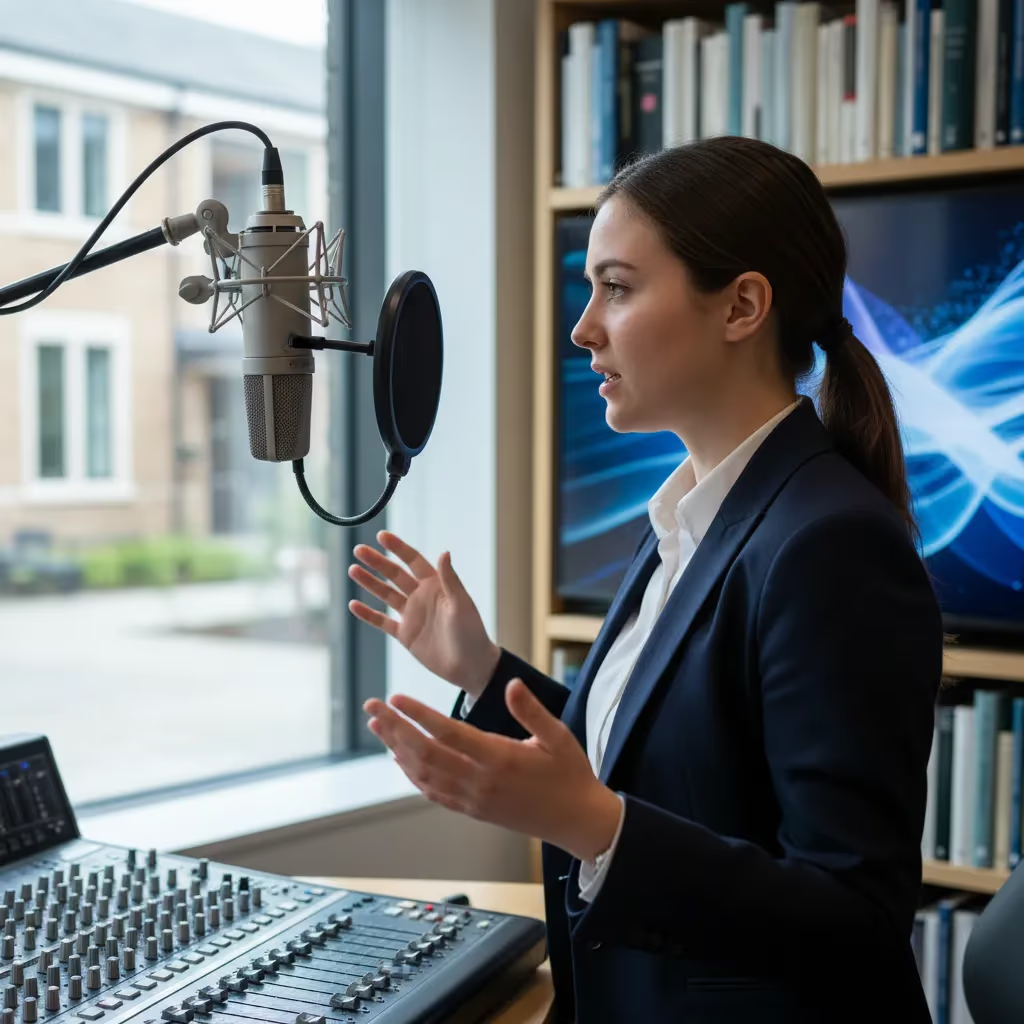
The International Test of English Proficiency (iTEP) has become one of the most recognized English language assessments for academic and professional purposes worldwide. Whether you are preparing for university admission, professional certification, or immigration requirements, understanding the iTEP program thoroughly can significantly impact your success. This comprehensive guide provides seven essential tips to help you navigate the iTEP examination process with confidence and achieve your desired score.
The iTEP assessment evaluates test-takers across multiple language competencies, including grammar, listening, reading, writing, and speaking. Unlike some standardized tests that require months of preparation, the iTEP offers flexibility in scheduling and delivers results within days. However, proper preparation remains crucial for demonstrating your true English language abilities and meeting the requirements of your target institution or organization.
ITEP Practice Test Questions
Prepare for the iTEP - International Test of English Proficiency exam with our free practice test modules. Each quiz covers key topics to help you pass on your first try.
ITEP Business
Free ITEP Practice Test featuring Business. Improve your ITEP Exam score with mock test prep.
ITEP Essay and Note Writing
ITEP Mock Exam on Essay and Note Writing. ITEP Study Guide questions to pass on your first try.
ITEP Grammar and Structure
ITEP Test Prep for Grammar and Structure. Practice ITEP Quiz questions and boost your score.
ITEP Listening Comprehension Skills
ITEP Mock Test covering Listening Comprehension Skills. Online ITEP Test practice with instant feedback.
ITEP Prepared Spoken Responses
Free ITEP Quiz on Prepared Spoken Responses. ITEP Exam prep questions with detailed explanations.
ITEP Reading Comprehension Passages
ITEP Practice Questions for Reading Comprehension Passages. Build confidence for your ITEP certification exam.
ITEP Vocabulary in Context
ITEP Study Material on Vocabulary in Context. Prepare effectively with real exam-style questions.
ITEP - International Test of English Profi...
Free ITEP Test covering - International Test of English Proficiency iTEP Grammar Section Structures. Practice and track your ITEP exam readiness.
ITEP - International Test of English Profi...
ITEP Exam Questions covering - International Test of English Proficiency Listening to Academic Lectures. Master ITEP Test concepts for certification prep.

iTEP: Pros and Cons
- +itep test — structured iTEP training builds a solid foundation of skills
- +Multiple training formats available: online, in-person, and hybrid
- +Hands-on practice prepares you for real-world job scenarios
- +Training programs often include job placement assistance
- +Continuing education keeps your skills current with industry changes
- −Training programs can be time-intensive (weeks to months)
- −Quality varies significantly between training providers
- −Costs for comprehensive programs can be substantial
- −Hands-on components may require travel or in-person attendance
- −Self-paced learning requires strong discipline and motivation
Pros and Cons at a Glance
| Pros | Cons |
|---|---|
| itep test — structured iTEP training builds a solid foundation of skills | Training programs can be time-intensive (weeks to months) |
| Multiple training formats available: online, in-person, and hybrid | Quality varies significantly between training providers |
| Hands-on practice prepares you for real-world job scenarios | Costs for comprehensive programs can be substantial |
| Training programs often include job placement assistance | Hands-on components may require travel or in-person attendance |
| Continuing education keeps your skills current with industry changes | Self-paced learning requires strong discipline and motivation |
Sample iTEP - International Test of English Proficiency Practice Questions
Try these questions from our free iTEP - International Test of English Proficiency practice tests. The correct answer and an explanation follow each question.
A prompt asks you to "Describe a person who has had a significant influence on your life." Which of the following represents the most logical and effective structure for your response?
- A. Introduce the person and their relationship to you, explain two specific ways they influenced you with examples, and then briefly conclude.
- B. Describe the person's physical appearance in great detail for the entire time.
- C. Talk about an unrelated topic for the first half, then mention the influential person at the very end.
- D. Start with your conclusion, list some random facts about the person, and then state your main point.
Answer: A. Introduce the person and their relationship to you, explain two specific ways they influenced you with examples, and then briefly conclude.
An effective spoken response should have a clear and logical organization. This structure provides a clear introduction, develops the main idea with specific supporting details and examples, and ends with a concise summary or conclusion, making it easy for the evaluator to follow.
Scenario: An iTEP lecture on marine biology first explains the process of coral bleaching due to rising ocean temperatures. It then discusses how overfishing disrupts the reef ecosystem's balance. When writing your essay, what is the best way to link these two points?
- A. Use a transition to present them as two separate, human-induced threats to coral reefs.
- B. Argue that coral bleaching is a much more serious problem than overfishing.
- C. Conclude that coral reefs cannot be saved.
- D. Discuss only the point you found more interesting and ignore the other.
Answer: A. Use a transition to present them as two separate, human-induced threats to coral reefs.
The key skill being tested is synthesis. Both points are examples of dangers facing coral reefs. A good essay will connect them logically using a transition phrase (e.g., 'In addition to the threat of coral bleaching, another significant danger...'), showing that you understand how both points support a larger theme about the vulnerability of reef ecosystems.
In a spontaneous spoken response, a test-taker is asked: 'What do you enjoy about living in your city?' The response should ideally:
- A. Describe every neighborhood in detail
- B. Include two or three specific examples with brief explanations
- C. Focus only on comparing the city to other places
- D. List as many features as possible without explanation
Answer: B. Include two or three specific examples with brief explanations
Providing two or three focused, well-explained examples demonstrates both depth of thought and clarity of expression, which are key scoring criteria.
Listen to the beginning of a talk on photography. The speaker says, 'Today, we'll look at three key areas. First, we'll cover the basics of exposure: aperture and shutter speed. After that, we'll discuss principles of composition, like the rule of thirds. Finally, I'll offer some quick tips for editing your photos.' What will the speaker discuss immediately after explaining the basics of exposure?
- A. Tips for editing photos.
- B. The history of photography.
- C. How to choose a good camera.
- D. Principles of composition.
Answer: D. Principles of composition.
The speaker uses sequential language to structure the talk. They state that 'After that' (referring to the basics of exposure), 'we'll discuss principles of composition.'
Take the full iTEP - International Test of English Proficiency practice test
(iTEP) International Test of English Proficiency Questions and Answers

Conclusion
Preparing for the iTEP examination requires dedication, strategic planning, and consistent practice across all test components. By understanding the test structure, using available resources effectively, and developing strong strategies for each section, you position yourself for success. Remember that the iTEP measures your practical English communication abilities, so incorporating real-world language use into your preparation enhances both your test performance and overall proficiency.
The seven tips outlined in this guide provide a framework for comprehensive iTEP preparation. Start early, practice regularly, and approach the examination with confidence in your preparation. Whether pursuing academic opportunities, professional advancement, or personal goals, achieving your target iTEP score opens doors to new possibilities in English-speaking environments worldwide.

About the Author

Applied Linguist & Language Proficiency Exam Specialist
Georgetown UniversityDr. Yuki Tanaka holds a PhD in Applied Linguistics and an MA in TESOL from Georgetown University. A former language examiner with the British Council, she has 18 years of experience designing and teaching language proficiency preparation courses for TOEFL, IELTS, CELPIP, Duolingo English Test, JLPT, Cambridge FCE/CAE, and Versant assessments worldwide.
Join the Discussion
Connect with other students preparing for this exam. Share tips, ask questions, and get advice from people who have been there.
View discussion (8 replies)