
How to Pass the MBLEx: Study Strategies, Content Areas, and Timeline
Pass the How to Pass the MBLEx: Study exam with confidence. Practice questions with detailed explanations and instant feedback on every answer. 🔎
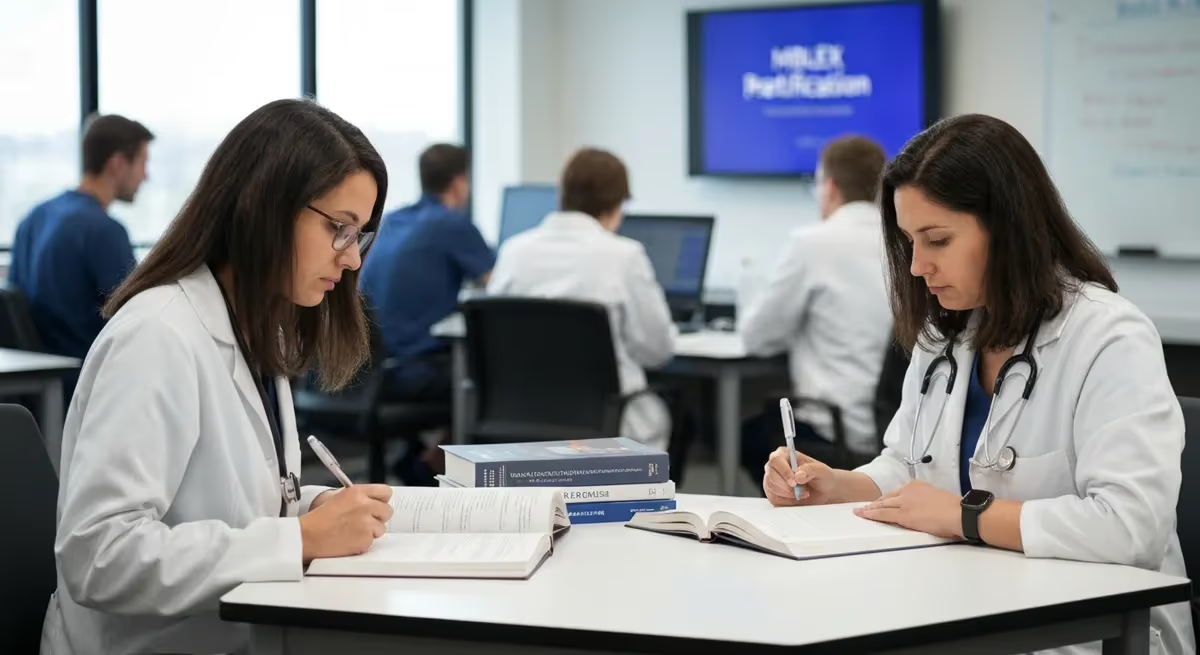
The most effective MBLEx preparation strategy combines active recall through practice testing, targeted study of weak content areas, and consistent daily review over 6-8 weeks. Students who follow a structured study plan pass at rates above 85%, compared to the national average of approximately 70% for first-time takers.
Advanced nursing candidates can reinforce their specialty knowledge and critical reasoning with our HSRT health sciences reasoning test 2026, aligned to national certification standards.
Individuals preparing for psychological or personality assessments can familiarize themselves with question formats using our MCMI personality assessment 2026, designed to reflect the structure and scoring of the official instrument.
The Massage and Bodywork Licensing Examination exam uses a multiple-choice format with questions covering all major domains. Most versions allow 2-3 hours for completion.
Questions test both knowledge recall and application skills. A score of 70-75% is typically required to pass.

Study Strategy Fundamentals
Understanding how to pass the MBLEx starts with understanding how the brain retains information. The science of learning tells us that three techniques dramatically outperform passive reading:
1. Active Recall
Active recall means testing yourself on material rather than re-reading notes. When you attempt to retrieve information from memory — even if you get it wrong — you strengthen the neural pathways for that knowledge. Practice questions are the most effective form of active recall.
Studies show that students who spend 60% of their study time on practice questions score 20-30% higher than students who spend the same total time re-reading textbooks. This is why MBLEx practice tests are the single most important study tool.
2. Spaced Repetition
Reviewing material at increasing intervals (1 day, 3 days, 7 days, 14 days) produces far better long-term retention than reviewing everything once. Flashcard apps like Anki automate this process. For the MBLEx, create flashcards for muscle origins and insertions, pathology contraindications, and ethics scenarios.
3. Interleaving
Instead of studying one topic for hours, mix topics within each study session. Study anatomy for 30 minutes, switch to ethics for 30 minutes, then do pathology for 30 minutes. This mixing forces your brain to differentiate between topics and improves your ability to identify the correct answer when exam questions jump between subjects.
Begin applying these strategies immediately with our MBLEx Anatomy and Physiology practice questions.
Content Area Priorities
Not all MBLEx content areas are created equal. Strategic allocation of study time based on exam weighting and your personal weak areas is essential for passing efficiently.
Tier 1: High Priority (50% of the exam)
These three areas account for half of all exam questions:
- Guidelines for Professional Practice (18%) — Covers scope of practice, client communication, documentation standards, hygiene and sanitation, draping procedures, and professional conduct. Many students overlook this section because it seems like "common sense," but the questions test specific protocols and standards that require study.
- Client Assessment, Reassessment & Treatment Planning (17%) — Includes intake procedures, health history review, postural assessment, range of motion testing, palpation findings, treatment modification, and documentation of outcomes. This section tests your clinical decision-making ability.
- Ethics, Boundaries, Laws & Regulations (15%) — Covers informed consent, dual relationships, sexual misconduct boundaries, HIPAA compliance, mandatory reporting, supervision requirements, and state-specific regulatory frameworks.
Tier 2: Medium Priority (27% of the exam)
- Benefits and Physiological Effects of Techniques (14%) — How different massage techniques affect the body: circulatory effects, neurological responses, myofascial release mechanisms, and when to use specific modalities.
- Pathology, Contraindications, Areas of Caution (13%) — Conditions that are absolute contraindications (never massage), local contraindications (avoid the area), and conditions requiring treatment modification. Know the difference between systemic and local contraindications.
Tier 3: Foundation Knowledge (23% of the exam)
- Kinesiology (12%) — Muscle actions, joint movements, biomechanics, and functional anatomy. Focus on the major muscles tested: origins, insertions, and primary actions.
- Anatomy & Physiology (11%) — Body systems, organ functions, tissue types, and structural anatomy. This is foundational knowledge that supports all other content areas.
The common mistake is spending 60% of study time on anatomy because it feels tangible and familiar. Adjust your plan to match the actual exam weighting — professional practice and clinical assessment deserve at least equal study time.
- ✓Review the official Massage and Bodywork Licensing Examination exam content outline
- ✓Take a diagnostic practice test to identify weak areas
- ✓Create a study schedule (4-8 weeks recommended)
- ✓Focus on your weakest domains first
- ✓Complete at least 3 full-length practice exams
- ✓Review all incorrect answers with detailed explanations
- ✓Take a final practice test 1 week before exam day
8-Week Study Timeline
This structured timeline gives you a day-by-day framework for how to pass the MBLEx in 8 weeks of consistent preparation.
Week 1: Diagnostic and Planning
- Take a full-length diagnostic practice exam (do not study first)
- Score by content area — rank your weakest to strongest areas
- Set up your study environment: flashcard app, textbook, practice question access
- Commit to 1-2 hours of study per day, 5-6 days per week
Weeks 2-3: Professional Practice and Ethics
- Study Guidelines for Professional Practice and Ethics together — they overlap significantly
- Focus on: scope of practice, informed consent, documentation, draping, HIPAA, boundaries
- Do 20-30 practice questions per day on these topics
- Create flashcards for key regulatory concepts and ethical scenarios
Weeks 4-5: Clinical and Pathology
- Study Client Assessment and Pathology/Contraindications
- Focus on: intake procedures, ROM assessment, contraindications list, when to refer
- Memorize absolute and local contraindications for common conditions
- Do 20-30 practice questions per day
Week 6: Anatomy, Kinesiology, and Techniques
- Review anatomy and kinesiology fundamentals — focus on high-yield muscles and joints
- Study technique benefits and physiological effects
- Use diagrams and models for visual learners
- Do 30-40 mixed practice questions per day
Week 7: Integration and Practice Exams
- Take 2 full-length practice exams under timed conditions (2 hours, no breaks)
- Review all missed questions thoroughly
- Fill gaps identified by practice exams
- Aim for 75%+ consistently before moving to the final week
Week 8: Final Review and Confidence Building
- Review flashcards and personal weak areas only
- Take one final practice exam — target 80%+
- Reduce study to 30-60 minutes per day
- Rest the day before the exam — trust your preparation
Resources and Tools
The right resources make your study time more efficient. Here are the most effective tools for MBLEx preparation:
Textbooks:
- Trail Guide to the Body (6th Edition) — The gold standard anatomy reference for massage therapy students. Clear illustrations of muscle attachments, bone landmarks, and palpation techniques.
- Mosby's Pathology for Massage Professionals (5th Edition) — Comprehensive pathology reference organized by body system. Covers indications, contraindications, and treatment modifications for hundreds of conditions.
- MBLEx Test Prep by David Merlino — Concise review guide designed specifically for the MBLEx, organized by content area.
Practice Test Resources:
- PracticeTestGeeks MBLEx practice tests — Free practice questions organized by content area with detailed explanations for every answer
- FSMTB Official Practice Exam — $50 for a practice test from the exam creator. The closest simulation of the real exam experience.
- Massage Exam Academy — Subscription-based question bank with 1,500+ questions and detailed rationales.
Study Tools:
- Anki — Free flashcard app with spaced repetition. Search for shared MBLEx decks or create your own.
- Visible Body (app) — 3D anatomy app that helps visual learners understand muscle layers and joint structures.
- Study groups — Form a group with 2-4 classmates who are also preparing. Quiz each other and explain concepts out loud — teaching others is one of the best ways to reinforce your own understanding.
How to Pros and Cons
- +Massage exam content is organized around a published blueprint, making targeted preparation efficient and systematic
- +Official and third-party practice materials provide realistic exposure to question types before the actual exam
- +Score reporting after practice tests and the actual exam provides detailed feedback for focused improvement
- +Study communities (forums, Discord groups, Reddit) share current insights about tested content and effective strategies
- +Multiple registration windows and retake policies give candidates flexibility in timing and recovery from suboptimal first attempts
- −High-quality preparation materials require financial investment that not all candidates can easily access
- −Time required for thorough preparation is often underestimated, leading to rushed review of critical content
- −Massage preparation resources vary widely in quality and accuracy — not all published guides are aligned with current exam content
- −Self-study without external accountability increases the risk of avoiding weak subjects and over-studying familiar ones
- −Performance under actual exam conditions often differs from practice performance due to time pressure and stress factors
Pros and Cons at a Glance
| Pros | Cons |
|---|---|
| Massage exam content is organized around a published blueprint, making targeted preparation efficient and systematic | High-quality preparation materials require financial investment that not all candidates can easily access |
| Official and third-party practice materials provide realistic exposure to question types before the actual exam | Time required for thorough preparation is often underestimated, leading to rushed review of critical content |
| Score reporting after practice tests and the actual exam provides detailed feedback for focused improvement | Massage preparation resources vary widely in quality and accuracy — not all published guides are aligned with current exam content |
| Study communities (forums, Discord groups, Reddit) share current insights about tested content and effective strategies | Self-study without external accountability increases the risk of avoiding weak subjects and over-studying familiar ones |
| Multiple registration windows and retake policies give candidates flexibility in timing and recovery from suboptimal first attempts | Performance under actual exam conditions often differs from practice performance due to time pressure and stress factors |
Sample Massage and Bodywork Licensing Examination Practice Questions
Try these questions from our free Massage and Bodywork Licensing Examination practice tests. The correct answer and an explanation follow each question.
A therapist notices a client has bruising in various stages of healing in multiple areas. What is the most appropriate action?
- A. Proceed with the session and work around the bruises
- B. Ask the client about the bruising and document the response; consider whether mandatory reporting applies
- C. Confront the client about possible domestic abuse directly
- D. Refuse the session without explanation
Answer: B. Ask the client about the bruising and document the response; consider whether mandatory reporting applies
Therapists are often mandated reporters; they should document observations, sensitively inquire when appropriate, and follow applicable reporting laws.
How does massage affect tissue extensibility in areas with chronic fibrosis?
- A. It increases collagen cross-linking, making tissue stiffer
- B. It applies mechanical force that can remodel collagen fibers and improve extensibility
- C. It dissolves fibrous tissue through enzymatic action
- D. It has no effect on collagen structure
Answer: B. It applies mechanical force that can remodel collagen fibers and improve extensibility
Sustained mechanical loading from massage can stress collagen fibers along lines of tension, encouraging realignment and improving the extensibility of fibrotic tissue.
A new client discloses they have a history of trauma and asks the therapist to avoid certain areas of the body. What should the therapist do?
- A. Explain that full-body massage is more therapeutic and proceed
- B. Document the client's preferences and strictly honor them throughout the session
- C. Reassess mid-session and massage the avoided areas if the client seems relaxed
- D. Refer the client to a psychotherapist instead
Answer: B. Document the client's preferences and strictly honor them throughout the session
Trauma-informed care requires honoring the client's stated boundaries and documenting them to ensure consistent respect of their preferences.
A client with chronic low back pain has been cleared by their physician for massage therapy. Which assessment technique is most appropriate to identify specific areas of muscular tension?
- A. Palpation of the lumbar paraspinal muscles
- B. Performing a straight leg raise test
- C. Checking deep tendon reflexes
- D. Measuring leg length discrepancy with a tape measure
Answer: A. Palpation of the lumbar paraspinal muscles
Palpation is the primary hands-on assessment tool massage therapists use to locate areas of muscular tension, trigger points, and tissue changes.
Take the full Massage and Bodywork Licensing Examination practice test
MBLEx Questions and Answers
About the Author

Board Certified Massage Therapist & MBLEx Exam Specialist
Pacific College of Health and ScienceChristine Lee is a Board Certified Therapeutic Massage and Bodywork professional (BCTMB) and Licensed Massage Therapist with a Bachelor of Science in Massage Therapy from Pacific College of Health and Science. With 14 years of clinical practice and exam coaching experience, she specializes in helping massage therapy graduates pass the MBLEx, NCBTMB, and state massage therapy licensing examinations.
Join the Discussion
Connect with other students preparing for this exam. Share tips, ask questions, and get advice from people who have been there.
View discussion (6 replies)