
Local Home Inspectors: Complete Guide to Finding, Hiring, and Working With Trusted Inspection Pros Near You
Find local home inspectors near you. Compare pricing, certifications, what they look for, and how to hire the best inspector for your property purchase. ⏳
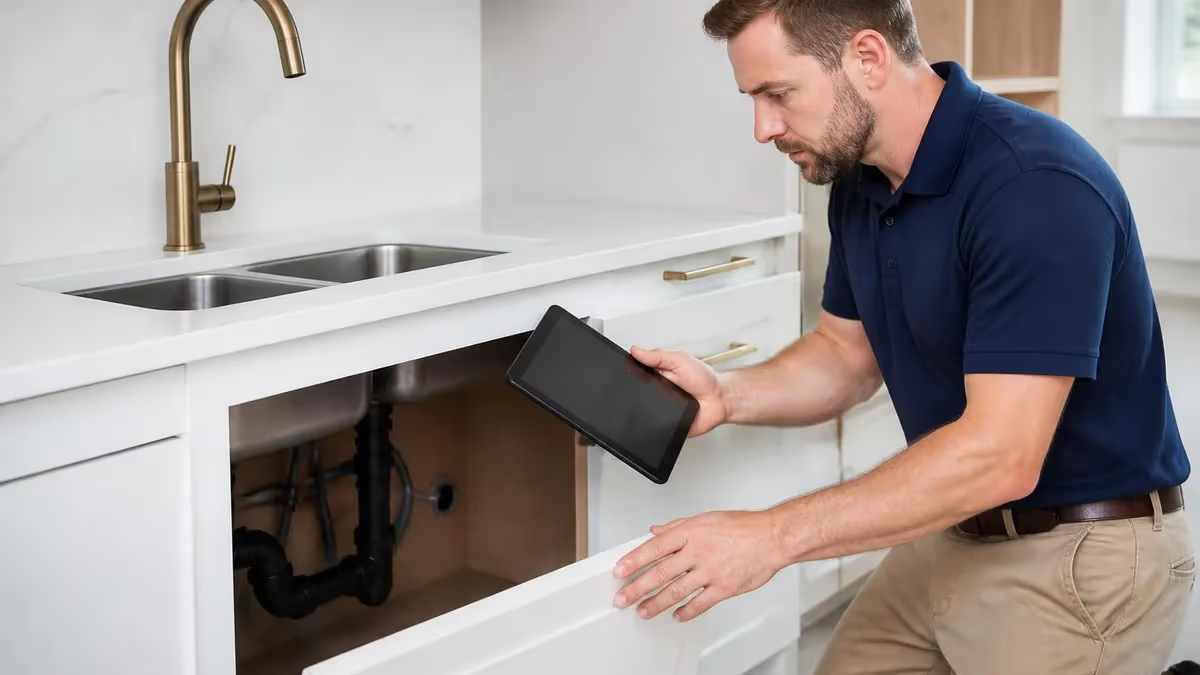
Finding qualified local home inspectors can mean the difference between a confident home purchase and a financial nightmare buried in undisclosed defects. Whether you are searching for home inspectors near me in a major metro area or a rural community, the inspector you choose will shape your understanding of the property, your negotiating use, and your peace of mind for years to come. This guide walks you through everything that matters when hiring a local inspector in the United States today.
Local home inspectors are state-licensed or certified professionals who perform a non-invasive visual examination of a residential property's accessible systems and components. They evaluate roofing, structure, electrical, plumbing, HVAC, insulation, ventilation, interior surfaces, appliances, and grading. A typical inspection takes two to four hours on-site and produces a detailed written report — often 40 to 80 pages with photos — within 24 to 48 hours. Most buyers schedule this work during the option period after an offer is accepted.
The phrase "local" carries real weight here. A nearby inspector understands regional construction practices, climate-driven defects, soil conditions, and the building codes enforced in your specific municipality. An inspector in Houston knows post-tensioned slab foundations; one in Minneapolis recognizes ice dam damage and frost heave; a Chicago inspector spots tuckpointing failures on century-old brick three-flats. National chains can be excellent, but the technician walking your property should know what failures are common within a 30-mile radius.
Pricing for local home inspectors generally falls between $300 and $700 for a standard single-family inspection under 2,500 square feet. Larger homes, older properties, and inspections in high-cost-of-living regions can run $800 to $1,500 or more once you add specialty services. Common add-ons include radon testing ($125–$200), termite or wood-destroying organism reports ($75–$150), sewer scope inspections ($200–$350), pool and spa evaluations ($100–$200), and mold or air-quality sampling ($300–$600).
The inspection industry is fragmented and largely small-business driven. The U.S. Bureau of Labor Statistics tracks roughly 100,000 active home inspectors nationally, with most operating as sole proprietors or running teams of two to five inspectors. That fragmentation is good news for consumers — you have choice — but it also means quality varies dramatically. Two inspectors examining the same house can produce reports that differ in length, depth, photo quality, and the clarity of recommendations by a factor of three or more.
This guide will help you navigate that variability. You will learn how to verify credentials, compare quotes intelligently, understand what good inspectors actually look for, recognize red flags before you sign a contract, and use the final report to negotiate effectively with the seller. We will also touch on regional pricing differences, common scope-of-work questions, and how to interpret findings without panicking over normal wear and tear.
By the end, you should have a clear, practical framework for choosing a local home inspector who is competent, communicative, properly insured, and aligned with your interests rather than the listing agent's. That is the standard worth aiming for — and it is achievable in nearly every U.S. market if you know what to ask.
Local Home Inspectors by the Numbers

How to Find Reliable Local Home Inspectors
Start with your state's official licensing roster. Texas TREC, Florida DBPR, New York Department of State, and Illinois IDFPR all publish searchable databases showing active licenses, expiration dates, and any disciplinary actions filed against an inspector.
InterNACHI and ASHI both maintain member directories searchable by ZIP code. Membership signals continuing education, adherence to a standards of practice document, and a code of ethics. Look for members in good standing with five or more years of active practice.
Google Business Profile reviews, Yelp, and Angi provide social proof. Filter for reviews mentioning specific defects found, report quality, and post-inspection communication. Be cautious of inspectors with only five-star reviews and no detail — those patterns often indicate solicited or filtered feedback.
Ask friends, family, and coworkers who recently bought homes, not your real estate agent's preferred list. Agents may recommend inspectors who close deals smoothly rather than those who deliver the most thorough findings. Independent referrals reduce conflicts of interest.
Call your top candidates. Ask how long they have inspected, how many homes per year, whether they personally perform the inspection, sample report availability, insurance coverage, and turnaround time. A good inspector welcomes these questions and answers without hesitation.
What do home inspectors look for during a typical residential inspection? The scope is defined by state regulation in licensed states and by association standards of practice — primarily ASHI, InterNACHI, and CREIA — in non-licensed states. The Standards of Practice are remarkably consistent across organizations. They require inspectors to evaluate readily accessible, installed systems and components on a non-invasive basis. The inspector does not move furniture, lift carpets, open walls, or operate shut-off systems.
Roof and exterior inspection is the first major category. The inspector evaluates shingle condition, flashing integrity at penetrations, gutters and downspouts, fascia and soffits, the chimney exterior, and any visible signs of leak history from inside the attic. Methods vary by inspector and property — some walk the roof, others use a drone, and some inspect from a ladder at the eave. Wind, snow, and ice damage are flagged where present, and remaining service life is typically estimated.
Structural and foundation evaluation follows. Inspectors document the foundation type — slab, crawl space, basement, or pier-and-beam — and look for cracks, settlement, moisture intrusion, deflection of floor joists, and signs of past or active movement. They examine framing visible in the attic and crawl space, check for sagging beams, and identify post-and-beam supports, sister joists, or amateur repairs that suggest historic structural problems requiring further evaluation by a licensed engineer.
Electrical systems receive close attention because they pose immediate safety risks. The inspector evaluates the service entrance, main panel, branch circuits, grounding, GFCI and AFCI protection, smoke and carbon monoxide detectors, and a representative sample of outlets and switches. Common findings include double-tapped breakers, missing knockouts, undersized wire to circuit breakers, federal Pacific or Zinsco panels, ungrounded outlets in older homes, and missing GFCI protection in bathrooms, kitchens, garages, and exterior locations.
Plumbing inspection covers visible supply piping material — copper, PEX, galvanized steel, or polybutylene — drain and waste vent piping, water heater age and condition, functional flow at fixtures, signs of leaks under sinks and around toilets, and the operation of bathroom and kitchen fixtures. Polybutylene supply lines and galvanized drains are routinely called out as material limitations even when not actively leaking, because both have well-documented failure histories. If you are curious how to become a home inspector, plumbing knowledge is one of the most technically demanding areas to master.
HVAC equipment is run through normal cycles when temperatures allow. The inspector checks age, capacity, filter condition, refrigerant line insulation, condensate drainage, ductwork at accessible locations, and combustion safety at gas furnaces and water heaters. Heat exchangers cannot be fully inspected without disassembly, so cracked or rusted heat exchangers are typically called out as suspect findings requiring a licensed HVAC technician's evaluation. Refrigerant pressure testing is outside the scope of a general inspection.
Interior systems round out the inspection — windows, doors, ceilings, walls, floors, stairs, railings, fireplace dampers, garage doors with auto-reverse safety, and built-in appliances. Inspectors operate appliances through one normal cycle and document brand, model, and approximate age. They do not test cosmetic items, calibration, or anything requiring specialty tools beyond a moisture meter, infrared thermometer, electrical tester, and combustion analyzer.

Home Inspector Practice Test Questions
Prepare for the Home Inspector Test exam with our free practice test modules. Each quiz covers key topics to help you pass on your first try.
Home Inspector MCQ
Home Inspector Exam Questions covering MCQ. Master Home Inspector Test concepts for certification prep.
Home Inspector Test
Free Home Inspector Practice Test featuring Test. Improve your Home Inspector Exam score with mock test prep.
Home Inspector Trivia
Home Inspector Mock Exam on Trivia. Home Inspector Study Guide questions to pass on your first try.
Home Inspector Home Online Inspector Test
Home Inspector Test Prep for Home Online Inspector Test. Practice Home Inspector Quiz questions and boost your score.
Home Inspector Top Rated Home Inspector
Home Inspector Questions and Answers on Top Rated Home Inspector. Free Home Inspector practice for exam readiness.
Home Inspector Ultimate Home Inspector
Home Inspector Mock Test covering Ultimate Home Inspector. Online Home Inspector Test practice with instant feedback.
Home Inspector Electrical System Safety Ha...
Free Home Inspector Quiz on Electrical System Safety Hazards. Home Inspector Exam prep questions with detailed explanations.
Home Inspector Forced-Air Furnace Inspection
Home Inspector Practice Questions for Forced-Air Furnace Inspection. Build confidence for your Home Inspector certification exam.
Home Inspector Plumbing DWV Systems
Home Inspector Test Online for Plumbing DWV Systems. Free practice with instant results and feedback.
Home Inspector Roofing Systems and Materials
Home Inspector Study Material on Roofing Systems and Materials. Prepare effectively with real exam-style questions.
Home Inspector Structural Framing Defects
Free Home Inspector Test covering Structural Framing Defects. Practice and track your Home Inspector exam readiness.
Home Inspectors Chicago, Minnesota, and Regional Pricing
Chicago area home inspectors generally charge between $400 and $700 for a single-family home up to 2,500 square feet, with three-flats and vintage greystones often pushing fees toward $750. The dense stock of pre-1940 brick construction, parapet walls, tuckpointing concerns, and basement moisture issues all add inspection time. Lead paint disclosure, radon testing, and sewer scope add-ons are common given Chicago's clay soil and aging service laterals.
Suburban Cook, DuPage, Lake, and Will counties tend to run slightly less than city inspections for similar square footage. Inspectors handling vintage Oak Park, Evanston, or Wilmette properties typically charge a premium because of older mechanical systems and the higher prevalence of knob-and-tube wiring, octopus boilers, and original galvanized supply piping. Always confirm what is included in the base price before signing the inspection agreement.
Hiring a Local Independent Inspector vs. a National Franchise
- +Deep familiarity with local construction practices, soils, climate, and code enforcement
- +Direct communication with the owner-operator who actually performs your inspection
- +Often more flexible scheduling and faster report turnaround in smaller markets
- +Easier to verify reputation through neighbors, prior clients, and local social media
- +More likely to walk roofs and crawl spaces personally rather than send a junior tech
- +Pricing is often negotiable for repeat clients or bundled services like radon and sewer scope
- −Inconsistent report formats and quality between solo practitioners in the same market
- −Smaller insurance coverage limits than national chains with corporate-backed E&O policies
- −Limited backup if the inspector is sick, traveling, or fully booked during peak season
- −Some lack modern software, drone equipment, thermal imaging, or moisture mapping tools
- −Continuing education and training may be inconsistent without franchise oversight
- −May have weaker formal complaint resolution processes if a dispute arises post-inspection

Checklist for Hiring Local Home Inspectors Near You
- ✓Verify state license number on the official licensing board website
- ✓Confirm InterNACHI, ASHI, or CREIA membership in good standing
- ✓Request proof of general liability and errors and omissions insurance with current dates
- ✓Ask for a sample inspection report from a similar property type and age
- ✓Confirm exactly who will perform the inspection — owner, employee, or subcontractor
- ✓Verify total years inspecting and approximate number of homes inspected annually
- ✓Ask whether the inspector walks the roof when safe and enters crawl spaces fully
- ✓Confirm turnaround time for the written report — 24 to 48 hours is standard
- ✓Read the pre-inspection agreement carefully, especially liability caps and arbitration clauses
- ✓Plan to attend the inspection in person and walk through findings at the end
Never hire the inspector your listing agent recommends without independent vetting
Buyer's agents and listing agents both have financial incentives to close deals. Some inspectors knowingly write softer reports to maintain agent referral pipelines. Always verify credentials, read sample reports, and ideally interview two or three independent local home inspectors before committing.
Home inspectors professional liability is one of the most overlooked but critical factors when evaluating local inspectors. The inspection industry operates under significant legal exposure — a missed defect can lead to claims of negligence, breach of contract, or even fraud depending on the jurisdiction and the facts. Reputable inspectors carry two distinct policies: general liability covering bodily injury and property damage during the inspection itself, and errors and omissions insurance covering professional negligence claims arising from the report's content.
General liability coverage typically ranges from $300,000 to $1 million per occurrence and protects you and the homeowner if the inspector damages property during the visit — cracking a tile while accessing the attic, breaking a window during operation testing, or causing a leak when testing a valve. Errors and omissions, often called E&O, is the policy buyers care most about. E&O limits commonly range from $100,000 to $500,000 per claim, with deductibles between $1,000 and $5,000 paid by the inspector before coverage kicks in.
Many state licensing laws require minimum insurance limits. Texas mandates E&O coverage of at least $100,000. Florida requires $300,000 for inspectors operating under license. Illinois requires both general liability and E&O. Always ask for a certificate of insurance dated within the past 90 days, and verify the named insured matches the inspector or company you are hiring. Lapsed or expired coverage is unfortunately common, especially among solo operators between policy renewals.
Pre-inspection agreements typically include liability limitation clauses capping the inspector's exposure to the inspection fee itself. This is industry standard but legally questionable in some states. In recent court decisions in California, New York, and a handful of other states, courts have voided overly restrictive liability caps where the inspector's negligence was gross or where the contract terms were not clearly disclosed. Read the agreement carefully and ask questions before signing.
Arbitration clauses are nearly universal in inspection contracts and typically require any dispute to be resolved through binding arbitration rather than litigation in court. This generally favors the inspector because arbitration costs are split, awards are typically smaller, and discovery is limited. If you are uncomfortable with arbitration, negotiate this language out or find another inspector. Most will not budge on the liability cap but may agree to remove or modify the arbitration provision.
If you discover a significant defect after closing that you believe the inspector should have caught, document everything — photos, repair estimates, communication with the inspector, and the inspection report itself. Many disputes resolve informally when the inspector's insurer reviews the file. Some result in partial refunds, repair credits, or formal claims against the E&O policy. Truly egregious cases occasionally proceed to arbitration or court, but those are rare and expensive paths.
For aspiring inspectors curious about home inspector salary and insurance costs, expect to pay $1,500 to $4,000 annually for combined general liability and E&O coverage depending on state, claims history, business structure, and policy limits. This is a baseline cost of operating ethically in the industry and a clear marker of a serious professional.
Roughly 15 to 20 percent of solo home inspectors operate with lapsed or insufficient errors and omissions coverage at any given time. Request the certificate of insurance in writing before booking, confirm the policy expiration date is past your closing date, and check that policy limits meet or exceed your state's minimum requirements. This single step protects you from one of the most common consumer complaints in the inspection industry.
Once your local inspector delivers the report, the work shifts to you and your real estate agent. Understanding how to read, prioritize, and negotiate from the inspection report is just as important as choosing the right inspector. Most modern reports use software like HomeGauge, Spectora, or Horizon, producing color-coded findings with photos, captions, and recommendations. Categories typically break down into safety hazards, major defects, minor defects, maintenance items, and informational observations.
Safety hazards demand immediate attention regardless of price negotiation. These include missing GFCI protection in wet locations, double-tapped breakers, ungrounded outlets, missing handrails on stairs, broken smoke detectors, and gas leaks at appliances. Sellers almost always agree to repair safety items because failing to do so creates liability for them under most state disclosure laws. Get repairs done by licensed contractors with documentation, not handyman fixes that may not pass re-inspection.
Major defects are the cost-driving items: roof replacement, foundation movement, sewer line failure, electrical service upgrades, HVAC replacement, structural concerns, water intrusion, and significant pest damage. These typically run $3,000 to $30,000 or more. Your negotiation options include seller-paid repairs before closing, a credit at closing toward your own future repairs, a price reduction, or walking away from the deal if remedies cannot be agreed upon during the option period.
Minor defects and maintenance items rarely warrant negotiation in seller-friendly markets but become use in buyer-friendly conditions. Worn caulk, peeling paint, gutter cleaning, missing flashing, deteriorated weatherstripping, and similar items are part of normal home ownership. Lumping too many minor items into negotiation requests often backfires — sellers tune out and become uncooperative on the items that genuinely matter.
Re-inspection after repairs is worth the additional $150 to $300 fee for major work. The same inspector returns to verify that completed repairs are professional, complete, and properly permitted where required. Roof replacements, electrical panel changes, sewer line work, and structural repairs in particular benefit from re-inspection and documentation. Insurance and resale records should retain all permits, invoices, and re-inspection reports.
For aspiring inspectors wondering how much do home inspectors make and how reports affect their business, understand that report quality is the single biggest driver of referrals. Inspectors who write clear, evidence-based, photo-rich reports with measured recommendations earn repeat business from agents, attorneys, and buyers. Inspectors who write inflammatory or alarmist language without supporting evidence develop reputations that hurt long-term earning potential.
Finally, save your inspection report permanently. It becomes a baseline for future maintenance, supports warranty claims, helps with insurance disputes, and can be useful if you sell the property within a few years. A well-documented inspection report is one of the most valuable single documents in your home ownership file — treat it that way from day one.
Practical preparation makes any home inspection more productive. Start by attending the inspection in person whenever possible. Plan to arrive about an hour after the inspector begins so they can complete the most concentrated work undisturbed, then walk the property together for the final 30 to 60 minutes. This is when you ask questions, see findings firsthand, and develop a real understanding of how the home was built and maintained over its lifetime.
Bring a notebook or use your phone to record observations and questions. Note things the inspector points out that you want to research further, recommended specialists, and any conditions that concern you personally beyond what shows up in the report. A short voice memo at the end of the inspection summarizing the inspector's verbal impressions is more useful than relying on memory alone, especially when comparing properties if you are inspecting multiple homes during a search.
Test things yourself with the inspector's permission. Open and close every window, flush every toilet, run every faucet for two minutes including the hottest setting, open every cabinet and look under every sink with a flashlight, and open the electrical panel cover if local code permits. You will notice things — sticking windows, slow drains, water hammer in pipes, mildew odors — that may or may not make it into the formal written report.
Ask the inspector for maintenance priorities for the first year. A good inspector readily ranks what should be addressed in the first 30 days, the first 90 days, and the first 12 months. Service the HVAC, replace smoke detector batteries, clean the dryer vent, flush the water heater, check attic insulation depth, and walk the roof once in spring and fall. These habits extend system life and prevent the next inspection from finding the same neglected items.
Document the home's current condition for your own records. Take wide-angle photos of every room, mechanical area, and exterior elevation on move-in day. Save them with timestamps in cloud storage. If a defect appears later, your baseline photos help establish whether it was pre-existing, gradual, or sudden. This is especially valuable for insurance claims involving water damage, roof damage, or appliance failures.
Build a relationship with a trusted local inspector beyond the purchase. Many will return for pre-listing inspections when you eventually sell, post-renovation inspections after a major remodel, or annual maintenance walk-throughs. These engagements cost less than a full purchase inspection and catch deterioration early. A trusted inspector becomes part of your home maintenance team alongside your HVAC tech, plumber, electrician, and roofer.
Finally, remember that no inspection is perfect. Inspectors are generalists evaluating accessible systems in a limited time. They cannot predict failures, see through walls, or guarantee future performance. Their job is to surface what is reasonably observable on inspection day and help you make a more informed decision. With that realistic expectation, a quality local home inspection becomes one of the highest-value services you will pay for during the entire home buying process.
Home Inspector Questions and Answers
Certified Home Inspector: Complete Guide to Training, Certification, Salary & Career Path in 2026
Pillar to Post Home Inspectors: Complete Guide to America's Largest Home Inspection Franchise
Home Inspector Pro Review 2026: Pricing, Features & Top Alternatives
Free National Home Inspector Questions and Answers
FREE Safety Home Inspector Questions and Answers
About the Author

Licensed Real Estate Broker & Licensing Exam Specialist
University of Wisconsin School of BusinessSandra Taylor is a Graduate Realtor Institute (GRI) and Accredited Buyer's Representative (ABR) designee with an MBA in Real Estate from the University of Wisconsin School of Business. She has 18 years of residential and commercial real estate brokerage experience and coaches real estate license candidates through state salesperson and broker pre-license examinations across multiple states.