
HAM Radio Practice Test: Free Practice Questions for Technician, General, and Amateur Extra License Exams
Free ham radio practice test questions for Technician, General, and Extra exams. ✍🏼 Study questions, exam pattern, pass mark, and online testing options.
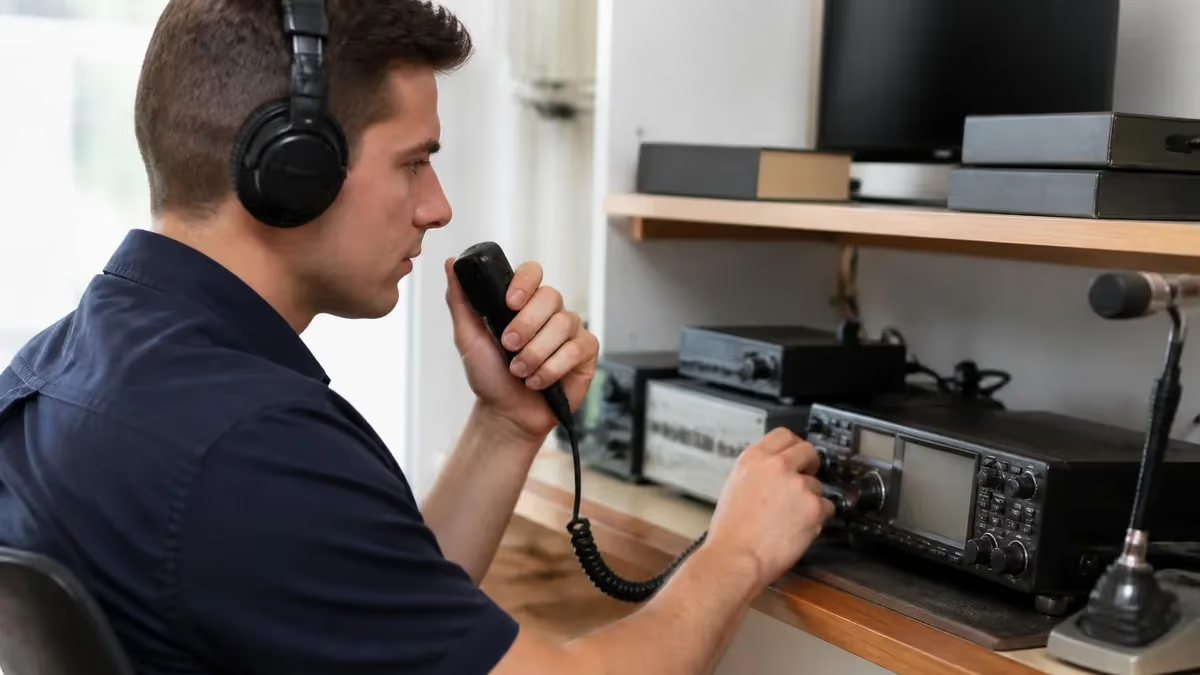
Ham radio practice tests are the most effective preparation tool for the FCC ham radi license exams. Because the FCC publishes the entire question pool publicly, every question on the actual exam comes from these pools — making practice tests the exact same questions you'll face on test day. Most successful candidates pass after working through the question pool 2-3 times until they score 85%+ consistently on practice exams.
The FCC issues three classes of amateur radio licenses: Technician (entry-level), General (intermediate), and Amateur Extra (highest). Each class has its own exam: Technician has 35 questions from a 423-question pool, General has 35 questions from a similar-sized pool, and Amateur Extra has 50 questions from a 622-question pool. Passing each exam is sequential — Technician first, then General, then Extra.
The Technician exam is the most-attempted entry point. It tests basic knowledge of: FCC rules and regulations, operating practices, electrical principles, antennas, propagation, RF safety, station equipment, and procedures. The passing score is 74% (26 of 35 correct). With the public question pool, candidates can prepare specifically — there are no surprises in the test format or content.
Online practice testing has revolutionized ham radio prep. Sites like HamStudy.org, eHam.net, QRZ.com, and the ARRL itself provide free practice exams that draw from the current question pool. Some sites offer adaptive testing that focuses on your weak areas. Others provide full-length exams that mimic the actual test experience. Combining multiple practice resources gives the strongest preparation.
Actual exam delivery has also expanded. Traditional in-person testing through ARRL VEC (Volunteer Examiner Coordinator) or W5YI VEC remains available — find local exam sessions through ARRL's online directory. Since 2020, online testing has become widely available — proctored exams via Zoom, costing roughly the same as in-person ($15 fee plus $35 FCC application fee). Online testing is more convenient and pass rates are similar.
This page is your starting point for ham radio practice testing. We cover the question pools, recommended preparation timeline, exam format details, online testing options, and how to choose your practice resources. Whether you're a complete beginner targeting the Technician license, or an existing Technician preparing for General or Extra, this guide gives you the structure for effective preparation.

Key Practice Test Information
- Question pools: Public — same questions on real exam
- Technician exam: 35 questions, 74% pass (26/35)
- General exam: 35 questions, 74% pass
- Amateur Extra exam: 50 questions, 74% pass
- Question pool size (Tech): 423 questions
- Question pool size (General): 432 questions
- Question pool size (Extra): 622 questions
- Recommended practice score: 85%+ consistently before exam
- Study time (Technician): 10-40 hours typical
- Online testing available: Yes, via ARRL VEC, W5YI VEC, others
- Total exam cost: $50 ($35 FCC fee + $15 session fee)
- License validity: 10 years (renewable)
The three ham radio license classes and what each tests. Most beginners start with Technician, then potentially move to General and Extra over time. Each class unlocks new operating privileges.
Technician class: The entry-level license. Allows operation on all VHF and UHF bands (with full power and modes) plus limited HF privileges (specific portions of 10 meters and segments of other HF bands). The exam covers: FCC rules and regulations (8 questions), operating practices (5 questions), electrical principles (7 questions), antennas and propagation (5 questions), station equipment (6 questions), RF safety (4 questions). Most exams from a 423-question pool.
General class: Intermediate license. Adds significant HF privileges — full HF band access except specific Extra-only segments. Operating privileges expand substantially. Exam adds depth on: HF operating practices, additional antennas and propagation, more electrical theory, emergency operations, RTTY and digital modes. Same 35-question format, same 74% pass.
Amateur Extra class: Highest class. Full access to all amateur radio privileges in all bands. Includes specific Extra-only HF segments (5 MHz, 80m, 40m, 20m, etc.). Exam adds: complex electrical theory, advanced antenna design, propagation forecasting, regulatory specifics, signal analysis, satellite operations, software defined radio. 50-question exam, 74% pass.
Each class is sequential — you must pass Technician before taking General, and General before Extra. Many hams stop at Technician (sufficient for local VHF/UHF operation, repeaters, emergency comms). Others progress to General within months for HF privileges. Extra is for committed enthusiasts who want full privileges and to participate in DX (long-distance) operations on premium HF segments.
License validity is 10 years for all classes. Renewal is free if completed within the renewal window. After expiration, a 2-year grace period exists during which you can reapply without retesting. Beyond grace period, retesting is required.
License Class Comparison
Entry-level. VHF/UHF full access. Some HF privileges. 35 Q, 74% pass. Pool: 423 Qs.
Intermediate. Most HF privileges. 35 Q, 74% pass. Pool: 432 Qs. Requires Tech first.
Highest. Full privileges all bands. 50 Q, 74% pass. Pool: 622 Qs. Requires General first.
Technician — practical for local operation, repeaters, emergency. ~20% of US hams stop here.
General — adds HF privileges within 6-12 months for active hams. Majority of licensed hams hold General or Extra.
Approximately 25% of US hams. Committed enthusiasts. Full HF privileges including DX segments.
The Technician exam in detail. Most beginners start here, so this is the most-commonly searched exam.
Exam structure: 35 multiple-choice questions, time limit typically 30-60 minutes (varies by VEC), 4-option questions (A, B, C, D), no penalty for guessing (only correct answers counted), score reported immediately after submission.
Question pool sources: Currently uses the 2022-2026 pool (released every 4 years). The pool contains 423 questions across 10 sections. Each exam draws 35 questions from this pool, with the same number per section to ensure balanced coverage.
Section breakdown for Technician exam:
T1 Commission's Rules: 6 questions on FCC regulations covering amateur radio
T2 Operating Procedures: 3 questions on standard operating procedures
T3 Radio Wave Propagation: 3 questions on signal propagation
T4 Amateur Radio Practices: 2 questions on best practices and operating standards
T5 Electrical Principles: 4 questions on basic electrical theory
T6 Electrical Components: 4 questions on common electronic components
T7 Station Equipment: 4 questions on transmitter, receiver, and equipment specifics
T8 Modulation Modes: 4 questions on transmission methods
T9 Antennas and Feed Lines: 2 questions on antennas and transmission lines
T0 Electrical and RF Safety: 3 questions on safety considerations
Total: 35 questions across all sections. The pool of 423 means each exam draws roughly 1 in 12 questions — substantial pool variety but every individual question is from the public pool.
Strategy: Because the pool is public, candidates can theoretically memorize all 423 questions if they want guaranteed passing. Most candidates aim for 85%+ on practice tests (showing they understand the underlying concepts) rather than memorizing answers blindly. The underlying understanding makes you a better operator, not just a test-passer.
Exam Topic Weights (Technician)
Best practice test resources for ham radio preparation. Free and paid options exist; combining multiple resources strengthens preparation.
HamStudy.org: Most popular free practice site. Adaptive testing focuses on your weak areas. Full-length practice exams. Question pool browsing. Mobile-friendly. Account creation tracks progress over time. Free to use. Highly recommended starting point.
eHam.net: Original ham radio practice test site. Free practice tests for all three classes. Less polished than HamStudy but functional. Used by many older hams.
QRZ.com: Ham radio community site with practice tests. Also useful for finding repeaters, contacts, news. Practice test feature is solid; account creation free.
ARRL practice tests: Free practice exams through the American Radio Relay League. Quality is good; ARRL is the primary US amateur radio organization. Account creation free.
HamExam.com: Comprehensive site with practice tests, study guides, and study aids. Some content is free; subscription unlocks more features. Solid resource.
Study guides (books): ARRL publishes 'Ham Radio License Manual' for Technician and General, and 'Ham Radio Extra License Manual' for Extra. Each is approximately $25-30. Comprehensive coverage of all exam topics. Best for those who prefer reading over testing.
Gordon West manuals: Another popular series. 'Technician Class' by Gordon West Radio School is widely used. Less expensive than ARRL but similar quality. Pairs well with online practice testing.
YouTube channels: HamStudy on YouTube, K0HAX channel, various others publish video study materials. Free and good for visual learners. Combine with practice testing.
Phone apps: HamStudy app (iOS/Android), Ham Radio Prep app, others. Convenient for studying on the go. Most free or low-cost.
Combining resources: Most successful candidates use HamStudy as primary practice site, supplement with a book or video course for topics they're weak on, and use the ARRL practice tests for final confidence-check.
Practice Test Resources
Cost: Free
Best for: Most candidates
Features: Adaptive testing, full-length practice exams, progress tracking, mobile-friendly. Multiple study modes (flashcards, practice tests, study sessions). Tracks your weak areas and focuses practice there.
Why popular: Polished UI, free, effective adaptive learning. Best starting point for most beginners.
Preparation timeline for Technician exam. Most successful candidates dedicate 10-40 hours of study spread over 2-8 weeks. Customize to your learning pace.
Week 1: Familiarization. Sign up for HamStudy.org. Take a full-length practice test cold — without any preparation. Most people score 20-40% on first attempt. This baseline shows where you are.
Week 2: Foundation building. Read ARRL Ham Radio License Manual or Gordon West Technician Class book. Watch HamStudy.org video tutorials for each section. Take practice tests focusing on the sections you read about. Aim for 50-70% on practice tests by end of week 2.
Week 3: Targeted practice. Identify your weak sections from practice tests. Re-read those chapters. Take section-specific practice tests. Use flashcards for terminology and rules memorization. Aim for 75-80% on practice tests.
Week 4: Full-length practice. Take 3-5 full-length practice tests. Mix question selection (random vs. adaptive). Review every missed question and understand why. Aim for 85-95% on practice tests.
Week 5: Confidence-building. Take ARRL practice test. Take one or two more full-length practice tests on HamStudy. Review topics that still trip you up. Ensure you can pass consistently at 90%+.
Exam day: Take the actual test through ARRL VEC, W5YI VEC, or online proctored. Most pass with 28-32 of 35 correct (above 80%).
For accelerated preparation: 1-2 weeks of intensive study (40 hours total) can be sufficient for highly-motivated candidates with electrical/technical background. For those without technical background, allow 6-8 weeks at 5-10 hours per week.
Common pitfalls: Memorizing without understanding (works for the test but you'll be a worse operator). Skipping FCC rules section (often the highest-weight area). Underestimating electrical theory (4 questions, but often where candidates lose points). Skipping safety section (3 critical questions, easier to learn).
Study Plan
Week 1: Baseline
Week 2: Foundation
Week 3: Targeted Practice
Week 4: Full-Length Practice
Week 5: Confidence
Exam Day
Post-Exam
How to take the actual exam. Two paths: in-person at a VEC test session, or online proctored. Both are legitimate; choose based on preference and availability.
In-person testing: Find a local exam session through ARRL's session finder (find.arrl.org). Sessions are run by Volunteer Examiner Coordinators (VECs) — primarily ARRL VEC and W5YI VEC. Sessions happen at clubs, libraries, schools, sometimes hamfests. Cost: $15 session fee + $35 FCC application fee = $50 total.
Arrive 15 minutes early with: photo ID, application form (FRN required from FCC website), $15 cash or check for session fee, optionally calculator (basic four-function only). Sit through the exam. Receive results immediately. Pass or fail decision is final at the session.
If you pass: Examiners process your application. You'll receive your call sign by email within 1-2 weeks. Begin operating only after call sign is issued.
If you fail: Wait and retake. You can retake at a different session as soon as 1 day later. Most fail rates are low (only 10-15% fail on first attempt) but if you do fail, regular practice and retaking is the path forward.
Online testing (since 2020): Proctored via Zoom or similar. Available through ARRL VEC, W5YI VEC, and others. Schedule a session, complete the exam online, pay $35 FCC fee + $15-25 session fee. Same passing requirements as in-person. Convenient for those without local sessions.
Online testing requirements: Webcam (for proctoring), reliable internet, quiet room, photo ID, and clean test environment. Verify your local VEC's specific technology requirements before scheduling.
For both methods: After passing, you'll need an FRN (FCC Registration Number) before applying. Sign up for FRN at fcc.gov before your exam.
An FRN (FCC Registration Number) is required to apply for an amateur radio license. You must obtain your FRN BEFORE your exam — most VECs require it on the application form. Apply for FRN at fcc.gov (free, 10 minutes). Without an FRN, your application can't be processed even if you pass the exam. Many first-time applicants skip this step and discover the problem on exam day. Don't be one of them — apply for FRN well before your exam date.
What you can do with each license class. Privileges are the practical reason for taking the exams — they translate to actual operating capabilities.
Technician privileges: Operate on all amateur VHF (Very High Frequency, 30-300 MHz) and UHF (Ultra High Frequency, 300 MHz-3 GHz) bands with full power and modes. Includes 6 meters (50 MHz), 2 meters (144 MHz), 1.25 meters (220 MHz), 70 cm (440 MHz), 33 cm (902 MHz), and 23 cm (1240 MHz). Plus limited HF: portions of 10 meters (28-29.5 MHz), some segments of 80 meters, 40 meters, and 15 meters for voice; CW (Morse) privileges on 10, 15, 40, 80 meters.
Practical Technician use: Local repeater operation (2 meter and 70 cm repeaters in your area). Direct simplex communication with nearby hams. Emergency communications (ARES, RACES). Public service events (parades, races). Mobile and portable operation. Some basic HF (10 meter when conditions are good).
General privileges: All Technician privileges plus substantial HF access. Voice privileges on most HF bands: 160m, 80m, 40m, 20m, 17m, 15m, 12m, 10m. CW privileges throughout HF. Digital modes (RTTY, PSK, FT8) throughout most HF.
Practical General use: Long-distance HF operation (DX). Contests and operating events. Award programs (DXCC, WAS, WAC). Most amateur radio activities open up at General level.
Amateur Extra privileges: Everything General has, plus specific 'Extra-only' HF segments. The most valuable Extra-only segments are: 5 MHz (60m), portions of 80m, 40m, 20m, 17m, 15m, and 10m. These segments are typically less crowded and have better propagation for certain operating styles.
Practical Extra use: Premium DX operation in less-crowded segments. Award chasing where bands are crowded. Contesting. Operating during high-traffic events when Extra-only segments give competitive advantage.
License upgrade economics: From Technician to General typically requires 20-40 hours of additional study. From General to Extra requires 40-80 hours. Total time investment to reach Extra from no license: 80-200 hours. Most committed hams reach Extra within 1-2 years of starting.

Operating Privileges by Class
VHF/UHF full. Limited HF. Repeaters. Local + emergency. Sufficient for many operators.
All Tech + most HF. DX work. Contests. Awards. Most ham activities open.
All General + Extra-only HF segments. Premium DX. Competitive contesting. Full privileges.
Limited HF voice. Cannot work most DX. Limited contest options.
Cannot operate Extra-only segments. Some contest classes restricted.
Extra-only segments. Some operating modes only at Extra. No license restrictions.
Common exam question types and what to expect. Understanding the patterns helps with efficient practice.
Question style: Multiple choice, 4 options, one correct answer. No 'all of the above' or 'none of the above' in the current pool. No fill-in-the-blank or essay.
Question types: Some are knowledge-based (memorize a fact, recall on exam). Some are concept-based (understand a principle, apply to new situation). Some are calculation-based (use a formula to compute a value). Most questions are knowledge-based; few are calculations.
Time management: 30-60 minutes typical for 35 questions. Generally comfortable — about 1-2 minutes per question. Don't rush; read each question carefully.
Tricky question patterns: Some questions include subtle words that change meaning ('minimum' vs 'maximum,' 'must' vs 'should'). Reading carefully prevents these traps. Some questions test understanding of specific frequencies, power limits, or rules — memorize these accurately.
Calculation-heavy areas: Ohm's law (V=IR), power calculations (P=I²R), simple antenna length calculations (wavelength). Math is basic — calculator is allowed but most calculations can be done mentally.
Memorization-heavy areas: FCC rules (specific call sign formats, license classes, operating conditions), frequencies for various bands, signal types, modes. These require repetition to memorize.
Sample questions to expect:
'What is the maximum transmitter power for amateur stations on 144 MHz?' — Tests memorization of power limits (1500W for Technician on VHF/UHF).
'Which of the following is the lowest band on which a Technician licensee can use voice?' — Tests knowledge of Technician HF voice privileges (10 meters).
'If a transmitter delivers 50 watts to an antenna with a gain of 6 dB, what is the effective radiated power?' — Tests power calculation (50W × 4 = 200W).
For all sample questions and topic areas, work through HamStudy.org's question browser to see exactly what's tested.
The FCC updates the amateur radio question pools every 4 years. Currently using the 2022-2026 pool (released July 2022; expires June 2026). When the pool updates, old practice tests become outdated within a few months. Verify your practice test source is using the current pool — most reputable sites (HamStudy, eHam, ARRL) update within weeks of new pool release. Check the pool date listed on your practice site to confirm current content. Outdated practice questions may not appear on your actual exam, defeating the purpose of practice testing.
After passing — what to do next. The exam is the gateway; ham radio is the journey.
Get your call sign: After passing, the VEC submits your application to the FCC. Within 1-2 weeks, you receive your call sign by email. You can search the FCC's amateur radio database to confirm. The call sign is yours for life (with renewal every 10 years).
Buy equipment: For Technician, the most practical first purchase is a handheld VHF/UHF radio ($100-200 for entry-level models like Baofeng UV-5R, $200-500 for quality units like Yaesu FT-65 or Icom IC-V86). Add a mobile/base station later as interest grows.
Join clubs: Local amateur radio clubs offer mentorship, training, equipment loans, and operating events. Find clubs via ARRL's club directory. Active clubs typically meet monthly.
Start operating: Begin with local repeaters and simplex. Try emergency nets. Operate during events. Build experience with on-air etiquette. Listen before transmitting; this is essential learning.
Upgrade your license: Most active hams progress to General within 6-12 months. The added HF privileges open substantially more amateur radio activity. Some reach Extra within 1-2 years.
Get involved in special interests: DX (long-distance work), contests (organized competitive operating), public service (ARES, RACES emergency comms), Field Day (annual emergency operations exercise), and many others. Most active hams develop one or two specialties.
Renewal: Your license is good for 10 years. Renew in your last year of the cycle (or 2-year grace period after expiration) at no cost. After grace period, retesting required.
License upgrade economics: A new ham investing in Technician ($50), basic equipment ($200), and one club membership ($30/year) can be on-air for less than $300 total. Adding General license (free re-application; some study cost for materials) for substantially more capability is one of the best amateur radio investments.
Ham Pros and Cons
- +Ham practice tests reveal knowledge gaps that content review alone can't identify
- +Timed practice builds the pace needed for the real exam
- +Reviewing wrong answers is the highest-ROI study activity
- +Multiple free sources available
- +Score tracking shows measurable readiness
- −Third-party tests vary in quality and exam alignment
- −Taking tests before content review produces misleading scores
- −Memorizing answers without understanding concepts doesn't transfer
- −Authentic official practice material is limited
- −Practice scores don't perfectly predict actual exam performance
Pros and Cons at a Glance
| Pros | Cons |
|---|---|
| Ham practice tests reveal knowledge gaps that content review alone can't identify | Third-party tests vary in quality and exam alignment |
| Timed practice builds the pace needed for the real exam | Taking tests before content review produces misleading scores |
| Reviewing wrong answers is the highest-ROI study activity | Memorizing answers without understanding concepts doesn't transfer |
| Multiple free sources available | Authentic official practice material is limited |
| Score tracking shows measurable readiness | Practice scores don't perfectly predict actual exam performance |
Sample HAM - Radio Extra Class Test Practice Questions
Try these questions from our free HAM - Radio Extra Class Test practice tests. The correct answer and an explanation follow each question.
What privilege does an Amateur Extra class license provide that a General class license does not?
- A. The ability to operate digital modes
- B. Access to all amateur frequency allocations including Extra-only sub-bands
- C. Permission to use more than 1500 watts PEP
- D. The right to build and sell amateur equipment
Answer: B. Access to all amateur frequency allocations including Extra-only sub-bands
Amateur Extra licensees have access to all US amateur allocations, including exclusive phone and CW sub-bands not available to General class.
Which FCC form is used to apply for an amateur radio license or upgrade?
- A. FCC Form 605
- B. FCC Form 159
- C. FCC Form 312
- D. FCC Form 740
Answer: A. FCC Form 605
FCC Form 605 is the Main Form for Commercial and Amateur Radio Service Applications, used for license grants and upgrades.
What is the minimum age requirement to hold an amateur radio license in the United States?
- A. 16 years old
- B. 18 years old
- C. No minimum age
- D. 14 years old
Answer: C. No minimum age
There is no minimum age requirement to obtain an amateur radio license in the United States.
How long is the grace period during which an expired Amateur Extra class license holder may renew without retesting?
- A. 1 year
- B. 2 years
- C. 5 years
- D. 10 years
Answer: B. 2 years
An expired amateur license may be renewed without examination for up to two years after expiration.
HAM Questions and Answers
Ham radio practice tests are the most effective preparation tool for the FCC amateur radio license exams. The combination of public question pools, free practice sites like HamStudy.org, and structured study materials means that anyone who commits 10-40 hours can pass the Technician exam. The total investment ($50 exam cost plus minimal study material cost) is small relative to the lifelong amateur radio capabilities the license unlocks.
For prospective hams, the recommended path is: take a baseline practice test to see where you stand, study using ARRL or Gordon West materials, practice extensively on HamStudy.org until you consistently score 85%+, then schedule your actual exam through ARRL VEC or W5YI VEC. Whether you choose in-person or online testing, the question pool remains the same and the preparation approach works identically. Pass, receive your call sign, and you've joined the global amateur radio community.
About the Author

Educational Psychologist & Academic Test Preparation Expert
Columbia University Teachers CollegeDr. Lisa Patel holds a Doctorate in Education from Columbia University Teachers College and has spent 17 years researching standardized test design and academic assessment. She has developed preparation programs for SAT, ACT, GRE, LSAT, UCAT, and numerous professional licensing exams, helping students of all backgrounds achieve their target scores.
Join the Discussion
Connect with other students preparing for this exam. Share tips, ask questions, and get advice from people who have been there.
View discussion (8 replies)