
Gaokao 2026 October: China's National College Entrance Exam Explained
🎯 Free Gaokao : China's National College practice test with instant feedback and detailed answer explanations. Prepare for your exam.
Gaokao: China's National College Entrance Examination Explained
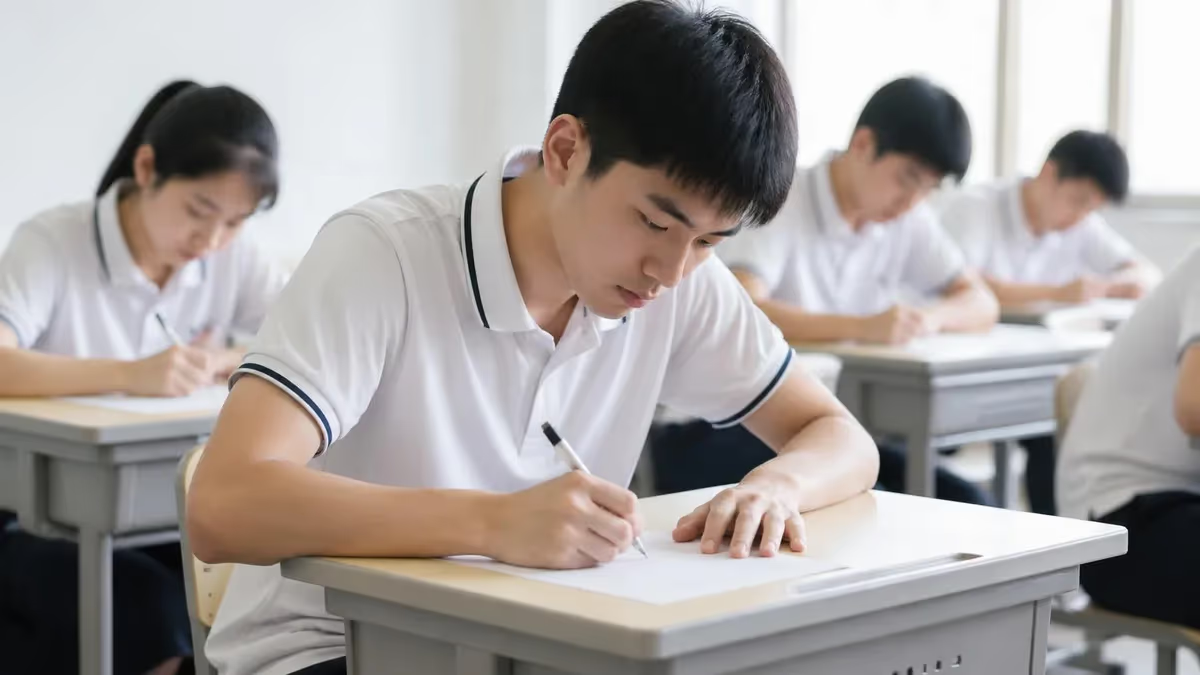
The Gaokao — short for 普通高等学校招生全国统一考试 — is China's national gaokaoination. More than 13 million students take it each year across two days in early June, making it one of the largest standardized tests conducted anywhere in the world. For Chinese high school students, it's the culmination of twelve years of education. The score you earn determines which university you can attend, which major you can study, and — in ways that extend far beyond campus — the trajectory of your professional life. There's no other exam in China with comparable weight, and no substitute pathway to elite university admission for most domestic students.
The Gaokao is administered nationally by the Ministry of Education, though individual provinces have some autonomy over the scoring cutoffs used for their universities and — historically — the specific exam papers used. The national exam (all-China unified test) has become more standardized over time, but score cutoffs for university admission still vary significantly by province. A student in Beijing might get admitted to Peking University with a score that wouldn't be sufficient for the same school from a student applying from Henan or Hunan, where competition for limited provincial quotas to elite schools is far more intense. This geographic variation in effective score requirements is one of the most discussed equity issues in Chinese education. Understanding how these admission thresholds work is essential context for interpreting any Gaokao score — the raw number means different things depending on where you're taking the exam. The university admission process and what specific scores open which doors is covered in depth in practice sets about gaokao university admission questions and answers that detail how score-to-school placement actually works.
The exam itself covers three compulsory subjects — Chinese Language and Literature (语文), Mathematics (数学), and a Foreign Language (外语, almost always English) — each worth 150 points, totaling 450 points. Students then complete additional subject tests that bring the total to 750. Under the traditional system still used in some provinces, students chose a science track (with physics, chemistry, biology) or a humanities track (with history, geography, political science). Under the newer 3+3 and 3+1+2 reform models adopted by many provinces, students have more flexibility in choosing which elective subjects they test in, though Physics or History is often required as one of the first elective choices. The compulsory subjects are identical for all students and directly comparable across provinces. The elective structure varies by province. Chinese Language is consistently described as the hardest compulsory subject because it demands not just reading comprehension but sophisticated literary analysis, classical Chinese interpretation, and a high-scoring argumentative essay. The Chinese essay alone is the subject of intense preparation among Gaokao candidates. Understanding what makes a high-scoring Gaokao essay — structure, argument quality, use of literary and historical examples — requires more preparation than just knowing the subject material, and practice with gaokao essay analysis questions and answers develops the evaluative perspective candidates need to write at the standard the exam rewards.
The foreign language section is typically English, though other languages (Japanese, Russian, French, German, Spanish, Portuguese) are permitted. Most students test in English because English proficiency is both tested and valued in Chinese higher education and professional contexts. The English section includes reading comprehension, cloze test (fill in the blanks), grammar usage, and a writing component. The reading comprehension and cloze test sections are particularly challenging because they require both broad vocabulary and precise reading speed under time pressure. Students who've practiced with difficult reading passages and diverse fill-in-the-blank contexts perform better — a gaokao english cloze questions and answers practice set builds the contextual reasoning and vocabulary breadth that these questions demand specifically, not just general English proficiency.

Gaokao 2026: Overview
- Day 1: Chinese Language (150 pts, 150 min) | Mathematics (150 pts, 120 min)
- Day 2: Foreign Language (150 pts, 120 min) + elective subjects (total score varies by province)
- Total possible score: 750 points (compulsory 450 + electives 300)
- Compulsory subjects: All students in all provinces take the same Chinese, Math, and Foreign Language exams
- Elective model: Varies by province — traditional arts/science split, 3+3 model, or 3+1+2 model
- Results timing: Scores released approximately 4 weeks after the exam; university application opens immediately after

- ✓Review the official gaokao exam content outline
- ✓Take a diagnostic practice test to identify weak areas
- ✓Create a study schedule (4-8 weeks recommended)
- ✓Focus on your weakest domains first
- ✓Complete at least 3 full-length practice exams
- ✓Review all incorrect answers with detailed explanations
- ✓Take a final practice test 1 week before exam day
Gaokao Preparation: How China's Top Scorers Study
The Gaokao preparation culture in China is one of the most intensive in the world. Most high school students spend all three years of high school (grades 10-12) building toward the exam, but the final year — Grade 12, called 高三 — is almost entirely dedicated to Gaokao preparation. School schedules during Grade 12 typically run from early morning through late evening, with structured self-study periods after formal instruction. Weekend study groups, tutoring, and supplemental classes at academic training centers (补习班) are normal parts of preparation. The academic pressure during this period is genuinely significant, and families plan household routines around creating optimal study conditions for Gaokao candidates.
The subjects that most differentiate high scorers from average scorers are Chinese and Mathematics — both because they're the highest-point subjects and because they're the most conceptually demanding. A student who scores 140+ in both Chinese and Math has a massive advantage over a student scoring 110 in both. English, by comparison, has a lower effective ceiling for differentiation because many students achieve high English scores through systematic vocabulary and grammar prep. The compulsory subjects are well-understood — Gaokao candidates can access 15+ years of past exam papers, model answers, and question-type breakdowns. The most effective preparation is working through previous years' papers systematically, category by category, until the question types feel genuinely familiar. Knowing what question formats appear in the compulsory subject section is as important as knowing the content — a student who's only seen one question type format will spend cognitive resources on the format itself during the exam. Practicing with gaokao compulsory subjects questions and answers builds the question-format fluency that allows candidates to focus all their exam-day cognitive resources on the reasoning tasks rather than the format.
Physics preparation is a strong differentiator for students on the science track. Mechanics and kinematics — velocity, acceleration, force diagrams, work-energy theorem — are the most consistently tested physics topics and the areas where exam questions tend to be most conceptually layered. A question that appears to ask about projectile motion often requires simultaneous application of kinematic equations and energy conservation principles. Building the habit of identifying all the physical principles in play before writing any equations — not just the most obvious one — is what separates students who score in the 120s on physics from those who score in the 80s. Practice with gaokao physics mechanics questions and answers develops this multi-principle reasoning habit before exam day, when time pressure makes methodical thinking harder to maintain spontaneously.
Score reporting and university application happen within a tight window after the exam — typically a few weeks from score release to application deadline. Students and families should research university cutoff score histories before exam day, not after, so that the application strategy is ready when scores are announced. Schools set cutoff scores annually based on the applicant pool, so historical cutoffs are estimates rather than guarantees. Applying only to schools with historically safe cutoffs produces conservative but lower-ceiling outcomes; applying to schools where your score is at or slightly below the historical cutoff is higher-variance but can produce dramatically better placements. Strategic university list-building — understanding provincial quota allocations, subject requirements for specific majors, and how scores translate across different school tiers — is preparation work that pays off during the application window regardless of your Gaokao score. The students who arrive knowing their university target score, understanding provincial quotas, and having applied strategic preparation to their weakest subjects earn the scores that make that planning worthwhile.
Gaokao 2026: Pros and Cons
- +Standardized testing creates a relatively meritocratic pathway to elite education — raw score matters more than family connections for university admission
- +All subjects and scoring weights are publicly documented — there are no surprises in exam structure for well-prepared candidates
- +Fifteen years of past papers are publicly available — the most authentic preparation material is free and accessible
- +One exam, one score: simplicity in university application process compared to multi-component application systems in other countries
- +High clarity on university admission criteria — students know exactly what score range targets which schools
- −Two days determine outcomes shaped by twelve years of education — a bad test day has outsized consequences with no retake pathway
- −Geographic inequality: provincial quota systems mean effective cutoff scores differ dramatically by where a student is registered
- −Extreme academic pressure during Grade 12 creates documented mental health challenges for many students and families
- −Exam content rewards memorization-heavy preparation styles that may not reflect the critical thinking elite universities and employers value
- −Students from rural and lower-income families face significant resource disadvantages in accessing high-quality Gaokao preparation
Pros and Cons at a Glance
| Pros | Cons |
|---|---|
| Standardized testing creates a relatively meritocratic pathway to elite education — raw score matters more than family connections for university admission | Two days determine outcomes shaped by twelve years of education — a bad test day has outsized consequences with no retake pathway |
| All subjects and scoring weights are publicly documented — there are no surprises in exam structure for well-prepared candidates | Geographic inequality: provincial quota systems mean effective cutoff scores differ dramatically by where a student is registered |
| Fifteen years of past papers are publicly available — the most authentic preparation material is free and accessible | Exam content rewards memorization-heavy preparation styles that may not reflect the critical thinking elite universities and employers value |
| One exam, one score: simplicity in university application process compared to multi-component application systems in other countries | Students from rural and lower-income families face significant resource disadvantages in accessing high-quality Gaokao preparation |

Sample Gaokao Exam Practice Questions
Try these questions from our free Gaokao Exam practice tests. The correct answer and an explanation follow each question.
Following China's 2015 nationwide cleanup of Gaokao bonus-point (加分) policies, which of the following categories STILL qualifies for national-level 加分 (全国性加分项目)?
- A. Provincial-level academic subject competition winners (省级学科竞赛获奖者)
- B. Students who held the position of class president or student council officer
- C. Children of 烈士 (革命烈士子女, children of revolutionary martyrs)
- D. Graduates of nationally recognized model high schools (全国示范高中毕业生)
Answer: C. Children of 烈士 (革命烈士子女, children of revolutionary martyrs)
The 2015 reforms drastically cut the number of qualifying 加分 categories, eliminating most competition-based and school-honor bonuses. Children of 革命烈士 (revolutionary martyrs) remains one of the very few surviving national-level加分 categories, reflecting the government's policy to honor families of those who died serving the state. Provincial-level competition awards were specifically removed from the national list.
China's 'South-to-North Water Diversion Project' primarily addresses which geographic problem?
- A. Coastal flooding in eastern cities
- B. Severe water deficit in the north due to uneven spatial distribution of water resources
- C. Saltwater intrusion into Pearl River Delta estuaries
- D. Excessive glacial melt water in the Tibetan Plateau
Answer: B. Severe water deficit in the north due to uneven spatial distribution of water resources
Northern China has 65% of the cultivated land but only 20% of water resources; the diversion project transfers water from the water-rich Yangtze basin to the arid north via three canal routes.
The World Trade Organization (WTO), which China joined in 2001, primarily functions to:
- A. Regulate international trade through negotiating rules and resolving trade disputes between member nations
- B. Provide development aid to poor countries
- C. Manage the global monetary system
- D. Coordinate military security arrangements
Answer: A. Regulate international trade through negotiating rules and resolving trade disputes between member nations
The WTO (世界贸易组织) sets and enforces the rules governing international trade, helps member nations negotiate trade agreements, and provides a mechanism for resolving trade disputes.
According to China's compulsory education curriculum, the primary function of the Chinese Communist Party as defined in the Constitution is:
- A. To lead all aspects of national work as the governing party
- B. To serve as an advisory body to the National People's Congress
- C. To manage economic policy exclusively
- D. To oversee military affairs only
Answer: A. To lead all aspects of national work as the governing party
China's Constitution establishes the CPC as the leading political force governing all state and social affairs in China.
gaokao Questions and Answers
About the Author

Educational Psychologist & Academic Test Preparation Expert
Columbia University Teachers CollegeDr. Lisa Patel holds a Doctorate in Education from Columbia University Teachers College and has spent 17 years researching standardized test design and academic assessment. She has developed preparation programs for SAT, ACT, GRE, LSAT, UCAT, and numerous professional licensing exams, helping students of all backgrounds achieve their target scores.