
FREE HVAC Installation and Repair Questions and Answers 2026 October
✍🏼 Pass your FREE HVAC Installation and Repair exam on the first attempt. Practice questions with detailed answer explanations, hints, and instant scoring.
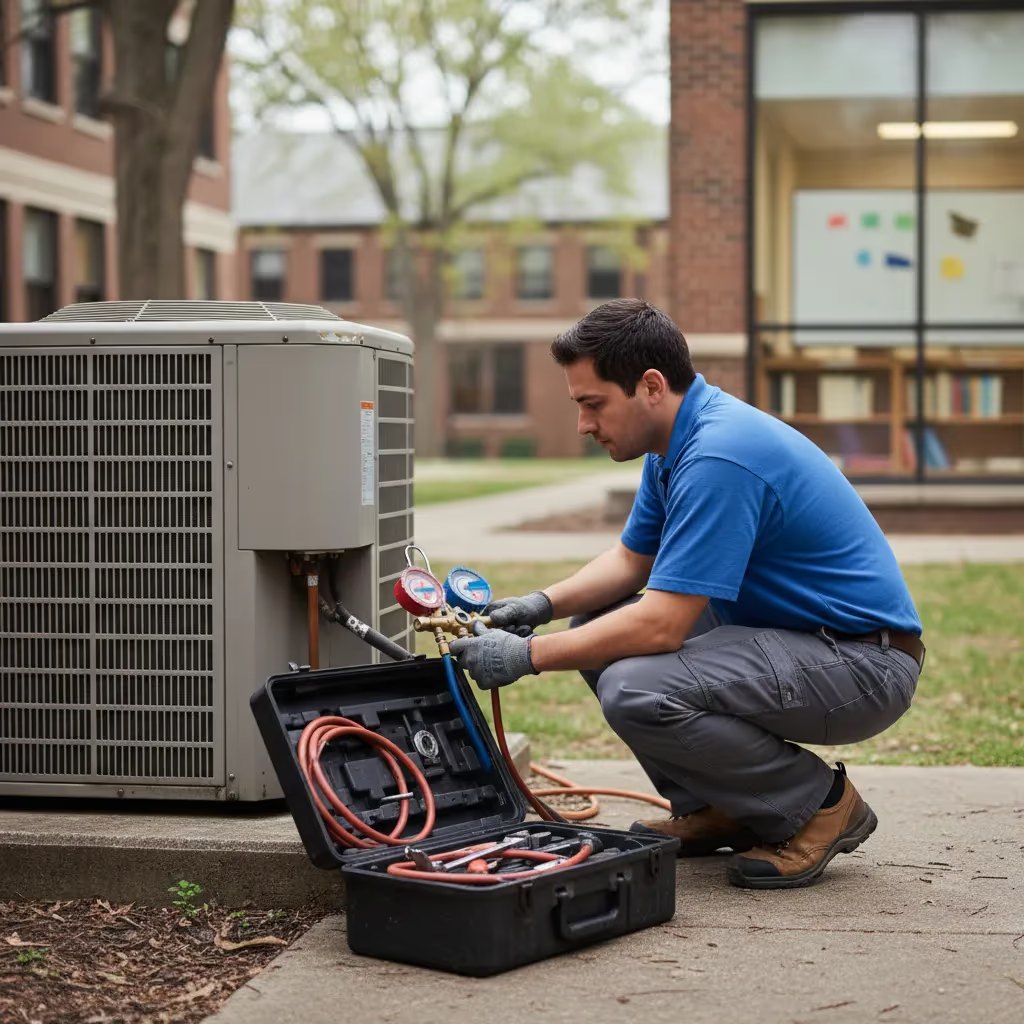
Sample HVAC - Heating, Ventilation, and Air Conditioning Practice Questions
Try these questions from our free HVAC - Heating, Ventilation, and Air Conditioning practice tests. The correct answer and an explanation follow each question.
What type of control system is most common in residential HVAC versus commercial HVAC?
- A. Residential: BAS with DDC controllers; Commercial: simple thermostats
- B. Residential: Simple thermostats; Commercial: Building Automation Systems (BAS) with DDC controls
- C. Both use simple thermostats equally
- D. Both use BAS systems regardless of building size
Answer: B. Residential: Simple thermostats; Commercial: Building Automation Systems (BAS) with DDC controls
Residential HVAC relies on simple programmable or smart thermostats with on/off or basic two-stage control. Commercial HVAC typically uses full Building Automation Systems with DDC controllers, VAV boxes, sensors, and centralized monitoring/control.
A supermarket HVAC system presents unique challenges compared to standard commercial HVAC primarily due to:
- A. Higher ceilings requiring more airflow
- B. Open refrigerated cases that significantly increase the cooling and dehumidification load
- C. Stricter fire suppression integration requirements
- D. Higher lighting power density than office buildings
Answer: B. Open refrigerated cases that significantly increase the cooling and dehumidification load
Open refrigerated display cases release cold air and moisture into the store continuously, dramatically increasing the sensible and latent cooling loads.
Compared to commercial systems, residential HVAC systems typically have:
- A. More complex control sequences
- B. Simpler on/off or two-stage controls with a single thermostat
- C. Higher static pressure requirements
- D. More redundancy built into the design
Answer: B. Simpler on/off or two-stage controls with a single thermostat
Residential systems use simple thermostats with single-stage or two-stage control, whereas commercial systems use complex DDC sequences for multi-zone management.
What is the purpose of 'commissioning' (Cx) in commercial HVAC, and what does it verify?
- A. Installing HVAC equipment according to manufacturer instructions
- B. A systematic quality assurance process verifying that all HVAC systems are installed, programmed, and operating as specified by the design
- C. A regulatory inspection required by state HVAC boards
- D. Testing refrigerant charge after installation
Answer: B. A systematic quality assurance process verifying that all HVAC systems are installed, programmed, and operating as specified by the design
Commissioning is a quality assurance process that systematically verifies and documents that HVAC systems are designed, installed, and operating according to the Owner's Project Requirements (OPR) and design documents. It includes functional testing, control sequence verification, and performance testing.
Take the full HVAC - Heating, Ventilation, and Air Conditioning practice test
About the Author

NATE Certified HVAC Technician & Licensing Exam Trainer
Universal Technical InstituteMike Johnson is a NATE-certified HVAC technician and EPA 608 universal-certified refrigerant handler with a Bachelor of Science in HVAC/R Technology. He has 19 years of commercial and residential HVAC installation and service experience and specializes in preparing technicians for NATE certification, EPA 608, A2L refrigerant safety, and state HVAC contractor licensing examinations.
Join the Discussion
Connect with other students preparing for this exam. Share tips, ask questions, and get advice from people who have been there.
View discussion (8 replies)