
Forklift Rental Cost: Complete 2026 October Pricing Guide for Daily, Weekly, and Monthly Rates
Complete forklift rental cost guide for 2026 October. Compare daily, weekly, and monthly rates by capacity, fuel type, and region. Save up to 40% with smart tips. ✏️
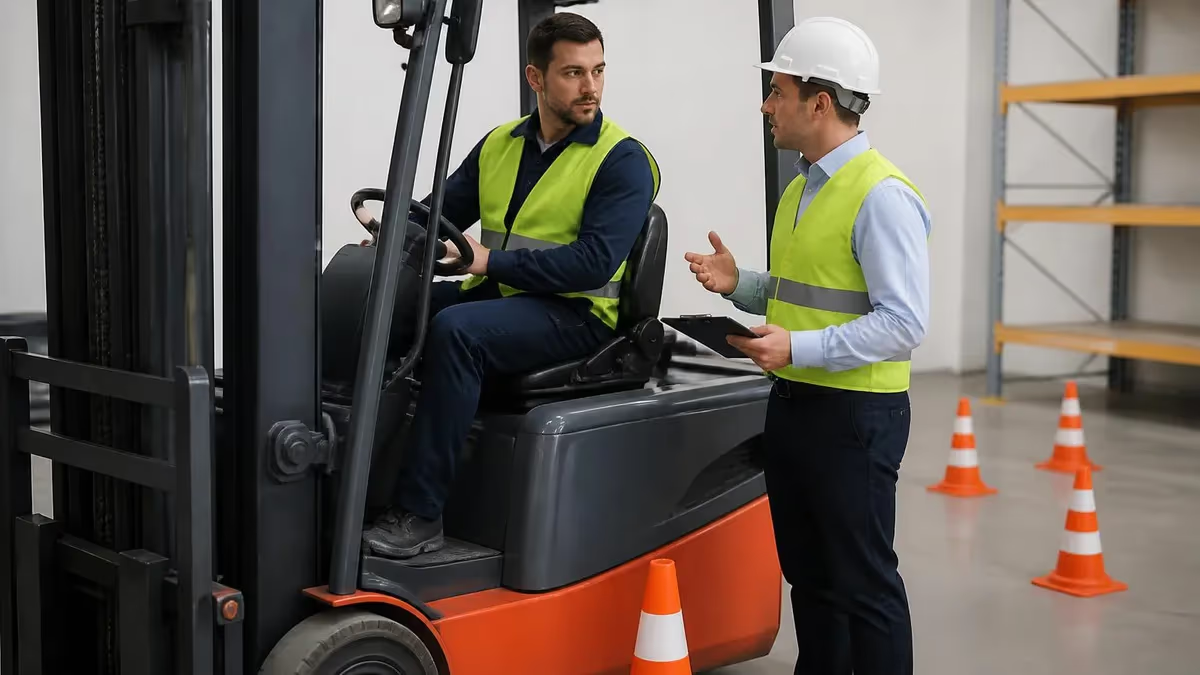
Understanding the true cost to rent a forklift in 2026 means looking beyond the sticker price on a forklift rental quote. Whether you need a forklift for a one-day warehouse reorganization, a three-month construction project, or seasonal inventory surge, rental rates vary dramatically based on capacity, fuel type, attachments, and regional demand. Most small to mid-size operations spend between $150 and $400 per day, $400 to $1,200 per week, and $900 to $3,500 per month, but those ranges shift quickly when you add specialized equipment or premium service contracts.
Renting forklifts has become the dominant procurement strategy for businesses that need flexibility without the capital expense of ownership. Purchase prices for new electric forklifts now average $25,000 to $45,000, while internal combustion models with higher lift capacities can exceed $70,000. For companies using forklifts fewer than 1,500 hours per year, rental almost always wins the total cost of ownership analysis. This is especially true when you factor in maintenance, forklift repair, storage, insurance, and depreciation that owners absorb but renters do not.
The rental market itself has matured significantly since 2020, with national chains like United Rentals, Sunbelt, and Herc Rentals competing against thousands of regional dealers. This competition has stabilized pricing but also created enormous variance in what you actually pay. Two warehouses in the same city renting identical 5,000-pound electric forklifts can pay rates differing by 35 percent based purely on contract terms, delivery distance, and negotiation. Knowing what drives those differences is the single most valuable skill in forklift procurement.
Beyond the base rental rate, hidden costs frequently double the final invoice. Delivery and pickup fees range from $75 to $400 each way. Damage waivers add 10 to 15 percent. Environmental surcharges, fuel charges, and overtime hour penalties stack quickly. Operator certification verification is now standard practice, with many rental companies refusing to release equipment until they receive proof of OSHA-compliant training for each driver who will touch the machine.
This guide breaks down 2026 forklift rental pricing across every major category: capacity class, power source, rental duration, and use case. We compare warehouse forklifts to rough terrain models, electric to propane to diesel, and short-term rentals to long-term lease-to-own structures. You will learn how to read a rental contract line by line, what questions to ask before signing, and where regional differences create surprising savings opportunities for organized buyers.
We also address the certification requirements that govern who can legally operate a rented forklift on your property. OSHA does not exempt rental equipment from the same training mandates applied to owned forklifts. Whether the operator works for you, a staffing agency, or the rental company itself, documentation must exist and be current. Failure here exposes employers to citations averaging $15,625 per serious violation under 2026 enforcement schedules.
By the end of this guide, you will have the framework to estimate forklift rental cost for any project, identify the right equipment class, negotiate fair contract terms, and avoid the five most expensive mistakes renters make. We close with detailed FAQs answering the questions buyers actually ask their procurement teams every quarter.
Forklift Rental Cost by the Numbers (2026)
Key Facts at a Glance
| Item | Value | Details |
|---|---|---|
| Regional Price Variance | 35% | Same equipment, different markets |
| Damage Waiver Cost | 10-15% | Optional but commonly required |
| Operator Cert Cost | $150 | Required by OSHA before use |

Forklift Rental Cost by Capacity and Duration
Power source remains the single largest variable in forklift rental cost after capacity. Electric forklifts dominate indoor warehouse work, while propane and diesel rule outdoor and heavy-duty applications. Each fuel type carries distinct rental economics that buyers often overlook when comparing quotes. The base rate is just the starting point — total cost of operation over a rental period can swing by 25 percent based on fuel and energy considerations alone.
An electric forklift in the 4,000 to 6,000 pound capacity range typically rents for $200 to $290 per day, $550 to $850 per week, and $1,100 to $1,800 per month. The rental rate often includes a battery and charger, but charging electricity costs $4 to $8 per shift depending on local utility rates. Lithium-ion battery rentals carry a 15 to 25 percent premium over lead-acid but eliminate the need for battery changes during multi-shift operations and reduce maintenance hassles significantly.
Propane forklifts, also called LPG models, occupy a middle price tier and account for roughly 60 percent of warehouse rentals nationally. Daily rates run $175 to $325, with monthly rates between $950 and $1,600. The hidden cost here is propane itself. A standard 33-pound cylinder lasts 6 to 8 operating hours and costs $20 to $35 to refill. Heavy users blow through three cylinders per shift, adding $60 to $105 in daily fuel expense that no rental contract covers.
Diesel forklifts dominate outdoor and rough terrain applications where power requirements exceed what propane can deliver. Rental rates start at $375 per day for 6,000-pound models and climb above $700 daily for 15,000-pound and larger units. Diesel fuel is a renter expense, with typical consumption of 2 to 4 gallons per hour. At 2026 average diesel prices around $4.10 per gallon, fuel alone can add $80 to $130 per operating day to your total cost.
Specialty equipment like reach trucks, order pickers, and a lull forklift command premium pricing. Telehandlers used in construction rent for $450 to $900 daily, while electric reach trucks for high-bay warehouses run $250 to $450 daily. These machines often require operator certifications specific to their classification, and the rental companies verify training documentation more strictly than for standard counterbalance forklifts.
Attachments and accessories add another pricing layer that catches first-time renters off guard. A side-shift carriage, standard on most modern forklifts, is usually included. But fork extensions ($25-$50 daily), rotators ($75-$150 daily), drum handlers ($60-$120 daily), and paper roll clamps ($90-$180 daily) carry separate line items. Always specify your attachment needs at quote time to avoid scrambling for compatible equipment on the job site.
Regional variance compounds all these factors. Coastal metropolitan areas like Los Angeles, Seattle, and the Northeast corridor consistently price 20 to 30 percent above national averages due to higher real estate costs at rental yards, congestion-related delivery expenses, and stricter emissions requirements that limit fleet composition. Conversely, Midwest and Southeast markets often deliver the most competitive base rates, though delivery distance can erode that advantage for rural job sites.
Forklift certification Practice Test Questions
Prepare for the Forklift certification Certification exam with our free practice test modules. Each quiz covers key topics to help you pass on your first try.
Forklift certification Certification Forkl...
Forklift certification Exam Questions covering Certification Forklift certification Maintenance and Repairs. Master Forklift certification Test concepts for certification prep.
Forklift certification Certification Forkl...
Free Forklift certification Practice Test featuring Certification Forklift certification Maintenance and Repairs Questions and Answers. Improve your Forklift certification Exam score with mock test prep.
Forklift certification Certification Forkl...
Forklift certification Mock Exam on Certification Forklift certification Operator Training and Certification Requirements. Forklift certification Study Guide questions to pass on your first try.
Forklift certification Certification Forkl...
Forklift certification Test Prep for Certification Forklift certification Operator Training and Certification Requirements Questions and Answers. Practice Forklift certification Quiz questions and boost your score.
Forklift certification Load Handling and S...
Forklift certification Questions and Answers on Load Handling and Stability. Free Forklift certification practice for exam readiness.
Forklift certification OSHA Regulations an...
Forklift certification Mock Test covering OSHA Regulations and Compliance. Online Forklift certification Test practice with instant feedback.
Forklift certification Pre-Operation Inspe...
Free Forklift certification Quiz on Pre-Operation Inspections. Forklift certification Exam prep questions with detailed explanations.
Forklift certification Refueling and Recha...
Forklift certification Practice Questions for Refueling and Recharging Procedures. Build confidence for your Forklift certification certification exam.
Forklift certification Safe Driving and Ma...
Forklift certification Test Online for Safe Driving and Maneuvering. Free practice with instant results and feedback.
Forklift certification Workplace Hazard Id...
Forklift certification Study Material on Workplace Hazard Identification. Prepare effectively with real exam-style questions.
Forklift certification Forklift Instructions
Free Forklift certification Test covering Forklift Instructions. Practice and track your Forklift certification exam readiness.
Forklift certification Forklift MCQ
Forklift certification Exam Questions covering Forklift MCQ. Master Forklift certification Test concepts for certification prep.
Forklift certification Forklift Employer R...
Free Forklift certification Practice Test featuring Forklift Employer Responsibilities. Improve your Forklift certification Exam score with mock test prep.
Forklift certification Forklift Penalties ...
Forklift certification Mock Exam on Forklift Penalties for Non-Compliance. Forklift certification Study Guide questions to pass on your first try.
Forklift Rental Terms by Equipment Type
An electric forklift rental contract typically includes the truck, one battery, and a single-phase or three-phase charger sized to your facility's electrical service. Daily rates for 5,000-pound models range $200 to $290, with weekly rates of $550 to $850 and monthly contracts at $1,100 to $1,800. Lithium-ion upgrades add 20 percent but eliminate water-checking, equalization charging, and battery rotation labor that lead-acid units demand from operators across multi-shift schedules.
Battery rental separation has become common among national chains. The truck rents at one rate, and the battery and charger are itemized separately at $200 to $450 per month. This pricing structure benefits renters who need a single truck for several months but allows fleet managers to swap batteries between identical chassis. Always confirm whether your quote includes battery, charger, and any required electrical service upgrades to your building circuit panel.
Should You Rent or Buy a Forklift?
- +No capital outlay or financing required, preserving cash flow for core business operations
- +Maintenance, repairs, and tire replacements are typically the rental company's responsibility
- +Easy to scale fleet up during peak seasons without long-term commitments
- +Access to newer models with current safety features and emissions standards
- +No storage, insurance, or registration burdens for occasional users
- +Flexible upgrade path when capacity or attachment needs change mid-project
- +Tax treatment as operating expense rather than depreciating asset simplifies accounting
- −Per-hour cost is substantially higher than owning if used more than 1,500 hours yearly
- −Delivery, pickup, and damage waiver fees add 15-25 percent to base rental rates
- −Limited customization since attachments and modifications require dealer approval
- −Operator must still hold valid OSHA certification verified by the rental company
- −Equipment may not be the exact model or specification you requested if inventory is tight
- −Long-term rentals often exceed purchase price when total payments are calculated
- −Damage charges at return can be substantial for what owners would consider normal wear

Forklift Rental Pre-Booking Checklist
- ✓Measure aisle widths, door heights, and overhead clearances at the work site
- ✓Determine maximum load weight and load center to size capacity correctly
- ✓Confirm whether indoor, outdoor, or mixed operation is required for fuel selection
- ✓Verify operator OSHA certification documentation is current and on file
- ✓Get three written quotes from different rental companies for the same specification
- ✓Ask explicitly about delivery, pickup, fuel, damage waiver, and environmental fees
- ✓Confirm minimum rental period and what happens with early returns or extensions
- ✓Inspect the forklift on delivery and document any existing damage with photos
- ✓Verify required attachments such as side shift, fork extensions, or specialty clamps are included
- ✓Confirm hour meter reading at delivery and understand monthly hour caps before overtime kicks in
When Renting Beats Buying
Industry analysts consistently identify 1,500 annual operating hours as the rough breakeven point between renting and owning a forklift. Below that threshold, rental almost always wins on total cost of ownership when you factor in maintenance, repairs, storage, and depreciation. Above 1,500 hours, ownership typically pays off within three to four years even after financing costs are included.
Negotiating a forklift rental contract is where experienced procurement professionals separate themselves from first-time renters who pay rack rates. Every line item in a standard rental agreement is negotiable, and rental companies expect serious buyers to push back on at least three or four charges. The biggest opportunities lie in delivery fees, damage waivers, fuel surcharges, and minimum rental period commitments. Walking in with three competing quotes is the single most effective negotiation tool available.
Delivery and pickup fees are often quoted as flat $150 to $400 charges, but they should reflect actual mileage and labor. A delivery within 15 miles of the dealer's yard should cost no more than $125 each way for standard counterbalance equipment. Anything higher is fair game for negotiation, especially if you can commit to a longer rental period. Many dealers will waive one direction of delivery for monthly contracts above $1,500, which alone can save $200 to $400 on a typical small business rental.
The damage waiver is the most misunderstood charge on a forklift rental contract. Listed as a percentage of the base rate (typically 10 to 15 percent), it functions like collision insurance and covers accidental damage during normal use. It does not cover negligence, operator misuse, or theft. Many corporate renters carry their own equipment floater insurance through commercial general liability policies, in which case the rental damage waiver is duplicate coverage. Always check with your insurance broker before automatically accepting it.
Fuel charges deserve close attention because they hide in two places. First, propane and diesel rentals nearly always require return at the same fuel level as delivery, with refueling fees of $5 to $7 per gallon if you fall short. Second, electric rentals may include charging electricity in the base rate or bill it separately based on facility meter readings. Always ask explicitly how fuel and energy costs are structured and what the per-gallon or per-kilowatt refill rate would be at return.
Hour meter overages catch renters off guard more than any other line item. Monthly rentals typically include 176 operating hours, equivalent to one operator running the machine 8 hours daily for 22 working days. Overtime hours bill at premium rates of $4 to $12 per hour depending on equipment class. A heavy-use operation running two shifts can easily exceed 350 monthly hours, adding $700 to $1,400 to a contract that looked competitive on the base rate.
Environmental and disposal fees are increasingly common, particularly on the West Coast where regulatory compliance costs are higher. These charges, typically $25 to $75 per rental, cover tire disposal, battery handling, and emissions testing for the rental company's fleet. They are usually non-negotiable on individual rentals but can sometimes be waived as part of a multi-machine or long-term contract. Always ask whether they appear on the quote and what specifically they cover.
Operator services represent the final cost category. If your team lacks certified community forklift operators for the specific equipment class you are renting, many dealers provide hourly operator services at $45 to $75 per hour with a 4-hour minimum. While expensive compared to using your own staff, this avoids OSHA citations for using uncertified operators and provides experienced drivers familiar with the specific machine being rented. For one-day specialized lifts, this can be the most economical path.
Federal regulation 29 CFR 1910.178(l) requires every forklift operator — including those using rented equipment — to hold current OSHA-compliant certification specific to the truck class being operated. Rental companies routinely require proof of certification before releasing equipment, and citations for using uncertified operators average $15,625 per serious violation in 2026. Certification must be completed and documented before the operator's first day on the rented machine.
The buy-versus-rent decision framework starts with annual operating hours but extends to a half-dozen secondary factors that often tip the analysis one way or the other. Beyond the basic 1,500-hour breakeven, businesses must consider seasonality, capital availability, technological obsolescence risk, maintenance capabilities, and the strategic value of fleet flexibility. A nuanced analysis often reveals that renting two or three machines while owning a core fleet provides the optimal mix.
Seasonality plays an enormous role for retailers, agricultural businesses, and construction contractors. A garden center that needs four forklifts from March through July and only one from September through January should never own four units. The off-season storage, insurance, and gradual depreciation of three idle machines easily exceeds the cost of seasonal rentals at premium rates. Smart operators build their owned fleet to handle baseline demand and rent during peaks, achieving 30 to 45 percent total cost reduction over a five-year horizon.
Capital availability and tax treatment matter especially for small businesses and startups. Renting forklifts converts a capital expenditure into an operating expense, fully deductible in the year incurred and not affecting borrowing capacity or balance sheet metrics that lenders scrutinize. New equipment purchases under Section 179 still qualify for accelerated depreciation in 2026, but the cash flow timing of owning versus renting often favors rental for businesses prioritizing working capital deployment in growth phases.
Maintenance capability is the silent factor in fleet decisions. Owners must either employ a qualified mechanic or maintain service contracts with local dealers, both of which add fixed overhead. Renters get included maintenance as part of their contract, with the rental company dispatching technicians at no additional charge for normal breakdowns. For businesses with one or two forklifts, eliminating maintenance headaches alone justifies rental even when the per-hour cost is higher.
Technology obsolescence has become a real consideration as battery technology, telematics, and operator assistance features advance rapidly. A forklift purchased in 2020 lacks the lithium-ion options, fleet management telematics, pedestrian detection systems, and emissions compliance now standard on 2026 models. Renters automatically benefit from the rental company's fleet refresh cycles, while owners must either accept aging technology or absorb the depreciation hit on early replacement decisions.
The lease-to-own option bridges rental and outright purchase for businesses that need predictability but want to eventually own equipment. Typical terms run 36 to 60 months with monthly payments comparable to long-term rental rates, but with equity accumulation toward a buyout price at term end. This works well for businesses with stable, predictable forklift needs that lack capital for immediate purchase. Always compare lease-to-own total cost against bank financing on outright purchase, as financing rates often beat lease-embedded interest charges.
Multi-year rental contracts represent another middle path. Many dealers offer 12, 24, and 36-month contracts at substantially lower monthly rates than month-to-month rentals, with included maintenance and free swap-outs if equipment needs change. A 36-month rental contract on a 5,000-pound electric forklift might run $850 monthly versus $1,400 monthly on a flexible contract — a $19,800 total savings if you commit to the term. This works best for businesses certain of their three-year forklift needs and qualified forklift driver roster.
Practical execution tips separate companies that consistently pay fair prices from those that overpay rental invoices month after month. Start by building a relationship with two or three rental providers in your market rather than always taking the lowest bid. Loyal customers consistently receive priority equipment access during tight supply periods, faster service response, and informal discounts that never appear in published rate sheets. The rental industry runs on relationships, and being a known, reliable customer pays dividends.
Document every rental from start to finish with photos. Before the equipment leaves the dealer's yard or the moment it arrives at your site, take 20 to 30 photos covering all sides, the mast, forks, tires, dash, hour meter, and any existing dents or scratches. Email these to the dealer with a timestamped delivery confirmation. At return, repeat the process. This single practice has saved customers thousands in disputed damage charges and almost always shifts the burden of proof back to the rental company.
Pre-shift inspections are required by OSHA on every operating day, but they also protect renters from being billed for damage that occurred before they took possession. Use the manufacturer's daily inspection checklist or OSHA Form 178. Document each inspection in writing and report any defects to the rental company in writing within 24 hours of discovery. Verbal reports never count if a dispute arises at return regarding pre-existing conditions on the rented equipment.
Battery management on electric rentals deserves special attention because mishandling reduces battery life and triggers damage charges that can exceed $3,000 for a replacement battery. Never let batteries fully discharge below 20 percent state of charge. Always complete a full charge cycle (8 to 10 hours) rather than opportunity charging. Add distilled water only after charging, never before. These three rules prevent 90 percent of battery damage claims at return time.
Plan for hour meter caps in your daily operations. If your monthly contract includes 176 hours and you have 22 working days, that allows exactly 8 operating hours daily. Two-shift operations need monthly contracts with 350+ included hours or weekly contracts at standard 40-hour caps. Track hour meter readings weekly and forecast whether you will exceed the included threshold. Sometimes upgrading to a larger contract mid-month saves money compared to overtime charges at the overrun rates.
Communicate proactively about extensions and early returns. Most rental contracts auto-renew at the daily rate if returned late, which can balloon a $1,200 monthly contract into $1,800 with just two extra days. Conversely, returning early rarely earns refunds — you typically pay the full minimum contracted period. If your needs change mid-rental, call the dealer immediately rather than assuming they will pro-rate fairly at return. Negotiated mid-stream changes almost always work out better than surprises at billing time.
Finally, build a forklift rental budget into project quoting from the very first stage. Construction contractors who include rental cost recovery in their bids never lose money on equipment. Warehouse managers who account for peak-season rental in their annual operations budget never face uncomfortable conversations with finance teams. Treating forklift rental as a planned, budgeted, well-negotiated procurement category rather than an emergency expense transforms it from a frustration into a strategic flexibility tool that competitors who own everything cannot match.
Sample Forklift certification Practice Questions
Try these questions from our free Forklift certification practice tests. The correct answer and an explanation follow each question.
A forklift operator is working in a cold storage facility and the forklift stalls unexpectedly. What is the safest immediate action?
- A. Repeatedly try to restart the engine to avoid the load freezing
- B. Lower the forks, set the parking brake, and report the stall to maintenance
- C. Leave the forklift with forks raised until help arrives
- D. Push the forklift manually to a charging station
Answer: B. Lower the forks, set the parking brake, and report the stall to maintenance
The operator must lower the forks to the ground to eliminate the hazard of elevated load, engage the parking brake, and contact maintenance for assistance.
What must an employer do if a forklift operator is observed operating the forklift unsafely?
- A. Terminate the employee immediately
- B. Provide refresher training and re-evaluate the operator
- C. Issue a warning and document it
- D. Report the operator to OSHA
Answer: B. Provide refresher training and re-evaluate the operator
If a forklift operator is observed operating the equipment unsafely, OSHA mandates that the employer take corrective action. This includes providing refresher training to address the specific unsafe behaviors and then re-evaluating the operator's proficiency. This ensures that the operator's skills are brought back up to standard and that safe practices are reinforced, preventing potential accidents.
The 'stability triangle' is a critical concept for forklift safety. Which three points form the corners of this triangle on a standard counterbalanced forklift?
- A. The operator's seat, the top of the mast, and the counterweight.
- B. The two front wheels and the pivot point of the rear axle.
- C. The tips of the forks and the two rear wheels.
- D. The front axle and the two pivot points of the rear wheels.
Answer: B. The two front wheels and the pivot point of the rear axle.
The stability triangle is an imaginary area on the ground formed by connecting the two front wheels and the center pivot point of the rear axle. As long as the combined center of gravity of the forklift and its load remains within this triangle, the forklift will be stable.
An operator is preparing to recharge an electric forklift battery. Which of the following is a critical safety requirement for the designated charging area?
- A. The area must be carpeted to prevent static discharge.
- B. Charging must occur outdoors, regardless of weather conditions.
- C. Adequate ventilation must be in place to disperse hydrogen gas.
- D. The forklift's key must remain in the 'on' position during charging.
Answer: C. Adequate ventilation must be in place to disperse hydrogen gas.
Electric forklift batteries emit hydrogen gas, which is highly flammable and explosive, especially near the end of the charging cycle. OSHA requires designated charging areas to have adequate ventilation to prevent the accumulation of hydrogen gas to explosive levels.
Forklift Questions and Answers
Forklift Tires: Complete Guide to Types, Sizing, Wear Patterns, and Replacement Costs
Forklift Accessories: Complete Guide to LED Lights, Attachments, Safety Gear, and Productivity Upgrades for 2026
Can a Forklift Enter a 26 ft Box Truck? Complete Guide to Loading, Operations, and Equipment Selection
Forklift License Renewal: Complete Guide to Forklift License Expiry, OSHA Recertification, and Operator Requirements for 2026
Forklift Safety Training: Complete OSHA Compliance Guide for Operators and Employers
About the Author

Certified Crane Operator & Skilled Trades Exam Specialist
Ferris State UniversityRobert Martinez is a Journeyman Ironworker, NCCCO-certified crane operator, and forklift trainer with a Bachelor of Science in Construction Technology from Ferris State University. He has 21 years of ironworking, rigging, and heavy equipment operation experience across high-rise and industrial construction sites. Robert prepares candidates for crane operator, rigger, forklift, and skilled trades certification examinations.