
Forklift Training Certification: Complete Guide to Requirements, Process, and Career Benefits
Master forklift training certification requirements, costs & steps. Covers electric forklift, stand up forklift & operator rules. ✅ Start your career today.

Forklift training certification is the gateway to one of the most in-demand skilled trades in American warehousing, manufacturing, and logistics. Whether you are eyeing a new career, upgrading existing skills, or managing a fleet of electric forklift units, understanding the full certification process is essential. OSHA mandates that every forklift operator complete formal training before operating any powered industrial truck — and failing to comply can result in fines exceeding $15,000 per violation. If you are also exploring forklift training certification resources alongside equipment decisions, this guide covers everything in one place.
The United States has more than 855,000 forklift operators actively employed, and that number is projected to grow as e-commerce continues to expand warehouse square footage at record rates. Every single one of those operators must carry a valid certification of forklift operation — a document that proves they have completed both formal instruction and practical hands-on evaluation. Unlike a driver's license, forklift certification is employer-specific and equipment-specific, meaning the rules are more nuanced than most newcomers expect.
Forklifts come in a wide variety of classes, from the ubiquitous counterbalance sit-down model you picture in a big-box retailer backroom to specialized stand up forklift designs used in narrow-aisle distribution centers. Each class has its own operating characteristics, stability triangle dynamics, and load-handling rules. Your training must address the specific type of equipment you will operate, which means a certification earned on a stand up forklift does not automatically authorize you to run an electric forklift order picker without additional instruction.
Cost is a major concern for both individuals and employers. A private forklift training program can run anywhere from $150 for an online theory course to $1,200 for a full multi-day hands-on class at a community college or equipment dealership. Employers who train in-house can reduce per-person costs dramatically — sometimes to under $75 when existing certified trainers deliver the program. Understanding cost structures helps you choose the right path without overspending or cutting corners that put safety at risk.
Recertification is also a legal requirement, not an optional refresher. OSHA 29 CFR 1910.178(l) requires operators to be re-evaluated at least every three years, or sooner if they are observed operating unsafely, are involved in a near-miss or accident, or are assigned to a different class of equipment. Many employers schedule annual refresher sessions to stay well ahead of the regulatory deadline and maintain a culture of continuous safety improvement across their forklift operator teams.
This guide walks you through every stage of forklift training certification — from understanding OSHA's foundational requirements to choosing a training provider, passing your evaluation, maintaining your certification, and using it to advance your career. You will also find practical information about forklift for sale and forklift rentals markets, since many operators transition from certification into fleet-management or supervisory roles where equipment procurement knowledge is a major asset.
Whether you are just starting out or you manage a team and need to bring your workforce into compliance, the information here is designed to give you a clear, actionable roadmap. Read through the full guide, then use the practice quizzes embedded throughout to test your knowledge against real OSHA-style questions before your formal evaluation day.
Forklift Certification by the Numbers

How to Get Your Forklift Certification: Step-by-Step
Choose Your Training Program
Complete Formal Classroom Instruction
Pass the Hands-On Practical Evaluation
Receive Your Certification Card
Schedule Recertification Before Expiry
Understanding your forklift training options is critical because not every program delivers the same quality, and price does not always correlate with compliance. OSHA does not endorse or certify training providers — the regulation places responsibility squarely on the employer to ensure any training received meets the performance standards outlined in 1910.178(l). That means a $49 online-only certificate has zero legal standing unless an in-person practical evaluation conducted by a qualified trainer at your actual worksite is also documented and on file.
Employer-run in-house training programs are the gold standard for compliance and cost-effectiveness. When a company employs a certified forklift trainer — someone who has the knowledge, training, and experience to both teach and evaluate — the per-operator cost can be as low as $50 to $100, covering just materials and the trainer's time. Large distribution centers and manufacturing plants with dozens of forklift operator roles typically develop strong internal programs with written curricula, video modules, and structured practical evaluations tailored to their specific equipment fleet and facility layout.
Third-party training companies fill an important gap for small businesses and individual operators who do not have in-house resources. These providers — often affiliated with forklift dealerships, safety consulting firms, or community colleges — offer scheduled public classes ranging from half-day to two-day programs.
Costs typically fall between $150 and $500 per person for a complete program that includes classroom instruction, a written test, and a practical evaluation on the provider's equipment. Some programs offer on-site training where the trainer comes to your facility and uses your actual forklifts, which is particularly valuable if your facility has unusual racking configurations or tight aisle constraints.
Online hybrid programs have grown significantly in popularity since 2020, and they can be legitimately OSHA-compliant when structured correctly. The theory and knowledge portions — covering regulations, load physics, inspection procedures, and hazard identification — can be completed at your own pace through a learning management system. However, the practical evaluation must always be conducted in person by a qualified evaluator on the type of equipment you will operate. Reputable online providers clearly disclose this requirement and either provide evaluator materials to employers or connect students with local evaluation partners.
Community colleges in most US states offer forklift operator certification courses as part of their workforce development or continuing education catalogs. These programs are typically priced between $200 and $800 and run over several days or evenings. They are excellent for job-seekers who do not yet have employer-sponsored training access and want a credential that demonstrates baseline competency to prospective employers. Some community college programs also include exposure to multiple forklift classes, giving graduates broader marketability across the electric forklift and counterbalance segments of the industry.
The forklift rental market also plays a role in training logistics. Operations that rely on short-term forklift rentals — renting a stand up forklift for a seasonal warehouse surge, for example — still bear full OSHA responsibility for ensuring every operator using that rented equipment is trained and certified on that specific class of truck. Forklift rental companies are not responsible for operator certification; that responsibility stays with the company using the equipment. This is a common compliance gap that OSHA inspectors actively look for during workplace audits in distribution and construction settings.
Choosing the right training format comes down to three variables: your budget, your timeline, and your access to equipment for practical evaluation. If your employer is sponsoring the training, work with your safety coordinator to identify an in-house trainer or a reputable third-party provider who can come on-site. If you are self-funding as a job-seeker, a local community college or well-reviewed private training center is your best bet for a credential employers will recognize and trust as they make hiring decisions in a competitive labor market.
Forklift Classes: Stand Up, Electric Forklift, and Counterbalance Types
Class I electric forklifts are sit-down counterbalanced models powered entirely by a battery pack, making them ideal for indoor facilities where propane exhaust would violate air quality standards. Class II includes electric narrow-aisle equipment such as reach trucks and order pickers. Both classes require operators to understand battery charging procedures, water levels for flooded lead-acid batteries, and the unique braking characteristics of electric motors — including regenerative braking, which feels very different from a combustion engine's behavior during deceleration.
Training for electric forklift operation specifically addresses battery safety: never charge a battery in an unventilated space, always disconnect the charger before moving the truck, and inspect battery connectors for corrosion or damage during every pre-shift check. Lithium-ion battery systems, increasingly common in modern fleets, introduce additional considerations around thermal management and charging protocols that differ significantly from traditional lead-acid systems. Operators who master electric forklift nuances are highly valued in cold-storage, pharmaceutical, and food-grade warehousing environments.

Employer-Run vs. Third-Party Forklift Training: Which Is Better?
- +Employer-run training uses your actual equipment and facility layout for maximum relevance
- +In-house programs typically cost 60–80% less per operator than third-party classes
- +Training can be scheduled around shift patterns without sending operators off-site
- +Company-specific hazards and SOPs are naturally integrated into the curriculum
- +Builds internal trainer capacity that scales cost-effectively as your workforce grows
- +Easier to document and maintain compliance records within existing HR systems
- −Requires a qualified in-house trainer — finding and certifying one has upfront cost
- −Small employers with only 1–3 operators may not justify building an internal program
- −In-house trainers can develop blind spots or bad habits that propagate to trainees
- −Curriculum may become outdated if the trainer does not stay current on OSHA updates
- −No external credential — some employers are skeptical of self-issued certifications
- −If the trainer leaves, the program may lapse or require expensive third-party intervention
Pros and Cons at a Glance
| Pros | Cons |
|---|---|
| Employer-run training uses your actual equipment and facility layout for maximum relevance | Requires a qualified in-house trainer — finding and certifying one has upfront cost |
| Training can be scheduled around shift patterns without sending operators off-site | In-house trainers can develop blind spots or bad habits that propagate to trainees |
| Company-specific hazards and SOPs are naturally integrated into the curriculum | Curriculum may become outdated if the trainer does not stay current on OSHA updates |
| Builds internal trainer capacity that scales cost-effectively as your workforce grows | No external credential — some employers are skeptical of self-issued certifications |
| Easier to document and maintain compliance records within existing HR systems | If the trainer leaves, the program may lapse or require expensive third-party intervention |
Forklift Operator Certification Compliance Checklist
- ✓Confirm the training program covers your specific forklift class (I through VII)
- ✓Verify the trainer holds documented qualifications to both instruct and evaluate operators
- ✓Complete all required formal instruction hours before beginning the practical evaluation
- ✓Pass the written knowledge assessment with a score of 70% or higher (or employer's threshold)
- ✓Demonstrate competency in pre-shift inspection on the actual truck you will operate
- ✓Receive a signed certification card listing your name, date, trainer, and authorized equipment classes
- ✓Ensure your employer files a copy of your training record in your personnel file
- ✓Set a calendar reminder for your three-year recertification due date immediately after qualifying
- ✓Update your certification whenever you are assigned to a new class of forklift equipment
- ✓Report any near-miss incidents, unsafe conditions, or equipment defects to your supervisor immediately
The Employer — Not the Training Provider — Is Legally Accountable
Under OSHA 29 CFR 1910.178(l), the employer bears full responsibility for ensuring forklift operators are trained, evaluated, and certified before operating powered industrial trucks. No external certificate or online course automatically satisfies this requirement — a qualified person at your company must evaluate each operator on their specific equipment and document the result. If OSHA audits your facility, they will ask to see written training records for every operator, not just certification cards.
The career outlook for certified forklift operators is remarkably strong heading into the second half of the 2020s. The Bureau of Labor Statistics projects steady demand growth driven by e-commerce fulfillment expansion, nearshoring of manufacturing from overseas, and the ongoing build-out of cold-chain logistics infrastructure across the Sun Belt. Distribution centers exceeding one million square feet — facilities that require hundreds of certified forklift operators — are being permitted and constructed at a pace unseen since the early 2000s. This sustained growth means newly certified operators entering the job market face genuinely favorable hiring conditions.
Salary ranges for forklift operators vary significantly by region, industry, and experience level. Entry-level operators with fresh certification of forklift qualifications typically earn between $16 and $20 per hour in most US markets, translating to $33,000 to $42,000 annually. Mid-career operators with three to seven years of experience and multi-class certifications frequently earn $22 to $28 per hour. In high-cost metropolitan areas such as the San Francisco Bay Area, the New York metro, and Seattle, top-end operators at unionized facilities regularly clear $35 per hour plus comprehensive benefits packages that include health insurance, retirement matching, and paid time off.
Beyond base wages, certified forklift operators have multiple pathways to earnings growth. The most direct path is multi-class certification — adding authorizations for Class II narrow-aisle equipment or Class VII rough-terrain telehandlers to a basic counterbalance certification makes an operator significantly more versatile and valuable. Many employers offer differential pay of $1 to $3 per hour for each additional class an operator is qualified on, reflecting the genuine scarcity of operators who can competently handle multiple truck types across a complex facility.
Supervisory and lead roles represent another major earnings step. Experienced forklift operators who demonstrate safety leadership, mentoring ability, and operational knowledge are frequently promoted to shift lead or warehouse supervisor positions with salaries ranging from $50,000 to $75,000 annually. Some companies require these leads to become qualified trainers themselves — completing a train-the-trainer program that costs $300 to $800 and adds a meaningful credential that further differentiates them from peers competing for limited promotional opportunities.
The forklift for sale and equipment management sector also opens doors for experienced operators. Dealerships selling forklifts — including electric forklift models, stand up forklift units, and large counterbalance trucks — actively recruit experienced operators as demonstrators, application specialists, and field service coordinators. These roles use deep equipment knowledge in a commercial context and typically pay in the $55,000 to $80,000 range with commissions. The forklift rental industry similarly employs experienced operators in fleet management, customer training, and rental equipment inspection roles.
For operators interested in independence, obtaining certification and experience can serve as the foundation for launching a consulting or contract training business. Experienced trainers who establish themselves as qualified evaluators can contract with small businesses that cannot justify an in-house trainer, charging $400 to $1,200 per on-site training day. In regions with dense small and mid-size manufacturing activity — the Midwest, Southeast, and parts of the Southwest — a solo consulting operation focusing on forklift operator certification compliance can generate $80,000 to $120,000 annually with minimal overhead.
Finally, the increasing adoption of automated and semi-automated material handling equipment — autonomous mobile robots, semi-automated reach trucks, and warehouse management system-integrated forklifts — is creating new demand for operators who can work alongside and supervise automated systems. Operators who combine traditional forklift certification with technology literacy and comfort working with WMS software are positioning themselves for the highest-value roles in next-generation distribution centers, where human-robot collaboration defines daily operational reality.

Operating a forklift with an expired certification carries the same OSHA penalty exposure as operating with no certification at all — up to $15,625 per willful violation. If an incident occurs while an operator's certification is lapsed, employer liability increases dramatically, and workers' compensation claims become significantly more complex. Renew before the expiration date, not after, and keep documentation in personnel files for at least five years following each recertification cycle.
Maintaining your certification over a long career requires more than just showing up for the three-year renewal evaluation. The most respected forklift operators treat safety as a daily practice — conducting thorough pre-shift inspections every single shift, reporting equipment defects immediately rather than hoping they resolve on their own, and actively mentoring newer operators on the floor. This professional discipline not only keeps worksites safer but also builds the reputation that leads to promotions, pay increases, and supervisory opportunities over a sustained career arc.
Pre-shift inspections are among the most critical habits a certified forklift operator can build. OSHA requires operators to inspect their equipment before each shift using a checklist that covers fluid levels, tire condition, horn function, lights, load backrest, fork condition, mast chains, and overhead guard integrity.
A defective forklift must be tagged out of service and reported to a supervisor immediately — operating a truck with a known defect is a citable violation regardless of whether an incident occurs. Many experienced operators develop a personal walk-around routine that takes less than five minutes but catches the kinds of progressive defects — slow hydraulic leaks, developing tire flat spots, worn fork tine tips — that can escalate into serious failures if ignored over multiple shifts.
Load capacity management is another area where ongoing knowledge makes a measurable safety difference. Every forklift has a data plate specifying the maximum rated load capacity, and that capacity changes when attachments are used or when the load center differs from the standard 24 inches.
Operators must consult the data plate and, when needed, a modified capacity chart before attempting to lift unusual loads. Overloading a forklift by even ten percent can compromise the stability triangle and dramatically increase tip-over risk — the leading cause of fatal forklift incidents in the United States, accounting for roughly 25% of all forklift-related fatalities annually.
Travel safety rules require constant situational awareness. Speed limits in most warehouse facilities are set between 5 and 10 mph, but the real challenge is intersection management, pedestrian separation, and visibility through racking aisles. Operators should always travel with the load lowered to the travel position — approximately six to eight inches off the ground — to maintain forward visibility and keep the center of gravity as low as possible. At intersections, slowing to a complete stop, sounding the horn, and proceeding only after visual confirmation of clearance is the standard that OSHA and industry best practices universally endorse.
When operators work in environments that include forklift rental equipment — perhaps seasonal surges where the facility supplements its owned fleet with rented stand up forklift units or electric forklift order pickers — the certification rules are unchanged.
The rented equipment must be inspected before first use, operators must be certified on that class of truck, and any defects discovered must be reported to the rental company immediately and documented. Treating rented equipment with the same care as owned fleet equipment is both an OSHA requirement and a practical financial imperative, since damage to rental units is typically charged to the lessee at replacement cost rates.
Hazardous material awareness is a frequently overlooked component of forklift operator competency that becomes critical in certain industries. Chemical plants, battery manufacturers, and agricultural supply operations often require forklift operators to handle drums, IBCs, or palletized containers of hazardous materials. In these environments, operators must understand spill response procedures, proper load orientation requirements for hazmat containers, and the location and operation of emergency eyewash stations and spill containment equipment. Training in these environments should supplement base forklift certification with facility-specific hazmat familiarization tailored to the specific chemicals present on site.
Staying current with evolving OSHA guidance and industry standards is an ongoing professional responsibility. OSHA periodically issues letters of interpretation that clarify how existing regulations apply to new equipment types or emerging workplace configurations. Following OSHA's website updates, subscribing to industry newsletters from organizations like the Industrial Truck Association, and participating in professional networks of forklift operators and safety professionals ensures that your knowledge base remains current between formal recertification cycles and positions you as a genuinely knowledgeable professional rather than an operator who merely possesses a card.
Practical preparation for your forklift certification evaluation begins long before you step onto the training floor. The most effective candidates spend time reviewing OSHA 29 CFR 1910.178 in full — the regulation is publicly available on OSHA's website and is written clearly enough to serve as a study guide even for first-time readers.
Pay particular attention to the sections covering operator training requirements, pre-use inspection, traveling rules, loading and unloading procedures, refueling and recharging protocols, and the specific requirements for operating on ramps and dock levelers. These topics form the core of virtually every written knowledge assessment used by training providers nationwide.
Understanding the physics of forklift stability is arguably the most important conceptual knowledge a forklift operator can possess. The stability triangle — the three points defined by the two front wheels and the rear axle pivot point — determines whether a loaded or unloaded forklift will remain stable during travel and lifting operations. The forklift's center of gravity must remain inside this triangle at all times.
Raising a load shifts the combined center of gravity upward and forward, reducing the stability margin. Turning while carrying an improved load compounds this effect exponentially. Committing the stability triangle concept to deep, intuitive understanding — not just memorizing a definition — is what separates operators who respond correctly under time pressure from those who react too slowly to prevent tip-overs.
Hands-on practice time is irreplaceable. If your training provider offers open floor time before the formal evaluation, use all of it. Practice smooth, controlled starts and stops rather than jerky acceleration. Work on precise mast control — raising and lowering smoothly without overshooting target heights.
Practice tilting the mast back during travel to secure the load, then forward when stacking to deposit it precisely. Develop your spatial awareness for the forklift's rear-swing during turns, which is the opposite of a car's turning behavior and the source of many loading dock and aisle damage incidents caused by operators who have not yet internalized this critical difference.
Mock inspections are an excellent self-study technique. Before your evaluation day, practice conducting a full pre-shift inspection from memory — fluid levels, tire condition, fork tine measurement, chain tension, hydraulic function, lights, horn, and overhead guard. Time yourself. Aim for a thorough inspection completed in under seven minutes. Evaluators want to see methodical, systematic inspection behavior that demonstrates genuine internalization of the checklist, not a nervous candidate fumbling through a sheet of paper trying to remember whether they checked the brake fluid before or after the battery water level.
Emergency scenario preparation is also essential. Your evaluator may ask how you would respond to a tip-over in progress — the correct answer is to hold onto the steering wheel, brace your feet, lean away from the direction of fall, and never attempt to jump clear, as the overhead guard is designed to protect you and jumping increases injury risk significantly.
Similarly, know the procedure for a runaway truck: apply the service brake first, then the parking brake, then cut the ignition. Knowing these procedures cold gives you confidence under evaluation conditions and, far more importantly, the ability to respond correctly in a real emergency where panic can cost lives.
After you earn your certification, treat the card as the beginning of your professional development, not the end of your learning. Join industry forums, read safety incident case studies published by the National Safety Council and OSHA, and consider pursuing additional certifications in related areas such as aerial work platform operation, rigging and signaling, or hazardous materials handling. Each additional credential broadens your employability and signals to current and future employers that you take professional growth seriously — a quality that correlates strongly with promotion to lead operator, trainer, and supervisory roles throughout a warehouse and logistics career.
Finally, use the practice resources available to you right now. The quiz tiles embedded throughout this guide link to real OSHA-style practice questions covering emergency procedures and maintenance scenarios — the two areas that certification evaluators probe most deeply. Working through these practice questions multiple times, reviewing your incorrect answers carefully, and identifying the underlying principles behind each question is the most efficient and effective way to build the confident, well-grounded knowledge that makes both your formal evaluation and your daily operation genuinely safe and professional.
Sample Forklift certification Practice Questions
Try these questions from our free Forklift certification practice tests. The correct answer and an explanation follow each question.
The process of lifting loads onto loading out racking is about to commence. Before you start, what do you need to know?
- A. The upper weight that the racking tower can safely hold
- B. What material the racking tower is made of
- C. The length of the forklift
- D. Whether the load is correctly insured
Answer: A. The upper weight that the racking tower can safely hold
Before lifting loads onto racking, it is critical to know the maximum weight the racking tower can safely support. Exceeding this weight limit can lead to structural failure, causing the racking to collapse and resulting in severe accidents, injuries, or fatalities. This information ensures the load is within the racking's capacity, maintaining safety and preventing damage.
What must an employer's training certification record include?
- A. Operator name, training date, and evaluator identity
- B. Only the operator's signature
- C. The forklift serial number only
- D. A copy of the OSHA standard
Answer: A. Operator name, training date, and evaluator identity
The certification must record the operator's name, the date of training/evaluation, and who performed the evaluation.
Which event triggers mandatory refresher training regardless of the 3-year cycle?
- A. A routine shift change
- B. An accident or near-miss involving the operator
- C. A change in company logo
- D. A holiday schedule
Answer: B. An accident or near-miss involving the operator
Refresher training is required when an operator is involved in an accident or near-miss, is observed operating unsafely, or is assigned a different type of truck.
What is the minimum age requirement to operate a forklift in a non-agricultural setting in the US?
- A. 16 years old
- B. 21 years old
- C. 18 years old
- D. There is no federal age requirement
Answer: C. 18 years old
Under OSHA and the Fair Labor Standards Act, workers must be at least 18 years old to operate a forklift in non-agricultural workplaces.
Forklift Questions and Answers
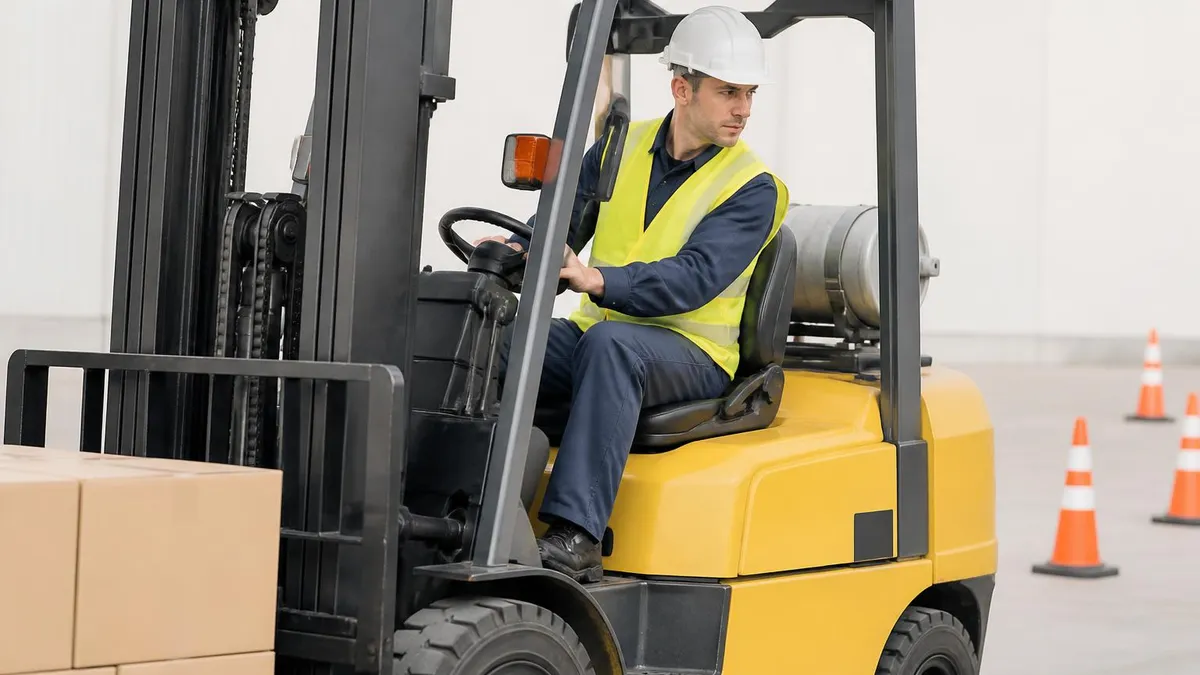
Forklift Rentals: Complete Guide to Pricing, Types, and Operator Requirements
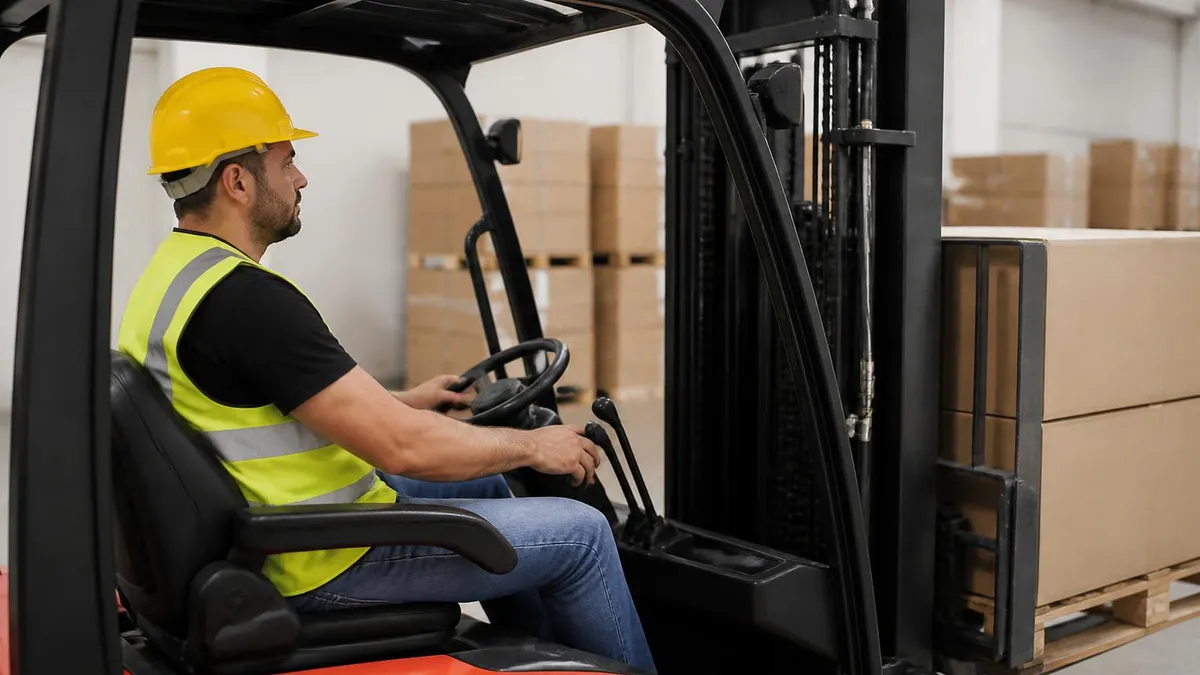
Forklift Hydraulic Fluid: Complete Guide to Types, Specifications, Change Intervals, and Troubleshooting for 2026
Forklift Certification 2026
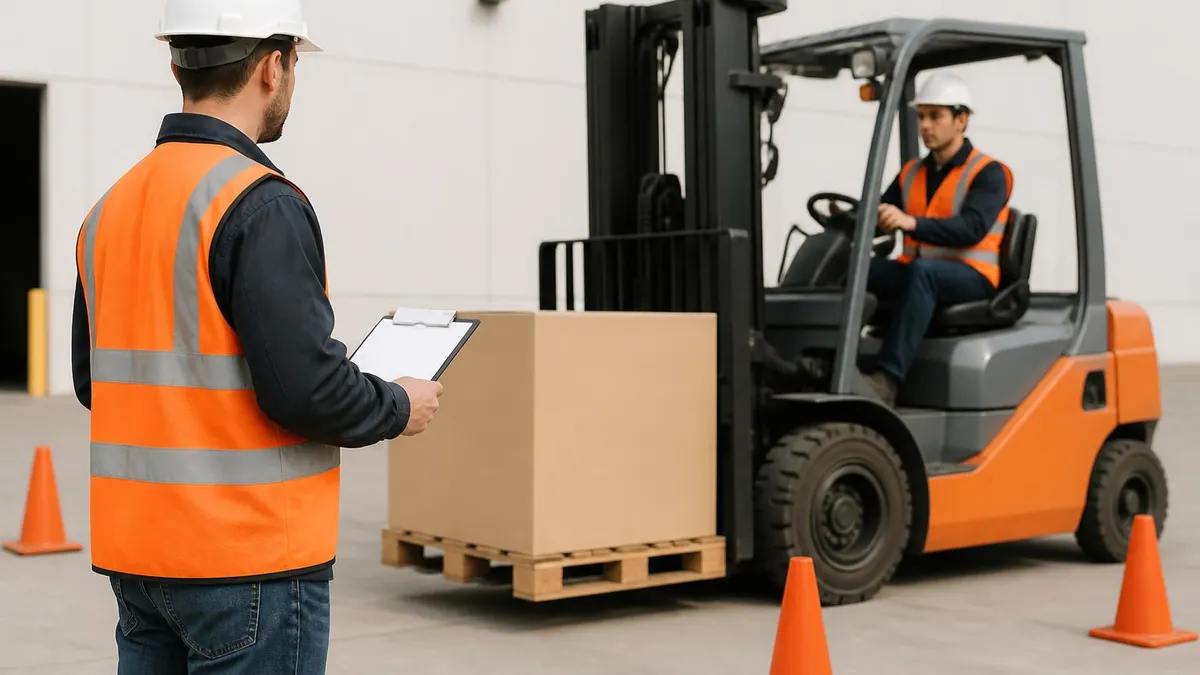
Forklift Parts and Maintenance: Complete Guide to Batteries, Chargers, and Replacement Components
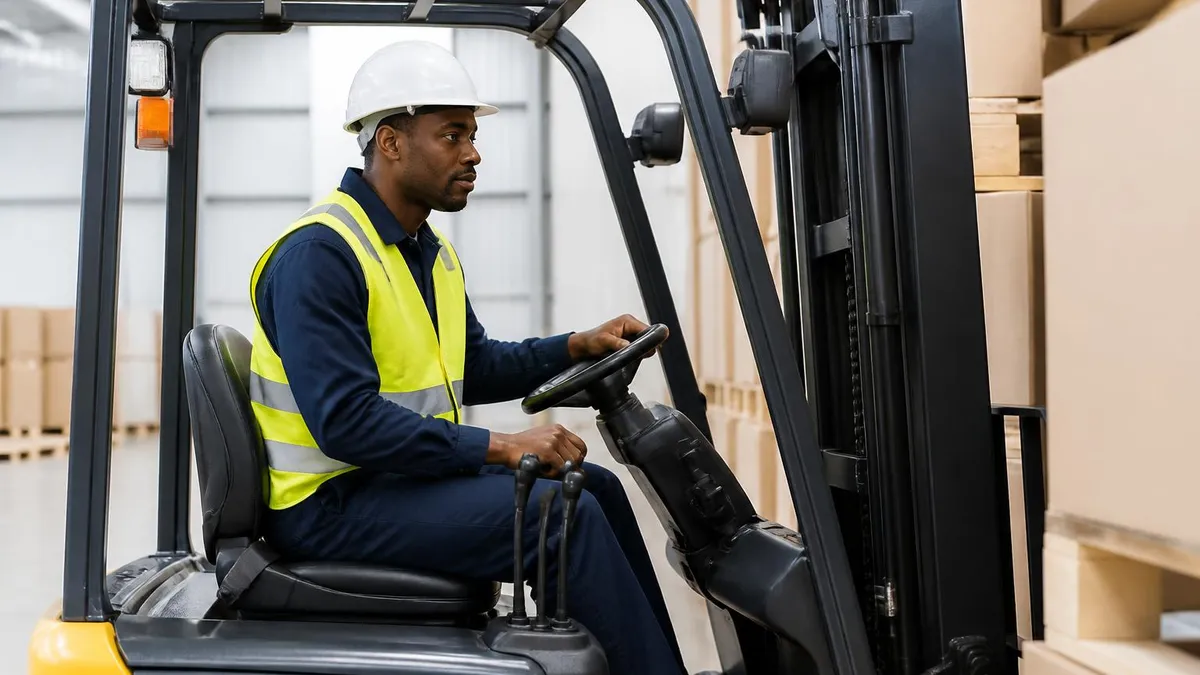
Can a Forklift Enter a 26 ft Box Truck? Complete Guide to Loading, Operations, and Equipment Selection
About the Author

Certified Crane Operator & Skilled Trades Exam Specialist
Ferris State UniversityRobert Martinez is a Journeyman Ironworker, NCCCO-certified crane operator, and forklift trainer with a Bachelor of Science in Construction Technology from Ferris State University. He has 21 years of ironworking, rigging, and heavy equipment operation experience across high-rise and industrial construction sites. Robert prepares candidates for crane operator, rigger, forklift, and skilled trades certification examinations.