
General Forklift Guide: Safety, Parts, Tires & OSHA Certification 2026 October
Get ready for your General Forklift Guide: 📚 Safety, Parts, certification. Practice questions with step-by-step answer explanations and instant scoring.
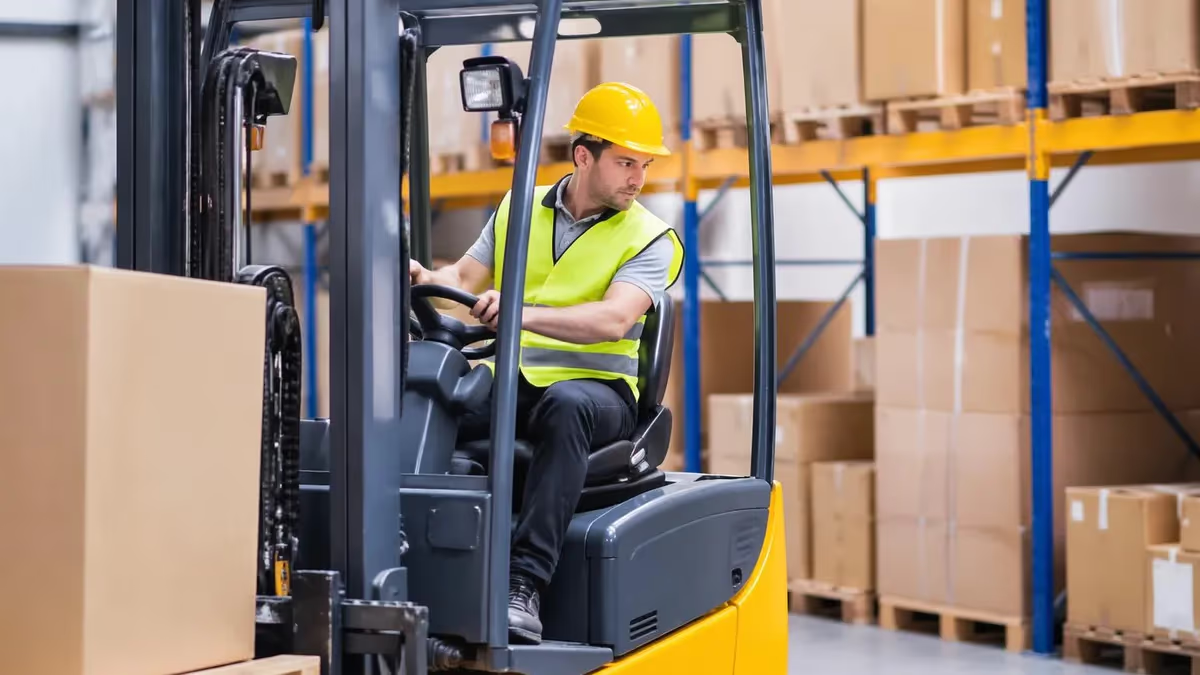
A general forklift serves as the backbone of warehouse operations, construction sites, and manufacturing floors across the country. Whether you're running a dock crew or just getting started as an operator, understanding forklift fundamentals keeps people safe and products moving. This guide covers everything from pneumatic general service forklift tires to OSHA training requirements, operator responsibilities, and the parts that keep these machines running.
One question that trips up new operators: where is an unloaded forklift center of gravity generally located? It sits roughly at the center of the vehicle's body, between the drive axle and the steer axle. Once you load the forks, that center shifts forward. Understanding this shift is critical -- it's the reason tip-overs kill roughly 85 workers every year in the U.S. alone. You can't fake this knowledge. OSHA expects you to know it cold before you ever touch the controls.
Pneumatic general service forklift tires matter more than most operators realize. They're the point of contact between a 9,000-pound machine and whatever surface you're driving on. Wrong tires mean poor traction, uneven weight distribution, and a higher rollover risk. Cushion tires work fine on smooth warehouse floors, but outdoor yards and rough surfaces demand pneumatic rubber. Different jobs call for different setups -- and the general forklift operator who ignores tire selection is asking for trouble. This guide walks through every angle so you can stay compliant, stay safe, and pass your certification the first time.
Center of Gravity and Forklift Stability
So where is an unloaded forklift center of gravity generally located? It's positioned near the center of the truck body, slightly toward the drive axle. That's important because OSHA's stability triangle -- formed by the two front wheels and the rear axle pivot -- determines whether a forklift stays upright or rolls. When you pick up a load, the combined center of gravity shifts forward and upward. Move it outside that triangle, and you've got a tip-over. Simple physics. Deadly consequences.
A forklift should generally be driven forward unless the load blocks your view. In that case, you drive in reverse and look over your shoulder. It's counterintuitive for new operators, but where is an unloaded forklift center of gravity generally located is the kind of question that appears on every certification exam -- and understanding the answer keeps you from making fatal mistakes on the job. Tilt your mast back when traveling. Keep forks six to eight inches off the ground. These aren't suggestions; they're the baseline for staying alive.
Speed matters too. Sharp turns at even moderate speed shift the center of gravity laterally. Combine that with an elevated load and you're looking at a Class IV or V truck on its side. Operators who've been doing this for years still get caught. Don't assume experience equals immunity. The physics don't care how many hours you've logged.
Forklift Tires, Parts, and Service Locations
If you're looking for general forklift Toms River NJ service or general service forklift tires Houston dealers, you'll find options ranging from national chains to local specialists. Tire selection isn't cosmetic -- it affects load capacity, stability, and operator comfort. Pneumatic tires (air-filled or solid pneumatic) handle outdoor terrain. Cushion tires sit lower and work on smooth indoor surfaces. Polyurethane press-on tires suit electric pallet jacks and light-duty warehouse lifts.
General service forklift tires Houston suppliers typically stock both pneumatic and cushion options for Class IV and V trucks. When you're shopping, check the tire's load rating against your forklift's data plate. A mismatched tire voids the capacity rating -- and that's an OSHA violation waiting to happen. Don't guess. Match specs to specs. A forklift should generally be driven forward unless the load obstructs visibility, and tire condition plays directly into safe stopping distances and steering response.
Beyond tires, forklift general parts include mast chains, hydraulic cylinders, carriage rollers, fork pins, and electrical components for battery-powered units. Supply chains for these parts run through OEM dealers, aftermarket distributors, and online warehouses. Common wear items -- forks, bearings, seals, hoses -- should be stocked on-site for any operation running more than a few trucks. Downtime costs money. A blown hydraulic hose on a Friday afternoon with no spare means lost revenue until Monday.
Forklift Classes and Tire Types
Pneumatic general service forklift tires come in two types: air-filled and solid. Air-filled pneumatics offer better shock absorption on rough terrain but risk punctures. Solid pneumatics eliminate flat tires entirely -- they're heavier and ride harder, but they won't strand you mid-shift. Class V internal combustion forklifts (outdoor, rough surface) almost always run pneumatic. If you're operating on gravel, dirt, uneven asphalt, or loading docks with debris, pneumatic is the only safe option.
General Forklift Safety Rules
General forklift safety starts before you even climb into the seat. Every shift begins with a pre-operation inspection. Check tires, forks, mast, hydraulics, controls, lights, horn, and battery or fuel level. If anything fails, tag the machine out. No exceptions. OSHA Standard 29 CFR 1910.178 makes this mandatory -- and your employer can be fined thousands for letting operators skip inspections.
Forklift general parts wear out. Mast chains stretch. Hydraulic seals leak. Fork heels thin from years of dragging across concrete. These aren't cosmetic issues -- they're failure points that can drop a 4,000-pound pallet on someone's head. Operators aren't mechanics, but they need to know what "normal" looks like so they can spot what isn't. A good operator catches problems before they become injuries.
Pedestrian awareness is non-negotiable. Sound your horn at blind corners. Slow down in pedestrian zones. Never carry passengers unless the forklift has an approved second seat. And here's one most people don't think about: never walk under raised forks. Ever. Not to grab something quick. Not for any reason. A hydraulic failure drops the carriage instantly -- there's no warning and no time to move. General forklift safety isn't about following rules because someone's watching. It's about going home in one piece.
Forklift Operator Jobs and Industry Demand
A general mills forklift operator or any food-manufacturing forklift position typically requires OSHA certification, experience with Class I or IV trucks, and familiarity with food-safe material handling. General Mills, Kellogg's, Tyson, and similar large manufacturers hire forklift operators year-round -- warehousing and distribution never stop. Pay ranges from $16 to $24 per hour depending on location, shift differential, and experience. Night shifts usually pay more. Cold storage pays a premium too.
The general forklift operator role extends well beyond warehouses. Construction sites need Class V and VII operators. Airports need tow tractor drivers (Class VI). Retail distribution centers run Class II reach trucks in narrow aisles. Each environment demands class-specific training. Your certification from one employer doesn't automatically transfer to another -- OSHA requires the new employer to evaluate you on their equipment and in their facility.
Job seekers who get certified before applying have an edge. It signals initiative and reduces the employer's training burden. Third-party certification programs at community colleges and vocational schools cost $150 to $400 and take one to two days. That's a small investment for a credential that opens doors at thousands of employers nationwide. If you're between jobs and have forklift experience, refreshing your certification is one of the highest-ROI moves you can make.
Pros and Cons of Forklift Certification
- +OSHA has a clearly defined training standard -- you know exactly what to prepare for
- +Certification typically takes only 1-2 days, making it one of the fastest career credentials
- +Employer-provided training is usually free, eliminating financial barriers to entry
- +Certified operators earn $2-5/hr more than uncertified warehouse workers on average
- +Credential is recognized across industries: warehousing, construction, manufacturing, retail
- +Multiple forklift classes mean you can specialize in high-demand niches like reach trucks
- −Certification is employer-specific -- switching jobs often means recertification
- −Online courses alone don't satisfy OSHA requirements; hands-on evaluation is mandatory
- −Third-party certification costs $150-400 if your employer doesn't provide training
- −Recertification every 3 years (or sooner) adds ongoing time and cost commitments
- −Physical demands of the job can lead to back strain, repetitive stress, and fatigue
- −Liability exposure increases -- certified operators are held to a higher safety standard
Pros and Cons at a Glance
| Pros | Cons |
|---|---|
| OSHA has a clearly defined training standard -- you know exactly what to prepare for | Certification is employer-specific -- switching jobs often means recertification |
| Employer-provided training is usually free, eliminating financial barriers to entry | Online courses alone don't satisfy OSHA requirements; hands-on evaluation is mandatory |
| Credential is recognized across industries: warehousing, construction, manufacturing, retail | Physical demands of the job can lead to back strain, repetitive stress, and fatigue |
| Multiple forklift classes mean you can specialize in high-demand niches like reach trucks | Liability exposure increases -- certified operators are held to a higher safety standard |
Forklift Parts, Equipment, and OEM Sources
General forklift company dealers and parts distributors operate in every major metro area. Whether you need a replacement mast chain for a Toyota 8FGU25 or a hydraulic pump for a Hyster H50, the supply chain is deep. OEM parts come through authorized dealers -- Toyota Material Handling, Crown, Hyster-Yale, KION Group -- while aftermarket suppliers offer compatible replacements at lower cost. For high-wear items like forks, bearings, and seals, aftermarket is often the practical choice.
General electric forklift parts deserve separate mention. Electric forklifts (Class I, II, III) use battery packs, chargers, motor controllers, contactors, and regenerative braking systems that IC trucks don't have. Battery maintenance alone is a specialized discipline -- watering, equalization charging, temperature monitoring. A 36V or 48V industrial battery costs $3,000 to $8,000, and improper maintenance cuts its lifespan in half. Operators should know basic battery care even if a maintenance team handles the details.
General forklift company operations also sell and rent complete units. Rental makes sense for seasonal volume spikes or short-term projects. Lease-to-own works for growing operations that need predictable monthly costs. When evaluating a general forklift company, check their parts inventory depth, service response time, and technician certifications. A dealer who can't get you a hydraulic hose within 24 hours isn't worth the relationship.
Daily Forklift Pre-Operation Checklist
- ✓Check tire condition -- look for cuts, wear, low pressure, and missing chunks on pneumatic tires
- ✓Inspect forks for cracks, bends, and heel wear -- replace forks worn beyond 10% of original thickness
- ✓Test all hydraulic functions: lift, lower, tilt forward, tilt back, side shift if equipped
- ✓Verify fluid levels -- hydraulic oil, engine oil (IC trucks), coolant, brake fluid
- ✓Check mast chains for stretch, corrosion, and proper lubrication
- ✓Test horn, backup alarm, lights, and any strobes or warning devices
- ✓Confirm battery charge level (electric) or fuel level (IC) is sufficient for the shift
- ✓Inspect overhead guard and load backrest extension for damage or loose bolts
- ✓Test service brake and parking brake -- the truck should hold on a grade
- ✓Review the forklift data plate and confirm you're certified for this truck class
General Forklift Companies and Regional Dealers
General forklift company inc operations and independent dealers like general forklift inc serve as the bridge between manufacturers and end users. These companies typically offer new and used truck sales, parts, service, and operator training under one roof. National players like Toyota Industries, Crown Equipment, and Hyster-Yale dominate the market, but regional dealers fill the gaps -- especially for used equipment, fast-turnaround service, and rental fleets.
Choosing the right dealer matters more than most buyers realize. A general forklift company inc that stocks common wear parts, employs factory-trained technicians, and offers 24/7 emergency service saves you money in the long run. Downtime is expensive. A $200 repair part that takes three days to arrive costs far more than the part itself when you've got a dock full of trailers and no working lift. Ask about service level agreements, parts delivery guarantees, and loaner programs before signing any purchase or lease contract.
For small operations that run only one or two forklifts, independent mechanics and mobile service providers are often more cost-effective than dealer service contracts. These operators come to your site, carry common parts on their trucks, and charge hourly rates that undercut dealer shop rates. The trade-off is availability -- a one-person mobile operation can't promise the same response time as a multi-technician dealership. Weigh your risk tolerance against your budget.
Forklift Service in Staten Island and the Northeast
General forklift Staten Island operations serve one of the busiest logistics corridors in the country. The Port of New York and New Jersey moves over 7 million TEUs annually, and every one of those containers gets handled by forklifts at some point. General forklift Staten Island NY dealers cater to port operations, warehouse districts, and the construction industry that's constantly reshaping the metro area.
If you're searching for general forklift Staten Island service, you'll find dealers specializing in Class V pneumatic-tire trucks for outdoor container yards and Class I/II electric units for indoor distribution centers. The salt air and freeze-thaw cycles of the Northeast accelerate corrosion on exposed steel -- mast rails, fork carriages, and hydraulic cylinder rods take a beating. Regular rust prevention and more frequent inspections are standard practice in this region compared to warmer, drier climates.
General forklift Staten Island NY companies also handle a significant volume of propane-powered trucks. Indoor air quality regulations in New York City push many enclosed operations toward electric, but outdoor yards still run LP gas. Propane forklifts require specific training on fuel cylinder handling, leak detection, and emergency shutoff procedures. If you're certified only on electric trucks and your new employer runs propane -- you'll need additional class-specific training before OSHA considers you qualified.
Operating a forklift without proper employer-issued certification is a direct OSHA violation under 29 CFR 1910.178. Penalties for employers can exceed $15,000 per violation -- and willful violations carry fines up to $156,259. Operators who refuse to work without certification are protected under OSHA's whistleblower provisions. Don't let anyone pressure you into operating equipment you haven't been trained and evaluated on.
Regional Forklift Markets and Service Networks
The general forklift Staten Island NY market is part of a larger tri-state service network that includes northern New Jersey, Brooklyn, Queens, and the Bronx. Dealers in this corridor compete aggressively on service response time because downtime at a port-adjacent warehouse costs real money fast. If you're evaluating forklift service providers in the northeast corridor, prioritize those with mobile service capabilities and local parts warehouses.
Outside the northeast, forklift demand clusters around distribution hubs. Dallas-Fort Worth, Houston, Chicago, Atlanta, and the Inland Empire in Southern California all have dense concentrations of forklift dealers and rental companies. General service forklift tires Houston is a common search because the Texas market runs heavy on outdoor pneumatic-tire operations -- oil and gas staging yards, lumber suppliers, and agricultural equipment dealers all need Class V trucks with the right rubber.
The used forklift market is worth mentioning. A well-maintained Class V truck with 5,000 hours retails for 40-60% of new price. That's a solid deal for small operations. But buyer beware -- check the mast for play, inspect the transmission, and pull maintenance records. A cheap forklift with a bad transmission costs more than a fair-priced one in good shape. Don't let the sticker price blind you to the total cost of ownership.
Forklift certification Practice Test Questions
Prepare for the Forklift certification Certification exam with our free practice test modules. Each quiz covers key topics to help you pass on your first try.
Forklift certification Certification Forkl...
Forklift certification Exam Questions covering Certification Forklift certification Maintenance and Repairs. Master Forklift certification Test concepts for certification prep.
Forklift certification Certification Forkl...
Free Forklift certification Practice Test featuring Certification Forklift certification Maintenance and Repairs Questions and Answers. Improve your Forklift certification Exam score with mock test prep.
Forklift certification Certification Forkl...
Forklift certification Mock Exam on Certification Forklift certification Operator Training and Certification Requirements. Forklift certification Study Guide questions to pass on your first try.
Forklift certification Certification Forkl...
Forklift certification Test Prep for Certification Forklift certification Operator Training and Certification Requirements Questions and Answers. Practice Forklift certification Quiz questions and boost your score.
Forklift certification Load Handling and S...
Forklift certification Questions and Answers on Load Handling and Stability. Free Forklift certification practice for exam readiness.
Forklift certification OSHA Regulations an...
Forklift certification Mock Test covering OSHA Regulations and Compliance. Online Forklift certification Test practice with instant feedback.
Forklift certification Pre-Operation Inspe...
Free Forklift certification Quiz on Pre-Operation Inspections. Forklift certification Exam prep questions with detailed explanations.
Forklift certification Refueling and Recha...
Forklift certification Practice Questions for Refueling and Recharging Procedures. Build confidence for your Forklift certification certification exam.
Forklift certification Safe Driving and Ma...
Forklift certification Test Online for Safe Driving and Maneuvering. Free practice with instant results and feedback.
Forklift certification Workplace Hazard Id...
Forklift certification Study Material on Workplace Hazard Identification. Prepare effectively with real exam-style questions.
Forklift certification Forklift Instructions
Free Forklift certification Test covering Forklift Instructions. Practice and track your Forklift certification exam readiness.
Forklift certification Forklift MCQ
Forklift certification Exam Questions covering Forklift MCQ. Master Forklift certification Test concepts for certification prep.
Forklift certification Forklift Employer R...
Free Forklift certification Practice Test featuring Forklift Employer Responsibilities. Improve your Forklift certification Exam score with mock test prep.
Forklift certification Forklift Penalties ...
Forklift certification Mock Exam on Forklift Penalties for Non-Compliance. Forklift certification Study Guide questions to pass on your first try.
Preparing for Your Forklift Certification Exam
Whether you're a first-time operator or recertifying after three years, preparation matters. General forklift Staten Island NY training programs and similar courses across the country follow the same OSHA framework: formal instruction, practical training, and evaluation. The written portion tests your knowledge of load capacity, stability triangles, pedestrian safety, pre-operation inspections, and emergency procedures. The practical portion puts you behind the wheel.
Use practice tests to identify weak spots before your evaluation. Most operators know how to drive -- it's the regulatory and safety knowledge that catches people off guard. Questions about OSHA violation penalties, recertification triggers, attachment capacity deductions, and tip-over response protocols separate prepared candidates from unprepared ones. Our practice quizzes above cover exactly these topics.
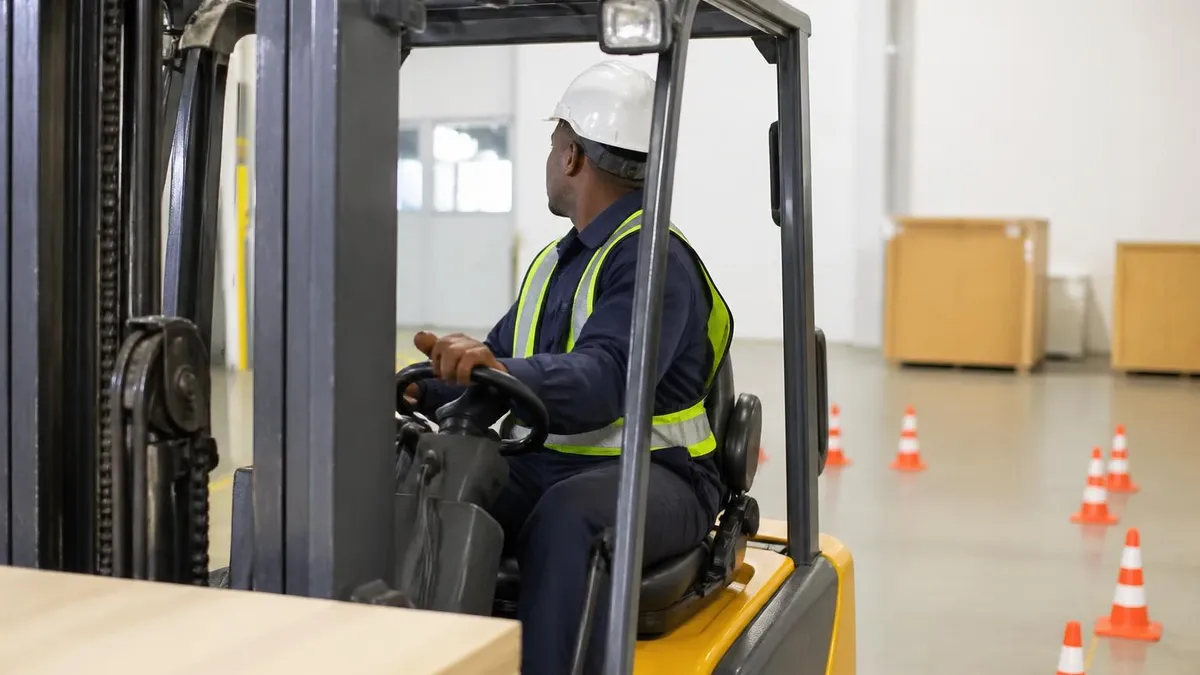
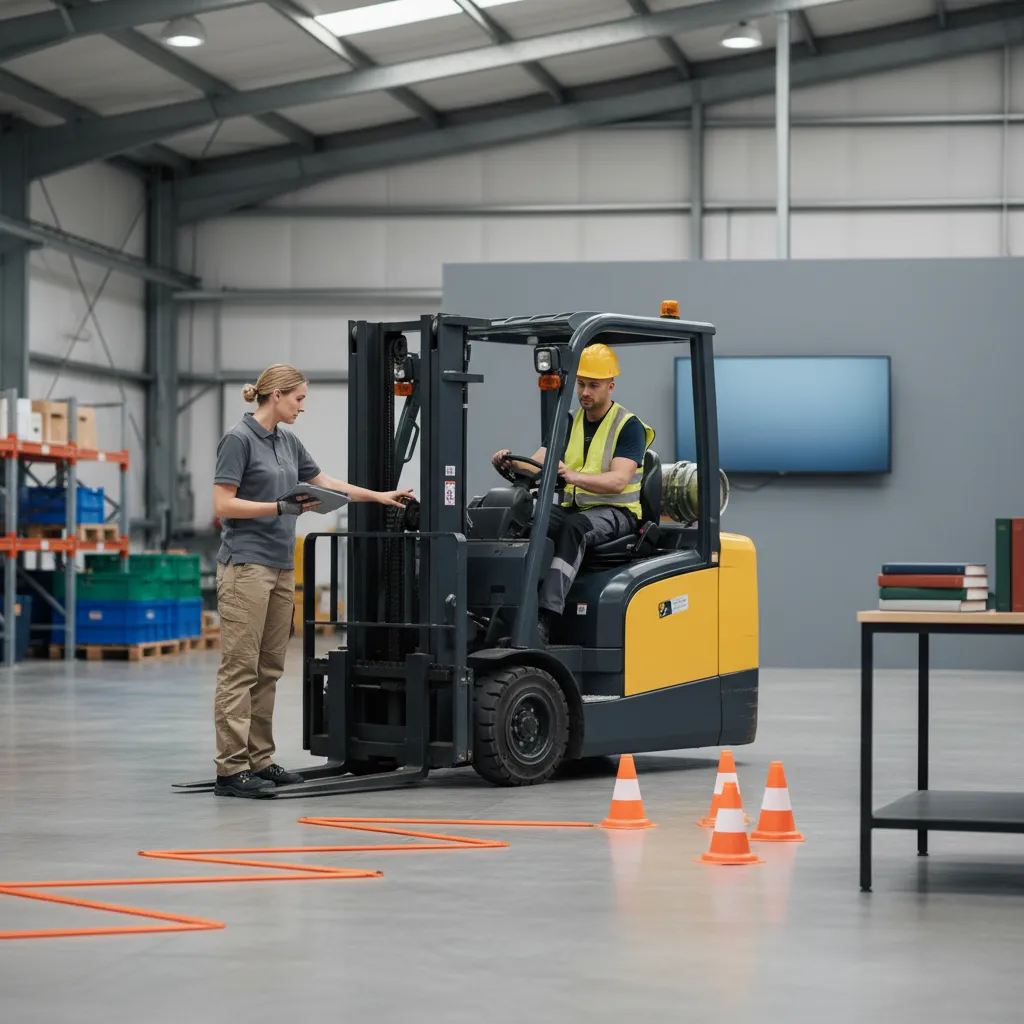
Don't underestimate the practical evaluation either. Your trainer will watch you perform a pre-operation inspection, pick up and transport a load, stack at height, navigate an aisle, and park safely. Smooth, deliberate movements score better than fast ones. Check mirrors. Sound the horn at intersections. Keep your forks low when traveling. These aren't trick requirements -- they're the habits that keep operators alive for entire careers. Certification isn't the finish line. It's the starting point for a career where attention to detail literally saves lives.
Sample Forklift certification Practice Questions
Try these questions from our free Forklift certification practice tests. The correct answer and an explanation follow each question.
When replacing a forklift battery, what safety precaution is most important?
- A. Wear rubber gloves and eye protection to prevent acid contact
- B. Change the battery as quickly as possible
- C. Leave the forklift running during the swap
- D. Only replace batteries in direct sunlight
Answer: A. Wear rubber gloves and eye protection to prevent acid contact
Battery acid is highly corrosive, so PPE including rubber gloves and eye protection must be worn during battery replacement.
According to OSHA guidelines, which of the following is strictly prohibited in areas designated for forklift refueling and battery charging?
- A. Listening to music with headphones.
- B. Parking forklifts for longer than one hour.
- C. Storing tools and spare parts.
- D. Smoking, open flames, and creating sparks.
Answer: D. Smoking, open flames, and creating sparks.
Both gasoline/LPG refueling and electric battery charging can create flammable vapors (fuel fumes or hydrogen gas). OSHA strictly prohibits any potential ignition sources, such as smoking, open flames, sparks, or electrical arcs, in these designated areas to prevent fires or explosions.
According to OSHA regulations (29 CFR 1910.178), when must a forklift pre-operation inspection be performed?
- A. Only when a new operator uses the forklift
- B. At the beginning of each shift or daily, whichever is more frequent
- C. Once per week, if the forklift is used regularly
- D. After the forklift has been refueled or recharged
Answer: B. At the beginning of each shift or daily, whichever is more frequent
OSHA standard 29 CFR 1910.178(q)(7) mandates that powered industrial trucks must be inspected at least daily before being used. If a forklift is used around the clock, it must be inspected after each shift.
Under OSHA 1910.178, how often must an employer evaluate each forklift operator's performance?
- A. At least once every three years
- B. At least once every year
- C. Only once at hiring
- D. Every five years
Answer: A. At least once every three years
OSHA requires employers to evaluate each powered industrial truck operator's performance at least once every three years.
Forklift Questions and Answers
About the Author

Certified Crane Operator & Skilled Trades Exam Specialist
Ferris State UniversityRobert Martinez is a Journeyman Ironworker, NCCCO-certified crane operator, and forklift trainer with a Bachelor of Science in Construction Technology from Ferris State University. He has 21 years of ironworking, rigging, and heavy equipment operation experience across high-rise and industrial construction sites. Robert prepares candidates for crane operator, rigger, forklift, and skilled trades certification examinations.