
How to Format Cells in Excel: Complete Guide to Number, Text, Date, and Custom Formatting
Learn how to format cells in Excel with number, currency, date, text, and custom formats. Step-by-step guide with shortcuts and pro tips. 🎓

Learning how to format cells in Excel is one of the most fundamental skills you can develop because formatting controls how your data appears, how readable your worksheets become, and how reliably formulas interact with your values.
Cell formatting in Excel encompasses far more than simply changing fonts or filling cells with color. It includes number formats that convert 0.25 into 25%, date formats that render serial number 45000 as a recognizable calendar date, currency formats that align symbols and decimal places, and text formats that preserve leading zeros in product codes or ZIP codes. Each format is a display layer applied over the underlying value, which means the stored data never changes even when the on-screen representation does.
Most beginners reach for the formatting buttons on the Home tab, and those shortcuts handle ninety percent of everyday tasks effectively. However, the real power lies inside the Format Cells dialog box, accessible through the Ctrl+1 keyboard shortcut. This dialog exposes six tabs covering Number, Alignment, Font, Border, Fill, and Protection, giving you precise control over every visual aspect of your data. Mastering this dialog separates casual users from confident Excel professionals.
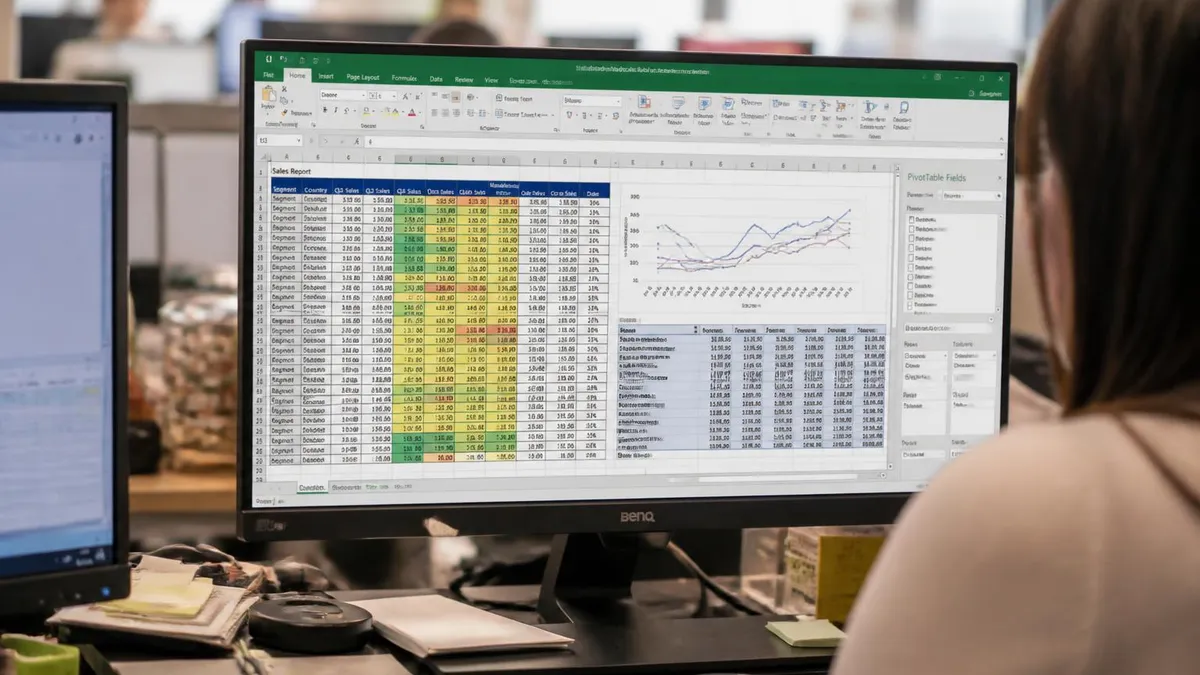
Conditional formatting takes the concept further by applying formats dynamically based on cell values, formulas, or rules. You can highlight expenses above a threshold in red, color-scale a temperature dataset from blue to orange, or flag duplicate entries automatically. This rule-based approach turns static spreadsheets into interactive dashboards that update themselves whenever the underlying data changes, which is essential for monthly reports, sales trackers, and inventory sheets.
Custom number formatting deserves special attention because it unlocks possibilities the default options cannot match. Using format codes like 0.00, #,##0, or yyyy-mm-dd, you can build display patterns tailored to your industry or audience. Accountants often create formats that show negatives in parentheses, scientists prefer scientific notation with three decimals, and project managers may want elapsed time displayed as hours regardless of how many days have passed.
Throughout this guide you will see exactly how to apply each format, which keyboard shortcuts save the most time, and how to avoid the common traps that cause formulas to break or numbers to display incorrectly. By the end you will know how to format cells in Excel for any scenario, from quick personal spreadsheets to polished corporate deliverables that need to look consistent across every page and every printed copy.
We will also cover how formatting interacts with sorting, filtering, pivot tables, and exports, because a cell that looks correct on screen can still break when copied into another tool. Understanding the difference between displayed values and stored values is the key insight that prevents most formatting frustrations and gives you confidence to build spreadsheets that behave predictably under every condition.
Cell Formatting by the Numbers
Step-by-Step: Opening and Using the Format Cells Dialog
Select Your Range
Open Format Cells
Choose a Tab
Apply Settings
Confirm and Review
Number formats are the workhorse of Excel formatting because nearly every cell holds either a number, a date, or a piece of text that needs to be displayed in a specific way. The General format is the default, displaying numbers exactly as you type them up to about eleven digits before switching to scientific notation. While General works for casual entries, professional spreadsheets almost always require an explicit format applied to every column so that readers immediately understand whether a value represents dollars, percentages, dates, or counts.
The Currency and Accounting formats look similar but behave differently in important ways. Currency places the dollar sign directly next to the number, while Accounting aligns the symbol on the left edge of the cell and lines up decimal points in a perfectly vertical column.
Accounting is the preferred choice for financial statements because the vertical alignment makes addition errors easier to catch and the format renders zeros as dashes, signaling the absence of a value cleanly.
Date formats hide one of Excel's most clever design choices. Internally every date is stored as a serial number counting days since January 1, 1900, so February 15, 2026 becomes the integer 46068. Times are stored as decimal fractions of a day, meaning 6:00 AM is 0.25. Because dates are numbers, you can subtract them to calculate elapsed days, add seven to jump a week ahead, or feed them into functions like WEEKDAY and EOMONTH that expect numeric input. This dual nature is why a date can suddenly display as 46068 if you accidentally apply General format.
Percentage format multiplies the underlying number by 100 for display purposes only. If you type 0.25 into a cell formatted as Percentage, it shows 25%, but the stored value remains 0.25 for calculation purposes. This trips up new users who type 25 expecting 25% and instead see 2500%. The safe practice is to format cells as Percentage before entering values, which prompts Excel to interpret a typed 25 as 0.25 automatically.
Scientific notation becomes essential when working with very large or very small numbers. A format code of 0.00E+00 displays 1,234,567 as 1.23E+06, condensing twelve characters into seven. Engineering and scientific disciplines rely on this format daily, and Excel respects it even when the underlying value carries fifteen significant digits of precision. Just remember that visual rounding never changes the stored number, only how it appears on screen and in printed reports.
Text format forces Excel to treat whatever you type as literal characters, which is critical for preserving leading zeros in ZIP codes, product SKUs, and phone numbers. Without Text format, typing 01234 produces 1234 because Excel sees a number and strips the leading zero. Apply Text format first, and the cell stores 01234 exactly as entered. The drawback is that text-formatted numbers cannot be summed or used in numeric formulas, so reserve Text format for true identifier fields.
Fraction format displays decimals as fractions like 1/2 or 3/8, which appears in woodworking, cooking, and engineering specifications where fractional measurements remain the industry standard. You can choose precision from single-digit denominators up to three-digit denominators, or pin the denominator to a specific value like halves, quarters, or sixteenths. Behind the scenes the cell still holds a decimal, ensuring that mathematical operations stay accurate.
Microsoft Excel Practice Test Questions
Prepare for the Microsoft Excel exam with our free practice test modules. Each quiz covers key topics to help you pass on your first try.
Microsoft Excel Excel Basic and Advance
Microsoft Excel Exam Questions covering Excel Basic and Advance. Master Microsoft Excel Test concepts for certification prep.
Microsoft Excel Excel Formulas
Free Microsoft Excel Practice Test featuring Excel Formulas. Improve your Microsoft Excel Exam score with mock test prep.
Microsoft Excel Excel Functions
Microsoft Excel Mock Exam on Excel Functions. Microsoft Excel Study Guide questions to pass on your first try.
Microsoft Excel Excel MCQ
Microsoft Excel Test Prep for Excel MCQ. Practice Microsoft Excel Quiz questions and boost your score.
Microsoft Excel Excel
Microsoft Excel Questions and Answers on Excel. Free Microsoft Excel practice for exam readiness.
Microsoft Excel Excel Trivia
Microsoft Excel Mock Test covering Excel Trivia. Online Microsoft Excel Test practice with instant feedback.
Microsoft Excel Advanced Data Analysis Tools
Free Microsoft Excel Quiz on Advanced Data Analysis Tools. Microsoft Excel Exam prep questions with detailed explanations.
Microsoft Excel Advanced Formula and Macro...
Microsoft Excel Practice Questions for Advanced Formula and Macro Creation. Build confidence for your Microsoft Excel certification exam.
Microsoft Excel Advanced Formulas and Macros
Microsoft Excel Test Online for Advanced Formulas and Macros. Free practice with instant results and feedback.
Microsoft Excel Basic and Advance Question...
Microsoft Excel Study Material on Basic and Advance Questions and Answers. Prepare effectively with real exam-style questions.
Microsoft Excel Creating and Managing Charts
Free Microsoft Excel Test covering Creating and Managing Charts. Practice and track your Microsoft Excel exam readiness.
Microsoft Excel Data Visualization with Ch...
Microsoft Excel Exam Questions covering Data Visualization with Charts. Master Microsoft Excel Test concepts for certification prep.
Microsoft Excel Formulas and Functions
Free Microsoft Excel Practice Test featuring Formulas and Functions. Improve your Microsoft Excel Exam score with mock test prep.
Microsoft Excel Formulas and Functions App...
Microsoft Excel Mock Exam on Formulas and Functions Application. Microsoft Excel Study Guide questions to pass on your first try.
Microsoft Excel Formulas Questions and Ans...
Microsoft Excel Test Prep for Formulas Questions and Answers. Practice Microsoft Excel Quiz questions and boost your score.
Microsoft Excel Functions Questions and An...
Microsoft Excel Questions and Answers on Functions Questions and Answers. Free Microsoft Excel practice for exam readiness.
Microsoft Excel Managing Data Cells and Ra...
Microsoft Excel Mock Test covering Managing Data Cells and Ranges. Online Microsoft Excel Test practice with instant feedback.
Microsoft Excel Managing Tables and Data
Free Microsoft Excel Quiz on Managing Tables and Data. Microsoft Excel Exam prep questions with detailed explanations.
Microsoft Excel Managing Tables and Table ...
Microsoft Excel Practice Questions for Managing Tables and Table Data. Build confidence for your Microsoft Excel certification exam.
Microsoft Excel Managing Worksheets and Wo...
Microsoft Excel Test Online for Managing Worksheets and Workbooks. Free practice with instant results and feedback.
Microsoft Excel MCQ Questions and Answers
Microsoft Excel Study Material on MCQ Questions and Answers. Prepare effectively with real exam-style questions.
Microsoft Excel Questions and Answers
Free Microsoft Excel Test covering Questions and Answers. Practice and track your Microsoft Excel exam readiness.
Alignment, Fonts, and Borders for vlookup excel-Ready Worksheets
The Alignment tab controls horizontal and vertical positioning, text rotation, indent levels, and wrapping behavior. Horizontal options include Left, Center, Right, Fill, Justify, and Center Across Selection. The last option deserves attention because it centers text visually across multiple cells without merging them, preserving the ability to sort and filter the rows properly, which merged cells frequently break in unpredictable ways.
Vertical alignment becomes important when row heights vary, since text defaults to the bottom of each cell. Setting vertical alignment to Center keeps labels visually balanced inside taller rows used for headers. Rotation lets you angle text from minus ninety to plus ninety degrees, which is perfect for narrow column headers that would otherwise force columns to widen and waste valuable horizontal space on the screen and printed page.

Built-in Number Formats vs Custom Format Codes
- +Built-in formats apply instantly with one click from the Home tab dropdown
- +Custom format codes give precise control over decimal places and symbols
- +Custom formats can include conditional color rules using square brackets
- +Built-in date formats automatically adapt to regional locale settings
- +Custom formats support text suffixes like units, codes, or labels
- +Conditional formatting layers dynamic visual cues on top of any base format
- −Custom format codes have a learning curve with cryptic symbols like # and 0
- −Built-in formats sometimes round incorrectly for very small values
- −Heavy conditional formatting can slow down large workbooks noticeably
- −Custom formats do not change underlying values, which confuses copy-paste users
- −Regional locale changes can break custom date format codes unexpectedly
- −Format painter sometimes copies unwanted properties along with the format
Pros and Cons at a Glance
| Pros | Cons |
|---|---|
| Built-in formats apply instantly with one click from the Home tab dropdown | Built-in formats sometimes round incorrectly for very small values |
| Custom format codes give precise control over decimal places and symbols | Heavy conditional formatting can slow down large workbooks noticeably |
| Custom formats can include conditional color rules using square brackets | Custom formats do not change underlying values, which confuses copy-paste users |
| Built-in date formats automatically adapt to regional locale settings | Regional locale changes can break custom date format codes unexpectedly |
| Custom formats support text suffixes like units, codes, or labels | Format painter sometimes copies unwanted properties along with the format |
Pre-Flight Checklist: How to Merge Cells in Excel and Format a Worksheet Cleanly
- ✓Select your entire data range before applying any number format to ensure consistency
- ✓Apply Currency or Accounting format to all monetary columns and verify decimal places
- ✓Format date columns with a clear ISO or regional pattern so sorting works correctly
- ✓Use Center Across Selection instead of Merge Cells whenever possible to preserve sorting
- ✓Set column widths slightly wider than the longest visible value to avoid pound-sign overflow
- ✓Bold the header row and apply a fill color that contrasts with the body text
- ✓Add bottom borders below headers and above total rows to guide the reader's eye
- ✓Apply Wrap Text to long label columns so descriptions stay readable without truncation
- ✓Lock cell protection on formulas before sharing the workbook with external collaborators
- ✓Preview in Page Layout view to confirm formatting holds up when the workbook is printed
Double-click the Format Painter to lock it on
Single-clicking the Format Painter on the Home tab applies the source format once and then deactivates. Double-clicking keeps it active so you can paint the same format across multiple non-contiguous ranges. Press Escape or click the brush icon again to release. This trick saves enormous amounts of time when applying consistent formatting across dozens of scattered cells throughout a large workbook.
Custom number formats unlock the full expressive power of Excel display options through a compact code language built around four sections separated by semicolons. The pattern is positive;negative;zero;text, meaning you can specify a different appearance for each value category in a single format code. For example, the code #,##0;[Red]-#,##0;"-";@ displays positive numbers with thousand separators, negative numbers in red with a minus sign, zero as a dash, and any text value exactly as typed without modification.
The pound sign (#) and zero (0) are placeholders that behave subtly differently. A pound sign displays a digit only if it is significant, while a zero forces a digit to appear even if the position would otherwise be blank. So the format 0000 displays 7 as 0007, while #### displays 7 as 7. This distinction matters when formatting product codes, room numbers, or any identifier that must show a fixed number of digits regardless of the underlying value.
Adding literal text to a format code is as easy as wrapping the text in double quotes. The code 0.0" kg" displays 3.5 as 3.5 kg while leaving the cell value as the pure number 3.5 for use in formulas. This is far better than typing "3.5 kg" as text, which would block any mathematical operations. The same approach works for dollars, percentages, and any other unit your industry requires.
Color codes inside square brackets let you embed conditional coloring directly into the format itself. Valid color names include Black, Blue, Cyan, Green, Magenta, Red, White, and Yellow, plus the syntax [Color1] through [Color56] for the full palette. A format like [Green]▲0.0%;[Red]▼0.0% shows percentage changes with green up-triangles for gains and red down-triangles for losses, perfect for executive dashboards where status must be readable at a glance.
Conditional brackets extend the four-section format to true rule-based logic without requiring conditional formatting overhead. The format [>=1000000]0.0,,"M";[>=1000]0.0,"K";0 displays values in millions when at least one million, thousands when between one thousand and one million, and as plain integers otherwise. This kind of dynamic abbreviation is invaluable for displaying revenue, headcount, or quantities that span several orders of magnitude in the same column.
Date format codes use the letters d, m, y for day, month, and year, with the number of letters controlling the display style. The code d shows a single digit when possible, dd shows two digits with leading zero, ddd shows the abbreviated weekday like Mon, and dddd shows the full weekday like Monday. Month codes work similarly, where mmm shows Jan and mmmm shows January. Combining these into a custom format like dddd, mmmm d, yyyy renders 2026-05-18 as Monday, May 18, 2026 for elegant report headers.
Time format codes follow the same pattern with h for hours, m for minutes, and s for seconds. Square brackets around the unit, as in [h]:mm, change the behavior from a wrapping clock to an elapsed-time counter that exceeds twenty-four hours when needed. This is the secret to summing time durations correctly in timesheets, where the total of multiple shifts often exceeds a single day but should display as a continuous hour count rather than rolling over to dates.

If a cell is formatted as Text and you type a number into it, that number becomes a text string and will be ignored by SUM, AVERAGE, and most other numeric functions. Look for a small green triangle in the upper-left corner of the cell warning you about a number stored as text. Click the warning indicator and choose Convert to Number to fix the issue, or use the VALUE function to convert in a formula.
Conditional formatting layers dynamic rules on top of static formats and is one of the most powerful visualization tools Excel offers. The feature lives on the Home tab and includes preset rules for highlighting cells greater than a value, between two values, containing specific text, or matching a date range. Data bars draw mini in-cell horizontal bars proportional to each value, color scales paint cells in gradients, and icon sets add visual flags like arrows, stars, or traffic lights based on rank thresholds.
Beyond the presets, you can write your own formula-based rules using New Rule then Use a formula to determine which cells to format. A rule like =$E2>1000 highlights every row in your data range where column E exceeds one thousand, which is the same approach used in dashboards for resorts like institute of creative excellence training materials that flag standout performers in real time as data updates.
Removing duplicates is closely tied to formatting because conditional formatting can highlight duplicates before you delete them. Apply Highlight Cells Rules then Duplicate Values to mark every duplicate in a selected range with a colored fill. Once you have visually confirmed the duplicates are what you expect, you can use Data then Remove Duplicates to actually purge them, knowing exactly what will disappear from your worksheet.
Drop-down lists, created through Data Validation, often pair with conditional formatting to color cells based on the selected option. For instance, if a column accepts the choices Pending, Approved, or Rejected from a dropdown, you can apply three conditional formatting rules so that Pending appears yellow, Approved appears green, and Rejected appears red. This visual coding transforms simple status tracking into a glanceable dashboard without any additional charts or pivot tables.
Tables created via Insert then Table or Ctrl+T bring automatic banded row formatting plus structured references, header repetition during printing, and total rows that update with summary functions. Tables also expand automatically as you add new data below or to the right, which means any conditional formatting and number formats you applied carry forward to new rows without manual reapplication. This is the single best habit for building scalable spreadsheets.
Themes and styles let you change the entire look of a workbook from the Page Layout tab. Choosing a new theme swaps the font set, color palette, and effects across every chart, table, and styled cell in the workbook at once. This is invaluable for corporate environments where branding standards change or for personal workbooks where you want to refresh the look without manually reformatting every element across dozens of sheets.
Printing introduces its own formatting concerns because what looks beautiful on a wide monitor may overflow onto extra pages or shrink to illegibility. Use Page Layout view to set print titles that repeat header rows on every page, configure Fit to one page wide by Page Setup, and apply Page Breaks Preview to manually adjust where pages divide. Applying these layout choices is just as important as cell formatting when the final deliverable is a printed PDF or a stack of paper reports.
Keyboard shortcuts dramatically accelerate cell formatting work once they become muscle memory. Ctrl+1 opens the Format Cells dialog, Ctrl+Shift+1 applies number format with two decimals and thousand separators, Ctrl+Shift+4 applies currency format, Ctrl+Shift+5 applies percentage format, and Ctrl+Shift+3 applies a date format. For text styles, Ctrl+B toggles bold, Ctrl+I toggles italic, and Ctrl+U toggles underline. Memorizing even half of these shortcuts saves several minutes per worksheet across a typical workday.
When sharing workbooks, consider how your formatting will translate to other users who may open the file in older Excel versions, on Mac, or in Google Sheets. Conditional formatting rules, custom number formats with embedded icons, and certain theme effects do not always survive the trip cleanly. Test important deliverables in the target environment before sending them out, and keep a fallback version with simpler formats if you suspect compatibility issues with the recipient's software setup.
Locking and protecting cells is part of the Format Cells dialog under the Protection tab, but it only takes effect after you also enable Protect Sheet on the Review tab. The two-step process trips up many users who lock a cell and then wonder why edits still work.
Number precision can surprise even experienced users because Excel stores up to fifteen significant digits but displays only what the format allows. When you see 1.23 on screen but the cell actually holds 1.234567, formulas use the full value rather than the rounded display. To force calculations to match the displayed precision, use the ROUND function explicitly or enable Set precision as displayed in File then Options then Advanced, though the latter option permanently truncates stored values and cannot be undone.
Copy and paste behavior differs based on what you choose from Paste Special. Paste Values strips all formatting and pastes only the numbers or text. Paste Formats copies only the formatting without the values. Paste Formulas brings the formula logic but not the formatting. Understanding these options prevents the frustrating scenario where pasted data adopts unwanted colors, fonts, or number formats inherited from the source worksheet.
Finally, document your formatting choices when building workbooks others will inherit. Add a cover sheet or hidden notes column explaining why certain cells use specific formats, which conditional rules apply where, and how new rows should be added to preserve consistency. This small investment in documentation pays huge dividends when colleagues or future versions of yourself need to modify the workbook months or years later without your direct guidance.
Practice is the single fastest way to internalize cell formatting because the dialog has too many options to memorize from reading alone. Open a blank workbook, type a mix of numbers, dates, and text, then experiment with every tab in the Format Cells dialog for fifteen minutes. After three or four sessions you will navigate the options instinctively and start applying formats by feel rather than by hunting through menus, which is exactly the level of fluency professional analysts rely on every day.
Sample Excel Practice Questions
Try these questions from our free Excel practice tests. The correct answer and an explanation follow each question.
A financial analyst needs to apply the specific formatting (cell color, font style, and number format) from a summary cell (A1) to a range of other cells (D1:D10) without overwriting the existing data or formulas in the destination cells. Which of the following is the most appropriate method?
- A. Format Painter
- B. Copy and Paste
- C. Find and Replace with Formatting
- D. Flash Fill
Answer: A. Format Painter
The Format Painter is the ideal tool for copying the formatting from one cell or range and applying it to another. It copies all formatting attributes—such as number formats, fonts, colors, and borders—without affecting the values or formulas in the destination cells.
What does Excel's "Custom" number format mean?
- A. A number format that you create to fit your specific needs
- B. A number format that only displays negative numbers
- C. A number format that is automatically applied to every cell in a worksheet
- D. A number format that rounds numbers up or down
Answer: A. A number format that you create to fit your specific needs
Excel's 'Custom' number format allows users to define their own specific rules for how numbers, dates, and text are displayed in cells. This provides a high degree of flexibility, enabling you to create unique display formats that are not available in the standard options. You can use special codes to control decimal places, currency symbols, text placement, and more.
It is acceptable to let long text stream into adjoining cells on a worksheet when
- A. There is not time to format the text
- B. There is no suitable abbreviation for the text
- C. Data will be entered in the adjacent cells
- D. No date will be entered in the adjacent cells
Answer: D. No date will be entered in the adjacent cells
When there is no data in the adjacent cells, long text flows into adjacent cells on the worksheet. As soon as data is entered into the adjacent cells, text will be visible upto cell length in which data is entered. For full visibility of data either we need o increase the length of cell or wrap text in particular cell.
Which function returns the number of cells in a range that meet a given condition?
- A. COUNT
- B. COUNTIF
- C. SUMIF
- D. COUNTA
Answer: B. COUNTIF
COUNTIF counts cells within a range that satisfy a single specified criterion.
Excel Questions and Answers

Standard Deviation Formula in Excel: STDEV.P vs STDEV.S Guide

How to Add a Filter in Excel: AutoFilter, Advanced and FILTER Function

Pivot Tables in Excel: Complete Guide to Building, Customizing, and Analyzing Data

Freeze Panes in Excel: Complete Guide to Locking Rows and Columns

How to Make a Chart in Excel: Types and Step-by-Step Guide
About the Author

Business Consultant & Professional Certification Advisor
Wharton School, University of PennsylvaniaKatherine Lee earned her MBA from the Wharton School at the University of Pennsylvania and holds CPA, PHR, and PMP certifications. With a background spanning corporate finance, human resources, and project management, she has coached professionals preparing for CPA, CMA, PHR/SPHR, PMP, and financial services licensing exams.