
ELA Regents 2026 July: Complete Study Guide, Exam Format, and Prep Strategies
Master the ELA Regents 2026 July with our complete guide. Exam format, scoring, strategies, and free practice tests. 🎯 Start preparing today!

The ELA Regents 2024 exam remains one of the most significant academic milestones for high school students across New York State. Officially known as the Common Core English Language Arts Regents Examination, this assessment measures a student's ability to read complex literary and informational texts, analyze arguments, interpret poetry, and produce well-organized, evidence-based writing. Earning a passing score is required for graduation in most New York high schools, making thorough preparation absolutely essential for every junior and senior sitting for this test.
Understanding what the 2024 administration looks like is the first step toward confident preparation. The New York State Education Department has maintained a consistent structure in recent years, emphasizing critical reading and analytical writing over rote memorization. Students who approach the exam with a clear sense of its format, timing, and scoring criteria tend to perform significantly better than those who study without a roadmap. This guide breaks down every section, offers targeted strategies, and connects you to practice resources that mirror actual exam conditions.
One of the most important things to recognize about the ELA Regents is that it rewards preparation that is active rather than passive. Simply re-reading your class notes or skimming old essays is rarely enough to move the needle on your score. Effective preparation involves timed reading of paired and extended passages, deliberate practice with argument analysis, and iterative writing exercises where you review your own work against the official scoring rubrics provided by NYSED. Building these habits early gives you a measurable advantage on test day.
The 2024 exam continues to feature three distinct parts, each targeting a different dimension of English Language Arts proficiency. Part 1 tests reading comprehension through multiple-choice questions tied to a literary text and an informational text. Part 2 asks students to analyze a set of sources and write an argumentative essay, while Part 3 centers on a close reading of a literary passage and a text-analysis response. Together, these three parts create a comprehensive picture of a student's ELA skills and academic readiness for college or career pathways.
Scoring on the ELA Regents is done on a raw-to-scale conversion system. Multiple-choice questions in Part 1 are worth two raw score points each, while the extended responses in Parts 2 and 3 are evaluated using holistic rubrics scored on a scale of 0 to 4. The total raw score is converted to a final scaled score ranging from 0 to 100, and students need a scaled score of at least 65 to pass. A score of 75 or above qualifies students for a Regents with Merit designation, which can strengthen college applications considerably.
For students aiming to review structured lessons alongside this guide, exploring curated ela regents 2024 resources can provide a systematic approach to each skill area tested on the exam. These lessons align closely with the Common Core Learning Standards that underpin the Regents, ensuring that every hour spent studying targets something that will genuinely appear on the test rather than peripheral material that sounds relevant but does not translate into points.
Whether you are taking the ELA Regents for the first time or retaking it to improve a previous score, the strategies in this guide apply equally. The exam rewards careful reading, precise textual evidence, and clear analytical reasoning — skills that can be learned and sharpened through deliberate practice. The sections below walk you through the exam format, scoring breakdown, study timeline, proven strategies, and common pitfalls, giving you everything you need to walk into the testing room prepared and confident.
ELA Regents 2024 by the Numbers

ELA Regents 2024 Exam Format
| Section | Questions | Time | Weight | Notes |
|---|---|---|---|---|
| Part 1 — Reading Comprehension | 24 | Approx. 90 min | ~48 raw pts | 24 multiple-choice questions across two passages (literary + informational) |
| Part 2 — Argument Essay | 1 | Approx. 60 min | Up to 4 pts (rubric) | Source-based argumentative essay using 3-4 provided texts |
| Part 3 — Text-Analysis Response | 1 | Approx. 30 min | Up to 4 pts (rubric) | Close-reading response to a single literary or informational passage |
| Total | 24 | 3 hours | 100% |
Understanding how the ELA Regents 2024 is scored is just as important as understanding what it tests. The exam uses a two-stage scoring process: first, raw points are tallied from each section, and then those raw points are converted to a final scaled score between 0 and 100. Part 1 generates up to 48 raw points from 24 multiple-choice questions worth 2 points each. Parts 2 and 3 are scored by trained educators using rubrics that evaluate four key dimensions: content and analysis, command of evidence, coherence and organization, and language use and conventions.
The Part 2 argument essay is scored on a 0–4 scale by two independent raters. Their scores are added together, meaning a student can earn a maximum of 8 raw points from Part 2 alone. If the two raters' scores differ by more than one point, a third rater resolves the discrepancy. This system is designed to ensure consistency and fairness across the tens of thousands of papers scored each administration cycle. Students should be aware that raters read quickly and decisively, so first impressions — meaning your introduction and overall organization — matter considerably.
Part 3, the text-analysis response, is also scored on a 0–4 rubric by two raters, producing a maximum of 8 raw points. However, Part 3 responses are typically shorter than the full argument essays required in Part 2. NYSED guidelines suggest that a strong Part 3 response includes a clear central idea, specific textual evidence with accurate citations, and commentary that explains how the author's use of a literary element or technique contributes to the overall meaning of the passage. Responses that summarize the text without analyzing technique tend to score in the 1–2 range.
When raw scores from all three parts are combined and converted, the resulting scaled score determines a student's outcome. A scaled score of 65 or higher means the student passes the ELA Regents and satisfies that particular graduation requirement. Students who score between 55 and 64 may be eligible for a Safety Net option under certain circumstances, though this varies by school district and individual education plan. The safest path is always to aim for a score well above the minimum, providing a buffer against any unexpected challenges on test day.
For students retaking the exam after a previous attempt, it is worth noting that scaled scores from multiple administrations cannot be combined or averaged — each administration stands on its own. This means that if you scored a 60 on a previous ELA Regents, you must score at least 65 on a subsequent attempt, rather than relying on the average of both scores. Knowing this reinforces the importance of targeted, gap-filling preparation between administrations rather than simply reviewing material you already understand well.
New York State administers the ELA Regents three times per year: in January, June, and August. The June administration is by far the most popular, with the largest number of students sitting for the exam each year. The January administration gives students who need to retake the exam an early opportunity in the school year, while the August session serves as a final chance before the academic year begins. Registration deadlines and specific testing dates are published by NYSED and individual school districts, so students should confirm their registration status well in advance of each administration window.
Score reports are typically released within a few weeks of the exam date, and students can access results through their school or directly through the NYSED online portal. Teachers and counselors receive score data that allows them to provide targeted support for students who did not meet the passing threshold. If you believe your essay was scored incorrectly, there is a formal re-scoring request process, though these requests are rarely overturned because the dual-rater system is specifically designed to minimize scoring errors from the outset.
ELA Regents 2024 Study Strategies by Section
Effective preparation for Part 1 begins with regular exposure to complex literary and informational texts. The passages selected for the ELA Regents are deliberately challenging, often drawn from classic literature, contemporary nonfiction, or historical documents. Practice reading these types of texts actively — annotating as you go, identifying the author's central claim or theme, noting shifts in tone, and flagging specific lines that carry significant meaning. Timed practice helps you build the reading stamina and pacing skills needed to work through two full passages under exam conditions without running short on time.
When answering the multiple-choice questions, avoid the trap of relying on memory of the passage. Always return to the text to verify your answer, especially for questions that ask about specific lines or the author's word choice. The four answer choices in Part 1 are crafted carefully: one is clearly correct, one is a close distractor that misreads the passage, and two are clearly incorrect. Training yourself to eliminate the two obvious wrong answers first, then distinguish between the correct answer and the close distractor, can significantly raise your accuracy rate on this section.

ELA Regents 2024: Advantages and Challenges of the Exam Format
- +Clear rubrics published by NYSED allow students to know exactly what raters are looking for
- +Multiple administrations per year give students several opportunities to pass or improve their score
- +Part 1 multiple-choice format allows for systematic elimination strategies that can raise scores
- +Provided sources in Part 2 mean you do not need outside knowledge — everything you need is on the page
- +The exam's emphasis on evidence-based writing builds skills that transfer directly to college coursework
- +A well-structured study schedule of 8–12 weeks is typically sufficient to reach the passing threshold
- −Passages can be exceptionally complex, requiring strong background reading habits built well before exam day
- −Essay sections require sustained writing under time pressure, which many students find stressful
- −The 3-hour exam length demands significant stamina and concentration that must be trained, not assumed
- −Scoring variability between raters exists despite the dual-rater system, creating some unpredictability in essay scores
- −Students who struggle with reading fluency may find the volume of text in Parts 1 and 2 overwhelming
- −The August administration has fewer available seats and less school-based support than the June session
ELA Regents 2024 Preparation Checklist
- ✓Download and review the official NYSED ELA Regents scoring rubrics for Parts 2 and 3.
- ✓Complete at least three full-length timed practice exams using released NYSED exams from prior years.
- ✓Practice annotating literary and informational passages within a 10-minute window to build speed.
- ✓Write at least five timed argument essays, then self-score each using the official Part 2 rubric.
- ✓Write at least five timed text-analysis responses and compare them against scored exemplars from NYSED.
- ✓Study vocabulary in context by reading passages from The New York Times, The Atlantic, or similar sources weekly.
- ✓Review the Common Core Learning Standards for ELA to ensure you understand what each skill category expects.
- ✓Identify your two weakest skill areas and devote focused study sessions to each before the exam date.
- ✓Practice citing textual evidence precisely, using both direct quotation and accurate paraphrase techniques.
- ✓Confirm your exam registration date, testing location, and required materials with your school counselor at least two weeks ahead.
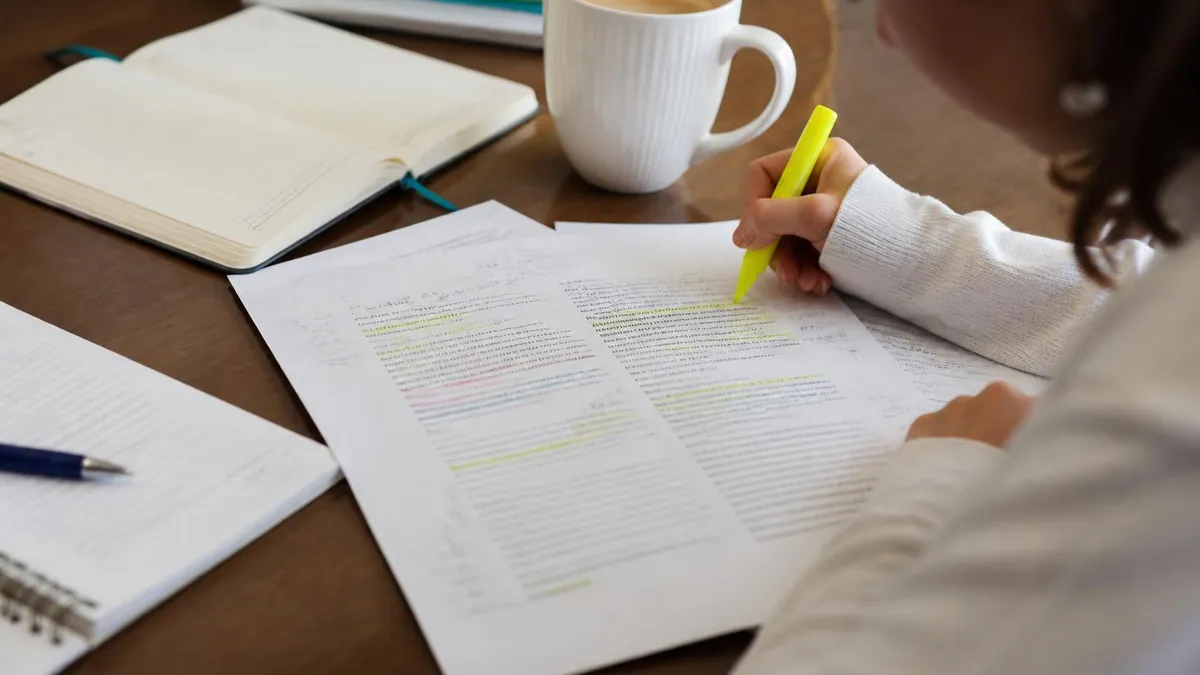
Evidence Is Everything on This Exam
Every point you earn on the ELA Regents essay sections depends on how well you use textual evidence. Students who state claims without quoting or citing the source text consistently score in the 1–2 range, regardless of how insightful their ideas are. Train yourself to cite first and explain second — this single habit can raise your essay scores by a full point or more.
Writing strong essays for the ELA Regents 2024 requires mastering the rubric criteria before you sit down to write a single practice essay. The NYSED rubrics for both Part 2 and Part 3 assess four domains: content and analysis, command of evidence, coherence and organization, and language use and conventions. Understanding what each domain actually means — and what distinguishes a score of 2 from a score of 3 or 4 — is fundamental to improving your performance on the written sections of the exam.
Content and analysis refers to how deeply and accurately you engage with the ideas in the source texts. A score of 4 in this domain requires insightful analysis that goes beyond surface-level observation and demonstrates a nuanced understanding of the text's complexity. A score of 2, by contrast, indicates that the student's analysis is simplistic or relies heavily on plot summary rather than genuine literary or rhetorical insight. The practical implication is that you should always ask yourself: am I explaining why this matters, or just describing what happens? The former earns points; the latter does not.
Command of evidence measures how effectively you select and integrate textual evidence to support your claims. Strong evidence use means choosing quotes that are specific and relevant, introducing them with appropriate context, and following each quote with commentary that explains its significance to your argument.
Weak evidence use includes long block quotes with no analysis, vague paraphrases that could apply to any text, or claims that cite no source material at all. In practice, a useful formula is: introduce the evidence, present the quote or paraphrase, then explain its meaning in your own words and connect it explicitly to your central claim.
Coherence and organization evaluate whether your essay flows logically from beginning to end and whether each paragraph contributes to the overall argument. The most effective structure for the Part 2 argument essay includes a clear thesis statement in the introduction, body paragraphs that each advance a distinct sub-claim supported by evidence, and a conclusion that synthesizes your argument rather than simply restating it. Transitions between paragraphs should be logical and substantive, not just filler phrases like "furthermore" or "additionally" disconnected from the actual content of the paragraphs they connect.
Language use and conventions — often called the grammar and mechanics domain — measures your control over standard English grammar, punctuation, spelling, and sentence variety. Students aiming for a 3 or 4 in this domain should write in varied sentence structures, avoid comma splices and run-on sentences, and demonstrate a range of vocabulary appropriate to formal academic writing. While the occasional minor error will not cost you a full point, essays filled with frequent grammar errors or that rely on very simple sentence structures throughout will be capped at a lower score regardless of how strong the ideas are.
One frequently overlooked strategy for improving writing scores is studying released student essays from past ELA Regents administrations. NYSED publishes annotated sample essays at each score point for both Part 2 and Part 3, along with detailed explanations of why each essay earned the score it received. Reading these annotations carefully — especially for essays that scored 2 and 3, where the distinction is most instructive — gives you a calibrated sense of what the rubric actually looks like in practice, not just in the abstract language of the criteria descriptions.
Finally, time management within the essay sections is a skill that must be practiced deliberately. Many students spend too long reading and annotating the Part 2 sources and then rush their essay writing, producing a draft that is shorter and less developed than their actual abilities would permit.
A recommended pacing guide for Part 2 is: 20 minutes reading and annotating sources, 10 minutes outlining your argument, 35 minutes drafting, and 5 minutes reviewing for clarity and errors. For Part 3, aim for 10 minutes reading and annotating, 5 minutes planning, 20 minutes drafting, and 5 minutes reviewing. Sticking to these windows during practice builds the muscle memory for exam day.
New York State ELA Regents registration deadlines are set by individual school districts, not by NYSED directly. Missing your school's registration window can mean waiting until the next administration — typically several months away. Confirm your registration status with your school counselor no later than six weeks before the exam date, and verify that you are registered for the correct administration (January, June, or August).
Test day preparation begins well before you walk into the testing room. Students who perform best on the ELA Regents 2024 tend to have established consistent study routines in the weeks leading up to the exam, gotten adequate sleep in the 72 hours before the test, eaten a balanced meal on the morning of the exam, and arrived at the testing location early enough to settle in without rushing.
While these details might seem like common sense, the research on academic performance under standardized testing conditions consistently shows that physical and logistical preparation has a measurable impact on scores, independent of academic preparation.
On the morning of the ELA Regents, bring everything you need: two or more sharpened pencils for the bubble sheet, blue or black pens for the essay sections, a valid photo ID if required by your district, and your admission ticket if one was issued. Some testing centers also allow water bottles — check your school's policy in advance. Avoid last-minute cramming on the morning of the exam; your brain consolidates information during sleep, and reviewing new material at the last moment is more likely to increase anxiety than to add meaningful knowledge that will help you on the test.
During the exam itself, managing your reading pace in Part 1 is critical. The 24 multiple-choice questions in Part 1 must be answered alongside careful reading of two passages, and students who spend too long on difficult questions risk running out of time before reaching the end of the section.
A recommended approach is to read each passage once with light annotation, answer all questions you can answer confidently, mark the difficult ones, and then return to the marked questions after finishing the rest. Never leave a question blank — there is no penalty for wrong answers on the ELA Regents, so an educated guess is always better than no answer.
For the Part 2 essay, resist the temptation to begin writing the moment you receive the exam booklet. The minutes spent planning your argument are among the most valuable minutes of the entire exam. Students who write without a clear outline often find themselves restating the same point in different paragraphs or losing track of their central argument midway through. A quick five-bullet outline — thesis, three pieces of evidence with source labels, and a note about the counterargument you will address — takes less than ten minutes and dramatically improves essay coherence and flow.
When writing your essays, prioritize depth over length. A common misconception among students is that longer essays automatically score higher. In reality, a focused, well-organized essay of five paragraphs that analyzes evidence precisely will outscore a sprawling seven-paragraph essay that includes repetitive or off-topic content. Raters are trained to identify genuine analytical thinking, and padding — restating the same idea in multiple sentences — is transparent to experienced scorers. Write what you mean clearly and move on rather than circling back to points already made.
After submitting your ELA Regents exam, resist the urge to obsessively reconstruct your answers or compare notes with classmates in the hallway. There is nothing productive that can come from post-exam analysis before you have your score, and the anxiety created by hearing that others answered differently than you did is rarely helpful.
Instead, acknowledge the work you put into preparation, give yourself permission to rest, and wait for your official score report. If your score falls below your target, use the NYSED score breakdown — available through your school — to identify which sections cost you the most points and build a targeted study plan for the next administration.
Looking ahead, the skills tested on the ELA Regents extend far beyond New York State graduation requirements. Close reading, evidence-based argumentation, and clear analytical writing are foundational competencies for college coursework across virtually every discipline, from history to biology to business. Students who invest seriously in preparing for the ELA Regents often report that the skills they built during preparation gave them a genuine academic advantage in their first year of college. For students interested in exploring these skills more deeply before exam day, a structured review of strategies and sample questions can provide that critical extra edge.
Building a realistic study schedule is one of the most practical steps any student can take when preparing for the ELA Regents 2024. The amount of preparation time needed varies by student, but most educators recommend beginning dedicated exam preparation at least eight weeks before the administration date. Students who are retaking the exam after a previous attempt can often succeed with a more focused six-week plan, particularly if they use their previous score breakdown to identify and target specific weak areas rather than reviewing all material from scratch.
A structured eight-week plan might look like this: Week 1 and 2 focus on reading comprehension skills — working through released NYSED Part 1 passages, timing yourself, and tracking your accuracy on each question type. Week 3 and 4 shift to argument writing, with at least two full timed Part 2 essays written and self-scored using the rubric.
Week 5 and 6 target text-analysis skills, with daily short annotation practice and at least three timed Part 3 responses. Week 7 brings everything together with two full practice exams under realistic timed conditions. Week 8 is for light review, rest, and logistical preparation — no new material, just reinforcing what you already know.
During your study period, the quality of your practice materials matters as much as the quantity of time you put in. The most reliable practice materials are actual released ELA Regents exams from previous years, which are publicly available on the NYSED website. These exams are formatted exactly like what you will see on test day, use passages of similar complexity and length, and include official scoring rubrics and annotated sample essays at each score level. Third-party materials can supplement your preparation, but nothing replaces the authenticity of actual past exams when building your familiarity with the format.
Vocabulary development is often underemphasized in ELA Regents preparation but can have a meaningful impact on your performance. The passages in Part 1 frequently include complex academic vocabulary and domain-specific terms that students encounter infrequently in everyday life. Building vocabulary through wide reading — particularly of nonfiction essays, literary fiction, and journalism — is more effective than memorizing word lists, because contextual exposure to vocabulary creates deeper and more flexible word knowledge than definition memorization alone. Students who read broadly for 20–30 minutes daily throughout their preparation period consistently report feeling more comfortable with the language of the exam passages.
Practice with feedback is categorically more valuable than practice without it. After writing a timed practice essay, do not simply set it aside and move on. Instead, read it against the NYSED rubric, identify the specific criteria where your response falls short, and note one or two concrete things you will do differently in your next essay. This reflective practice cycle — write, evaluate, identify gaps, adjust — is what separates students who plateau at a certain score level from those who make consistent, measurable improvement over the course of their preparation period.
Students with Individualized Education Programs or 504 accommodations should work with their school's special education coordinator to ensure that their testing accommodations are properly documented and requested for the ELA Regents administration.
Common accommodations include extended time (time and a half or double time), a separate testing room, a reader or scribe, large-print materials, and use of a calculator for students with specific processing needs. These accommodations must typically be requested several weeks before the exam date, and they must be documented as part of the student's existing plan — they cannot be added ad hoc on the day of the exam.
As you approach the final days before the ELA Regents, your mental and physical state deserves as much attention as your academic preparation. Sleep deprivation impairs both reading comprehension and writing quality more severely than most students realize — the cognitive functions that the ELA Regents tests most heavily, including sustained attention, working memory, and verbal reasoning, are among the first to degrade under sleep restriction.
Aim for at least 8 hours of sleep on each of the two nights before the exam, limit caffeine to your normal baseline (this is not the time to experiment with energy drinks), and plan to arrive at the testing center 15–20 minutes early so you have time to settle in without rushing.
ELA Questions and Answers

ELA Lessons: Grade-Band Guide to Reading, Writing, and Language Strands

ELA Exam NYS: Complete Study Guide for the New York State English Language Arts Assessment

ELA Anchor Charts: The Complete Teacher's Guide to Visual Learning Tools

ELA Lesson: A Complete Guide to Teaching and Mastering English Language Arts

ELA Questions: Complete Guide to Types, Strategies, and Practice
About the Author
Educational Psychologist & Academic Test Preparation Expert
Columbia University Teachers CollegeDr. Lisa Patel holds a Doctorate in Education from Columbia University Teachers College and has spent 17 years researching standardized test design and academic assessment. She has developed preparation programs for SAT, ACT, GRE, LSAT, UCAT, and numerous professional licensing exams, helping students of all backgrounds achieve their target scores.
Join the Discussion
Connect with other students preparing for this exam. Share tips, ask questions, and get advice from people who have been there.
View discussion (5 replies)