

EEG Practice Test
Updated for October 2026Note: The R. EEG T. exam is a single computer-based, multiple-choice exam administered by Prometric on ABRET's behalf. It is delivered in two sections of 120 minutes each (4 hours total testing time), covering pre-study procedures, performing the EEG study, post-study procedures, and ethics/professional issues. There is no separate oral or practical component.
EEG Technologist Flashcards
Quick review for key EEG concepts and terminology
👁️What causes eye blink artifacts?
Eye blink artifacts are caused by the movement of the eyelid over the cornea, generating a positive potential field that affects frontal electrodes (Fp1, Fp2).
GET EEG EXAM PREP📉What is an impedance check?
An impedance check verifies the quality of the connection between the electrode and the scalp. Acceptable impedance for clinical EEG is typically below 5 kOhms.
TRY EEG MOCK EXAMWhat is the EEG Medical Test?
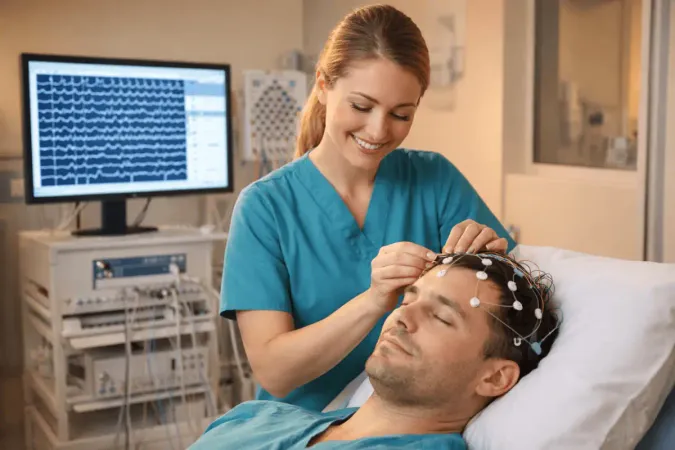
The eeg medical test is a non-invasive procedure that records the brain's electrical activity. It is the primary diagnostic tool for epilepsy but is also used for sleep disorders, encephalopathies, and coma evaluation. Understanding eeg test is for what purpose is fundamental for technologists.
EEG Exam Score Calculator
Total Scored Questions
150
105 out of 150 correct
70%
Required to Pass: ~70% (Estimated)
The total cost to become a certified EEG technologist ranges from $7,000 to $25,000 including education. However, many employers offer tuition reimbursement for exam fees. Try our NCLEX practice test.
EEG Practice Test Questions
Prepare for the EEG - Electroencephalography exam with our free practice test modules. Each quiz covers key topics to help you pass on your first try.
EEG Abnormal Epileptiform Patterns
EEG Exam Questions covering Abnormal Epileptiform Patterns. Master EEG Test concepts for certification prep.
EEG Activation Procedures
Free EEG Practice Test featuring Activation Procedures. Improve your EEG Exam score with mock test prep.
EEG Artifact Identification
EEG Test Prep for Artifact Identification. Practice EEG Quiz questions and boost your score.
EEG Electrode Placement and Montages
EEG Questions and Answers on Electrode Placement and Montages. Free EEG practice for exam readiness.
EEG - Electroencephalography Abnormal Epil...
EEG Mock Test covering - Electroencephalography Abnormal Epileptiform Patterns Questions and Answers. Online EEG Test practice with instant feedback.
EEG - Electroencephalography Activation Pr...
Free EEG Quiz on - Electroencephalography Activation Procedures Questions and Answers. EEG Exam prep questions with detailed explanations.
EEG - Electroencephalography Artifact Iden...
EEG Practice Questions for - Electroencephalography Artifact Identification Questions and Answers. Build confidence for your EEG certification exam.
EEG - Electroencephalography Electrode Pla...
EEG Test Online for - Electroencephalography Electrode Placement and Montages Questions and Answers. Free practice with instant results and feedback.
EEG - Electroencephalography Instrumentati...
EEG Study Material on - Electroencephalography Instrumentation and Calibration Questions and Answers. Prepare effectively with real exam-style questions.
EEG - Electroencephalography Neuroanatomy ...
Free EEG Test covering - Electroencephalography Neuroanatomy and Physiology Questions and Answers. Practice and track your EEG exam readiness.
EEG - Electroencephalography Non-Epileptif...
EEG Exam Questions covering - Electroencephalography Non-Epileptiform Abnormalities Questions and Answers. Master EEG Test concepts for certification prep.
EEG - Electroencephalography Normal EEG Wa...
Free EEG Practice Test featuring - Electroencephalography Normal EEG Waveforms Questions and Answers. Improve your EEG Exam score with mock test prep.
EEG - Electroencephalography Patient Safet...
EEG Mock Exam on - Electroencephalography Patient Safety and Ethics Questions and Answers. EEG Study Guide questions to pass on your first try.
EEG - Electroencephalography Pediatric and...
EEG Test Prep for - Electroencephalography Pediatric and Neonatal EEG Questions and Answers. Practice EEG Quiz questions and boost your score.
EEG Evoked Potentials
EEG Questions and Answers on Evoked Potentials. Free EEG practice for exam readiness.
EEG ICU and Continuous EEG Monitoring
EEG Mock Test covering ICU and Continuous EEG Monitoring. Online EEG Test practice with instant feedback.
EEG Instrumentation and Calibration
Free EEG Quiz on Instrumentation and Calibration. EEG Exam prep questions with detailed explanations.
EEG Neuroanatomy and Physiology
EEG Practice Questions for Neuroanatomy and Physiology. Build confidence for your EEG certification exam.
EEG Non-Epileptiform Abnormalities
EEG Test Online for Non-Epileptiform Abnormalities. Free practice with instant results and feedback.
EEG Normal EEG Waveforms
EEG Study Material on Normal EEG Waveforms. Prepare effectively with real exam-style questions.
EEG Patient Safety and Ethics
Free EEG Test covering Patient Safety and Ethics. Practice and track your EEG exam readiness.
EEG Pediatric and Neonatal EEG
EEG Exam Questions covering Pediatric and Neonatal EEG. Master EEG Test concepts for certification prep.
EEG Routine
Free EEG Practice Test featuring Routine. Improve your EEG Exam score with mock test prep.
EEG Sleep Staging and Sleep EEG
EEG Mock Exam on Sleep Staging and Sleep EEG. EEG Study Guide questions to pass on your first try.
EEG Technologist Career Paths
Specializing in different areas of neurodiagnostics opens doors to advanced roles.
Pediatric EEG
Specializes in performing EEGs on neonates and children, requiring patience and knowledge of developmental patterns.
LTM TechLong-
Term Monitoring technologists work in Epilepsy Monitoring Units (EMU), observing patients for days to capture seizures.
IOM Tech
Intraoperative Monitoring involves monitoring nervous system integrity during spinal and brain surgeries.
Sleep Tech
Polysomnography (PSG) involves monitoring sleep cycles to diagnose disorders like sleep apnea.
EEG Test Day Checklist
- ✓Valid Government ID (2 forms)
- ✓ABRET Authorization Email
- ✓Arrive 30 mins early
- ✓Review 10-20 System
- ✓Comfortable clothing (layer)
- ✓Leave electronics in car/locker
- ✓Hydrate and eat beforehand
- ✓Positive mindset!
Master the EEG Exam
Get instant access to 500+ free practice questions, detailed flashcards, and a complete study guide. Start your journey to becoming a Registered EEG Technologist today!
EEG Certification Renewal
Renewal Cycle
5 Years
CEUs Required
30 Hours
Renewal Fee
$150
Earn your CEUs through ASET webinars, regional conferences, or journal quizzes. Keeping your certification active is essential for career advancement and potential travel opportunities.
EEG: Pros and Cons
- +EEG certification validates expertise recognized by employers nationwide
- +Certified professionals typically earn 15-20% higher salaries
- +Opens doors to advanced positions and leadership roles
- +Demonstrates commitment to professional standards and ethics
- +Builds a strong professional network through certification communities
- −Exam preparation typically requires 2-4 months of dedicated study
- −Certification and exam fees can range from $150-$500+
- −Must complete continuing education to maintain active certification
- −Pass rates vary — thorough preparation is essential for success
- −Some certifications require prerequisite experience or education
Pros and Cons at a Glance
| Pros | Cons |
|---|---|
| EEG certification validates expertise recognized by employers nationwide | Must complete continuing education to maintain active certification |
| Opens doors to advanced positions and leadership roles | Pass rates vary — thorough preparation is essential for success |
| Demonstrates commitment to professional standards and ethics | Some certifications require prerequisite experience or education |
Sample EEG - Electroencephalography Practice Questions
Try these questions from our free EEG - Electroencephalography practice tests. The correct answer and an explanation follow each question.
To minimize the risk of electrical shock to the patient, what is the single most important electrical safety practice in the EEG laboratory?
- A. Using a notch filter to remove 60 Hz interference.
- B. Ensuring all electrodes have an impedance below 1 kOhm.
- C. Plugging all patient-connected equipment into the same properly grounded, hospital-grade outlet cluster.
- D. Applying a separate ground electrode for each piece of monitoring equipment.
Answer: C. Plugging all patient-connected equipment into the same properly grounded, hospital-grade outlet cluster.
Using a single, common ground point for all equipment connected to the patient prevents the formation of ground loops and minimizes the risk of leakage currents passing through the patient. Plugging the EEG machine and any other connected devices into the same outlet block ensures they share a common ground reference. Applying multiple ground electrodes from different pieces of equipment can be dangerous and is known as 'double grounding'.
Pattern-reversal VEPs are preferred over flash VEPs in clinical practice primarily because they:
- A. Are faster to perform
- B. Require less patient cooperation
- C. Produce more consistent waveforms with smaller normal variance
- D. Do not require specialized equipment
Answer: C. Produce more consistent waveforms with smaller normal variance
Pattern-reversal stimuli generate highly reproducible P100 components with tight normative ranges, making subtle latency delays more detectable than with flash VEPs.
Which practice best protects patient confidentiality when transmitting an EEG recording electronically to an interpreting neurologist at another facility?
- A. Send via standard email with the patient's name in the subject line for easy identification
- B. Use a HIPAA-compliant encrypted platform with patient identifiers limited to the minimum necessary
- C. Attach the file to a shared public cloud folder for easy access
- D. Print the record and fax it to the neurologist's personal fax number
Answer: B. Use a HIPAA-compliant encrypted platform with patient identifiers limited to the minimum necessary
HIPAA requires that electronic protected health information be transmitted only through encrypted, secure channels with minimum necessary disclosure.
A 5-year-old girl is evaluated for frequent staring spells. During hyperventilation, the EEG shows a 12-second burst of generalized, synchronous, and symmetric 3 Hz spike-and-wave discharges with an abrupt onset and offset. The patient was unresponsive during the event. This EEG finding is the classic hallmark of:
- A. Lennox-Gastaut Syndrome
- B. Childhood Absence Epilepsy
- C. Benign Rolandic Epilepsy
- D. Juvenile Myoclonic Epilepsy
Answer: B. Childhood Absence Epilepsy
The classic electroclinical signature of Childhood Absence Epilepsy (CAE) is the presence of generalized, symmetric, 3 Hz spike-and-wave discharges that are associated with clinical absence seizures (staring, unresponsiveness). [12, 19, 22] These events are often provoked by hyperventilation, have an abrupt start and stop, and occur in otherwise neurologically normal children. The other listed syndromes have distinctly different EEG and clinical features.
EEG Questions and Answers
Official Resources
- ABRET Neurodiagnostic Credentialing and Accreditation — the board that administers the R. EEG T. registration exam, publishes eligibility pathways, and sets the content outline you should study from.
- American Clinical Neurophysiology Society (ACNS) — issues the EEG guidelines, terminology, and technical standards that exam questions are based on.
About the Author

Registered Nurse & Healthcare Educator
Johns Hopkins University School of NursingDr. Sarah Mitchell is a board-certified registered nurse with over 15 years of clinical and academic experience. She completed her PhD in Nursing Science at Johns Hopkins University and has taught NCLEX preparation and clinical skills courses for nursing students across the United States. Her research focuses on evidence-based exam preparation strategies for healthcare certification candidates.