
Practice Theory Test UK: Free DVSA Mock Tests & 2026 October Pass Guide
📝 Take a free practice theory test UK 2026 October with real DVSA-style questions, hazard perception tips, mock exams, and instant scoring to pass first time.
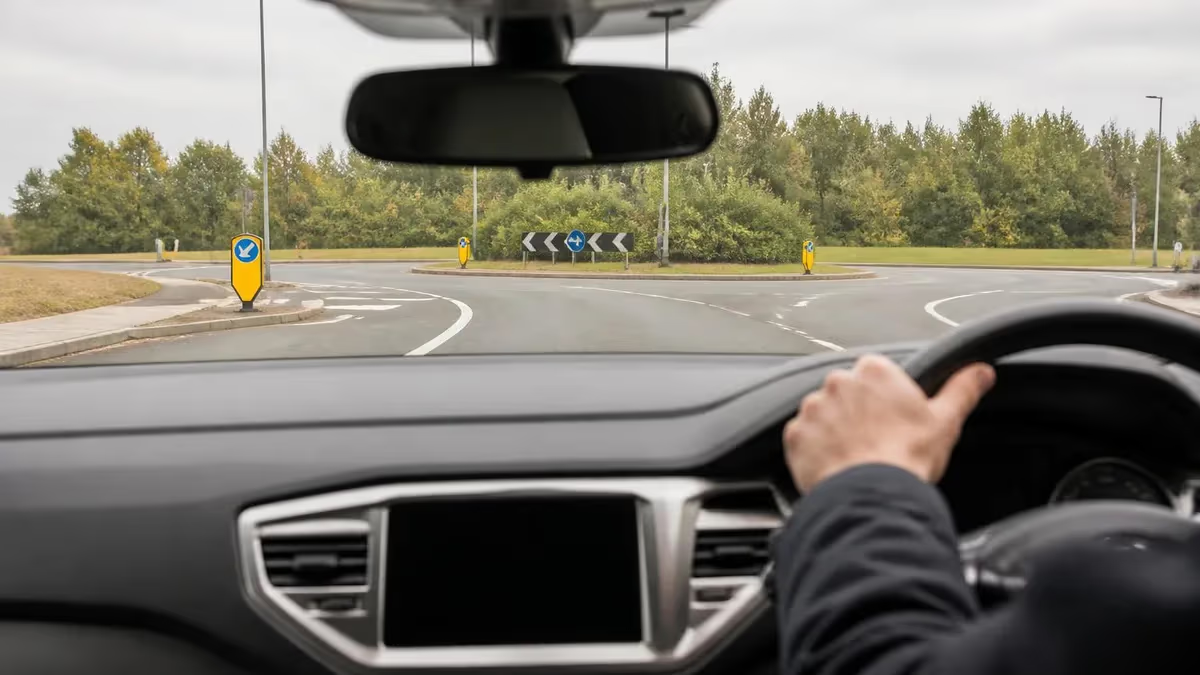
The practice theory test UK pathway is the single most effective way to prepare for the official DVSA driving theory exam, and in 2026 it remains the gold standard for learner drivers across England, Scotland, and Wales. Whether you are a complete beginner who has just received your provisional licence or someone retaking the test after a near miss, working through a realistic theory mock test under timed conditions is what separates a comfortable pass from a frustrating fail. The official test has not changed in structure, but the question bank evolves each year.
If you are searching for a driving test online mock test free practice, start with the free driving theory test practice questions on this page: every answer comes with an explanation, and the study notes below cover the DVSA exam topics in order.
The current DVSA theory test contains 50 multiple-choice questions drawn from a bank of more than 700, followed by a 14-clip hazard perception section. You have 57 minutes for the multiple-choice paper and need 43 out of 50 correct, alongside 44 out of 75 on hazard perception, to pass overall. Both elements must be passed in the same sitting, which is why a structured practice routine matters far more than simply reading the Highway Code from cover to cover.
According to the most recent DVSA statistics, the pass rate sits at just 44.2%, meaning more candidates fail than pass on their first attempt. The biggest reason is not poor knowledge — it is poor exam technique. Learners panic on tricky wording, run out of time on the case study, or freeze on the hazard clips. Quality practice theory test sessions train both your recall and your composure, which is exactly what the real exam tests.
This guide walks you through everything you need to build an exam-ready revision plan: how the questions are structured, what categories appear most often, how the hazard perception scoring really works, and which mistakes cause the majority of fails. You will also find free practice quizzes embedded throughout this page so you can test yourself as you read, immediately turning theory into active recall instead of passive scrolling.
One of the most useful changes in recent DVSA guidance is the move toward scenario-based questions. Rather than asking you to recite a stopping distance, modern questions describe a situation — wet road, dual carriageway, lorry braking ahead — and ask what you would do. This means rote memorisation alone will not cut it. You need to understand why a rule exists, not just what it says, and timed mock tests are the fastest way to develop that judgement under pressure.
By the end of this article you will know exactly how many practice tests to take, what score threshold reliably predicts a real-world pass, and how to use revision apps, books, and free online quizzes together rather than as competing tools. The aim is not just to pass the theory test — it is to pass it confidently the first time so you can move on to booking your practical driving test without delays, retake fees, or wasted weeks.
UK Theory Test by the Numbers
Key Facts at a Glance
| Item | Value | Details |
|---|---|---|
| Pass Mark | 43/50 | Multiple choice section |
| Time Limit | 57 min | Multiple choice only |
| Test Fee | £23 | Car category |
| Question Bank | 700+ | Official DVSA pool |
DVSA Theory Test Format 2026
| Section | Questions | Time | Weight | Notes |
|---|---|---|---|---|
| Multiple Choice | 50 | 57 min | Pass: 43/50 | Including case study |
| Hazard Perception | 14 | ~20 min | Pass: 44/75 | Click on developing hazards |
| Practice Time | 0 | 15 min | Optional | Familiarisation before MC |
| Instructions Video | 0 | ~3 min | Mandatory | Before hazard perception |
| Total | 64 | approx 1 hour 57 min | 100% |
Effective preparation for the practice theory test UK 2026 starts with understanding that you are training two very different skills at once. The multiple-choice section rewards systematic knowledge of the Highway Code, road signs, and vehicle handling rules, while the hazard perception section rewards spatial awareness, pattern recognition, and quick reactions. Treating them as one revision task is the most common mistake learners make, and it almost always shows up as a fail in one section while passing the other.
The DVSA recommends a minimum of 20 hours of dedicated theory revision before booking your test, but research from driving instructor associations suggests most successful candidates put in closer to 30 to 40 hours spread across four to six weeks. Cramming the night before a test simply does not work because hazard perception relies on muscle memory and timing that only develops through repeated viewing of varied clips. Plan your study around short, focused sessions rather than marathon weekends.
Start with the official DVSA theory test book or the Safe Driving for Life app to build foundational knowledge, then transition into pure mock testing once you can comfortably explain each topic. The shift from reading to testing should happen earlier than most learners think — ideally after just one full pass of the source material. Active recall via quizzes builds retention dramatically faster than re-reading, a finding consistently supported by cognitive science research on long-term memory.
Tracking your scores matters enormously. A simple spreadsheet listing each theory mock test attempt, your score, the date, and the topics you got wrong reveals patterns within a week. You will quickly notice if you keep tripping on motorway rules, alcohol limits, or stopping distances, and you can then target those specific weak areas instead of revising everything equally. This data-driven approach typically halves the total study time needed to reach a reliable pass standard.
For the hazard perception element, watch the official DVSA sample clips first to calibrate what counts as a developing hazard. Many learners over-click thinking they will earn more points, but the system penalises repetitive clicking patterns and can score zero on a clip if it detects you are gaming it. The correct technique is to click once when you spot a potential hazard, then again only if the situation clearly escalates — a parked car becoming a moving car, for example.
Mix your study formats deliberately: 30% reading, 50% theory test practice online, 20% hazard clips is a strong default ratio for most learners. If you have weak English literacy or learning difficulties, request the DVSA's voiceover option when booking — this reads each question aloud and adds up to 60 minutes extra time. There is no shame in using these adjustments, and they are designed specifically to make the test fair rather than to give an unfair advantage.
Finally, schedule your real theory test only once you are consistently scoring 47/50 or higher on mock tests and clicking confidently on hazard clips. Booking too early is the leading cause of wasted £23 retake fees. Treat the booking itself as a reward you earn through practice scores, not a deadline that forces revision.
Theory Mock Test Online: How to Use Free Driving Theory Test Practice Properly
A theory mock test is only useful if it copies the real exam conditions. The official car theory test gives you 57 minutes for 50 multiple-choice questions with a pass mark of 43, followed by 14 hazard perception clips scored out of 75 with a pass mark of 44. When you do theory test practice online, set a 57-minute timer, answer all 50 questions in one sitting, and do not look at the explanations until the end. Five-minute bursts never build the concentration you need for the final ten questions, which is where tired candidates drop marks.
Remember that the DVSA stopped publishing the live question bank in 2012, so no free practice site can show you the exact questions you will face. What good practice does is teach the underlying rules: stopping distances, speed limits by road type, the hierarchy of road users, and what each road sign shape means.
The DVSA offers its own free practice questions and a hazard perception demo through Safe Driving for Life, so do that official mock at least once to see how clips are scored on the five-point scale. Then use the free quizzes on this page for volume: aim for at least 15 full timed mocks, track every score, and only book at gov.uk once your last five attempts are all 47 out of 50 or better.
DVSA Practice Test Questions
Prepare for the DVSA - UK Driving Theory Test exam with our free practice test modules. Each quiz covers key topics to help you pass on your first try.
DVSA Eco-Friendly Driving and Vehicle Loading
DVSA Exam Questions covering Eco-Friendly Driving and Vehicle Loading. Master DVSA Test concepts for certification prep.
DVSA Hazard Awareness
Free DVSA Practice Test featuring Hazard Awareness. Improve your DVSA Exam score with mock test prep.
DVSA Incidents, Accidents and First Aid
DVSA Mock Exam on Incidents, Accidents and First Aid. DVSA Study Guide questions to pass on your first try.
DVSA Motorway Rules and Smart Motorways
DVSA Test Prep for Motorway Rules and Smart Motorways. Practice DVSA Quiz questions and boost your score.
DVSA Rules of the Road (Highway Code)
DVSA Questions and Answers on Rules of the Road (Highway Code). Free DVSA practice for exam readiness.
DVSA - UK Driving Theory Hazard Awareness ...
DVSA Mock Test covering - UK Driving Theory Hazard Awareness and Perception. Online DVSA Test practice with instant feedback.
DVSA - UK Driving Theory Motorway Rules an...
Free DVSA Quiz on - UK Driving Theory Motorway Rules and Regulations. DVSA Exam prep questions with detailed explanations.
DVSA - UK Driving Theory Road and Traffic ...
DVSA Practice Questions for - UK Driving Theory Road and Traffic Signs. Build confidence for your DVSA certification exam.
DVSA - UK Driving Theory Rules of the Road
DVSA Test Online for - UK Driving Theory Rules of the Road. Free practice with instant results and feedback.
Question Categories on the Practice Theory Test
Road signs and markings account for roughly 15-20% of multiple-choice questions on the DVSA theory test, making them one of the highest-yield categories to master early. Circular signs give orders, triangular signs warn, and rectangular signs inform — but the test often asks about specific lesser-known signs like the level crossing without a barrier or the national speed limit applying symbol.
Common traps include white-on-blue signs (which give positive instructions like minimum speed) versus white-on-red signs (which prohibit). You should also master road markings such as zigzag lines outside zebra crossings, double white lines with broken inner lines, and box junction rules. Spending an evening with the official sign reference alongside a focused mock test will dramatically lift this category score.
Online Practice Tests vs Traditional Study Methods
- +Free unlimited attempts on most reputable platforms with instant scoring
- +Mirror exact DVSA format including timing pressure and question count
- +Adaptive learning algorithms surface your weakest topics automatically
- +Mobile access means revision fits into commutes, lunch breaks, and queues
- +Track score trends over time to predict real-test readiness accurately
- +Built-in hazard perception simulators with official-style developing clips
- +Cover the full 700+ question bank rather than a printed subset
- −Quality varies wildly — some sites use outdated 2018 question wording
- −Screen fatigue can reduce focus during longer 50-question sessions
- −Easy to click-through without truly absorbing the explanations
- −Some apps charge monthly subscriptions for premium features unnecessarily
- −No replacement for hands-on driving lessons reinforcing the theory
- −Internet outages can interrupt revision flow at inconvenient moments
Pre-Test Practice Theory Test UK Checklist
- ✓Read the official Highway Code 2026 edition cover to cover at least once
- ✓Complete a minimum of 15 full-length 50-question mock tests under timed conditions
- ✓Score consistently 47 out of 50 or higher across your last five practice attempts
- ✓Watch all 14 official DVSA sample hazard perception clips and review your timing
- ✓Achieve 50 plus out of 75 on practice hazard perception sessions consistently
- ✓Memorise all stopping distances for dry, wet, and icy road conditions
- ✓Review the 2022 Highway Code hierarchy of road users updates thoroughly
- ✓Book your test only when scoring above pass mark for two consecutive weeks
- ✓Print your provisional licence number and theory test booking confirmation email
- ✓Plan your travel route to the test centre and arrive at least 15 minutes early
The 47/50 Rule for Real-Test Readiness
Driving instructors consistently report that learners who reach a stable 47 out of 50 score on at least five different mock tests have a 90% plus chance of passing the real theory test on their first attempt. Anything below 45/50 reliably indicates more revision is needed, regardless of how confident you feel.
Stress and unfamiliar exam-centre conditions typically knock 2-3 points off your home practice score, which is exactly why building a buffer above the 43/50 pass mark matters more than scraping it during revision.
The most common reasons learners fail the practice theory test UK are surprisingly predictable, and recognising them early can save you both money and weeks of delay. The first major mistake is misreading questions under time pressure. Each question gives you roughly 68 seconds, which feels generous until you encounter scenario questions with three paragraphs of context. Many learners panic, skim, and pick the answer that looks vaguely right rather than the one that matches the exact wording, especially on negatively phrased questions asking what you should not do.
The second frequent failure point is the hazard perception clip technique. The scoring system uses a five-point sliding scale per clip — clicking at the moment the hazard begins to develop earns five points, while clicking too late earns one or zero. Clicking too early or in suspiciously even rhythms triggers the anti-cheat detection, and your score for that clip drops to zero regardless of accuracy. Learners who fail hazard perception have usually never practised on simulated clips with proper feedback.
A third trap involves the case study at the end of the multiple-choice section. This presents a short story followed by five linked questions, and many candidates rush through it after the time spent on the main 45 questions. The case study is not separately timed but does count toward your 50-question total and your 43/50 pass mark. Treat it with the same care as the rest, and re-read the scenario if even one question feels ambiguous.
Overconfidence after a few good mock test scores is another silent killer. Scoring 48/50 once does not mean you have mastered the material — it might just mean you got lucky with the random selection from the 700-question bank. Real readiness shows up as consistency across many different test variations, not a personal best in one session. Track your moving average rather than your peak, and only book when that average sits firmly above 45/50.
Some learners also neglect the fitness-to-drive and first-aid categories assuming they are minor. In reality, the DVSA can include four or five questions from these topics in a single test, and missing all of them puts you immediately at the pass-fail threshold. Topics like alcohol blood limits, prescription medication warnings, and the recovery position for unconscious casualties appear regularly and reward focused 20-minute revision sessions.
Finally, do not underestimate the importance of physical preparation. Taking the test dehydrated, tired, or rushing from work consistently shaves 2-4 marks off practice-equivalent performance. Treat test day like a job interview — sleep eight hours, eat a proper breakfast, and arrive with time to use the toilet and settle into the test-centre environment. The mental load of urgency or discomfort eats into your concentration far more than most candidates expect.
Several lookalike websites charge £30-£60 for so-called premium DVSA practice tests that are actually outdated, contain incorrect answers, or use scraped material no longer reflecting the 2026 question bank. The DVSA does not officially endorse any third-party test except its own Safe Driving for Life products.
Always verify free practice resources cite the latest Highway Code edition and ideally include hazard perception clips reflecting current road environments rather than 2010-era footage.
On the morning of your real DVSA theory test, your strategy should focus on calm execution rather than last-minute cramming. Trying to learn new material on test day actively damages performance because it adds anxiety and disrupts the recall pathways you spent weeks building. Instead, do a light 15-minute warm-up — perhaps 10 mock questions from a category you find easy — to put your brain into recall mode without introducing stress about unfamiliar content.
Arrive at the test centre at least 20 minutes early with two forms of identification including your photocard provisional licence. Test centres are strict on punctuality, and arriving even 10 minutes late can void your booking and forfeit your £23 fee with no refund. Bring water and a snack for after the test, but note that personal items including phones must be locked in a secure locker before entering the test room. Booking changes are still possible up to three working days before — see the theory test booking change guide if you need to rearrange last minute.
Inside the test room you will receive a 15-minute optional practice session covering how the touchscreen works, navigation between questions, and how to flag questions for review. Use this practice time fully even if you feel confident — it familiarises you with the specific terminal, screen brightness, and click responsiveness which can subtly differ from home setups. Skipping it is one of the most common rookie errors among self-taught candidates.
During the multiple-choice section, use the flag-for-review feature liberally. If a question takes more than 90 seconds to answer confidently, flag it, pick your best guess, and move on. Returning to flagged questions at the end with a fresh perspective regularly converts uncertain answers into correct ones because your subconscious has been processing them in the background. The exam clock works in your favour if you manage it actively rather than passively.
For the hazard perception section, there is a mandatory 3-minute video explaining the scoring rules and how to click. Watch it even if you have seen it before, because the test will not begin until the video finishes regardless. Each clip lasts roughly one minute, and you should sit comfortably with your finger near the mouse button rather than hovering over it tensely. Tension causes erratic clicking and false-positive detections from the scoring algorithm.
Once both sections are complete, you receive your provisional pass result on screen immediately, followed by a printed certificate at reception. This certificate is valid for two years from the date of issue, so plan your practical driving test booking accordingly. Letting your theory pass expire is heart-breakingly common and means starting the whole process from scratch with another £23 fee and weeks of repeat revision.
If you do not pass, you must wait three clear working days before retaking the test. Use that time strategically — review the score breakdown the DVSA emails you, focus revision on the two or three weakest categories shown, and re-enter the test room with targeted improvements rather than generic re-study. Most candidates pass on their second attempt with this focused approach.
Final preparation in the last week before your practice theory test UK should focus on consolidation rather than expansion. Stop introducing new revision materials and instead cycle through your existing mock tests, targeting only the questions you have previously got wrong. This technique, sometimes called the Leitner system, takes advantage of spaced repetition and ensures your weakest areas receive disproportionate attention without overwhelming your working memory in the days before the exam.
Sleep is dramatically underrated as a revision tool. Memory consolidation happens primarily during deep sleep, meaning a full eight-hour night the day before the test does more for your recall than three extra hours of late-night cramming. Avoid alcohol entirely for the 48 hours leading up to your test — even moderate consumption disrupts REM sleep and impairs the precise reaction times you need for hazard perception clicks.
Practise the hazard perception section in conditions that mirror real-test stress. Sit at a desk, time yourself, do not pause clips, and avoid checking your phone between sequences. Most home-practice failures come from learners pausing or rewinding clips, which is impossible in the real test. The clips run continuously back-to-back, and you need to maintain concentration across all 14 in roughly 20 minutes without significant breaks.
Build mental rehearsal into your routine for the final three days. Visualise arriving at the test centre, sitting at the terminal, working through the practice screen, and confidently flagging questions. Sports psychology research consistently shows that mental rehearsal improves real performance because it primes the neural pathways involved in execution. Five minutes morning and evening is enough to feel a measurable difference in calmness on test day.
Consider doing one final full-length mock test 48 hours before your real exam, then no formal testing in the final day. This gives you a baseline confidence score and avoids the trap of a poor last-minute mock shaking your self-belief. If that mock test reveals significant weakness — scoring under 45/50 or under 50/75 on hazard perception — seriously consider whether rescheduling is the right call. Test centres allow free rescheduling up to three clear working days in advance.
On the practical front, double-check your booking email, the test centre address, parking arrangements, and public transport timings the day before. Print or screenshot your booking reference in case mobile signal fails inside the test centre. Pack your photocard provisional licence and any prescribed glasses or contact lenses, since the DVSA can refuse entry if your stated visual aids are not present. If you are unsure about the format more broadly, the practical test process is covered in our book driving test guide.
Above all, remember that the theory test is a knowledge and judgement check designed to make UK roads safer — it is not a trick exam, and the DVSA is not trying to fail you. Candidates who treat it with respect, prepare consistently, and arrive calm pass at well above the national average rate. With the structured approach in this guide and the embedded driving theory test free practice quizzes you can return to whenever you have ten spare minutes, your first-time pass is genuinely within reach.
Theory Test Practice Flashcards
Tap a card to flip it. Ten quick facts that come up again and again in the real exam.
📝 How many questions are in the UK car theory test and how long do you get?
The multiple-choice section has 50 questions and you get 57 minutes. That works out at just over a minute per question, so flag anything you are unsure about and come back to it.
START RULES OF THE ROAD PRACTICE TEST✅ What is the pass mark for the multiple-choice section?
You need 43 out of 50, so you can only afford seven wrong answers. Most instructors say you should be scoring 47 or higher on practice tests before you book the real thing.
START RULES PRACTICE TEST🎯 How is the hazard perception part scored?
There are 14 video clips and 75 points available; the pass mark is 44. Each developing hazard scores up to five points, and clicking earlier earns more. One clip contains two hazards.
START HAZARD AWARENESS PRACTICE TEST💷 How much does the car theory test cost and where do you book it?
The car theory test costs £23. Book it only on the official GOV.UK booking service; unofficial sites charge extra fees for the same appointment.
START VEHICLE SAFETY PRACTICE TEST📅 How long is a theory test pass certificate valid?
Two years from the date you pass. If you do not pass your practical driving test within that time, you must sit and pay for the theory test again, so plan your lessons around the deadline.
START DOCUMENTS PRACTICE TEST🚗 What is the national speed limit for a car on a single carriageway?
60 mph for a car, and 70 mph on a dual carriageway or motorway. If you are towing a trailer or caravan those limits drop to 50 mph and 60 mph respectively.
START MOTORWAY RULES PRACTICE TEST🚦 What does a red circle on a road sign mean?
Circular signs give orders: a red ring means you must not do something, such as exceed a speed limit or enter a road. Blue circles give positive instructions, triangles warn, and rectangles inform.
START ROAD SIGNS PRACTICE TEST🌧️ How does wet weather change your following distance?
Leave at least a two-second gap in dry conditions and double it to four seconds in the wet. On ice, stopping distances can be up to ten times longer than on a dry road.
START HAZARD PERCEPTION PRACTICE TEST🚶 Who has priority at a junction under the hierarchy of road users?
Since the 2022 Highway Code update, drivers turning into or out of a junction must give way to pedestrians waiting to cross and must not cut across cyclists going straight ahead.
START VULNERABLE ROAD USERS PRACTICE TEST🔁 How soon can you retake the theory test if you fail?
You must wait three clear working days before you can sit it again, and you pay the £23 fee each time. Use the score breakdown to target the topics you dropped marks on.
START FIRST AID PRACTICE TESTSample DVSA UK Driving Theory Practice Questions
Try these questions from our free DVSA UK Driving Theory practice tests. The correct answer and an explanation follow each question.
You are approaching a horse and rider on a country lane. What is the maximum speed at which you should pass?
- A. 10 mph
- B. 20 mph
- C. 30 mph
- D. The speed is not specified, but you must pass 'wide and slow'
Answer: A. 10 mph
The Highway Code (Rule 215) is very specific about passing horses. You must slow down to a maximum of 10 mph and allow at least 2 metres of space. Horses are flight animals and can be easily scared by vehicles that are moving too fast or are too close.
What does a circular sign with a red border and a diagonal red bar through it indicate?
- A. A speed limit that applies in that area
- B. A mandatory instruction to turn around
- C. A prohibition — that particular action is not permitted
- D. An advisory warning to slow down
Answer: C. A prohibition — that particular action is not permitted
A red circle with a diagonal bar is used for prohibition signs, meaning the depicted action is not allowed.
When must you use dipped headlights?
- A. Only when it is completely dark
- B. When visibility is seriously reduced, and at night on unlit roads
- C. Only on motorways at night
- D. Whenever you switch on any lights
Answer: B. When visibility is seriously reduced, and at night on unlit roads
You must use dipped headlights when visibility is seriously reduced (generally when you cannot see for more than 100 metres) and at night on unlit roads. You should also use them at dusk and dawn.
Under the Highway Code hierarchy of road users, who bears the greatest responsibility for the safety of others?
- A. Pedestrians
- B. Cyclists
- C. Drivers of large vehicles
- D. All road users equally
Answer: C. Drivers of large vehicles
The 2022 Highway Code update introduced a hierarchy of road users. Those who can cause the greatest harm (drivers of large vehicles, then car drivers) bear the greatest responsibility to reduce the danger they pose to more vulnerable road users.
DVSA Questions and Answers
Official Resources
- GOV.UK: Theory test — the official guide to the car theory test, including what to take, the pass marks and how results work.
- GOV.UK: Book your theory test — the only official DVSA booking service, where the car theory test costs £23.
- Safe Driving for Life: Free practice tests — the DVSA's own free theory practice questions and hazard perception demo.
Practice Theory Test: Free UK Driving Practice (2026)

Theory Test Book: Best Study Books to Pass in 2026
How Long Does the Theory Test Take? Complete UK Timing Guide 2026
Theory Test Booking Change: How to Reschedule, Cancel & Move Your DVSA Test in 2026
Book Driving Test: How to Schedule Your DVSA Test Online, Costs & What to Expect
About the Author

Licensed Driving Instructor & DMV Test Specialist
Penn State UniversityRobert J. Williams graduated from Penn State University with a degree in Transportation Management and has spent 20 years as a certified driving instructor and DMV examiner consultant. He has personally coached thousands of applicants through written knowledge tests, skills assessments, and commercial driver licensing programs across more than 30 states.