
How to Set Up a DMV Account: Complete Guide for DMV Customer Service Representatives
Learn how to set up a DMV account step by step. Complete guide for DMV customer service representatives & NY DMV help. ✅

To set up a DMV account, use your state's official .gov DMV website and verify your identity with details from your license or ID; requirements differ by state. In New York, you first create an NY.gov ID, then link it to MyDMV using your 9-digit DMV ID Number, license document number, last four Social Security digits, date of birth and ZIP code on file.
If you are wondering how to set up a DMV account or how to navigate the systems that a DMV customer service representative uses every day, you have come to the right place. Setting up a DMV account — whether as a member of the public seeking online services or as an employee learning internal DMV workflows — is the essential first step toward accessing everything the Department of Motor Vehicles has to offer. This guide walks you through every aspect of the process, from initial registration to managing credentials for ongoing use.
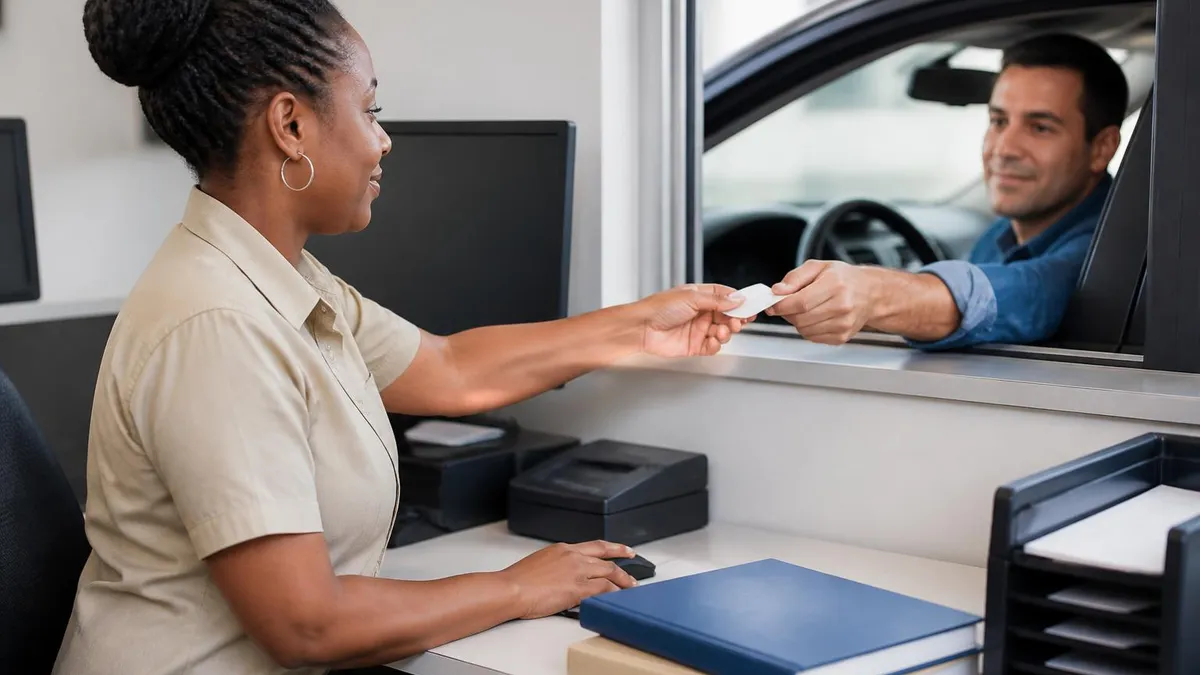
A DMV customer service representative is the frontline professional who helps citizens renew licenses, register vehicles, process title transfers, schedule road tests, and resolve billing disputes. These representatives work inside DMV branch offices and remote call centers, and they interact with multiple digital systems simultaneously. Understanding how account setup works — both for customers and for staff — gives you a critical head start whether you are preparing for the DMV representative exam or simply trying to serve the public more effectively.
Many first-time visitors to a state DMV portal feel overwhelmed by the number of account types available. There are personal accounts tied to a driver license number, business accounts linked to an EIN for dealerships and fleet operators, and internal employee accounts used by DMV staff to process transactions. Each account type has its own setup steps, required documentation, and security protocols. Knowing which type you need before you start saves significant time and reduces the chance of creating a duplicate or misconfigured profile.
New York State, for example, operates the NY.gov unified identity platform, which means residents set up a single sign-on account that connects to DMV services, tax services, and other state agencies. If you have ever tried to reach help and asked how do I speak to a DMV representative in NY, you already know that the NY DMV Contact Center answers general questions by phone but cannot process transactions, so most business is done online through a MyDMV account.
For those pursuing a career as a DMV representative, demonstrating familiarity with account setup procedures during your exam and during onboarding interviews signals professional readiness. You can begin your dmv account setup knowledge journey by reviewing the official study materials alongside the practice exams linked throughout this article. Understanding the systems from both the citizen side and the employee side is what separates a good candidate from a great one.
This article covers the most common account setup scenarios you will encounter, the security requirements that protect sensitive motor vehicle data, troubleshooting steps for locked or unverified accounts, and the role account management plays in the day-to-day responsibilities of a DMV representative. Whether you are studying for your certification exam or coaching new employees on DMV onboarding, the information here will give you a solid, practical foundation to work from.
By the end of this guide you will understand the complete lifecycle of a DMV account — creation, verification, role assignment, password management, and deactivation — and you will be prepared to handle the most frequent account-related questions that members of the public bring to the service counter every single day.
NY DMV Account and Contact Quick Reference
Verified New York facts for DMV account setup and contact (source: dmv.ny.gov).
| Item | Verified detail |
|---|---|
| Account system | NY.gov ID, then link to MyDMV |
| NY.gov ID sign-up info | Name, email, address, username; then create a password and security questions after the setup email |
| MyDMV linking info | 9-digit DMV ID Number, 8- or 10-digit document number, last 4 SSN digits, date of birth, ZIP on file |
| Contact Center phone | 1-518-486-9786 or 1-800-698-2931 |
| Contact Center hours | Weekdays 8 a.m.–4 p.m. ET, except state holidays |
| Can representatives process transactions? | No; use online services |
| Road test scheduling line | 1-518-402-2100 (24/7) |
| TDD / accessibility | 711 or 1-800-662-1220 |
DMV Account Setup & Representative Role by the Numbers

How to Set Up a DMV Account: Step-by-Step Process
Gather Required Documents
Visit the Official State DMV Portal
Enter Personal Information & Verify Identity
Set Up Security Credentials
Verify Your Email Address
Log In and Complete Your Profile
The role of a DMV customer service representative extends far beyond simply handing over forms at a service counter. Representatives are responsible for verifying the authenticity of identity documents, processing financial transactions for fees and taxes, entering data accurately into state motor vehicle databases, and explaining complex regulatory requirements to members of the public who may be confused or frustrated. A single data entry error can result in the wrong person receiving a registration renewal or, worse, a license being suspended incorrectly — consequences that can take weeks to untangle.
When a DMV representative first joins a state agency, one of the earliest tasks during onboarding is setting up access to the various software platforms the office uses. These typically include the core motor vehicle database, a document imaging system for scanned records, a payment processing terminal, and a customer queue management application. Each of these platforms has its own login credentials, and the new employee must follow IT provisioning procedures to get accounts activated within the correct permission tiers.
In New York State, DMV representatives must also be familiar with the NY.gov identity platform because many of the public-facing inquiries they handle involve helping citizens who are locked out of their own online accounts. If a caller asks how do I speak to a DMV representative in NY, the representative must guide that person through the account recovery process — which includes verifying the caller's identity without being able to see their password — before any account changes can be made. This requires both technical knowledge and strong communication skills.
Understanding account permissions is especially critical for representatives who work with commercial accounts. A vehicle dealer, for instance, has a business DMV account that allows bulk title processing and dealer plate management. A fleet company may have sub-accounts for individual vehicles or drivers. When a representative helps a business customer with account setup, they must verify the dealership license number, confirm that the business is in good standing with the state, and ensure that the correct transaction types are enabled for that account class — not a task for someone unfamiliar with the DMV's account hierarchy.
Training for new DMV representatives typically covers account management extensively because it underpins nearly every customer interaction. Staff are taught to recognize signs of identity fraud during account creation — for example, a Social Security number that does not match the name or birth date on file, or a license number that belongs to a different individual. Catching these discrepancies at the account setup stage prevents fraud from entering the system and protects both the citizen and the state agency from liability.
The DMV representative exam tests candidates on their knowledge of consumer protection laws, vehicle inspection standards, and the proper procedures for handling account-related disputes. Preparing for this exam means understanding not just the steps of account setup, but also the regulatory framework that governs what information can be stored, how long records must be retained, and under what circumstances account access can be suspended or terminated. These topics appear frequently in practice test questions and in the structured curriculum used by state DMV training programs.
For candidates studying for the representative exam, it is worth noting that the exam covers both the procedural and the interpersonal dimensions of the role. Being able to explain account setup to a first-time user in plain language, without resorting to jargon, is itself a tested competency. Practice tests that simulate real customer scenarios — including account lockouts, identity mismatches, and fee payment issues — are among the most effective preparation tools available.
DMV Customer Service Representative: Account Types & Key Procedures
A personal DMV account is tied directly to an individual's driver license or state ID number. To create one, the citizen must provide their full legal name, date of birth, license number, and the last four digits of their Social Security number. Once verified, the account allows online renewals, address changes, appointment scheduling, record requests, and fee payments — all without a visit to a branch office.
Security for personal accounts includes email verification and, depending on the state, security questions or two-factor authentication. If you are locked out, use the portal's password-reset option first, then contact your state DMV if that fails.

Online DMV Account Setup: Advantages and Limitations
- +Complete renewals, address changes, and record requests 24/7 without visiting a branch
- +Receive renewal reminders by email where your state offers them
- +Pay DMV fees online using the payment methods your state accepts
- +Track the status of pending applications and title transfers in real time
- +Reduce wait times at branch offices by completing pre-registration steps online
- +Access a full digital history of past DMV transactions linked to your account
- −Account creation requires personal information that some users are uncomfortable providing online
- −Identity verification errors are common when name or birth date does not exactly match DMV records
- −Sign-in security options can lock out users whose contact details are out of date
- −Not all DMV transactions are available online — some still require an in-person visit with original documents
- −Technical outages on state portals can prevent time-sensitive renewals from being completed remotely
DMV Account Setup Checklist: Everything You Need Before You Start
- ✓Have your current driver license or state ID card physically in hand before starting.
- ✓Confirm your legal name on the license matches your Social Security records exactly.
- ✓Use a personal email address you actively monitor — avoid work emails that may block state notifications.
- ✓Enable two-factor authentication on your email account before linking it to your DMV profile.
- ✓Prepare your last four SSN digits — most portals require this for identity verification.
- ✓For business accounts, download your current state business registration certificate in advance.
- ✓Write down or store your username and security questions in a secure password manager.
- ✓Log in a second time after verification to confirm your account status shows as 'Active' or 'Verified'.
- ✓Choose a strong, unique password and store it in a password manager.
- ✓Complete every verification step your state requires, then log in again to confirm the account works.
Always Confirm Account Status Before Processing Any Transaction
Before making changes to any customer's DMV account — including address updates, license reinstatements, or payment processing — always confirm the account status shows as fully verified and active. Processing a transaction on a restricted or unverified account can cause records to be flagged for manual review, delay the customer's service or trigger additional review.
Even with a well-designed online portal, account setup errors are among the most common issues that DMV customer service representatives encounter every day. The single most frequent problem is a name mismatch: the applicant enters their name as it appears on a bank card or utility bill rather than as it appears on their driver license, and the system rejects the account creation request. Representatives must be prepared to explain this clearly and calmly, because many callers interpret the rejection as a security flag against them personally rather than a simple data-entry discrepancy.
The second most common issue involves Social Security number verification. Some states verify the SSN against Social Security Administration records. If a citizen recently changed their name due to marriage or divorce but has not yet updated their SSA records, the SSN verification will fail even if the DMV record has been updated. In these cases, the representative must walk the customer through the process of contacting the SSA to correct the discrepancy before attempting DMV account creation again — a process that can frustrate customers who need online access urgently.
Account lockouts are another frequent scenario. Many portals lock an account after repeated failed login attempts, a security measure designed to prevent brute-force credential attacks. When a locked citizen calls the DMV, the representative must first verify the caller's identity through an out-of-wallet challenge — asking questions about vehicle registration details or past transaction amounts that only the legitimate account holder would know — before unlocking the account or initiating a password reset. Skipping any step in this verification sequence is a serious security breach that can result in disciplinary action.
For business accounts, a common complication involves authorized administrator turnover. When the person originally designated as the business account administrator leaves the company, the DMV typically requires documentation proving the new administrator's authority before transferring access; requirements vary by state. This process exists to prevent former employees from retaining access to sensitive business transaction histories after they leave the organization.
Duplicate accounts are a subtler but equally problematic issue. Citizens who forget they already created an account sometimes create a second one, which can result in split transaction histories, conflicting address records, and payment allocation errors. When a representative discovers a duplicate account situation, the agency's own procedure governs how records are merged, and the action should be documented carefully.
Technical outages on state DMV portals are a reality that representatives must handle gracefully. When the online system is unavailable, representatives are trained to offer in-person alternatives, explain estimated restoration timelines based on the IT department's communications, and in some cases process emergency transactions manually using paper forms that are later entered into the system when service is restored. Keeping customers informed and providing realistic timelines is essential for maintaining trust during these disruptions.
Understanding these common failure modes is directly relevant to the DMV representative exam, which includes scenario-based questions designed to test how candidates would respond to unusual or complicated account situations. Candidates who have worked through a variety of practice exam scenarios — including identity mismatch, account lockout, and business account transfer cases — are significantly better prepared to answer these questions correctly under timed exam conditions.

DMV representatives are strictly prohibited from asking customers for their full password, full Social Security number, or full account PIN over the phone. Legitimate DMV verification uses partial identifiers and out-of-wallet questions only. Any procedure that requires a customer to share a full password should be treated as a security incident and escalated to a supervisor immediately.
Preparing for the DMV customer service representative exam requires a structured approach that covers both the technical knowledge tested on the written assessment and the soft skills evaluated during the hiring and onboarding process. Hiring tests and requirements vary by state and agency, so check your state's official job posting. Topics commonly covered include knowledge of motor vehicle laws and regulations, ability to process transactions accurately and efficiently, understanding of consumer protection requirements, and familiarity with vehicle inspection and safety standards.
One of the most effective preparation strategies is to work through a large bank of practice questions organized by topic area. This approach allows you to identify your weakest knowledge domains early — for example, you may find that consumer protection statutes are less familiar to you than vehicle registration procedures — and allocate your study time accordingly. Practice exams also help you develop the test-taking stamina needed to maintain accuracy through a long assessment, which many candidates overlook.
Beyond the written exam, candidates for DMV representative positions are typically evaluated on their typing speed and accuracy, their ability to use office software and database applications, and their customer service skills demonstrated during a structured interview or role-play exercise. Hiring managers want to see that candidates can remain calm and professional when a customer is upset, find accurate information quickly in a database, and communicate complex regulatory information in plain language that a non-expert can understand.
Account management knowledge is increasingly tested during the interview phase as well. Hiring panels may ask scenario questions such as: a customer believes someone has fraudulently created a DMV account using their identity — what do you do? Or: a business account has two administrators listed and both are claiming sole authority — how do you proceed? These questions test your procedural knowledge, your judgment, and your ability to prioritize competing considerations including customer service, security, and regulatory compliance.
Continuing education is an important aspect of the DMV representative role after hiring. State DMV agencies regularly update their software platforms, fee schedules, and regulatory requirements, and representatives are expected to complete mandatory training whenever significant changes are implemented. Staying current with these updates is not just a professional obligation — many agencies require it.
For candidates who are still in the exam preparation phase, resources like the practice tests on this site are invaluable. They help you practice the kinds of topics and scenario questions you may see, expose you to the types of scenario questions that appear on the assessment, and give you immediate feedback on your performance so you can focus your remaining study time where it will have the greatest impact. The more practice questions you complete, the more confident you will feel walking into the actual exam.
Whether your goal is to pass the representative exam on your first attempt, to accelerate your onboarding as a new DMV employee, or to deepen your expertise in account management procedures as an experienced representative, the combination of structured study, hands-on practice, and familiarity with the systems described in this article will put you in the strongest possible position to succeed in this demanding and rewarding public service career.
Practical preparation for the DMV representative exam and for the daily work of account management goes well beyond memorizing rules and procedures. The most effective approach combines knowledge of the regulations with real-world practice scenarios that force you to apply what you know in conditions similar to those you will face on the job. In this final section, we consolidate the most actionable advice for candidates and new representatives.
Start your preparation by looking for any official exam guide or job posting from your state's personnel or civil service agency. If it lists topic weights, split your study time roughly in proportion.
When studying account setup and management procedures specifically, practice explaining the steps out loud as if you were talking to a first-time customer. This technique, sometimes called the Feynman method, forces you to identify gaps in your own understanding: if you cannot explain why a step exists — not just what it is — you have not yet learned it deeply enough to apply it flexibly when an unusual case comes up. Representatives who truly understand the purpose behind each procedure make better judgment calls in ambiguous situations.
Time management during the actual exam is a skill that deserves specific practice. Practice under timed conditions from the beginning of your preparation, not just in the final days before the exam. Use the results from timed practice sessions to identify not just which questions you get wrong, but which question types take you longest to answer — those are the areas where additional study will yield the greatest time savings on exam day.
For the interpersonal and communication skills evaluated during hiring, consider practicing with a study partner who plays the role of a difficult or confused customer. Work through scenarios involving account lockouts, disputed fees, identity verification failures, and commercial account disputes. Practicing these conversations out loud will help you develop the calm, clear communication style that DMV hiring managers look for and that makes a genuine difference in customer satisfaction scores at branch offices and call centers.
After you are hired, invest time in learning keyboard shortcuts and database navigation tricks from experienced colleagues. The speed and accuracy with which you can retrieve and update account records directly affects how many customers you can serve per hour, which in turn affects your performance evaluations. Many experienced representatives have developed personal workflows that allow them to process standard transactions significantly faster than the baseline taught during initial training — that institutional knowledge is worth seeking out actively.
Finally, take advantage of every practice exam resource available to you, including the quizzes linked throughout this article. Regular practice not only reinforces the content knowledge tested on the representative exam but also builds the mental stamina and test-taking confidence that help candidates perform at their best when it counts. Consistent, deliberate practice helps.
DMV Questions and Answers

DMV Customer Service Representative: Complete Career Guide & Permit Test Practice

DMV Drivers License: Application, Tests, REAL ID and Renewals

DMV Learners Permit Practice Test: Complete 2026 Prep Guide for First-Time Test Takers
DMV Road Sign Test: Complete Guide to Passing on Your First Try in 2026

How to Make a DMV Reservation: Complete Guide to Scheduling Your DMV Appointment
About the Author
Licensed Driving Instructor & DMV Test Specialist
Penn State UniversityRobert J. Williams graduated from Penn State University with a degree in Transportation Management and has spent 20 years as a certified driving instructor and DMV examiner consultant. He has personally coached thousands of applicants through written knowledge tests, skills assessments, and commercial driver licensing programs across more than 30 states.
Join the Discussion
Connect with other students preparing for this exam. Share tips, ask questions, and get advice from people who have been there.
View discussion (8 replies)