
DLAB Army Test 2026 July — Scores, Format & Complete Preparation Guide
💯 Boost your DLAB Army exam score with practice questions and detailed answer explanations. Track progress with instant feedback.
What Is the DLAB?
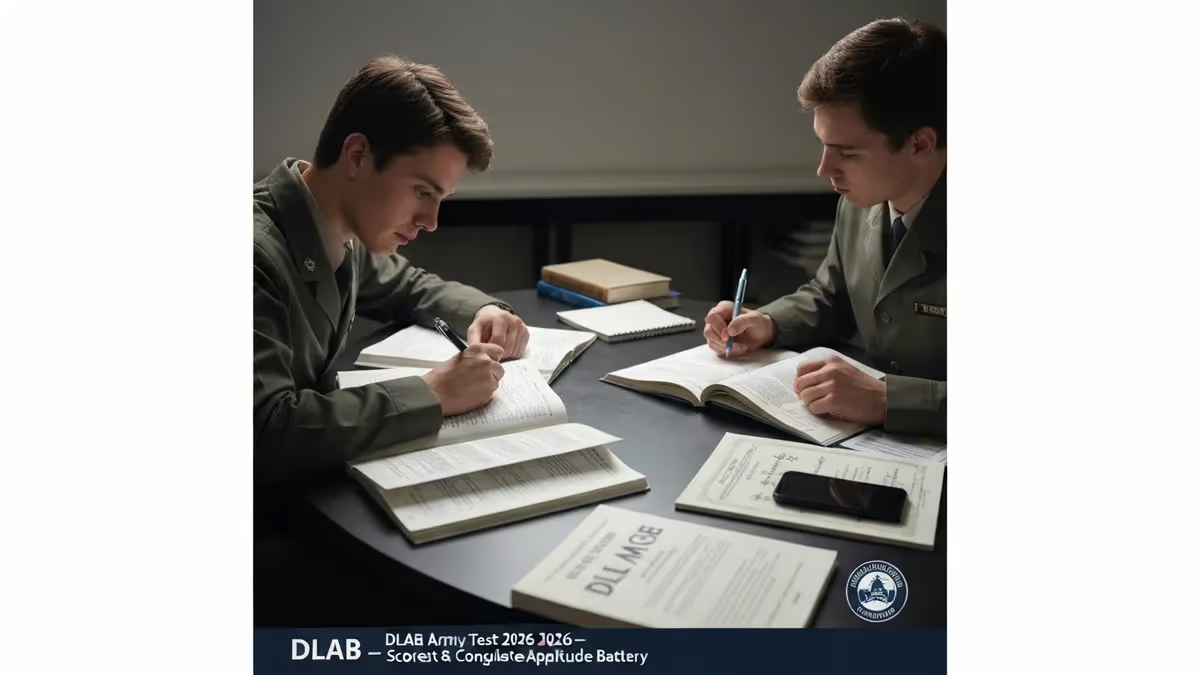
The Defense Language Aptitude Battery (DLAB) is a standardized cognitive test administered by the US military to predict a person's ability to learn a foreign language. It does not test knowledge of any existing language — instead, it uses a specially constructed artificial language to measure the underlying cognitive skills that drive language learning: pattern recognition, rule application, auditory discrimination, and working memory.
The test was developed by the Defense Language Institute Foreign Language Center (DLIFLC) in Monterey, California, which also runs the flagship US military language training program. Soldiers, sailors, airmen, and Marines take the DLAB as part of qualification for language-related military jobs. For a broader overview of all DLAB resources, see our dlab exam overview page.
A high army dlab score opens opportunities in intelligence, special operations, signals, and other career fields that require foreign language proficiency. The defense language aptitude battery is only administered at Military Entrance Processing Stations (MEPS) and some military installations — it is not available to civilians.
DLAB Test Format
The DLAB uses an artificial language called the Pattern Practice Language (PPL). The test is divided into two main sections, both administered in a single session:
Part 1 — Phonology / Sound Recognition (Audio Section):
- You hear audio recordings in the artificial language and must identify sound patterns and relationships
- Tests include: sound matching (which of four sounds matches what you heard?), minimal pair discrimination (are two sounds the same or different?), and sound-to-symbol correspondence (which written symbol represents the sound you heard?)
- This section cannot be studied from a textbook — it depends on your natural auditory processing ability
Part 2 — Morphology and Grammar (Pattern Practice Section):
- You are given written grammar rules in the artificial language and must apply them to new examples
- Tests your ability to recognize patterns, apply rules consistently, and generalize from examples to new cases
- This section has more trainable elements — practice with inflected languages (Latin, Russian, German) improves performance
The full test takes approximately 2.5–3 hours including instructions, practice items, and the scored sections. There is no penalty for guessing — always attempt every item. Study using our dlab practice test to familiarize yourself with both section types before test day.

DLAB Scoring Explained
The DLAB produces a single score on a scale of 0 to 176. The score reflects performance across both sections — phonology and grammar pattern practice. There is no section-level scoring; only the composite matters for qualification purposes.
Score interpretation and dlab scoring thresholds:
- 130–176: Excellent — qualifies for all language categories including Category IV (Arabic, Chinese, Korean, Japanese)
- 110–129: Strong — qualifies for Category III and IV languages (Russian, Hebrew, Thai, and most difficult)
- 100–109: Good — qualifies for Category II languages (German, Indonesian) and some Category III
- 85–99: Minimum — qualifies for Category I languages only (Spanish, French, Italian, Portuguese)
- Below 85: Does not meet minimum — cannot qualify for language MOS
Your dlab score is valid for 2 years. If you do not use it within 2 years for a language assignment, you must retest. The retake waiting period is 6 months from your last attempt. Most soldiers only get one or two opportunities to take the DLAB, so preparation matters significantly. For full dlab practice materials including both phonology and grammar sections, use our test guide.
DLAB Score Requirements by MOS
Each language-related military occupational specialty has a minimum dlab scores requirement. Requirements can change by branch and fiscal year — always verify with your recruiter or career counselor:
- 35P — Cryptologic Language Analyst (Army): Minimum DLAB 111 (Cat III/IV languages); 101 for some European languages
- 35M — Human Intelligence Collector (Army): Minimum DLAB 101 (language bonus MOS)
- 09L — Interpreter/Translator Aide (Army): Minimum DLAB 85 + native speaker requirement for target language
- 18F — Special Forces Intelligence Sergeant: Minimum DLAB 100 recommended; language assignment depends on team needs
- CTI — Cryptologic Technician Interpretive (Navy): Minimum DLAB 110 for most languages
- 1N3 / 1N8 — Airborne Cryptologic Language Analyst (Air Force): Minimum DLAB 110
Scores above 120 give you the widest choice of language assignments. Most soldiers targeting high-demand intelligence careers (SIGINT, HUMINT) aim for 110+. The dlab study guide includes specific tips for reaching the 110+ score range.
How to Prepare for the DLAB
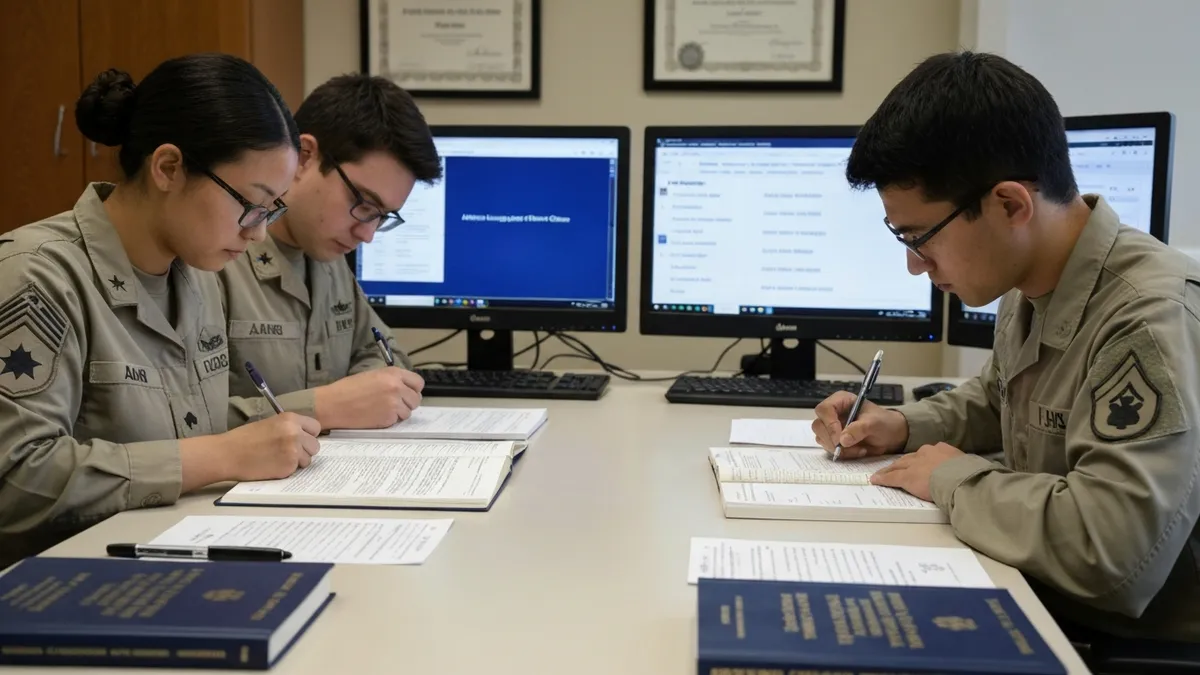
- ✓Take a full DLAB practice test first to assess your baseline — the phonology section is the hardest part to improve quickly
- ✓Study a highly inflected language: Latin, Russian, or German grammar rules help with the pattern practice section
- ✓Practice phoneme discrimination daily: listen carefully to minimal pairs (similar sounds) in languages you don't speak
- ✓Work through pattern recognition exercises: rule-based reasoning problems and code substitution puzzles
- ✓Strengthen your working memory: the test requires holding multiple grammar rules in mind simultaneously
- ✓Do NOT try to memorize DLAB questions — the test uses an artificial language, so old questions are useless
- ✓Practice under timed conditions — you must process audio quickly without replaying recordings
- ✓Target 110+ if possible: this score opens the widest range of language MOS options
- +Industry-recognized credential boosts your resume
- +Higher earning potential (10-20% salary increase on average)
- +Demonstrates commitment to professional development
- +Opens doors to advanced career opportunities
- −Exam preparation requires significant time investment (4-8 weeks)
- −Certification fees can be $100-$400+
- −May require continuing education to maintain
- −Some employers may not require certification
DLAB Army Test Questions and Answers
More DLAB Resources
About the Author
Educational Psychologist & Academic Test Preparation Expert
Columbia University Teachers CollegeDr. Lisa Patel holds a Doctorate in Education from Columbia University Teachers College and has spent 17 years researching standardized test design and academic assessment. She has developed preparation programs for SAT, ACT, GRE, LSAT, UCAT, and numerous professional licensing exams, helping students of all backgrounds achieve their target scores.
Join the Discussion
Connect with other students preparing for this exam. Share tips, ask questions, and get advice from people who have been there.
View discussion (6 replies)