
Firefighter Drug Test: What to Expect & How to Pass 2026 October
Pass your cps firefighter test exam. Practice questions with detailed answer explanations for the 2026 October exam. Instant scoring and study guides. 📚
Firefighter Drug Test: What Candidates Need to Know
Drug testing is a standard part of the firefighter hiring process, and it's not just a formality. Fire departments are public safety agencies—the consequences of impaired judgment in an emergency can be fatal. That's why most departments conduct pre-employment drug screens, and many also have ongoing random testing policies for active firefighters.
If you're preparing for a firefighter hiring process, understanding what the drug test entails, what substances get tested, and what happens if you fail is essential knowledge. A positive result typically disqualifies you from that department's hiring cycle—sometimes permanently.
When Drug Testing Happens in the Firefighter Hiring Process
Drug testing doesn't happen at the same stage across all departments, but it typically occurs at one or more of these points:
- Post-conditional offer: After a department extends a conditional job offer (after you've cleared the written exam, physical ability test, oral board, and background check), you'll be required to pass a medical examination that includes a drug screen. This is the most common placement.
- Pre-employment physical: Some departments schedule the drug test as part of the comprehensive pre-employment physical, conducted by an occupational health provider the department contracts with.
- Background investigation phase: A handful of departments include drug screening earlier in the process, particularly in departments with very competitive hiring pools where they want to screen out candidates before investing in full background investigations.
Once hired, random drug testing typically continues throughout your career. Most fire departments operate under drug-free workplace policies that authorize random testing, and collective bargaining agreements often specify the frequency and procedures for those tests.
What Substances Are Tested in a Firefighter Drug Test
Most firefighter pre-employment drug tests use a standard NIDA-5 panel (also called the DOT-5 panel), which screens for:
- Marijuana (THC metabolites)
- Cocaine and its metabolites
- Amphetamines and methamphetamine
- Opiates (codeine, morphine, heroin metabolites)
- Phencyclidine (PCP)
Many departments expand this panel to include additional substances. Expanded panels may add:
- Benzodiazepines (Xanax, Valium, Ativan)
- Barbiturates
- Synthetic opioids (oxycodone, hydrocodone, fentanyl)
- MDMA (Ecstasy)
- Propoxyphene
- Alcohol (though this is typically tested separately via breathalyzer if required)
The specific panel used varies by department, jurisdiction, and whether the department falls under any federal contractor requirements. If you're concerned about a specific substance, there's no reliable way to know the exact panel in advance—which is why the most practical advice is simply to stop using any controlled substances well before you begin the application process.
Important: The CPS exam covers multiple domains. Allocate more study time to unfamiliar topics while maintaining review of strong areas.
How Long Substances Stay in Your System
Detection windows vary significantly depending on the substance, the amount used, frequency of use, your metabolism, and body fat percentage. These are general guidelines—individual results vary:
Marijuana (THC): This is where most candidates get into trouble. THC metabolites are fat-soluble, meaning they accumulate in fatty tissue and release slowly. A single use may clear in 3–4 days for a very light, infrequent user. For someone who uses daily or near-daily, detection windows of 30–60 days in urine are realistic. Heavy, chronic users can test positive for up to 90 days in some cases. Hair follicle tests, if used, detect use for up to 90 days regardless of frequency.
Cocaine: Clears relatively quickly. Urine tests typically detect cocaine metabolites for 2–4 days after use. Heavy users may test positive for up to a week.
Amphetamines: Generally detectable in urine for 2–4 days after use. Methamphetamine clears somewhat more slowly, with detection windows of 3–5 days.
Opiates: Heroin and morphine metabolites typically clear in 2–4 days. Prescription opioids vary; some longer-acting formulations may be detectable for a week or more.
PCP: Generally detectable for 3–7 days for single use, and up to 30 days for chronic users.
Benzodiazepines: Short-acting benzos (like Xanax) clear in 2–3 days; longer-acting ones (like Valium) can be detectable for weeks in chronic users.
What About Legal Marijuana?
Marijuana legalization at the state level has complicated drug testing for many professions, and firefighting is no exception. Here's the reality: most fire departments continue to screen for marijuana and disqualify candidates who test positive, regardless of state law.
Why? Fire departments are typically public employers bound by their own drug-free workplace policies, and in some cases by federal requirements. The argument that departments have a legitimate interest in a drug-free workforce has been consistently upheld in courts, even in states with legal recreational marijuana.
Some departments have begun updating their policies. A handful of cities have removed marijuana from their pre-employment screening panels or changed their policies around recent use. But these are exceptions, not the rule. Don't assume your jurisdiction has changed its policy—confirm directly with the department's human resources or recruiting office.
If you use marijuana, the only reliable strategy is to stop using it early enough that it clears your system completely. Given the extended detection windows, candidates should realistically stop 60–90 days before they expect to be tested if they're regular users. That window is especially important because you often won't know exactly when in the hiring process you'll be asked to test.
Prescription Medications and the Drug Test
If you take prescription medications that might trigger a positive result—opioid pain relievers, stimulants like Adderall for ADHD, benzodiazepines—you should inform the Medical Review Officer (MRO) confidentially when you submit your sample. The MRO is a licensed physician who reviews confirmed positive results before they're reported to the employer. If you have a valid prescription, the MRO can verify it and typically report the result as negative to the department.
Don't wait for the MRO to contact you. Proactively disclosing prescription medications at the time of the test protects your candidacy and avoids unnecessary delays. Bring documentation (the prescription bottle or a note from your prescribing physician) to the collection site.
What Happens If You Fail the Drug Test
A confirmed positive result on a firefighter pre-employment drug test almost always results in immediate disqualification from that hiring process. The severity of consequences beyond that varies:
Immediate cycle disqualification: Universal. If you fail the drug test, that application is over.
Future eligibility restrictions: Many departments impose a waiting period before a failed candidate can reapply—often 1–5 years. Some departments maintain a permanent disqualification for positive drug tests.
Record and background implications: Your test result becomes part of your hiring record with that department. If you apply elsewhere, some departments will ask whether you've previously been disqualified from a law enforcement or public safety position. A drug test failure may need to be disclosed.
The practical takeaway: treat the firefighter drug test as a hard requirement, not a formality. Plan your application timeline accordingly, and if you have any doubt about whether a substance will clear in time, consult with a medical professional—not just internet forums.
Preparing for the Full Firefighter Hiring Process
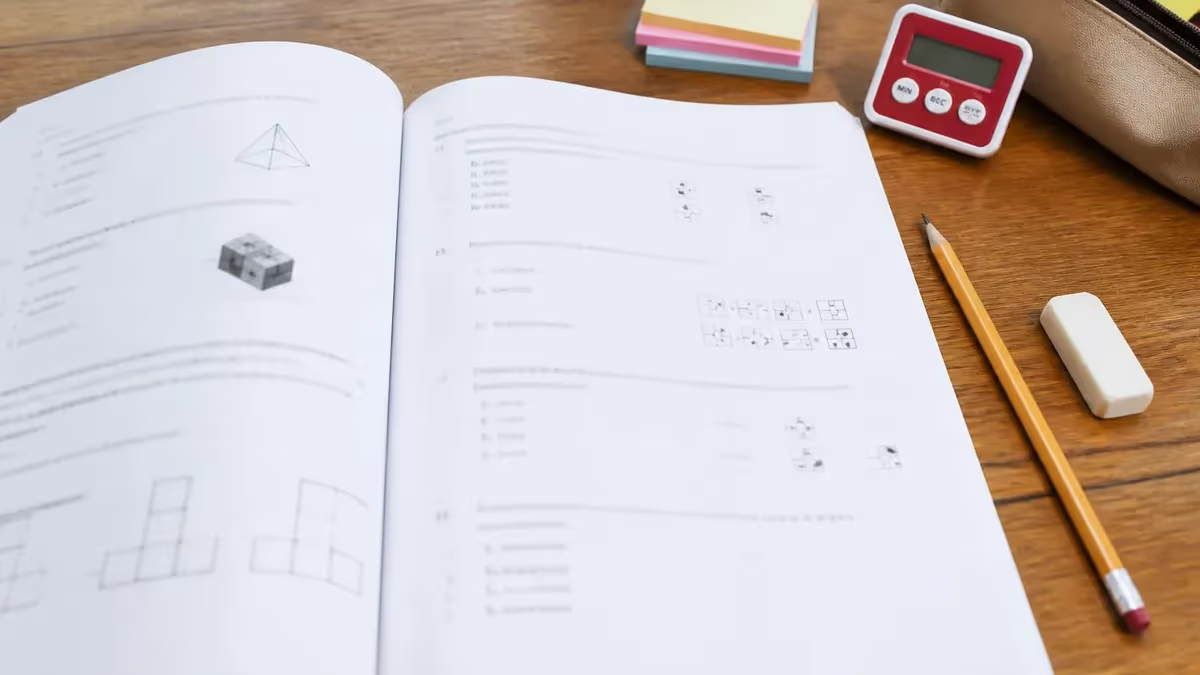
The drug test is one piece of a comprehensive hiring process. The written exam—often the CPS Firefighter Test—is typically the first major hurdle, testing math, reading comprehension, mechanical aptitude, and spatial reasoning. Passing that exam is what gets you far enough in the process to reach the medical exam and drug screen.
A positive result on the written exam followed by disqualification at the drug test is a genuinely painful outcome—you've invested time and energy in an application that ends preventably. The best approach is to address the drug test requirement early in your planning, well before you submit your application.

- +Validates your knowledge and skills objectively
- +Increases job market competitiveness
- +Provides structured learning goals
- +Networking opportunities with other certified professionals
- −Study materials can be expensive
- −Exam anxiety can affect performance
- −Requires dedicated preparation time
- −Retake fees apply if you don't pass
Pros and Cons at a Glance
| Pros | Cons |
|---|---|
| Validates your knowledge and skills objectively | Study materials can be expensive |
| Increases job market competitiveness | Exam anxiety can affect performance |
| Provides structured learning goals | Requires dedicated preparation time |
| Networking opportunities with other certified professionals | Retake fees apply if you don't pass |

Sample CPS Firefighter Test Practice Questions
Try these questions from our free CPS Firefighter Test practice tests. The correct answer and an explanation follow each question.
A firefighter needs to carry a 28-foot extension ladder alone. To maintain balance and stability with the least amount of effort, the firefighter should position their shoulder at what point on the ladder?
- A. At the ladder's marked center point or balance point.
- B. Approximately one-third of the way from the base.
- C. Exactly at the halfway mark of the first section.
- D. As close to the tip of the ladder as possible.
Answer: A. At the ladder's marked center point or balance point.
To balance an object for a single-person carry, it must be supported at its center of gravity. This is the point where the object's weight is evenly distributed on all sides. Carrying the ladder at this balance point prevents it from tipping forward or backward, allowing for a more stable and less strenuous carry.
A firefighter must carry two 50-foot sections of 1.75-inch hose up three flights of stairs. If each 50-foot section weighs 28 pounds when empty, what is the total weight of the hose the firefighter is carrying?
- A. 28 pounds
- B. 84 pounds
- C. 56 pounds
- D. 112 pounds
Answer: C. 56 pounds
The question asks for the total weight of the two sections of hose being carried. Multiply the weight of one section by the number of sections: 28 pounds/section * 2 sections = 56 pounds. The number of stairs is extra information not needed for the calculation.
A training officer says: 'To advance a charged 2½-inch line, the nozzle operator grips the nozzle, the backup firefighter positions at the hip, and a third member feeds slack. Minimum crew for this evolution is three members.' What is the minimum crew size stated for this evolution?
- A. Two members
- B. Four members
- C. Five members
- D. Three members
Answer: D. Three members
The training officer explicitly stated the minimum crew for this hose advancement is three members.
A firefighter's protective gear weighs 45 pounds. If a full crew of 8 firefighters suits up for a call, what is the total combined weight of all gear?
- A. 320 lbs
- B. 340 lbs
- C. 360 lbs
- D. 380 lbs
Answer: C. 360 lbs
Multiply the weight per person by the number of crew members: 45 × 8 = 360 pounds total.

Prepare for the CPS Firefighter Written Exam
The drug test is a hard requirement you need to plan around—but the written exam is the first major test you'll face in the hiring process. The CPS Firefighter Test covers math, reading comprehension, mechanical aptitude, and in some versions, memory and observation tasks. Solid preparation on the written exam gets you to the rest of the process.
Start with a diagnostic practice test to identify your weakest areas, then focus your study time there. The math section trips up many candidates who haven't worked with fractions, ratios, and percentages in years—consistent practice makes it manageable. Give yourself enough time before the exam to work through multiple full practice sets under timed conditions.
About the Author

Educational Psychologist & Academic Test Preparation Expert
Columbia University Teachers CollegeDr. Lisa Patel holds a Doctorate in Education from Columbia University Teachers College and has spent 17 years researching standardized test design and academic assessment. She has developed preparation programs for SAT, ACT, GRE, LSAT, UCAT, and numerous professional licensing exams, helping students of all backgrounds achieve their target scores.
Join the Discussion
Connect with other students preparing for this exam. Share tips, ask questions, and get advice from people who have been there.
View discussion (7 replies)