
CPR Scenarios: Real-Life Practice Cases for Adult, Child, and Infant Emergencies
Master CPR scenarios with real-world cases covering adult, child, and infant emergencies. Practice decision-making with ACLS algorithm walkthroughs 💡
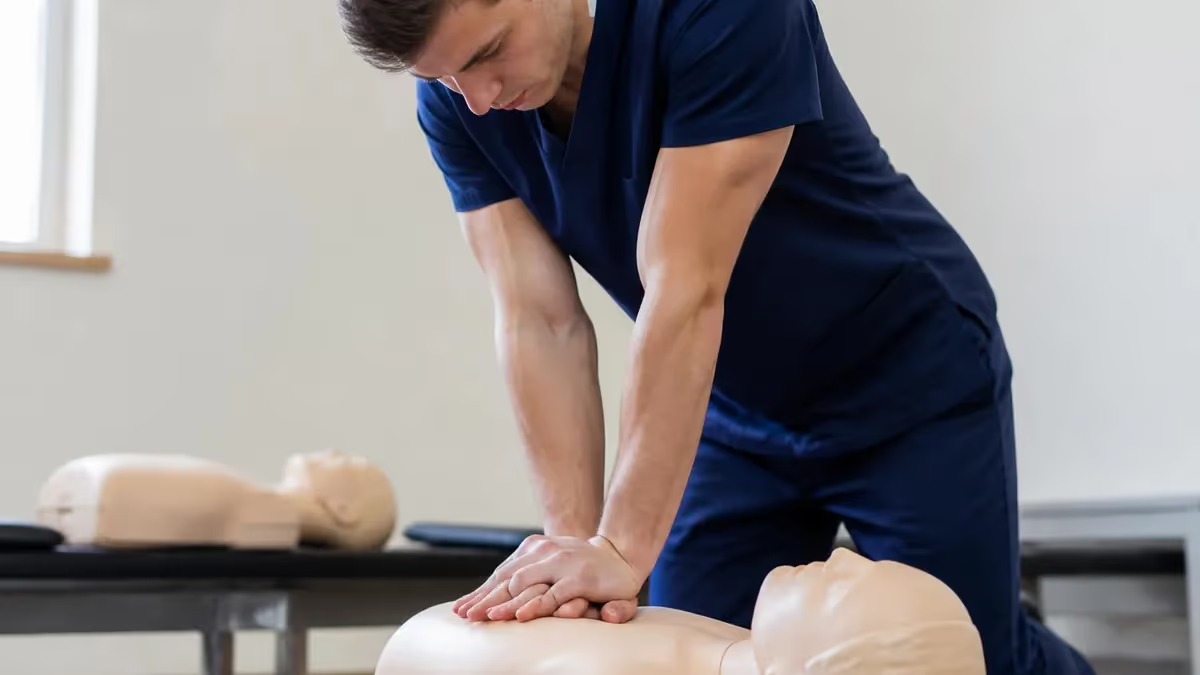
CPR scenarios are the bridge between memorizing compression depths and actually saving a life when a stranger collapses in front of you at the grocery store. Most certification courses spend hours on the acls algorithm, ratio numbers, and equipment names, but the part students forget fastest is how to translate that knowledge into action when the room is chaotic, the patient is unresponsive, and a panicked bystander is shouting for help. Working through realistic case studies is how that gap closes.
The value of a scenario is that it forces sequencing. You have to decide what comes first: shake and shout, call 911, check breathing, start compressions, or send someone for an AED. Real arrests do not pause while you remember the next step. The 2025 American Heart Association guidelines emphasize that early high-quality CPR and rapid defibrillation roughly double survival rates for witnessed cardiac arrests, but only when responders act inside the first two minutes.
This guide walks you through twelve common CPR scenarios drawn from National CPR Foundation curricula, AHA case banks, and emergency room debriefs. You will see adult sudden cardiac arrest at home, infant cpr for a choking baby, drowning rescues, opioid overdose response, and post-resuscitation positioning. Each case includes the decisions a lay rescuer or healthcare professional should make, the common mistakes that delay care, and the moment when an AED changes everything.
The scenarios also illustrate why life support has become a layered system rather than a single skill. Basic Life Support handles the first link in the chain, Advanced Cardiac Life Support adds medications and rhythm interpretation, and pals certification adds the pediatric-specific dosing and equipment that children require. Knowing where you fit in that chain prevents the freezing that kills bystander response.
Even if you have no medical background, you are the most important person in any cardiac arrest because you are the one who is there. Surveys show fewer than 40 percent of out-of-hospital arrests receive bystander CPR, and survival without it drops about 10 percent for every minute that passes. Walking through scenarios builds the muscle memory that prevents hesitation.
You will also see that not every scenario ends in resuscitation. Some end with recognizing that the person is breathing normally and placing them in a recovery position. Others end with continued compressions until paramedics arrive. The skill is not just CPR itself — it is matching the right response to the right situation, every time.
Use this article as a training companion. Read each scenario, picture yourself in the room, and rehearse your response out loud. That mental rehearsal is one of the most evidence-backed ways to improve real-world performance, and it costs nothing but a few minutes of focused practice.
CPR Scenarios by the Numbers

Adult Sudden Cardiac Arrest Scenarios
A 52-year-old man drops during a treadmill workout. He is unresponsive, not breathing normally. You shout for help, send someone to grab the AED on the wall, and begin compressions at 100-120 per minute while a second rescuer prepares the pads.
A spouse calls 911 after her husband collapses watching television. Dispatcher coaches hands-only CPR. You arrive as a neighbor responder, confirm pulselessness, and continue compressions until EMS arrives with manual defibrillation and the acls algorithm.
A diner slumps over after complaining of chest pressure. Staff initiate the emergency action plan, retrieve the AED kept behind the host stand, and rotate compressors every two minutes to maintain high-quality chest recoil and adequate rate.
A coworker is found unresponsive in a conference room. You verify the scene is safe, check responsiveness with a shoulder tap and shout, then assign roles: one calls 911, one retrieves the AED, one begins compressions immediately.
Pediatric scenarios run on a different mental script than adult ones, and the differences are precisely what trip up new rescuers. Children and infants are far more likely to arrest from a respiratory cause — choking, drowning, severe asthma, or airway obstruction — than from a primary cardiac rhythm problem. That means infant cpr emphasizes restoring breathing and oxygenation as quickly as compressions, and the compression-to-ventilation ratio shifts to 30:2 for one rescuer or 15:2 for two trained rescuers in pediatric BLS.
Picture scenario E: a 9-month-old at a family barbecue suddenly cannot cry, makes a high-pitched wheeze, and turns dusky. The grandparent picks the baby up, panics, and slaps her on the back. The correct response is five back blows with the heel of the hand between the shoulder blades, then five chest thrusts with two fingers on the lower sternum, alternating until the object dislodges or the infant becomes unresponsive. Then CPR begins.
Scenario F involves a 4-year-old pulled from a backyard pool. She is limp, blue, and not breathing. Rescue breaths come first in drowning scenarios because hypoxia is the root cause. Two slow breaths that make the chest visibly rise, then 30 compressions, then repeat. You continue this cycle until the child gasps, vomits, or paramedics arrive. Anyone with pals certification will recognize this as a textbook pediatric BLS sequence.
Scenario G shifts to a school setting where a 7-year-old with a known peanut allergy collapses minutes after eating a cookie. The respiratory rate is falling, lips are swelling, and an EpiPen is in the nurse's office. The cascade is administer epinephrine, call 911, monitor airway, and prepare to start CPR if breathing stops. This is where recognition speed matters more than compression technique.
Scenario H is a tragically common one: an infant found unresponsive in a crib. Sudden Unexpected Infant Death events still require a full resuscitation attempt unless rigor or lividity is obvious. Compressions on an infant use two fingers or two thumbs encircling the chest, depth one-and-a-half inches, rate 100-120. Many parents freeze at this scene, which is why hands-on infant CPR practice is invaluable.
Scenario I tests your judgment with a 12-year-old. Pediatric algorithms apply until puberty, but the AED uses adult pads if pediatric pads are unavailable — never delay shock delivery to hunt for the right pad set. Place adult pads in an anterior-posterior position on small chests to avoid overlap, and resume compressions immediately after every shock.
The unifying lesson across pediatric scenarios is that you cannot wait for certainty. If a child is not responding and not breathing normally, begin CPR. The cost of starting on a child who turns out to be merely deeply asleep is minor; the cost of waiting on a child in true arrest is catastrophic.

CPR Practice Test Questions
Prepare for the CPR Cardiopulmonary Resuscitation Practice exam with our free practice test modules. Each quiz covers key topics to help you pass on your first try.
CPR Basic CPR
CPR Exam Questions covering Basic CPR. Master CPR Test concepts for certification prep.
CPR and First Aid
Free CPR Practice Test featuring and First Aid. Improve your CPR Exam score with mock test prep.
CPR (Cardiopulmonary Resuscitation) Adult ...
CPR Mock Exam on (Cardiopulmonary Resuscitation) Adult CPR and AED Usage. CPR Study Guide questions to pass on your first try.
CPR (Cardiopulmonary Resuscitation) Airway...
CPR Test Prep for (Cardiopulmonary Resuscitation) Airway Obstruction and Choking. Practice CPR Quiz questions and boost your score.
CPR (Cardiopulmonary Resuscitation) Cardio...
CPR Questions and Answers on (Cardiopulmonary Resuscitation) Cardiopulmonary Emergency Recognition. Free CPR practice for exam readiness.
CPR (Cardiopulmonary Resuscitation) Child ...
CPR Mock Test covering (Cardiopulmonary Resuscitation) Child and Infant CPR. Online CPR Test practice with instant feedback.
CPR (Cardiopulmonary Resuscitation) High-P...
Free CPR Quiz on (Cardiopulmonary Resuscitation) High-Performance Team Dynamics. CPR Exam prep questions with detailed explanations.
CPR (Cardiopulmonary Resuscitation) Legal ...
CPR Practice Questions for (Cardiopulmonary Resuscitation) Legal and Ethical Considerations. Build confidence for your CPR certification exam.
CPR for Specific Populations
CPR Test Online for for Specific Populations. Free practice with instant results and feedback.
CPR Airway & Breathing Management
CPR Exam Questions covering Airway & Breathing Management. Master CPR Test concepts for certification prep.
CPR Assessment & Recognition of Cardiac Ar...
Free CPR Practice Test featuring Assessment & Recognition of Cardiac Arrest. Improve your CPR Exam score with mock test prep.
CPR Chest Compressions & Defibrillation
CPR Mock Exam on Chest Compressions & Defibrillation. CPR Study Guide questions to pass on your first try.
CPR Post-Resuscitation Care & Recovery
CPR Test Prep for Post-Resuscitation Care & Recovery. Practice CPR Quiz questions and boost your score.
What Does AED Stand For in Real Scenarios?
What does aed stand for? Automated External Defibrillator — a device that analyzes the heart rhythm and delivers a shock only if a shockable rhythm is detected. In a witnessed adult arrest, the AED is your single most powerful tool. Survival from ventricular fibrillation can exceed 70 percent when defibrillation occurs inside three minutes of collapse.
The scenario flow is simple: turn on the device, expose the bare chest, apply pads as pictured, let the AED analyze, and clear the patient before delivering a shock. Resume compressions immediately for two more minutes before the next rhythm check. Do not wait for EMS to arrive before opening the AED case.
Should You Train with Scenarios or Stick to Skills Drills?
- +Scenarios build decision-making speed, not just hand placement
- +Mental rehearsal improves real-world bystander response rates
- +Forces integration of 911 calling, AED use, and compressions
- +Reveals weak spots like role assignment and crowd control
- +Mirrors how certification exams now test competency
- +Reduces freezing by making the first 60 seconds automatic
- +Teaches when not to start CPR (obvious death, DNR documents)
- −Requires more class time than rote skills practice
- −Quality varies by instructor experience and scenario realism
- −Can feel awkward without a high-fidelity manikin
- −Stress inoculation is limited without unpredictable elements
- −Skill retention still degrades without quarterly refreshers
- −Some learners over-script and struggle with real chaos
- −Group dynamics can let quieter students hide and not practice

CPR Scenario Response Checklist
- ✓Confirm the scene is safe before approaching the patient
- ✓Tap and shout to check responsiveness within five seconds
- ✓Call 911 or assign a specific bystander by name and clothing
- ✓Send a second person for the nearest AED immediately
- ✓Check for normal breathing for no more than ten seconds
- ✓Begin compressions at 100-120 per minute and two inches deep
- ✓Allow full chest recoil between every single compression
- ✓Rotate compressors every two minutes to prevent fatigue decline
- ✓Apply AED pads as soon as the device arrives, no delay
- ✓Resume compressions immediately after every shock delivered
- ✓Hand off to EMS with a clear SAMPLE history summary
- ✓Debrief with your team afterward to capture lessons learned
If you are unsure, start compressions
The 2025 AHA guidelines explicitly state that lay rescuers should not delay CPR to perform a detailed pulse check. If the patient is unresponsive and not breathing normally, begin compressions within ten seconds of recognition. Agonal gasps are not normal breathing — they are a sign of impending death and demand immediate CPR.
Special circumstance scenarios test the edges of your training and force you to apply judgment beyond the standard acls algorithm. Drowning is the classic example. Unlike sudden cardiac arrest, drowning arrests are hypoxic from the start, meaning the lungs and bloodstream are oxygen-starved before the heart stops. The corrected sequence is five rescue breaths first if you are trained, then begin compressions. Hands-only CPR is acceptable if you are untrained, but ventilation matters here in a way it does not for an adult collapsing from a heart attack.
Opioid overdose scenarios have exploded in frequency. A 24-year-old found pulseless in a bathroom with constricted pupils and a syringe nearby almost certainly needs both naloxone and CPR. Administer intranasal naloxone if available, begin CPR if there is no pulse, and continue both until breathing returns or paramedics take over. Naloxone alone will not restart a heart that has already arrested — that is a critical scenario insight many bystanders miss.
Hypothermic arrest changes everything about resuscitation. A skier dug from an avalanche with a core temperature of 78 degrees Fahrenheit may be in a metabolically protected state. You continue CPR longer than usual, transport to a facility with rewarming capability, and remember the maxim: nobody is dead until they are warm and dead. Defibrillation may be unsuccessful below 86 degrees but should still be attempted once.
Pregnancy in the third trimester demands a left lateral tilt or manual uterine displacement to relieve aortocaval compression during compressions. The gravid uterus crushes the inferior vena cava when the patient is supine, reducing venous return and making compressions less effective. A bystander holds the abdomen to the patient's left while you compress in the center of the chest, slightly higher than the standard adult landmark.
Trauma arrest from major bleeding requires hemorrhage control first. Compressions on a patient who has bled out will not generate perfusion. Pack the wound, apply a tourniquet for limb bleeding, then begin CPR if there is still no pulse. The scene safety check matters more here than in any other scenario because many trauma arrests involve ongoing threats.
Electrical injury scenarios begin with confirming the power source is off. Never touch a patient still in contact with live current. Once safe, expect arrhythmias including ventricular fibrillation — the AED is essential. Also assess for entry and exit burns, which indicate the path of current and the likelihood of deep tissue damage and renal complications.
Finally, the post-resuscitation scenario matters as much as the arrest itself. Once you achieve return of spontaneous circulation, place the patient in the position recovery taught in your course — on their side, top knee bent forward, lower arm extended, airway monitored. This protects the airway from vomit and tongue obstruction while you wait for EMS transport to definitive care.
Agonal gasps — slow, irregular, snoring or gurgling breaths — appear in roughly 40 percent of cardiac arrests and are routinely mistaken for normal breathing. They are a death rattle, not recovery. If you see them, begin compressions immediately. Hesitating to confirm normal breathing has cost lives in documented scenarios reviewed by EMS quality assurance teams.
Practicing CPR scenarios at home is more effective than most people realize, and it does not require expensive equipment. The fundamental principle is mental rehearsal combined with physical movement. Pick a scenario from this article, read it out loud, then physically walk through your response in your living room — point to where you would call 911, where the AED would be, and where you would kneel relative to the patient. Sports psychologists call this visualization plus motor rehearsal, and emergency response literature confirms it improves real-world performance.
A pillow on the floor or a yoga block makes a reasonable compression target for practice. Set a metronome app to 110 beats per minute and compress in time, focusing on full release between each push. Two minutes is one full CPR cycle before AED reanalysis, and most untrained adults are surprised at how fatiguing two minutes of correct-depth compressions actually is. That fatigue is exactly why scenarios train rotation between rescuers.
Family scenario drills work especially well if you have children. Pick a Sunday afternoon, gather everyone, and run through a choking scenario for an infant, an adult collapse in the kitchen, and an unresponsive teen in a bedroom. Assign roles each round so every family member practices calling 911 and locating the home AED if you own one. The goal is automaticity, not perfection.
Online scenario banks from sources like the national cpr foundation and AHA offer free case studies you can read and answer alone. Many include branching decisions where wrong answers reveal what would have happened — these are particularly effective for building the pattern recognition that experienced clinicians develop over years of real cases. Spend fifteen minutes a week and your competence compounds steadily.
Workplace scenario drills are mandatory in many industries but optional in others. If you work in an office, propose a quarterly drill to your safety committee. Coordinate with the building's AED program if one exists, and time the response from collapse-recognition to first shock. Most untrained offices clock above six minutes, and the goal is under three. The improvement curve with practice is steep and rewarding.
The CPR we are practicing here is the lifesaving skill, and the time you invest in scenario training translates directly into someone's mother, child, or coworker walking out of a hospital instead of a morgue.
End every practice session with the same closing reflection: what would I do differently next time, and what part felt automatic? Capturing those answers in a small notebook builds the same after-action review habit that special operations medics use to maintain peak readiness. Your competence is a renewable resource, and scenario practice is how you renew it.
Final preparation for any CPR scenario comes down to three habits: keep your certification current, rehearse decision-making more than mechanics, and know where the AEDs in your daily environment are located. Certification cards typically expire every two years, and skill decay studies show measurable performance drops as early as three months post-class. A short monthly refresher video or app-based scenario drill keeps you sharp without requiring a full re-certification course.
Mechanics matter, but in real scenarios the decisions matter more. Knowing the exact compression depth is useless if you spend two minutes deciding whether the patient is really in arrest. Drill the recognition step until it takes under ten seconds. Drill the role assignment step until it is reflexive. The compressions themselves are the easiest part of CPR — your hands will do what they have been trained to do once you commit to acting.
Map the AEDs in your life. Most U.S. airports, gyms, schools, and shopping malls have publicly accessible AEDs, but you have probably never noticed them. Spend one week consciously scanning for the green AED sign wherever you go. Apps like PulsePoint AED in many cities crowdsource AED locations and can route you to the nearest device in an emergency. Knowing the location shaves the most critical minute off your response time.
Build a scenario response team in your household and workplace. In a real arrest, one person cannot do everything well. The strongest performance comes from teams of three or four with pre-assigned roles: a compressor, a ventilator or AED operator, a 911 communicator, and a crowd manager or family liaison. Run through these roles once a quarter even informally over dinner.
Recognize your own emotional responses. Many rescuers report a shaking, nauseated, hyper-focused state during a real arrest that they did not experience in training. This is the catecholamine surge of acute stress, and it is normal. Slow your breathing for three seconds, name the next action out loud, and your motor skills will return. Naming actions verbally — quote, I am calling 911 now, end quote — is a documented technique that prevents skipping steps.
Plan for the aftermath. Even successful resuscitations are traumatic. Critical incident stress debriefing is offered free in many EMS systems for lay rescuers involved in major incidents. Talk to someone within 72 hours if you participated in a real arrest. Suppressing the experience increases the chance of avoidance behavior that prevents future bystander action — exactly the opposite of the resilient response we want to build.
The single most important practical tip is this: act. The statistically worst response to a cardiac arrest is doing nothing while waiting for someone more qualified. Your imperfect CPR is dramatically better than perfect CPR that starts five minutes later when the paramedics arrive. Every scenario in this guide reinforces the same lesson: recognize, call, compress, defibrillate. In that order, every time, without delay.
CPR Scenario Flashcards
🫁 Adult vs. child vs. infant: how do compression-to-ventilation ratios change across CPR scenarios?
A single rescuer uses 30 compressions to 2 breaths for adults, children, and infants. With two rescuers, children and infants switch to 15:2. These are the breaths in CPR across the main scenarios tested in certification.
START CPR TECHNIQUES PRACTICE TEST🔌 In a witnessed adult arrest scenario, when do you deliver the first AED shock?
Attach the AED as soon as it arrives, stop CPR only while it analyzes, and shock immediately if it advises one. Resume compressions at once after the shock. Minimizing pauses around the shock improves survival.
START ADULT CPR AND AED PRACTICE TEST🚸 Infant choking scenario: what do you do when the infant becomes unresponsive?
For a conscious choking infant give 5 back blows then 5 chest thrusts, repeating until relieved. If the infant goes unresponsive, start CPR and check the mouth for the object before each set of breaths. This is a core scenarios-and-answers-for-choking case.
START CHOKING PRACTICE TEST📐 What depth and rate define high-quality compressions in any CPR scenario?
Push at a rate of 100 to 120 compressions per minute. Depth is at least 2 inches for adults, about 2 inches for children, and about 1.5 inches for infants. Allow full chest recoil between each compression.
START CHEST COMPRESSIONS PRACTICE TEST🧭 How do ACLS algorithms guide a mock code scenario?
ACLS algorithms route the team by rhythm: shockable rhythms (VF/pVT) get defibrillation plus epinephrine and amiodarone, while non-shockable rhythms (asystole/PEA) get epinephrine and a hunt for reversible causes. These ACLS scenarios for mock codes build on the BLS foundation.
START TEAM DYNAMICS PRACTICE TEST🔁 In an ACLS scenario, how often do you give epinephrine and reassess the rhythm?
Give epinephrine 1 mg every 3 to 5 minutes during cardiac arrest. Reassess the rhythm and check a pulse about every 2 minutes, which is also when you rotate the compressor to prevent fatigue. This cadence anchors most ACLS scenario workbook cases.
START EMERGENCY RECOGNITION PRACTICE TEST🤰 Pregnant patient arrest: what changes in this CPR scenario?
Perform standard high-quality CPR and, for an obviously pregnant patient, apply continuous manual left uterine displacement to relieve pressure on the vena cava. Hand placement stays on the center of the chest. Prepare early for possible resuscitative hysterotomy in advanced settings.
START SPECIAL POPULATIONS PRACTICE TEST💊 Opioid overdose scenario: when is naloxone appropriate alongside CPR?
If the person is unresponsive with no normal breathing but has a pulse, give rescue breaths and naloxone. If there is no pulse, start full CPR; naloxone can be given but never delays compressions or defibrillation. This is a common recognition scenario in CPR courses.
START RECOGNITION PRACTICE TEST⏱️ In a drowning scenario for a child, why do rescue breaths come first?
Drowning causes a breathing problem before the heart stops, so for a child or infant you give 2 initial rescue breaths and prioritize ventilation. Begin CPR with 30 compressions and 2 breaths if there is no pulse. Call for help and retrieve an AED as soon as possible.
START CHILD AND INFANT CPR PRACTICE TEST🛑 When can a lay rescuer stop CPR in a scenario?
Stop only when EMS takes over, the scene becomes unsafe, you are too exhausted to continue, the patient shows clear signs of life, or an AED tells you to pause for analysis. Lay rescuers should not interrupt compressions to repeatedly check for a pulse.
START ASSESSMENT PRACTICE TESTCPR Questions and Answers
CPR Card Lookup: How to Verify, Replace, and Access Your CPR Certification in 2026
AHA CPR: What It Is, Which Course You Need, and How to Get Certified
Adult CPR: Complete Step-by-Step Guide to Hands-Only and Standard CPR in 2026
CPR - Cardiopulmonary Resuscitation: Complete Study Guide 2026
Inappropriate CPR Songs: What Not to Play, Why It Matters, and Better Beat-Per-Minute Alternatives
Official Resources
- American Heart Association CPR & ECC publishes the BLS, ACLS, and PALS guidelines and the AHA ACLS algorithms that these scenarios follow.
- American Red Cross CPR Training offers the Red Cross certification courses whose scenario sets cover adult, child, and infant emergencies.
About the Author

Registered Nurse & Healthcare Educator
Johns Hopkins University School of NursingDr. Sarah Mitchell is a board-certified registered nurse with over 15 years of clinical and academic experience. She completed her PhD in Nursing Science at Johns Hopkins University and has taught NCLEX preparation and clinical skills courses for nursing students across the United States. Her research focuses on evidence-based exam preparation strategies for healthcare certification candidates.
Join the Discussion
Connect with other students preparing for this exam. Share tips, ask questions, and get advice from people who have been there.
View discussion (5 replies)