
CPR Ratio for Child: Complete Guide to Compressions, Breaths, and Pediatric Resuscitation in 2026 October
Master the CPR ratio for child: ✍🏼 30:2 single rescuer, 15:2 two rescuers. Learn compression depth, rate, AED use, and pediatric life support steps.
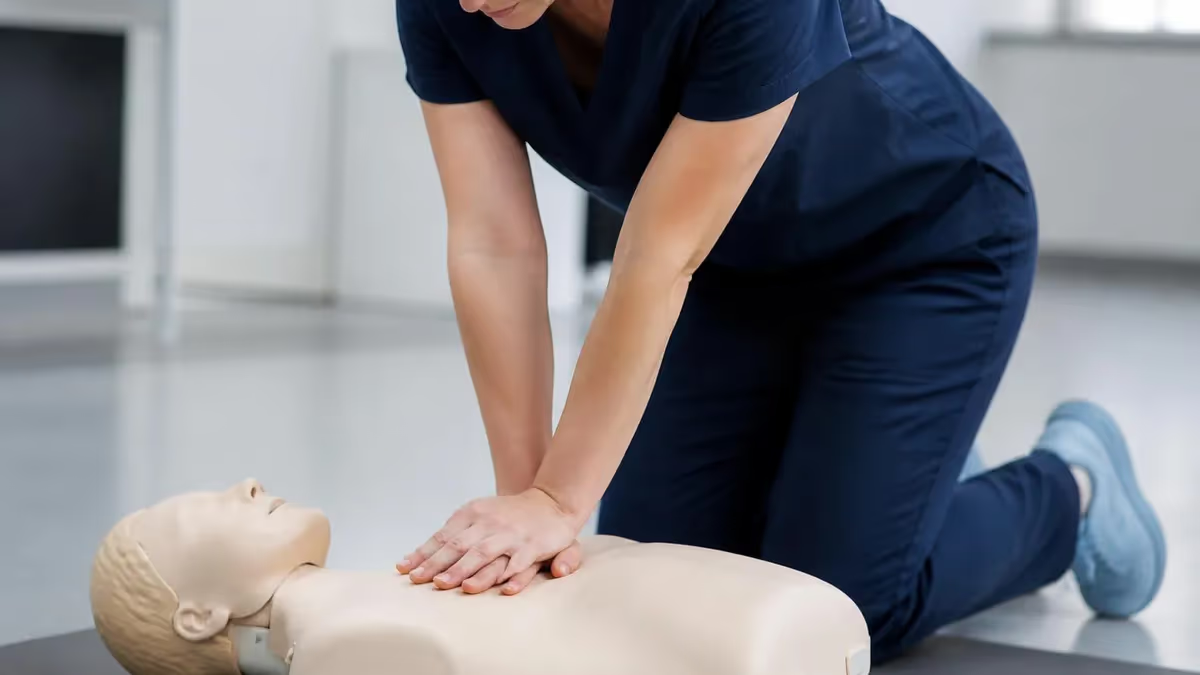
The correct cpr ratio for child is one of the most important numbers any rescuer, parent, teacher, coach, or healthcare provider can commit to memory. For a single lay rescuer, the ratio is 30 compressions to 2 rescue breaths, the same as adult CPR. For two trained healthcare providers using the pediatric acls algorithm framework, the ratio shifts to 15 compressions to 2 breaths to deliver more oxygen-rich blood to a child whose cardiac arrest is most often respiratory in origin.
Understanding why this ratio exists matters as much as memorizing it. Children rarely collapse from primary cardiac events the way adults do. Instead, pediatric arrest usually begins with a breathing problem such as drowning, choking, asthma, or trauma. Because hypoxia is the root cause, increasing the proportion of rescue breaths with a partner improves survival and neurologic outcomes. This is the foundation behind every modern pediatric resuscitation guideline taught today.
The American Heart Association defines a child for CPR purposes as anyone from age one to the onset of puberty, roughly 12 to 14 years old, recognized by chest or underarm hair development in males and breast development in females. Once puberty is evident, adult CPR ratios and depths apply. Below age one, infant cpr techniques take over with two fingers or the two-thumb encircling hands technique and special airway considerations.
This guide walks you through every dimension of the pediatric CPR ratio: compression depth, rate, hand placement, breath volume, AED pad selection, and how the algorithm changes when help arrives. We will also explore how the ratio fits into the broader chain of survival, from early recognition and activation of emergency response through advanced life support handoff in the emergency department or pediatric intensive care unit.
If you have never performed CPR on a child, the idea can feel terrifying. The good news is that the steps are simple, repeatable, and forgiving. Pushing too hard is far better than not pushing at all, and any compression is better than none. Bystander CPR doubles or triples the chance of survival, and the longer it takes to start, the lower the odds of a meaningful recovery. Hesitation is the real enemy.
By the end of this guide, you will know exactly when to use 30:2 versus 15:2, how to coordinate breaths with compressions, what to do if you are alone versus part of a team, and how to integrate an AED into your response. You will also understand how the cpr ratio for child connects to pals certification, BLS provider courses, and the broader pediatric advanced life support framework used in hospitals and ambulances every day.
Whether you are a parent learning the basics, a daycare worker renewing certification, a school nurse refreshing protocols, or a paramedic preparing for recertification, this resource gives you the depth and detail you need. Bookmark it, share it with colleagues, and pair it with hands-on practice to build the muscle memory that turns knowledge into life-saving action when seconds count.
Pediatric CPR by the Numbers

Step-by-Step Pediatric CPR Sequence
Scene Safety and Responsiveness
Activate Emergency Response
Check Breathing and Pulse
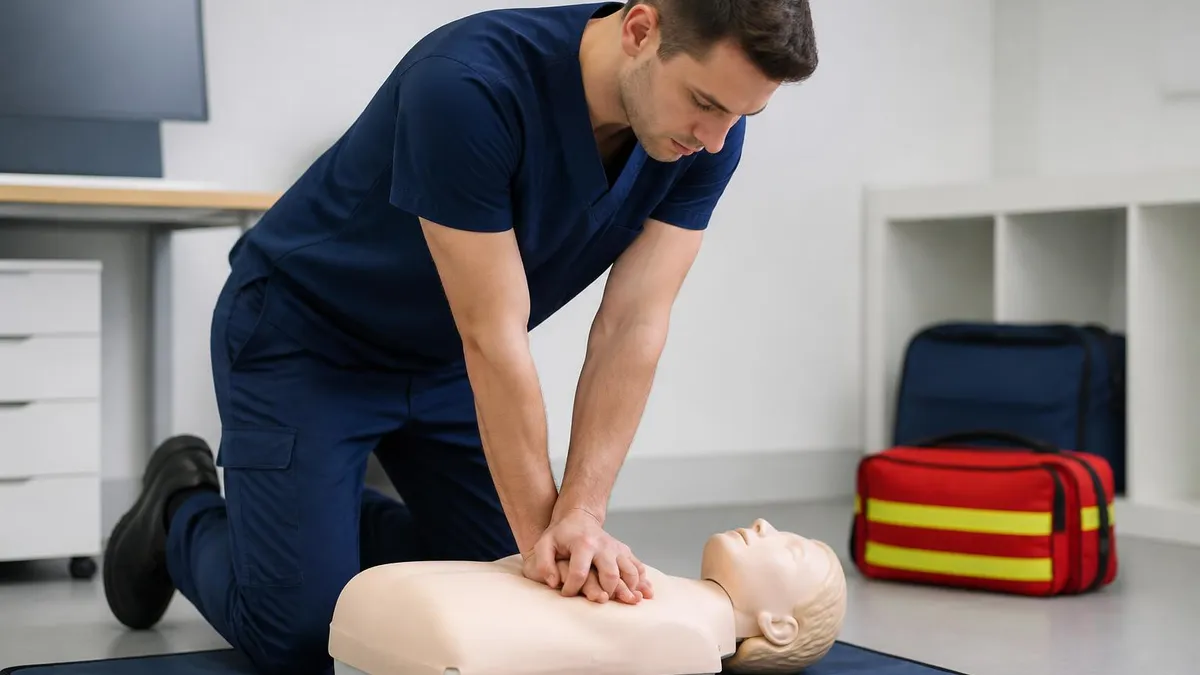
Begin Chest Compressions
Deliver Rescue Breaths
Attach AED and Continue
The 30:2 versus 15:2 distinction is the single most tested concept in pediatric CPR courses and the national cpr foundation curriculum. For lone rescuers without advanced training, 30 compressions followed by 2 breaths keeps the sequence simple and consistent across age groups, reducing cognitive load during a crisis. The same ratio applies whether you are working on a toddler, school-aged child, or adult, which is why the AHA standardized this number for single-rescuer scenarios across all age categories.
When two or more trained providers are present, the ratio drops to 15:2 for children and infants. This change reflects the pediatric pathophysiology of arrest. Because most pediatric arrests stem from respiratory failure, doubling the frequency of ventilations restores oxygenation faster while still maintaining adequate coronary and cerebral perfusion through near-continuous compressions delivered by a partner who can pause briefly for breaths.
The transition from 30:2 to 15:2 should happen the moment a second trained rescuer arrives and is ready to assist with ventilations using a bag-valve-mask or pocket mask. Communicate clearly: announce "switching to 15:2" so both providers stay synchronized. Switch compressor roles every two minutes to prevent fatigue, which is the leading cause of shallow, ineffective compressions that drop survival rates significantly.
Each cycle of 15 compressions should take roughly 9 to 10 seconds at a rate of 100 to 120 per minute. The two breaths that follow should each take about one second, delivered with just enough volume to make the chest visibly rise. Over-ventilation is a common error that increases intrathoracic pressure, reduces venous return to the heart, and lowers cardiac output during the very moments you are trying to restore it.
An advanced airway changes the rhythm entirely. Once an endotracheal tube, supraglottic airway, or i-gel device is in place, compressions become continuous at 100 to 120 per minute, and breaths are delivered asynchronously at one breath every 2 to 3 seconds, or roughly 20 to 30 breaths per minute. This represents a faster respiratory rate than older guidelines recommended and reflects evidence that pediatric patients benefit from more aggressive ventilation support.
Knowing when to apply which ratio comes from practice, not memorization alone. Manikin training during pals certification courses, simulation labs, and team-based code drills help providers internalize the timing so it becomes automatic. When real arrest happens, no one has time to think through ratios, depths, or rates. The muscle memory must already be there, ready to deploy without conscious effort.
Lay rescuers should not stress about switching ratios. Sticking with 30:2 throughout the entire resuscitation is perfectly acceptable and avoids confusion. What matters most is starting CPR fast, pushing hard and fast in the center of the chest, and continuing without interruption until professional help arrives with the equipment and training to take over advanced interventions.

CPR Practice Test Questions
Prepare for the CPR Cardiopulmonary Resuscitation Practice exam with our free practice test modules. Each quiz covers key topics to help you pass on your first try.
CPR Basic CPR
CPR Exam Questions covering Basic CPR. Master CPR Test concepts for certification prep.
CPR and First Aid
Free CPR Practice Test featuring and First Aid. Improve your CPR Exam score with mock test prep.
CPR (Cardiopulmonary Resuscitation) Adult ...
CPR Mock Exam on (Cardiopulmonary Resuscitation) Adult CPR and AED Usage. CPR Study Guide questions to pass on your first try.
CPR (Cardiopulmonary Resuscitation) Airway...
CPR Test Prep for (Cardiopulmonary Resuscitation) Airway Obstruction and Choking. Practice CPR Quiz questions and boost your score.
CPR (Cardiopulmonary Resuscitation) Cardio...
CPR Questions and Answers on (Cardiopulmonary Resuscitation) Cardiopulmonary Emergency Recognition. Free CPR practice for exam readiness.
CPR (Cardiopulmonary Resuscitation) Child ...
CPR Mock Test covering (Cardiopulmonary Resuscitation) Child and Infant CPR. Online CPR Test practice with instant feedback.
CPR (Cardiopulmonary Resuscitation) High-P...
Free CPR Quiz on (Cardiopulmonary Resuscitation) High-Performance Team Dynamics. CPR Exam prep questions with detailed explanations.
CPR (Cardiopulmonary Resuscitation) Legal ...
CPR Practice Questions for (Cardiopulmonary Resuscitation) Legal and Ethical Considerations. Build confidence for your CPR certification exam.
CPR for Specific Populations
CPR Test Online for for Specific Populations. Free practice with instant results and feedback.
CPR Airway & Breathing Management
CPR Exam Questions covering Airway & Breathing Management. Master CPR Test concepts for certification prep.
CPR Assessment & Recognition of Cardiac Ar...
Free CPR Practice Test featuring Assessment & Recognition of Cardiac Arrest. Improve your CPR Exam score with mock test prep.
CPR Chest Compressions & Defibrillation
CPR Mock Exam on Chest Compressions & Defibrillation. CPR Study Guide questions to pass on your first try.
CPR Post-Resuscitation Care & Recovery
CPR Test Prep for Post-Resuscitation Care & Recovery. Practice CPR Quiz questions and boost your score.
Compression Depth, Rate, and Technique for Child CPR
Compress at least one-third the depth of the chest, which is approximately 2 inches or 5 centimeters for most children. Going too shallow fails to generate adequate cardiac output, while excessive depth risks rib fractures, pneumothorax, or liver lacerations. Pediatric chests are more compliant than adults, so depth feedback devices on modern AEDs can help confirm you are reaching the target without overshooting.
Full chest recoil between compressions is just as critical as depth. Leaning on the chest between pushes prevents the heart from refilling with blood, dramatically reducing the effectiveness of each subsequent compression. Lift your hands slightly without losing contact, allowing the chest wall to spring back fully before pressing down again. This technique sustains coronary perfusion pressure throughout the resuscitation.
Hands-Only CPR vs Standard CPR for Children
- +Standard CPR with breaths addresses the respiratory cause of most pediatric arrests
- +Rescue breaths restore oxygenation faster in hypoxic children
- +Two-rescuer 15:2 ratio doubles breath frequency for better outcomes
- +Trained providers can deliver bag-valve-mask ventilation effectively
- +Combined approach matches AHA pediatric guidelines and pals certification standards
- +Better neurologic outcomes when breaths are integrated from the start
- −Hands-only CPR is simpler for untrained bystanders to remember and perform
- −Mouth-to-mouth contact concerns can delay action without barrier devices
- −Pausing for breaths interrupts coronary perfusion pressure briefly
- −Excessive ventilation is a common error that worsens outcomes
- −Bag-valve-mask skills require regular practice to maintain proficiency
- −Untrained rescuers may struggle with airway positioning and seal technique
Pros and Cons at a Glance
| Pros | Cons |
|---|---|
| Standard CPR with breaths addresses the respiratory cause of most pediatric arrests | Hands-only CPR is simpler for untrained bystanders to remember and perform |
| Rescue breaths restore oxygenation faster in hypoxic children | Mouth-to-mouth contact concerns can delay action without barrier devices |
| Trained providers can deliver bag-valve-mask ventilation effectively | Pausing for breaths interrupts coronary perfusion pressure briefly |
| Combined approach matches AHA pediatric guidelines and pals certification standards | Excessive ventilation is a common error that worsens outcomes |
| Better neurologic outcomes when breaths are integrated from the start | Bag-valve-mask skills require regular practice to maintain proficiency |

Pediatric CPR Performance Checklist
- ✓Confirm scene safety before approaching the child
- ✓Check responsiveness with shoulder tap and loud verbal stimulus
- ✓Activate 911 and request an AED immediately
- ✓Check pulse and breathing for no more than 10 seconds
- ✓Position child on a firm, flat surface like the floor
- ✓Place hand or hands on the lower half of the sternum
- ✓Compress at least 2 inches at 100-120 per minute
- ✓Allow complete chest recoil between every compression
- ✓Deliver 2 breaths per cycle with visible chest rise
- ✓Switch compressor every 2 minutes to prevent fatigue
- ✓Apply AED with pediatric pads or attenuator if under age 8
- ✓Continue cycles until EMS arrives or child responds
Every Minute Without CPR Drops Survival by 10 Percent
Bystander CPR doubles or triples the chance of a child surviving cardiac arrest with intact neurologic function. Brain cells begin dying within 4 to 6 minutes without circulation. Starting compressions immediately, even imperfectly, is far better than waiting for trained help. Do not let fear of doing it wrong stop you from saving a life.
Automated external defibrillator use in children requires special consideration that every rescuer should understand before the moment of crisis arrives. So what does aed stand for? AED stands for automated external defibrillator, a portable device that analyzes heart rhythm and delivers a measured electrical shock if a shockable rhythm like ventricular fibrillation or pulseless ventricular tachycardia is detected. While pediatric arrest is more often non-shockable, having an AED ready can still save lives when shockable rhythms occur.
For children under 8 years old or weighing less than 55 pounds, use pediatric pads or activate the pediatric attenuator key that reduces the energy dose from the adult setting of 150 to 200 joules down to roughly 50 to 75 joules. If pediatric pads or an attenuator are unavailable, use adult pads rather than withholding defibrillation entirely. A potentially life-saving shock at full dose is better than no shock at all when the rhythm is shockable.
Pad placement for small children should follow the anterior-posterior position, with one pad on the center of the chest and one on the upper back between the shoulder blades. This prevents the two pads from touching each other on a small chest, which would short-circuit the current and waste the shock. For larger children, standard anterior-lateral placement on the upper right chest and lower left side works just as it does for adults.
The AED voice prompts will guide you through every step, including when to stand clear, when to deliver the shock, and when to resume CPR. Trust the device. It will not advise a shock unless a shockable rhythm is present, so you cannot accidentally harm a child by attaching it. Modern AEDs are designed for use by completely untrained bystanders and have been deployed successfully in schools, airports, gyms, and shopping centers worldwide.
Recovery position is rarely used during active resuscitation, but the position recovery becomes important once a child regains a pulse and is breathing adequately on their own. Place them on their side with the lower arm extended forward, upper leg bent for stability, and head tilted slightly back to keep the airway open. This prevents aspiration of vomit and maintains airway patency while you wait for EMS to transport.
Special situations like drowning, electrocution, trauma, or drug overdose alter the standard approach. Drowning victims benefit from immediate rescue breaths before compressions due to the hypoxic mechanism. Trauma patients require cervical spine protection during airway management. Electrocution victims may need prolonged resuscitation as the heart can sometimes restart after extended downtime. Knowing these nuances comes from formal training, not internet articles alone.
Family presence during resuscitation has become standard practice in many emergency departments and pediatric intensive care units. Allowing parents to witness the resuscitation, when a dedicated support person can guide them, helps closure regardless of outcome. As a lay rescuer, you may be performing CPR with the child's parents watching. Stay focused, communicate calmly, and remember that your actions are giving their child the best possible chance at life support and survival.
Always verify you are accessing legitimate AHA, Red Cross, or accredited medical training providers before enrolling in certification courses or trusting clinical content.
Formal certification transforms knowledge into confident action. The most common pediatric-focused course is pals certification, also known as Pediatric Advanced Life Support, offered by the American Heart Association. PALS builds on Basic Life Support skills and adds advanced airway management, IV and intraosseous access, rhythm recognition, medication dosing by weight, and team-based code management. It is required for pediatric nurses, emergency physicians, paramedics, and many pediatric hospital staff.
For lay rescuers, parents, teachers, and coaches, a Heartsaver CPR AED course covering adult, child, and infant resuscitation is the ideal starting point. These four-hour courses include hands-on manikin practice with instructor feedback, choking management, AED operation, and the differences between age groups. Most are available in person through community centers, hospitals, fire departments, and online with skills check-offs at local testing sites.
Healthcare providers typically need BLS for Healthcare Providers certification, which goes deeper into two-rescuer CPR, bag-valve-mask ventilation, pulse checks, and team dynamics. BLS is the foundation for ACLS and PALS and must be renewed every two years. The acls algorithm framework for adults parallels the PALS algorithm for children, with both emphasizing high-quality CPR, rhythm-based interventions, and reversible cause identification using the H's and T's mnemonic.
Online-only certifications without hands-on skills verification are not accepted by hospitals, employers, or licensing boards in most cases. Always verify that any course you take meets your employer's requirements before paying. Look for AHA, American Red Cross, ASHI, or other accredited providers with verifiable certification cards that include unique identifiers, expiration dates, and QR codes for instant verification by employers.
Recertification typically occurs every two years for BLS, PALS, and ACLS. Some employers require annual skills refreshers or mock code participation between formal renewals. Many providers find that frequent low-stakes practice through code simulations, manikin sessions, and online refresher modules maintains skills far better than waiting for the two-year cycle to come around again.
Beyond formal courses, family-focused programs like Friends and Family CPR teach the basics without offering a certification card. These shorter sessions are perfect for new parents, grandparents, babysitters, and anyone who interacts regularly with children. The information taught is the same evidence-based content from full certification courses, just delivered without the testing and credentialing component.
Whichever path you choose, the most important step is taking action. Sign up for a course this month. Practice hands-on at least once per year. Talk through scenarios with family members and coworkers. Keep AEDs and pocket masks accessible at home, in your car, and at your workplace. The cpr ratio for child is simple to memorize, but applying it under pressure requires preparation that only comes from training and repetition.
Practical preparation transforms abstract knowledge into life-saving reflexes. Start by walking through your home, workplace, and child's school to identify the nearest AED locations. Many states now require AEDs in schools, gyms, and public buildings. Download the PulsePoint AED app or similar registries that map AED locations near you. Knowing where to send a bystander to retrieve one shaves precious seconds off the response time during a real emergency.
Build a small home emergency kit that includes a pocket mask with one-way valve, disposable gloves, a flashlight, and a printed CPR reference card sized for your refrigerator or wallet. The pocket mask eliminates direct mouth-to-mouth contact, addressing the hygiene concern that causes many bystanders to skip rescue breaths. Practice opening and assembling your mask at least twice per year so you can deploy it without fumbling under stress.
Teach the basics to every family member who is old enough to learn, typically by age 9 or 10. Children can learn to call 911, push hard and fast in the center of the chest, and follow AED voice prompts. Some of the most heartwarming survival stories involve children performing CPR on parents or grandparents. Empowering kids with this knowledge builds confidence and removes the panic that paralyzes adults during emergencies.
Coordinate with your child's school, sports league, and daycare to verify their CPR and AED protocols. Ask whether staff are certified, when they last renewed, where the AED is located, and what their cardiac emergency response plan looks like. If gaps exist, advocate for training and equipment. Many insurance plans, workplace wellness programs, and community foundations subsidize CPR training costs for parents and caregivers.
Mental rehearsal is a surprisingly powerful preparation tool used by elite athletes, military personnel, and emergency responders. Spend five minutes visualizing yourself responding to a child collapse at the park, in your home, or at a family gathering. Walk through the steps: check safety, check responsiveness, call 911, send for AED, start compressions. Mental rehearsal primes your brain to act rather than freeze when reality strikes.
Stay current with guideline updates. The American Heart Association releases major guideline revisions roughly every five years, with focused updates between cycles. Subscribe to the AHA's email list or follow trusted medical education channels to learn about changes that affect your skills. Recent updates have refined respiratory rate recommendations, defibrillation energy doses, and post-resuscitation care protocols based on emerging research.
Finally, take care of yourself emotionally if you ever do perform CPR. Even successful resuscitations are traumatic to witness and participate in. Survivors of pediatric arrest sometimes have lasting deficits, and not all victims survive. Critical incident stress debriefings, employee assistance programs, peer support groups, and licensed therapists can help you process the experience. Your willingness to act made a difference, regardless of outcome, and that courage deserves recognition and support.
CPR Questions and Answers
CPR Card Lookup: How to Verify, Replace, and Access Your CPR Certification in 2026
AHA CPR: What It Is, Which Course You Need, and How to Get Certified
BLS CPR Course: Complete Guide to Basic Life Support Certification in 2026
Adult CPR: Complete Step-by-Step Guide to Hands-Only and Standard CPR in 2026

CPR - Cardiopulmonary Resuscitation: Complete Study Guide 2026
About the Author

Registered Nurse & Healthcare Educator
Johns Hopkins University School of NursingDr. Sarah Mitchell is a board-certified registered nurse with over 15 years of clinical and academic experience. She completed her PhD in Nursing Science at Johns Hopkins University and has taught NCLEX preparation and clinical skills courses for nursing students across the United States. Her research focuses on evidence-based exam preparation strategies for healthcare certification candidates.
Join the Discussion
Connect with other students preparing for this exam. Share tips, ask questions, and get advice from people who have been there.
View discussion (5 replies)