
Adult CPR Compression Rate: The Complete Guide to 100-120 BPM in 2026 October
Master the adult CPR compression rate of 100-120 BPM. 📝 Learn proper technique, depth, ratios, ACLS algorithm integration, and AED use in this complete
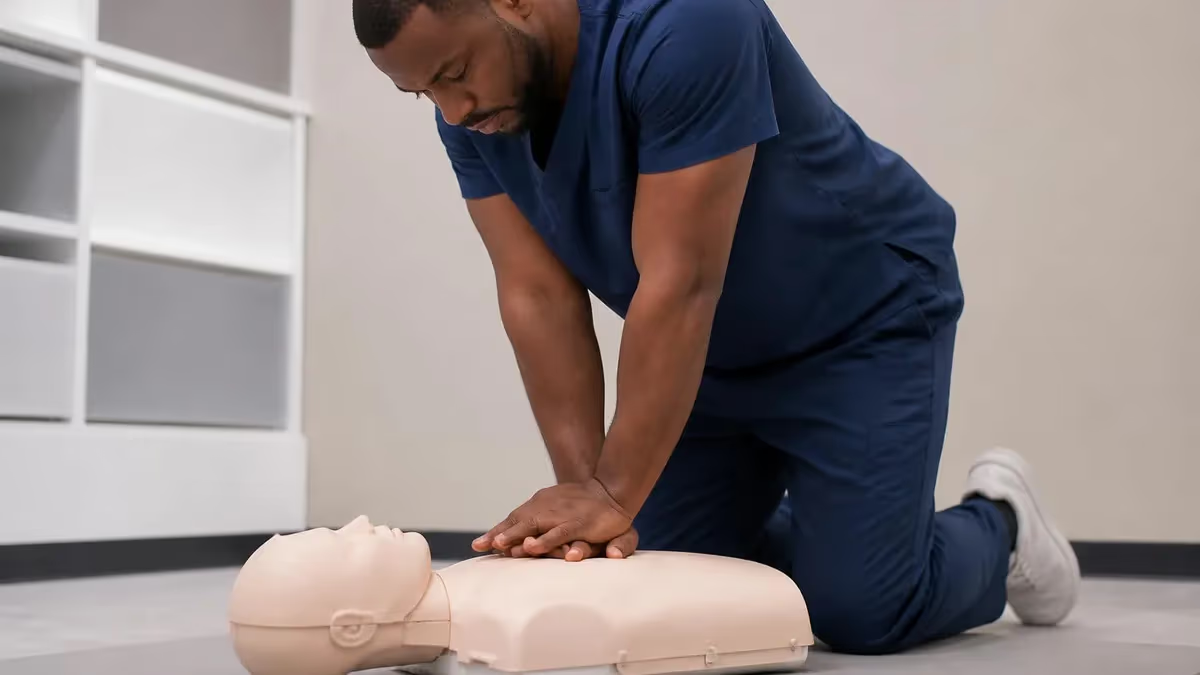
The adult CPR compression rate is one of the most critical metrics in resuscitation science, and getting it right can literally double a victim's chance of survival. Current American Heart Association guidelines mandate a compression rate of 100 to 120 compressions per minute for adult cardiac arrest victims, paired with a compression depth of at least 2 inches but no more than 2.4 inches. This narrow window, refined through decades of research and integrated into every modern acls algorithm, balances coronary perfusion pressure with adequate chest recoil between compressions.
Why this specific range? Studies published in Circulation demonstrate that compressions delivered below 100 per minute fail to generate sufficient forward blood flow, while rates exceeding 120 per minute compromise diastolic filling and reduce stroke volume. The sweet spot of 100-120 BPM produces optimal cerebral and coronary perfusion, which directly correlates with neurologically intact survival. Resuscitation Council data from out-of-hospital arrests show survival rates climb by 25% when rescuers consistently hit this target.
Counting compressions in real time is nearly impossible under stress, which is why timing devices, metronomes, and even popular songs have become standard training aids. The Bee Gees' "Stayin' Alive" famously runs at 103 BPM, while "Another One Bites the Dust" hits 110 BPM. Modern CPR feedback devices built into AED pads now provide real-time rate and depth coaching, eliminating much of the guesswork that historically plagued bystander CPR attempts in the critical first minutes before EMS arrival.
The compression rate matters because every interruption costs lives. Research from the Resuscitation Outcomes Consortium shows that even a five-second pause in compressions drops coronary perfusion pressure to near zero, requiring 15-20 seconds of subsequent compressions just to rebuild that pressure. This is why high-quality CPR emphasizes minimal interruptions, full chest recoil, and consistent rate maintenance throughout the entire resuscitation effort until return of spontaneous circulation or advanced care arrives.
Beyond rate, the compression-to-ventilation ratio of 30:2 for single-rescuer adult CPR represents another carefully calibrated component of effective resuscitation. Two-rescuer adult CPR maintains the same 30:2 ratio until an advanced airway is placed, at which point compressions become continuous at 100-120 BPM with one breath every 6 seconds. Understanding these nuances separates effective rescuers from those who simply go through the motions during a cardiac emergency.
This comprehensive guide will walk you through everything you need to know about adult CPR compression rate, including proper hand placement, depth requirements, common mistakes that destroy effectiveness, how compressions integrate with AED defibrillation and the broader chain of survival, and the science explaining why these specific numbers save lives. Whether you're a healthcare professional renewing your BLS certification, a workplace responder, or a concerned family member, mastering compression rate is the single highest-yield skill in resuscitation.
The National CPR Foundation, American Heart Association, American Red Cross, and European Resuscitation Council all align on the 100-120 BPM target, making this one of the most universally accepted standards in emergency medicine. We'll also cover how compression rate requirements differ for infant CPR victims, when to deploy the recovery position after successful resuscitation, and what the latest 2025-2026 updates mean for civilian rescuers and clinical providers alike.
Adult CPR Compression Rate by the Numbers

Compression Rate Standards and the Science Behind 100-120 BPM
Current AHA and ILCOR guidelines require 100-120 compressions per minute. This range optimizes coronary perfusion pressure while allowing sufficient diastolic filling between compressions for maximum cardiac output during arrest.
Depth of 5-6 cm in adults generates the forward blood flow needed to perfuse the brain and heart. Shallow compressions fail; excessive depth increases rib fracture and visceral injury risk without survival benefit.
Allowing the chest to fully return to neutral between compressions creates negative intrathoracic pressure that draws blood back into the heart. Leaning prevents recoil and dramatically reduces blood flow generated.
CCF is the percentage of resuscitation time spent actively compressing. Target is 60% minimum, ideally 80%+. Every interruption longer than 10 seconds destroys built-up perfusion pressure and worsens outcomes.
Compression quality degrades after 90 seconds of continuous effort even when the rescuer feels fine. Switching rescuers every 2 minutes during rhythm checks maintains the rate and depth standards required.
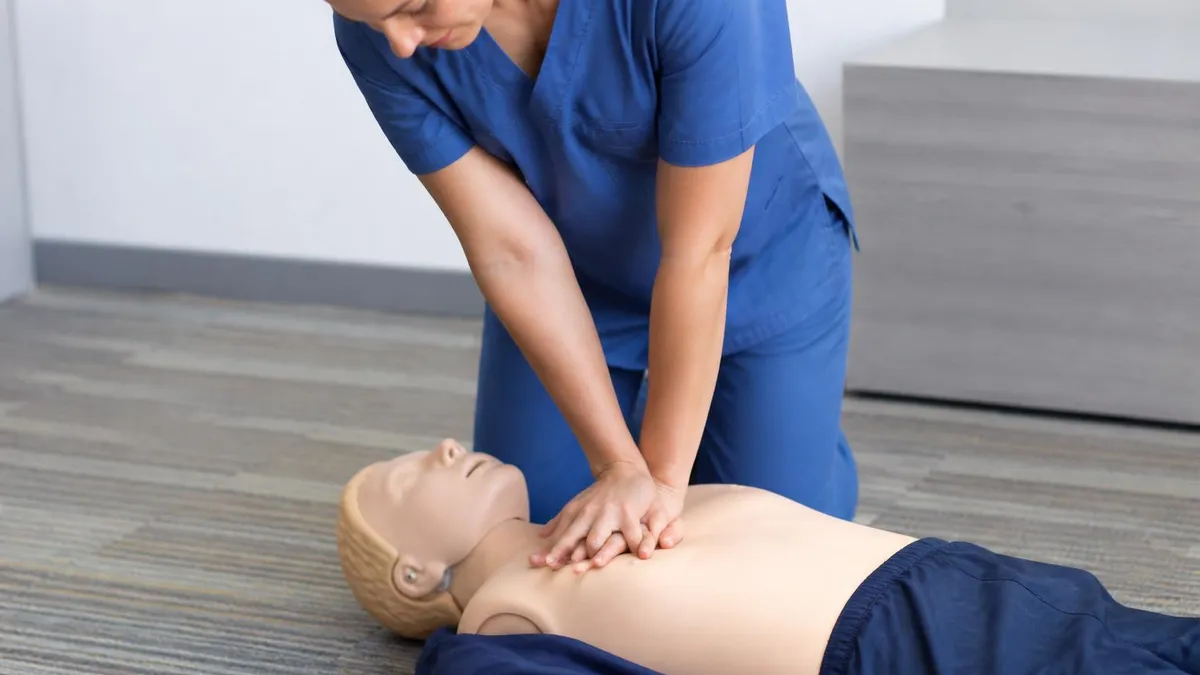
Proper hand placement forms the foundation of effective adult CPR compressions. Place the heel of your dominant hand on the lower half of the sternum, centered between the nipples on the breastbone. Stack your non-dominant hand directly on top, interlacing fingers to lift them off the chest wall. Position your shoulders directly above your hands with arms locked straight, using your upper body weight rather than arm strength to drive each compression downward through the chest.
Body mechanics matter enormously for sustaining 100-120 BPM over the eight to ten minutes it typically takes for EMS to arrive in urban areas, longer in rural settings. Kneel close to the victim's side at the level of their chest. Keeping your elbows fully extended and using a hip-hinge motion conserves energy and produces more consistent depth than bent-arm pushing. Most rescuers fatigue within two minutes regardless of fitness level, which is why early team formation and rotation are critical components of the resuscitation effort.
For respiratory rate during two-rescuer adult CPR without an advanced airway, deliver two breaths after every 30 compressions, each breath lasting about one second and producing visible chest rise. Avoid hyperventilation, which paradoxically reduces cardiac output by increasing intrathoracic pressure and impeding venous return. Once an endotracheal tube, supraglottic airway, or other advanced airway is in place, switch to continuous compressions at 100-120 BPM with asynchronous ventilations at one breath every 6 seconds, or 10 breaths per minute.
Compression-only CPR remains the recommended approach for untrained or unwilling bystanders responding to adult cardiac arrest. Research consistently demonstrates that hands-only CPR produces equivalent or better outcomes than standard CPR when delivered by lay rescuers during the first 6-8 minutes of arrest, largely because untrained rescuers struggle with rescue breath technique. This simplified approach also reduces hesitation, which translates directly to faster bystander response times and improved survival statistics.
Surface matters more than most people realize. Soft surfaces like mattresses absorb compression force, reducing effective depth by 30-50%. Whenever possible, move the victim to a firm flat surface, place a backboard underneath, or activate the bed's CPR mode if performing in-hospital resuscitation. Many modern hospital beds have a button that deflates air mattresses and locks the surface flat, restoring the firm platform necessary for adequate compression depth and rate maintenance.
Feedback devices have revolutionized real-time CPR quality. Modern AEDs and CPR coaching pucks measure depth, rate, and recoil, providing audio prompts like "push harder" or "good compressions." These devices improve compression quality metrics by 20-40% in clinical studies. The national cpr foundation and other certifying bodies now strongly recommend feedback device use during training and actual events, and many hospital systems have made them standard equipment on every code cart.
Counting cadence aloud helps team members synchronize and maintain rate awareness. Many providers count "one and two and three and four" up to 30 before pausing for ventilations. Metronomes set to 110 BPM, smartphone CPR apps, and even compression rate watches provide objective feedback when feedback-enabled AEDs are unavailable. Whatever tool you use, the goal remains consistent: deliver compressions that fall reliably within the 100-120 BPM window while maintaining proper depth and full chest recoil.
CPR Practice Test Questions
Prepare for the CPR Cardiopulmonary Resuscitation Practice exam with our free practice test modules. Each quiz covers key topics to help you pass on your first try.
CPR Basic CPR
CPR Exam Questions covering Basic CPR. Master CPR Test concepts for certification prep.
CPR and First Aid
Free CPR Practice Test featuring and First Aid. Improve your CPR Exam score with mock test prep.
CPR (Cardiopulmonary Resuscitation) Adult ...
CPR Mock Exam on (Cardiopulmonary Resuscitation) Adult CPR and AED Usage. CPR Study Guide questions to pass on your first try.
CPR (Cardiopulmonary Resuscitation) Airway...
CPR Test Prep for (Cardiopulmonary Resuscitation) Airway Obstruction and Choking. Practice CPR Quiz questions and boost your score.
CPR (Cardiopulmonary Resuscitation) Cardio...
CPR Questions and Answers on (Cardiopulmonary Resuscitation) Cardiopulmonary Emergency Recognition. Free CPR practice for exam readiness.
CPR (Cardiopulmonary Resuscitation) Child ...
CPR Mock Test covering (Cardiopulmonary Resuscitation) Child and Infant CPR. Online CPR Test practice with instant feedback.
CPR (Cardiopulmonary Resuscitation) High-P...
Free CPR Quiz on (Cardiopulmonary Resuscitation) High-Performance Team Dynamics. CPR Exam prep questions with detailed explanations.
CPR (Cardiopulmonary Resuscitation) Legal ...
CPR Practice Questions for (Cardiopulmonary Resuscitation) Legal and Ethical Considerations. Build confidence for your CPR certification exam.
CPR for Specific Populations
CPR Test Online for for Specific Populations. Free practice with instant results and feedback.
CPR Airway & Breathing Management
CPR Exam Questions covering Airway & Breathing Management. Master CPR Test concepts for certification prep.
CPR Assessment & Recognition of Cardiac Ar...
Free CPR Practice Test featuring Assessment & Recognition of Cardiac Arrest. Improve your CPR Exam score with mock test prep.
CPR Chest Compressions & Defibrillation
CPR Mock Exam on Chest Compressions & Defibrillation. CPR Study Guide questions to pass on your first try.
CPR Post-Resuscitation Care & Recovery
CPR Test Prep for Post-Resuscitation Care & Recovery. Practice CPR Quiz questions and boost your score.
Rate vs Depth vs Recoil: The Three Pillars of Quality CPR
Compression rate is the most monitored metric in modern resuscitation. Rates below 100 BPM fail to generate adequate forward flow, while rates above 120 BPM compromise diastolic filling and reduce cardiac output. The optimal window of 100-120 BPM emerged from large registry studies showing peak survival when rescuers consistently hit this target throughout the resuscitation effort.
Maintaining rate under stress requires deliberate practice. Use a metronome app, count aloud, or sing "Stayin' Alive" mentally to anchor your rhythm. Feedback-enabled AEDs now provide real-time rate coaching, with audio prompts saying "compress faster" or "compress slower" as needed. Studies show feedback devices improve rate compliance by 35%, translating directly to better neurologic outcomes for cardiac arrest survivors.

Hands-Only CPR vs Standard 30:2 CPR for Adult Cardiac Arrest
- +Easier for untrained bystanders to perform without hesitation or technique anxiety
- +Eliminates rescue breath barrier that often delays or prevents bystander CPR initiation
- +Maintains continuous chest compression fraction above 80% throughout the resuscitation
- +Produces equivalent survival outcomes in the first 6-8 minutes of witnessed adult arrest
- +Reduces disease transmission concerns that arose during respiratory pandemic periods
- +Simpler dispatcher-assisted CPR instructions improve compliance and response times
- −Less effective for asphyxial arrests including drowning, drug overdose, and pediatric cases
- −Not recommended for infant CPR or child CPR which require ventilations
- −Provides no oxygenation support for prolonged arrests beyond 8-10 minutes
- −Healthcare providers should still perform standard 30:2 CPR when trained and equipped
- −May be inadequate for arrests with primary respiratory etiology rather than cardiac cause
- −Does not replace BLS or ACLS provider-level interventions when those are available
Pros and Cons at a Glance
| Pros | Cons |
|---|---|
| Easier for untrained bystanders to perform without hesitation or technique anxiety | Less effective for asphyxial arrests including drowning, drug overdose, and pediatric cases |
| Eliminates rescue breath barrier that often delays or prevents bystander CPR initiation | Not recommended for infant CPR or child CPR which require ventilations |
| Reduces disease transmission concerns that arose during respiratory pandemic periods | May be inadequate for arrests with primary respiratory etiology rather than cardiac cause |
| Simpler dispatcher-assisted CPR instructions improve compliance and response times | Does not replace BLS or ACLS provider-level interventions when those are available |
Adult CPR Compression Rate Quality Checklist
- ✓Confirm scene safety and check for responsiveness with shout and shoulder tap
- ✓Call 911 and request AED before starting compressions on unresponsive adult
- ✓Position victim supine on firm flat surface with chest exposed for compression access
- ✓Place heel of hand on lower half of sternum centered between the nipples
- ✓Lock elbows straight and stack shoulders directly above hands for proper biomechanics
- ✓Compress at 100-120 BPM using a metronome, song, or feedback device for cadence
- ✓Push 2 to 2.4 inches deep on every compression without going beyond upper limit
- ✓Allow full chest recoil after each compression without leaning on the chest
- ✓Minimize interruptions to under 10 seconds for ventilations, AED use, and pulse checks
- ✓Rotate compressors every 2 minutes during rhythm checks to prevent fatigue degradation
Compression Rate Drives Survival More Than Any Other Single Factor
Among all measurable CPR quality metrics, compression rate within the 100-120 BPM target shows the strongest correlation with neurologically intact survival to hospital discharge. Studies of over 13,000 in-hospital arrests demonstrate that every 10 BPM deviation outside this window reduces survival odds by approximately 18%. Master the rate first, then layer in depth, recoil, and minimal interruptions to maximize your patient's chance of meaningful recovery.
AED integration with high-quality compressions represents the single most powerful intervention for out-of-hospital cardiac arrest. When you ask what does aed stand for, the answer is automated external defibrillator, a device designed to detect shockable rhythms (ventricular fibrillation and pulseless ventricular tachycardia) and deliver a defibrillation shock that can restore organized cardiac activity. AED deployment within 3-5 minutes of collapse can push survival rates above 50%, compared to under 10% without defibrillation.
The choreography of CPR and AED use matters enormously. Begin compressions immediately upon recognizing arrest, and continue them while a second rescuer retrieves and powers on the AED. Apply pads while compressions continue (one upper right chest, one lower left chest for anterior-lateral placement). Pause compressions only when the AED prompts for rhythm analysis, typically lasting 5-10 seconds. After shock delivery, resume compressions immediately without checking pulse or rhythm, continuing for two minutes before the next analysis cycle.
The acls algorithm builds on these foundational BLS skills with advanced interventions including airway management, vascular access, and pharmacology. Epinephrine 1 mg IV/IO every 3-5 minutes is administered during ongoing CPR for non-shockable rhythms (asystole, PEA) and for shockable rhythms after the second defibrillation attempt. Amiodarone 300 mg IV/IO is the first-line antiarrhythmic for refractory ventricular fibrillation after three failed shocks, with a follow-up 150 mg dose if needed for persistent arrhythmia.
Throughout ACLS care, compression quality remains the absolute foundation. Every advanced intervention layered on top of CPR depends on adequate underlying perfusion to reach its target tissue. Epinephrine cannot reach the heart if blood is not circulating. Defibrillation is less likely to succeed in a poorly perfused myocardium. This is why ACLS providers continue to emphasize the basics: compress hard, compress fast at 100-120 BPM, allow full recoil, and minimize interruptions throughout the entire resuscitation.
Team dynamics during ACLS resuscitation use the closed-loop communication and role-clarity principles taught in advanced life support courses. The team leader maintains situational awareness without performing hands-on tasks, while designated compressors, ventilators, medication administrators, and recorders execute their specific roles. Rotation timing, drug intervals, and rhythm analysis all coordinate around the 2-minute compression cycles that structure the resuscitation effort from initial recognition through return of spontaneous circulation.
Post-arrest care begins the moment ROSC is achieved. Targeted temperature management between 32-36°C for 24 hours, careful hemodynamic management with mean arterial pressure goals above 65 mmHg, glucose control, and neuroprognostication form the post-resuscitation bundle that determines long-term outcomes. Many patients who survive the initial arrest succumb to post-arrest brain injury, making this phase as critical as the CPR itself for ensuring meaningful neurologic recovery.
For pediatric patients, the principles transfer with important modifications. Infant cpr uses two fingers or two-thumb encircling technique with compression depth of 1.5 inches (one-third anterior-posterior chest diameter), child CPR uses one or two hands depending on size with depth of 2 inches, and both maintain the same 100-120 BPM rate as adults. Pals certification provides the specialized training healthcare providers need to manage pediatric arrest situations, including the often-asphyxial etiology that makes ventilation more critical than in adult arrests.

Current guidelines explicitly limit pulse checks to no more than 10 seconds. If you cannot definitively feel a pulse within that window, begin compressions immediately. Studies show that even trained healthcare providers correctly identify pulselessness only 65% of the time within 10 seconds, meaning the bias must always be toward starting CPR. The harm of unnecessary compressions on a perfusing patient is minimal; the harm of delayed compressions on an arrested patient is catastrophic.
Common compression rate mistakes destroy resuscitation effectiveness even when rescuers are performing the basic technique correctly. The most frequent error is compressing too fast, with adrenaline-fueled rescuers often hitting 130-150 BPM in the first minutes of an arrest. This excessive speed reduces diastolic filling time, decreases stroke volume, and paradoxically lowers cardiac output despite seemingly more vigorous effort. Slowing down to the 100-120 BPM target produces better forward flow than panicked rapid compressions.
The opposite error, compressing too slowly, typically emerges from fatigue after the first 90 seconds of continuous effort. Rate degradation is gradual and often unnoticed by the rescuer who feels they are maintaining cadence. This is why feedback devices and frequent rescuer rotation matter so much in real-world resuscitation. A fresh compressor at 110 BPM consistently outperforms a fatigued compressor whose rate has drifted to 85 BPM despite identical visible effort.
Inadequate depth ranks as the second most common quality failure. Many rescuers, particularly smaller-statured providers or those concerned about causing injury, deliver compressions only 1 to 1.5 inches deep. This produces inadequate forward flow regardless of perfect rate. The 2-inch minimum is non-negotiable for adult CPR effectiveness. Trust the science: cracked ribs heal, brains deprived of perfusion do not. Push hard, with confidence, to the full 2-2.4 inch depth on every single compression.
Leaning on the chest between compressions is a subtle but devastating error. Even minor weight transfer that prevents full recoil reduces cardiac output by 25% or more. Some rescuers develop this habit during practice on manikins with softer recoil springs than the human chest. Conscious effort to fully lift the heel of the hand (without losing position) between compressions preserves the negative intrathoracic pressure phase essential for venous return and ventricular filling.
Excessive interruptions for ventilations, pulse checks, AED analysis, and provider switches sabotage even otherwise perfect compressions. Every interruption longer than 10 seconds drops coronary perfusion pressure to near zero. Teams should choreograph transitions to minimize hands-off time: have the next compressor positioned and ready before the current one fatigues, perform pulse checks only during scheduled rhythm analysis pauses, and resume compressions immediately after defibrillation rather than waiting for rhythm confirmation.
Ventilation errors compound compression problems. Hyperventilation, defined as breaths delivered too rapidly or with excessive volume, increases intrathoracic pressure and reduces venous return. The recommended rate is one breath per 6 seconds (10 breaths per minute) with an advanced airway in place, or two breaths per 30 compressions without. Each breath should last one second and produce visible chest rise, no more aggressive than that. Bag-mask ventilation requires deliberate restraint to avoid this common pitfall.
Once ROSC is achieved and the patient resumes spontaneous circulation, careful airway management and the appropriate position recovery (recovery position) become priorities. Place the unresponsive but breathing patient on their side with the lower arm extended and upper arm supporting the head, maintaining an open airway and allowing drainage of any vomitus. Continue monitoring vital signs, prepare for potential re-arrest, and transfer care to advanced providers as quickly as possible for definitive post-arrest treatment in the hospital setting.
Practical training and regular skill refresh are essential for maintaining adult CPR compression rate competency. Research consistently shows that CPR skills degrade significantly within 3-6 months of initial certification, with compression rate accuracy falling first. The American Heart Association recommends brief skill refreshers every 3 months for healthcare providers and at least annual full recertification for clinical roles requiring BLS, ACLS, or PALS credentials to maintain provider quality.
Hands-on manikin practice with real-time feedback dramatically outperforms classroom-only or video-only learning. Modern training manikins measure rate, depth, recoil, and hand position simultaneously, providing immediate corrective feedback that builds muscle memory. Many AHA Training Centers now incorporate Resusci Anne QCPR or similar feedback-enabled manikins as standard equipment, and home-use options like the CPR Anytime kit allow personal practice between formal certification cycles.
Workplace AED programs save lives when properly maintained and accompanied by training. OSHA does not federally mandate workplace AEDs, but state laws and industry standards increasingly require them in fitness facilities, schools, airports, and large workplaces. Pair every AED installation with first responder training for designated personnel, monthly device checks for battery and pad expiration, and clear signage so any employee can locate the device during the critical first minutes of a cardiac arrest event.
For families and caregivers of high-risk individuals (those with known heart disease, recent cardiac events, or implanted devices), in-home CPR training and AED placement deserve serious consideration. Approximately 70% of out-of-hospital cardiac arrests occur in private residences, and bystander CPR initiated by family members can mean the difference between life and death during the 8-12 minutes before EMS arrival. The investment in training and equipment pays dividends measured in lives saved.
This article addresses cardiopulmonary resuscitation, the life-saving emergency procedure, which is unrelated to electronics services. If you arrived here searching for device repair, please redirect to that business. If you arrived seeking to learn the resuscitation technique that can save a human life, you are in the right place and we encourage you to pursue formal certification through a recognized training organization.
Stress inoculation through realistic simulation prepares rescuers for actual events. Practicing CPR on a manikin in a quiet classroom is fundamentally different from performing it on a real person in a chaotic environment with bystanders, distress, and uncertainty. High-fidelity simulation programs that incorporate noise, time pressure, family member actors, and complications provide the closest preparation for real-world performance and dramatically reduce the cognitive load during actual events.
Finally, remember that imperfect CPR is infinitely better than no CPR. A bystander who hesitates because they cannot remember the exact compression rate ratio or depth produces zero survival benefit. Even hands-only CPR delivered with imperfect technique at 80 BPM provides meaningful perfusion compared to no intervention at all. If you witness a sudden adult collapse and the person is unresponsive and not breathing normally, push hard and fast in the center of the chest, send someone for an AED, and continue until help arrives. That action alone can double or triple the victim's chance of survival.
CPR Questions and Answers
CPR Card Lookup: How to Verify, Replace, and Access Your CPR Certification in 2026
AHA CPR: What It Is, Which Course You Need, and How to Get Certified
Adult CPR: Complete Step-by-Step Guide to Hands-Only and Standard CPR in 2026

CPR - Cardiopulmonary Resuscitation: Complete Study Guide 2026
Inappropriate CPR Songs: What Not to Play, Why It Matters, and Better Beat-Per-Minute Alternatives
About the Author

Registered Nurse & Healthcare Educator
Johns Hopkins University School of NursingDr. Sarah Mitchell is a board-certified registered nurse with over 15 years of clinical and academic experience. She completed her PhD in Nursing Science at Johns Hopkins University and has taught NCLEX preparation and clinical skills courses for nursing students across the United States. Her research focuses on evidence-based exam preparation strategies for healthcare certification candidates.
Join the Discussion
Connect with other students preparing for this exam. Share tips, ask questions, and get advice from people who have been there.
View discussion (5 replies)