
CogAT Study Materials: Best Books and Resources by Grade 2026 October
Pass the CogAT Study Materials: 🔎 Best Books and exam with confidence. Practice questions with detailed explanations and instant feedback on every answer.

What CogAT Study Materials Your Child Actually Needs
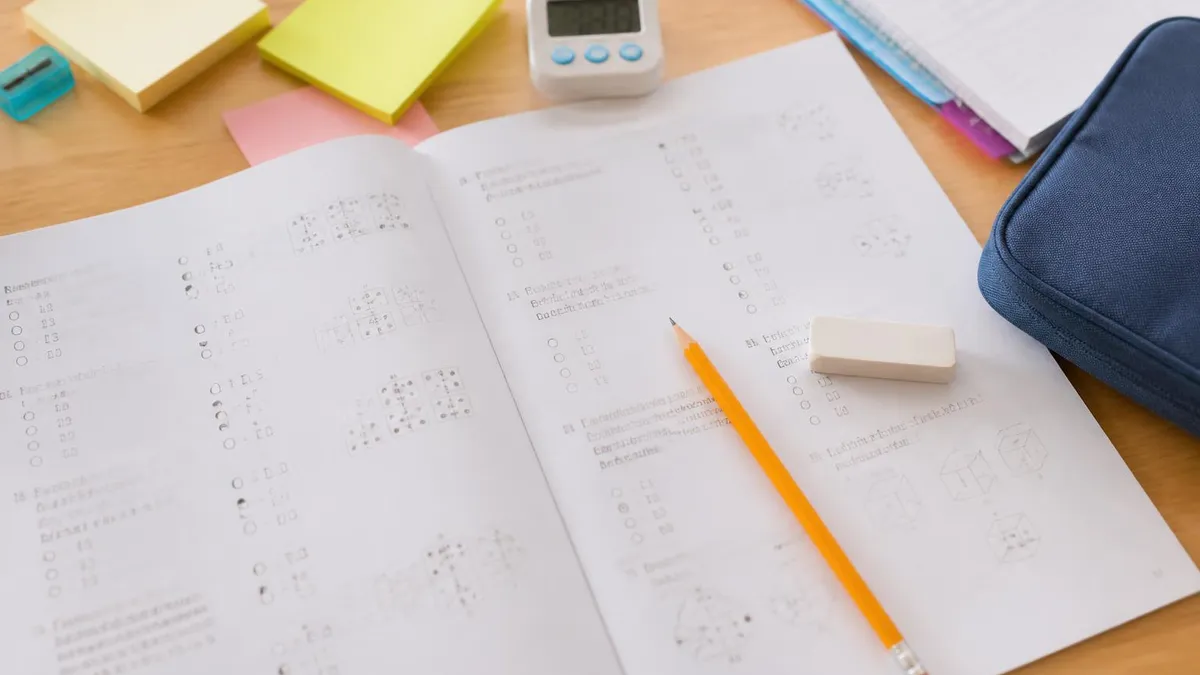
The CogAT doesn't test knowledge of school subjects — it tests reasoning ability. That distinction matters for how you choose and use study materials. Your child won't benefit from flashcards of math facts or spelling lists; they need practice with the specific question formats the CogAT uses: verbal analogies, number sequences, figure classifications, and pattern matrices. The right study materials expose your child to these formats repeatedly, so they walk into the test having seen and worked through the types of questions that will appear.
CogAT books and practice materials serve two functions. First, they familiarize your child with the question formats — many students who underperform on the CogAT do so because they've never seen a figure analogy or a number series question and don't understand what's being asked, not because they lack the underlying ability. Reducing unfamiliarity with the format is one of the highest-value things practice materials provide. Second, they build the specific reasoning skills the test measures — particularly for quantitative and nonverbal reasoning, regular practice with these question types does improve performance over time.
The most important factor when choosing CogAT study materials is grade-level accuracy. The CogAT uses different test levels for different grades, and the question types and difficulty vary significantly. A practice book for 2nd grade will be very different from one for 5th grade — both in how questions are presented and in which subtests are most heavily weighted. Always select materials that specify the grade level or CogAT level (K through 12) your child will be tested at, not general reasoning books that aren't aligned to the actual CogAT format.
Official CogAT practice materials aren't publicly available from Riverside Insights — the test publisher doesn't sell consumer prep books. All practice materials are third-party resources created to mirror the CogAT format. Quality varies considerably, so using well-reviewed books from established test prep publishers is important. Mercer Publishing, Origins Tutoring, and Gifted and Talented Test Prep are among the publishers consistently recommended by parents of CogAT-tested children. Reviews from parents in gifted education communities (GT forums, school district Facebook groups) are often more informative than generic product reviews.
One frequently asked question: does preparation give wealthy families an unfair advantage? That concern is real, but it doesn't change how individual families should approach preparation. What the research shows is that all children — regardless of background — benefit from format familiarization. The playing field isn't level, but individually, a child who practices is more likely to demonstrate their actual ability on the test than a child who hasn't seen the question formats before. Preparation closes the gap between a child's true cognitive ability and their test performance; it doesn't substitute for ability that isn't there.
Choosing CogAT Books by Grade Level
For kindergarten and first grade (CogAT Levels K and 1), look for picture-based practice materials with no or minimal reading required. At this level, verbal questions are presented with pictures, and quantitative questions use visual number representations. The Nonverbal battery is particularly important at this age because it's the one area least affected by early reading ability differences.
Mercer Publishing's CogAT Grade 1 practice books are frequently recommended by parents and school counselors as well-aligned to this level. Keep sessions very short — 10 to 15 minutes — and frame practice as puzzle play rather than test preparation to maintain engagement at this young age.
For grades 2 and 3 (CogAT Levels 2 and 3), reading becomes more central to the Verbal battery. Children who are strong readers but less confident in visual-spatial reasoning often show this pattern on the nonverbal battery at this level. Practice materials that include figure matrices and pattern analogies specifically are more valuable than general reasoning books at this age. The transition from picture-based to more abstract quantitative questions also happens at this level — look for materials that include both formats.
For grades 4 through 6 (CogAT Levels 4 through 6), the test shifts toward more abstract verbal reasoning and complex number sequences. Verbal analogy questions at this level often require understanding of relationships between concepts, not just vocabulary. Full battery practice books — combining verbal, quantitative, and nonverbal in a single volume — are practical for this age group. Origins Tutoring's level-specific books and the Gifted and Talented series both have good coverage at these levels.
For grades 7 and above (CogAT Levels 7–12), the test resembles more of a general cognitive aptitude test similar to what adults encounter on employment assessments. Abstract figure series and complex number analogies become significantly more challenging at this level. Some students preparing at this level also benefit from working through abstract reasoning puzzles (similar to IQ test practice materials) in addition to CogAT-specific books, since official CogAT prep books at the highest levels are harder to find in retail channels.
Practice at this level benefits from exposure to formal logic, abstract reasoning, and mathematical problem patterns. The CogAT practice tests available online can supplement print materials at this level, particularly for students who prefer screen-based practice. At this level, the reasoning skills the CogAT measures also overlap meaningfully with what other standardized tests assess, so preparation can serve double duty.
One frequently overlooked consideration: time management during the CogAT. The test is timed, and children who haven't practiced under timed conditions often use time inefficiently — spending too long on questions they're stuck on and running short on easier questions at the end. Any practice session in the final 2–3 weeks before the test should be timed at the appropriate pace. The CogAT practice test PDF can be printed and used as a paper-based timed practice session to simulate actual test-day conditions closely.
CogAT Study Materials Preparation Checklist
- ✓Confirm the CogAT Level your child will take (matches their current grade level)
- ✓Select practice books that specifically label the correct CogAT Level for your child's grade
- ✓Get at least one dedicated Nonverbal battery practice book — this battery is most unfamiliar to children
- ✓Include at least one full-length timed practice test in your prep materials
- ✓Read parent/teacher reviews in gifted education communities for specific book recommendations
- ✓Plan 4–8 weeks of regular 20–30 minute sessions rather than intensive last-minute cramming
- ✓Check with your child's school about any official sample questions or prep guidance they provide
- ✓Review explanations for wrong answers with your child — understanding why matters more than getting points
- ✓In the final 2 weeks, practice at least one battery under timed conditions
- ✓Maintain a calm, low-pressure approach — test anxiety is a real performance factor for children

How to Use CogAT Study Materials Effectively
Short daily sessions outperform long weekly sessions for this type of preparation. Children's attention and engagement drop significantly in sessions longer than 25–30 minutes, and the reasoning skills the CogAT tests develop through repeated exposure over time rather than through single intensive review sessions. A 20-minute daily session over 4–6 weeks consistently outperforms a 2-hour session once a week for the same total preparation hours.
Always review wrong answers together with your child. The answer key in most CogAT prep books includes explanations — reading these explanations out loud and working through why the correct answer is correct (and why your child's choice was incorrect) builds the reasoning pattern recognition that transfers to the actual test. Children who simply circle answers and check how many were right without understanding the reasoning behind errors don't improve nearly as much as children who analyze each mistake.
The quantitative battery is worth particular attention because parents often underestimate it. 'My child is great at math' doesn't automatically mean strong quantitative CogAT performance. CogAT quantitative questions test number reasoning — finding the pattern in a number sequence or identifying the relationship between two pairs of numbers — rather than arithmetic computation. A child who excels at traditional math operations but hasn't practiced number series and number analogy formats may struggle here. Dedicated quantitative reasoning practice, separate from the math homework your child brings home from school, is the most efficient way to improve this battery score.
For the Nonverbal battery specifically, verbal explanation of visual patterns is surprisingly effective. Ask your child to describe out loud what pattern they see in a figure matrix — 'the shape gets smaller and rotates' or 'the dots move from the top left to the bottom right' — before they choose their answer. Externalizing the visual reasoning process helps children who are new to this question type develop a systematic approach rather than guessing.
For the Verbal battery, reading widely in the weeks before the test indirectly supports performance. Children with broader vocabulary and stronger reading comprehension generally perform better on verbal analogies and sentence completion questions. This doesn't mean drilling vocabulary lists — regular pleasure reading in age-appropriate books, newspapers, or magazines builds the vocabulary naturally. The specific vocabulary tested in verbal analogies tends to be general conceptual vocabulary (relationships between things) rather than domain-specific academic terms.
Some parents find that working through a few practice questions with their child at the start of prep helps calibrate expectations in both directions. If your child breezes through the level-appropriate practice questions without errors, your prep focus should shift to timed practice and test-taking strategy rather than content. If your child struggles significantly with a specific battery, you've identified exactly where to concentrate your remaining preparation weeks. The diagnostic information from the first practice session is often more valuable than the practice itself.
CogAT Prep by School Level
Key focus: Familiarization with picture-based question formats. At this age, unfamiliarity with the question type is the primary obstacle — not reasoning ability.
Materials to use: Picture-based practice books with minimal reading. Verbal battery prep with picture analogies. Nonverbal practice with visual patterns and shape sequences.
Session length: 15–20 minutes maximum. Younger children's attention windows are short — keep sessions light, consistent, and positive.
Parent tip: Treat practice as a puzzle game, not test prep. Language like 'let's do some fun brain puzzles' produces better engagement than framing it as test preparation.
CogAT Study Materials: What Works and What Doesn't
- +Level-specific practice books aligned to the exact CogAT level for your child's grade — the most important quality factor
- +Regular short sessions (20 minutes daily) over 4–8 weeks — builds pattern recognition through repeated exposure rather than cramming
- +Reviewing explanations for wrong answers together — understanding the reasoning process matters more than tracking a score
- +Full-length timed practice tests in the final 2 weeks — builds pacing awareness and reveals remaining weak areas
- +A calm, low-stakes approach to practice — anxious children underperform relative to their ability; confidence-building is legitimate test prep
- −General reasoning books not specifically aligned to CogAT format — the question types are specific enough that non-aligned materials provide limited transfer
- −Last-minute cramming in the days before the test — doesn't build the pattern recognition the test measures; can also increase test anxiety
- −Drilling vocabulary lists rather than building vocabulary through reading — direct vocabulary drilling helps less than broad reading exposure for CogAT verbal performance
- −Practicing only the batteries your child already does well on — maximum score improvement comes from focusing on the weakest battery
- −Framing practice as high-stakes test prep — children who approach the CogAT anxiously often perform below their actual ability; maintain a relaxed, game-like practice approach
Pros and Cons at a Glance
| Pros | Cons |
|---|---|
| Level-specific practice books aligned to the exact CogAT level for your child's grade — the most important quality factor | General reasoning books not specifically aligned to CogAT format — the question types are specific enough that non-aligned materials provide limited transfer |
| Reviewing explanations for wrong answers together — understanding the reasoning process matters more than tracking a score | Last-minute cramming in the days before the test — doesn't build the pattern recognition the test measures; can also increase test anxiety |
| A calm, low-stakes approach to practice — anxious children underperform relative to their ability; confidence-building is legitimate test prep | Drilling vocabulary lists rather than building vocabulary through reading — direct vocabulary drilling helps less than broad reading exposure for CogAT verbal performance |
Building a CogAT Practice Schedule
A practical preparation schedule for most families: start 6 weeks before the test date. Week 1 — familiarize your child with all three battery question types without any time pressure. Let them see each format, understand what's being asked, and try examples. Don't worry about scores yet. Week 2 — begin timed battery sections. Use one battery per session, rotating through the three across the week. Week 3 through Week 5 — systematic practice across all three batteries. Focus extra time on the battery where your child struggles most based on Week 2 results.
Week 6 — take at least one full-length timed practice test under conditions that closely simulate the actual test environment, ideally at the same time of day the real test is scheduled. Review all errors together. Do light review only in the final 2–3 days before the test — no new material, just brief review of patterns your child has already practiced. Confirm test logistics the night before (time, location, what to bring). Well-rested children with a good breakfast perform measurably better on cognitive tests than tired, hungry children.
If your district provides advance notice of the CogAT test date (some districts test all students at a scheduled time; others test gifted referrals separately), use that timeline to work backward from the test date and plan your 6-week schedule. If your child's test date is announced less than 6 weeks away, prioritize ruthlessly: start with a diagnostic practice session across all three batteries to identify the weakest area, then spend the majority of remaining prep time on that battery.
Getting 1–2 weeks of focused nonverbal practice in before the test is far more valuable than 5 days of general preparation spread evenly. If you're preparing a child who has already been referred for gifted testing and you have limited time, prioritize Nonverbal battery practice — it's the battery most amenable to rapid improvement through practice, and it's the one most children have had the least school exposure to.
One thing that matters as much as study materials is sleep and nutrition on the day of the test. The CogAT measures cognitive processing, and cognitive processing is measurably impaired by sleep deprivation. A well-rested child who has practiced adequately will consistently outperform the same child who is tired. Getting your child to bed at a normal time the night before and providing a high-protein breakfast on test day isn't superstition — it's evidence-based performance optimization. The best study materials in the world can't compensate for a child who is running on four hours of sleep.
Managing your child's emotional state around the test is also an underrated preparation factor. Children who know they're being tested for gifted placement sometimes develop significant anxiety around the CogAT, which depresses their performance below their true ability. The most effective approach is honest but low-pressure framing: 'This is a test of how you think and solve problems. There's no way to get everything right, and that's fine — just try your best on each question.' Normalizing the experience of skipping hard questions and moving on (which is the correct time management strategy) also reduces test anxiety meaningfully.
A final note on buying CogAT study materials: new editions appear regularly, and older editions are sometimes sold at a discount. Using a book that's one or two years old is generally fine for most content — CogAT question formats don't change dramatically year to year. However, if your district is testing at a specific new CogAT version (CogAT Form 7 vs Form 8, for example), confirm that your practice materials align to the current version. Teachers and gifted coordinators at your school can typically confirm which CogAT form is currently administered.
Sample CogAT Practice Questions
Try these questions from our free CogAT practice tests. The correct answer and an explanation follow each question.
Book is to Reading as Fork is to ___?
- A. Kitchen
- B. Eating
- C. Metal
- D. Spoon
Answer: B. Eating
A book is used for reading, just as a fork is used for eating.
Verbal analogy: Author is to book as composer is to ___?
- A. Symphony
- B. Orchestra
- C. Violin
- D. Audience
Answer: A. Symphony
An author creates a book, just as a composer creates a symphony.
Book is to Read as Fork is to:
- A. Write
- B. Eat
- C. Cook
- D. Drink
Answer: B. Eat
A book is used for reading, and a fork is used for eating. This analogy shows a relationship of function.
two five one ____________
- A. vegetable
- B. number
- C. subtract
- D. seven
Answer: D. seven
The given sequence 'two, five, one' consists of numbers written out as words. To complete the pattern, the missing word should also be a number. Among the choices, 'seven' is the only option that fits this category, maintaining the theme of the list. This tests categorization and vocabulary related to numbers.
CogAT Study Materials Questions and Answers
About the Author

Educational Psychologist & Academic Test Preparation Expert
Columbia University Teachers CollegeDr. Lisa Patel holds a Doctorate in Education from Columbia University Teachers College and has spent 17 years researching standardized test design and academic assessment. She has developed preparation programs for SAT, ACT, GRE, LSAT, UCAT, and numerous professional licensing exams, helping students of all backgrounds achieve their target scores.