
COA Jobs: Complete Guide to Certified Ophthalmic Assistant Careers 2026 October
COA jobs complete guide to certified ophthalmic assistant careers — 🎓 JCAHPO certification, ophthalmic technician careers, salary, and exam prep.
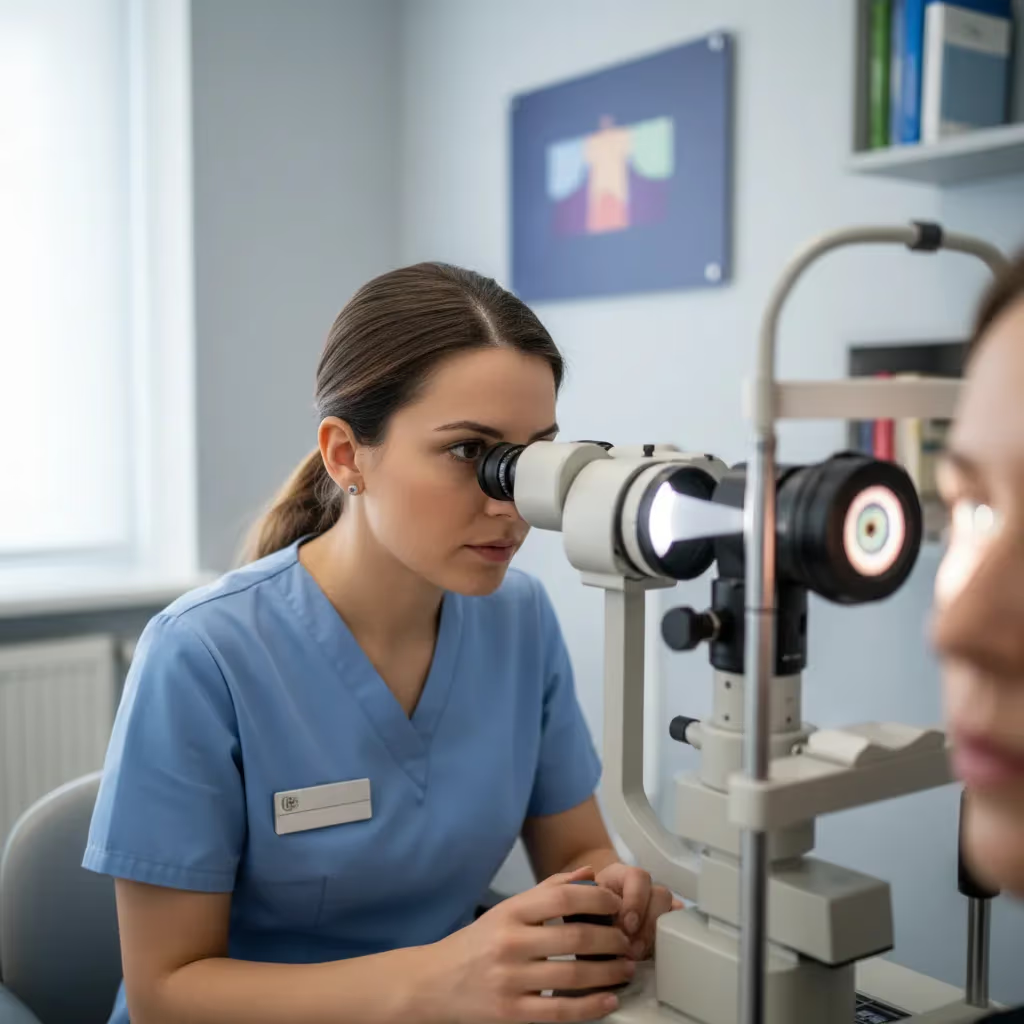
If you searched coa jobs complete guide to certified ophthalmic assistant careers, you're researching one of the fastest-growing allied health credentials — the JCAHPO Certified Ophthalmic Assistant (COA) certification. COAs work alongside ophthalmologists in clinical practice, performing patient history, visual assessments, ocular measurements, basic diagnostic tests, and patient education. The coa study guide from JCAHPO and supplementary practice tests prepare you for the certification exam that opens doors to clinical positions across ophthalmology practices, eye surgery centers, and academic medical centers. Strong demand for certified ophthalmic assistant jobs across the U.S. makes this credential a reliable career investment.
The COA is the entry-level certification in JCAHPO's three-tier ophthalmic technician credentialing pathway: COA → COT (Certified Ophthalmic Technician) → COMT (Certified Ophthalmic Medical Technologist). Each level builds on the previous one with progressively advanced clinical responsibilities and compensation. Many ophthalmic professionals start as COAs and advance through the credential ladder over their careers. The COA itself opens immediate clinical employment opportunities; subsequent credentials unlock advanced positions and higher pay scales.
This guide covers the COA exam, study materials, career outlook, and prep strategies. We'll also disambiguate the COA acronym briefly for readers who arrived from biochemistry (acetyl-CoA) or drug development (Clinical Outcome Assessment) contexts where the same letters carry different meanings.
COA Certification by the Numbers
A focused certified ophthalmic assistant jobs approach starts with understanding the COA credential. JCAHPO (Joint Commission on Allied Health Personnel in Ophthalmology) administers the COA certification through written and practical examination. The exam covers 17 content areas including patient history and documentation, visual assessment, ocular motility, tonometry and glaucoma, ocular anatomy, ophthalmic equipment, infection control, communication, pharmacology basics, and clinical procedures.
Strong performance across all 17 content areas produces the composite score needed for certification. Coa guidelines for counting clinical experiences appear in JCAHPO's eligibility criteria — your application must document supervised clinical hours from your training program or work experience pathway.
Eligibility requires 1,000+ documented work experience hours under the supervision of an ophthalmologist OR completion of an accredited ophthalmic assistant training program. Most candidates meet eligibility through one of these pathways within 12-18 months of starting in an ophthalmic clinical setting. Document your supervised hours as you work — JCAHPO requires verification from your supervising ophthalmologist as part of the application.
Don't wait until you're ready to apply to start documentation; track hours weekly throughout your training so the application paperwork is ready when you are.
Many ophthalmology training programs partner with local practices for clinical rotations during your formal coursework. Use those rotations strategically — observe diverse procedures (refraction, tonometry, OCT, visual field testing, surgical assisting) to build the broad clinical exposure COA exam questions test.
Network with current COAs and ophthalmic technicians during your prep window. Recent test takers know which content areas to emphasize and which prep resources actually helped versus those that wasted time.
A focused coa guidelines for counting clinical experiences approach helps clarify eligibility. The phrase developed coas should be suitable feasible acceptable complete and appears in pharmaceutical Clinical Outcome Assessment (COA) development guidance — a completely different COA acronym used in drug development and clinical trials. If you searched for that phrase, you're in the wrong context — see FDA's COA guidance documents for pharmaceutical Clinical Outcome Assessment information. The ophthalmic COA we cover here is the JCAHPO Certified Ophthalmic Assistant credential. Coa guidelines for the ophthalmic COA cover both certification eligibility and ongoing professional standards for working ophthalmic assistants.
The pharmaceutical COA acronym overlap creates occasional search confusion. JCAHPO's COA covers ophthalmic clinical work; pharmaceutical COA covers patient-reported outcomes, clinician-reported outcomes, observer-reported outcomes, and performance outcomes used in clinical trial endpoint design. The two fields have nothing in common despite the shared letters. This guide focuses on the ophthalmic career credential exclusively.
Search engines often return mixed results for COA queries — verify which COA your specific search context refers to before investing significant prep time in the wrong area.
Track your weekly practice scores by content area in a simple spreadsheet. Watching the trend across study weeks builds confidence and identifies plateau points needing study approach changes.
If your formal coursework didn't include extensive ocular pharmacology, prioritize that domain in your independent study window. Pharmacology demands systematic memorization of drug classes, mechanisms, and side effects.
COA Practice Test Questions
Prepare for the COA - Certified Ophthalmic Assistant exam with our free practice test modules. Each quiz covers key topics to help you pass on your first try.
COA - Certified Ophthalmic Assistant Ocula...
COA Exam Questions covering - Certified Ophthalmic Assistant Ocular Motility and Alignment. Master COA Test concepts for certification prep.
COA - Certified Ophthalmic Assistant Patie...
Free COA Practice Test featuring - Certified Ophthalmic Assistant Patient History and Documentation. Improve your COA Exam score with mock test prep.
COA - Certified Ophthalmic Assistant Tonom...
COA Mock Exam on - Certified Ophthalmic Assistant Tonometry and Glaucoma. COA Study Guide questions to pass on your first try.
COA - Certified Ophthalmic Assistant Visua...
COA Test Prep for - Certified Ophthalmic Assistant Visual Assessment and Testing. Practice COA Quiz questions and boost your score.
COA Ocular Anatomy and Physiology
COA Questions and Answers on Ocular Anatomy and Physiology. Free COA practice for exam readiness.
COA Ocular Motility and Alignment
COA Mock Test covering Ocular Motility and Alignment. Online COA Test practice with instant feedback.
COA Ophthalmic Instruments and Procedures
Free COA Quiz on Ophthalmic Instruments and Procedures. COA Exam prep questions with detailed explanations.
COA Patient History and Documentation
COA Practice Questions for Patient History and Documentation. Build confidence for your COA certification exam.
COA Tonometry and Glaucoma
COA Test Online for Tonometry and Glaucoma. Free practice with instant results and feedback.
COA Visual Assessment and Testing
COA Study Material on Visual Assessment and Testing. Prepare effectively with real exam-style questions.
COA History Taking and Documentation
Free COA Test covering History Taking and Documentation. Practice and track your COA exam readiness.
COA Lensometry and Refractometry
COA Exam Questions covering Lensometry and Refractometry. Master COA Test concepts for certification prep.
COA Ocular Motility and Pupils
Free COA Practice Test featuring Ocular Motility and Pupils. Improve your COA Exam score with mock test prep.
COA Ophthalmic Knowledge and Diagnostic
COA Mock Exam on Ophthalmic Knowledge and Diagnostic. COA Study Guide questions to pass on your first try.
COA Ophthalmic Pharmacology
COA Test Prep for Ophthalmic Pharmacology. Practice COA Quiz questions and boost your score.
COA Exam Content Areas
Patient care and assessment covers patient history taking, vital signs, visual acuity testing (Snellen chart, near vision), ocular motility evaluation, pupillary assessment, and basic visual field screening. These foundational skills support all other ophthalmic clinical activities. Practice with sample patient scenarios that walk through complete history and assessment workflow. Most exam questions in this domain test scenario-based application rather than pure recall.
A targeted certified ophthalmic assistant exam study guide covers all 17 JCAHPO content areas systematically. The official JCAHPO publication (Ophthalmic Medical Assisting: An Independent Study Course) is the authoritative reference and recommended primary source. Supplement with practice tests covering ocular anatomy, ocular motility, patient history, tonometry/glaucoma, and visual assessment — the highest-yield COA exam topics. A free coa study guide covers basics; the official JCAHPO publication provides comprehensive depth. Most successful candidates use both formats during prep — free practice for question drilling, official publication for content reference.
The COA exam itself is computer-based and administered at Pearson VUE testing centers globally. Total testing time runs 3 hours including instructions and breaks. Most candidates finish with 30+ minutes to spare if they keep moving steadily. Mark questions you're unsure of with the testing software's flag tool and return to them after answering everything you know. Don't burn 5 minutes on a single difficult question; flag and move forward decisively.
Schedule for your peak focus hours (typically morning) when concentration is sharpest for the 3-hour scenario-based exam.
Ophthalmic equipment manufacturer training programs (Zeiss, Heidelberg, Reichert, Haag-Streit) often offer free educational sessions covering specific equipment types. Take advantage of vendor-sponsored education during prep — practical equipment knowledge transfers directly to COA exam performance.
Attend ophthalmic technician conferences during prep if possible. JCAHPO's annual continuing education meeting includes technician-focused sessions that reinforce COA content while providing CE credits for after certification.
4 COA Test Prep Strategies
JCAHPO publishes the official Ophthalmic Medical Assisting: An Independent Study Course as the authoritative COA prep reference. The publication is calibrated to exam content. Combine with practice tests for question-format familiarity. Most successful candidates report using the official publication as their primary study source supplemented by 5-10 practice tests across content areas.
Ocular anatomy and ophthalmic pharmacology together account for significant exam coverage. Memorize cornea, lens, vitreous, retina, optic nerve anatomy plus dilating drops, glaucoma medications, and topical anesthetics. Build flashcards for each major anatomical structure and drug class — daily review compounds across weeks of prep.
Diagnostic testing scenarios appear repeatedly. Memorize indications, technique requirements, and common pitfalls for tonometry (Goldmann, non-contact), keratometry, autorefraction, OCT, visual field testing, and pachymetry. Active clinical practice with these tests dramatically improves exam scenario performance compared to textbook-only prep.
Track your supervised clinical experience hours weekly throughout your training. JCAHPO requires 1,000+ documented work experience hours under ophthalmologist supervision OR completion of an accredited training program. Don't wait until application time to start documentation — supervisor verification takes time and can delay application processing significantly.
A useful coa guidelines reference for COA candidates is JCAHPO's website (jcahpo.org), which publishes current eligibility requirements, exam content blueprints, study material lists, and recertification rules. A free coa study guide pdf from JCAHPO is sometimes available for free download; other comprehensive prep materials are available for purchase. The jcahpo coa study guide is the official prep reference and worth the investment for serious COA candidates. Combined with free practice tests from this site and other reputable sources, the JCAHPO publication provides the breadth and depth needed for first-attempt success.
Many ophthalmic technician training programs at community colleges and proprietary schools include JCAHPO study materials as part of their curriculum. Check with your training program before purchasing materials independently — coverage may already be included in your tuition.
Free supplementary resources also include study groups (online forums, Facebook groups for ophthalmic assistants), YouTube tutorials covering specific clinical procedures, and JCAHPO's online learning modules for continuing education topics.
Build a rotation of ocular anatomy review during commutes — flashcard apps on your phone make 10-15 minute structure review sessions accessible throughout the day. Small frequent exposure compounds across weeks.
Review ophthalmic abbreviations specifically — chart abbreviations (OD, OS, OU, IOP, BCVA, BLE) and pharmacology abbreviations appear regularly in exam scenario questions and clinical practice.
Becoming a Certified Ophthalmic Assistant: Pros and Cons
- +Median COA salary around $42K with significant variation by region and experience
- +Strong job stability — ophthalmology practices consistently need COAs
- +Clear advancement path through COT and COMT certifications
- +Professional credential portable across employers and states
- +Three-year recertification cycle with achievable continuing education requirements
- +Many practices cover COA exam costs as part of professional development
- −Eligibility requires 1,000+ supervised clinical hours OR accredited program
- −Initial exam fee plus prep materials add $400-700 to certification cost
- −Documentation of clinical hours requires supervisor verification time
- −Continuing education required every 3 years to maintain credential
- −Some practices don't reimburse exam costs despite requiring credential
- −Ophthalmology field requires comfort with eye examination procedures
Pros and Cons at a Glance
| Pros | Cons |
|---|---|
| Strong job stability — ophthalmology practices consistently need COAs | Documentation of clinical hours requires supervisor verification time |
| Clear advancement path through COT and COMT certifications | Some practices don't reimburse exam costs despite requiring credential |
| Professional credential portable across employers and states | Ophthalmology field requires comfort with eye examination procedures |
An effective certified ophthalmic assistant study guide approach combines the official JCAHPO publication with active clinical practice. Certified ophthalmic assistant study guide pdf downloads provide portable references for offline study during commutes or breaks at work. The combination of comprehensive textbook study (JCAHPO publication), portable PDF reference (for quick review), and weekly practice tests produces the multi-format reinforcement that the COA exam rewards. Most candidates need 3-6 months of structured prep including weekly practice testing for first-attempt success.
Active clinical work in an ophthalmology practice during prep significantly accelerates content mastery. Watching examinations, performing tonometry and visual acuity testing under supervision, and learning ocular anatomy through hands-on observation transfers to exam performance more effectively than textbook study alone. If you're not yet working in ophthalmology, arrange shadowing or observation hours through your training program or local practices to build the clinical familiarity COA exam scenarios assume.
Network with current COAs and ophthalmic technicians during prep — their insights on clinical workflow and common exam scenarios compound across your prep window.
Don't overlook surgical assisting content even if your clinical work focuses on outpatient settings. The exam tests surgical sterilization, instrument identification, and OR-specific protocols. Memorize sterile technique requirements and common ophthalmic surgical instruments.
If your practice has a surgery center, seek opportunities to observe procedures during your prep window. Surgical content questions appear regularly on current COA exam cycles.
COA Exam Prep Checklist
- ✓Confirm eligibility (1,000+ supervised hours OR accredited training program)
- ✓Track clinical hours weekly with supervising ophthalmologist signoff
- ✓Purchase JCAHPO Ophthalmic Medical Assisting Independent Study Course
- ✓Plan 3-6 month structured study window with weekly milestones
- ✓Cover all 17 JCAHPO content areas systematically
- ✓Drill ocular anatomy and pharmacology with daily flashcard review
- ✓Practice diagnostic testing scenarios (tonometry, OCT, visual fields)
- ✓Take 5-10 free COA practice tests across content areas
- ✓Schedule COA exam at Pearson VUE testing center 4-6 weeks ahead
- ✓Bring two forms of ID and arrive 30 minutes early to your testing center
A focused coa certification study guide approach builds the breadth and depth needed for first-attempt COA success. The coa exam study guide from JCAHPO covers all 17 content areas systematically; supplementary practice tests provide question-format familiarity. Most successful candidates report 3-6 months of structured prep combining the official publication with weekly practice tests. Cramming in 4-6 weeks rarely produces passing scores given the breadth of clinical content tested. Build your prep around your active clinical experience for the strongest exam performance.
If you're working as an ophthalmic technician without yet pursuing COA certification, your daily clinical activities reinforce many exam topics automatically. Use that advantage — when you encounter an unusual procedure or patient scenario at work, look up the related ophthalmic technique that evening. This converts work hours into informal study time without adding extra commitment.
Working ophthalmic technicians often need only 3-4 months of formal prep versus 6 months for those without prior clinical experience.
Build a study buddy partnership with another COA candidate during prep. Quiz each other on ocular anatomy and pharmacology — teaching reinforces your own learning while supporting your peer's preparation simultaneously.
Two Pathways to COA Eligibility
JCAHPO offers two pathways to COA eligibility: (1) Complete an accredited ophthalmic assistant training program from a JCAHPO-approved school, OR (2) Complete 1,000+ documented hours of supervised work experience in an ophthalmology practice. Most candidates qualify through Pathway 2 by working as ophthalmic technicians or assistants under ophthalmologist supervision. Document your supervised hours weekly with supervisor verification — JCAHPO requires this documentation as part of your COA exam application.
The phrase for complete oxidation acetyl coa enters belongs to biochemistry — Acetyl-CoA enters the citric acid cycle (Krebs cycle) for complete oxidation in cellular respiration. This is a completely different COA (Coenzyme A) than the JCAHPO Certified Ophthalmic Assistant credential we cover. If you searched for cellular respiration content, see general biochemistry references rather than ophthalmic certification materials. The acronym overlap creates occasional confusion but the contexts are entirely separate. A coa ophthalmology study guide covers JCAHPO content — patient care, ocular anatomy, diagnostic testing, ophthalmic pharmacology — focused on clinical eye care work.
The COA acronym carries multiple meanings across industries: Certified Ophthalmic Assistant (JCAHPO, ophthalmology), Clinical Outcome Assessment (FDA, drug development), Certificate of Analysis (manufacturing/QA), Coenzyme A (biochemistry, cellular respiration), Chief of Anesthesiology (medical organizational role), and others. Verify which COA your specific search context refers to before investing significant time in the wrong content area.
For ophthalmic clinical career interests, JCAHPO's COA is the relevant credential and primary focus of this guide.
Schedule recertification CE credits across the 3-year cycle rather than scrambling in the final months. Steady credit accumulation through monthly webinars and quarterly conferences makes renewal painless.
The COA is the entry-level certification in JCAHPO's three-tier ophthalmic technician credentialing pathway: COA → COT (Certified Ophthalmic Technician) → COMT (Certified Ophthalmic Medical Technologist). Each level builds on the previous one with progressively advanced clinical responsibilities and compensation. Many ophthalmic professionals start as COAs and advance through the credential ladder over their careers. COA opens immediate clinical employment; subsequent credentials unlock advanced positions and higher pay scales.
A reliable coa study guide pdf covering all 17 JCAHPO content areas provides the portable reference you need throughout prep. Download a copy to your phone and tablet for offline review during commutes or breaks at work. Coa study guide quizlet resources also exist for vocabulary and concept drilling — Quizlet flashcard decks created by previous COA candidates cover ocular anatomy terminology, pharmacology, and procedural definitions. Combine official JCAHPO publication for content depth, PDF references for portability, and Quizlet decks for daily flashcard drilling.
Some candidates also use mobile apps designed for medical/health student exam prep. Apps like Pocket Prep or specialized ophthalmic technician prep apps provide question banks accessible during commutes or short breaks. Multi-format prep tools accommodate diverse learning styles — visual, kinesthetic, auditory — better than textbook-only study.
Find the format combinations that work for your specific learning style and life schedule.
Many ophthalmology practices also recognize Quizlet or other community-built study resources as supplementary materials during onboarding — these informal resources don't replace JCAHPO content but accelerate vocabulary acquisition.
The phrase ipec coa guide for pharmaceutical excipients refers to IPEC's Certificate of Analysis guidance for pharmaceutical excipient quality control — yet another COA acronym (Certificate of Analysis) used in pharmaceutical manufacturing. This is unrelated to the JCAHPO Certified Ophthalmic Assistant credential. If you're researching pharmaceutical excipient quality, see IPEC publications and FDA pharmaceutical quality guidance. A coa study guide free resource for the ophthalmic certification covers JCAHPO content; free pharmaceutical COA guidance comes from FDA and IPEC publications. The shared letters create occasional search confusion across these unrelated industries.
For your ophthalmic clinical career, the JCAHPO COA pathway is the relevant focus. Start with the JCAHPO publication, drill practice questions weekly across all 17 content areas, document your supervised clinical hours, and schedule the COA exam at a Pearson VUE testing center once your practice scores stabilize at 75%+. The credential opens immediate ophthalmology employment and the foundation for COT and COMT advancement throughout your career.
Build your COA the right way and the rest of your ophthalmic career follows naturally.
Steady disciplined preparation across 3-6 months produces reliable first-attempt COA certification success that opens immediate ophthalmic clinical career advancement.
Track CE credits annually through JCAHPO's portal, attend at least one professional conference per renewal cycle, and treat your credential as the long-term professional asset it is across decades of ophthalmic clinical practice.
Build credentials sequentially through COT and COMT levels for full ophthalmic technician career advancement and the highest compensation tiers in the field.
Stay engaged with the JCAHPO professional community throughout your career.
Build the career steadily.
Sample COA - Certified Ophthalmic Assistant Practice Questions
Try these questions from our free COA - Certified Ophthalmic Assistant practice tests. The correct answer and an explanation follow each question.
A Certified Ophthalmic Assistant is performing confrontation visual field testing on a patient. The assistant and patient are seated facing each other. To properly test the patient's right eye, the assistant should instruct the patient to cover their left eye and the assistant should cover their:
- A. Left eye, looking at the patient's nose
- B. Right eye, looking at the patient's right eye
- C. Left eye, looking at the patient's right eye
- D. Right eye, looking at the patient's left eye
Answer: B. Right eye, looking at the patient's right eye
Confrontation visual field testing compares the patient's peripheral vision to the examiner's. To test the patient's right eye, the patient covers their left eye. The examiner then covers their own right eye (the one directly opposite the patient's covered eye) and instructs the patient to look at the examiner's open (left) eye. This allows for a direct comparison of the temporal field of the patient's right eye and the nasal field of the examiner's left eye, and vice versa.
When documenting the Chief Complaint (CC), the ophthalmic assistant should:
- A. Interpret the patient's symptoms and record a presumptive diagnosis.
- B. Use standardized medical abbreviations to save space in the chart.
- C. Record the patient's primary reason for the visit in their own words.
- D. List all symptoms the patient mentions during the intake process.
Answer: C. Record the patient's primary reason for the visit in their own words.
The chief complaint is the primary reason for the patient's visit and should be documented verbatim, using the patient's own words, to accurately reflect their main concern. Interpreting symptoms, using excessive abbreviations, or listing all symptoms belongs in other parts of the history, like the History of Present Illness (HPI).
A patient is prescribed a prostaglandin analog for glaucoma. Which of the following is a common, and often permanent, side effect the ophthalmic assistant should mention?
- A. Corneal thinning
- B. Increased iris pigmentation
- C. Decreased night vision
- D. Frequent headaches
Answer: B. Increased iris pigmentation
Prostaglandin analogs, such as latanoprost, are known to cause several side effects, including increased pigmentation (darkening) of the iris. This change is often permanent. Other common side effects include eyelash growth and conjunctival hyperemia (redness). Corneal thinning, decreased night vision, and frequent headaches are not primary, common side effects of this class of medication.
An ophthalmic assistant is checking the calibration of a Goldmann tonometer using the supplied calibration bar. At the '0' setting, what should happen when the dial is turned slightly forward (e.g., to +0.05)?
- A. The feeler arm should fall toward the examiner.
- B. The feeler arm should remain perfectly still.
- C. The feeler arm should fall toward the patient.
- D. The measurement drum should lock into place.
Answer: C. The feeler arm should fall toward the patient.
To verify the calibration of a Goldmann tonometer at the 0 position, the feeler arm should move freely. When the dial is turned slightly forward (clockwise, toward a positive value), the arm should fall away from the examiner and toward the patient. If it moves toward the examiner or doesn't move, it indicates an inaccuracy.
Take the full COA - Certified Ophthalmic Assistant practice test
COA Questions and Answers
About the Author

Optometrist & Vision Care Licensing Exam Expert
UC Berkeley School of OptometryDr. Susan Park is a Doctor of Optometry with a PhD in Visual Science from UC Berkeley School of Optometry. She has 15 years of clinical optometry practice and academic instruction experience and specializes in preparing optometry graduates for the NBEO Part I, II, and III board examinations, as well as opticianry licensing and vision therapy certification programs.
Join the Discussion
Connect with other students preparing for this exam. Share tips, ask questions, and get advice from people who have been there.
View discussion (7 replies)