
Do Correctional Officers Carry Guns? Inside CO Firearms Policies 2026 October
Do correctional officers carry guns? Inside housing units, no. At towers, transport, and SORT, yes. Full CO firearms policy breakdown. ❓
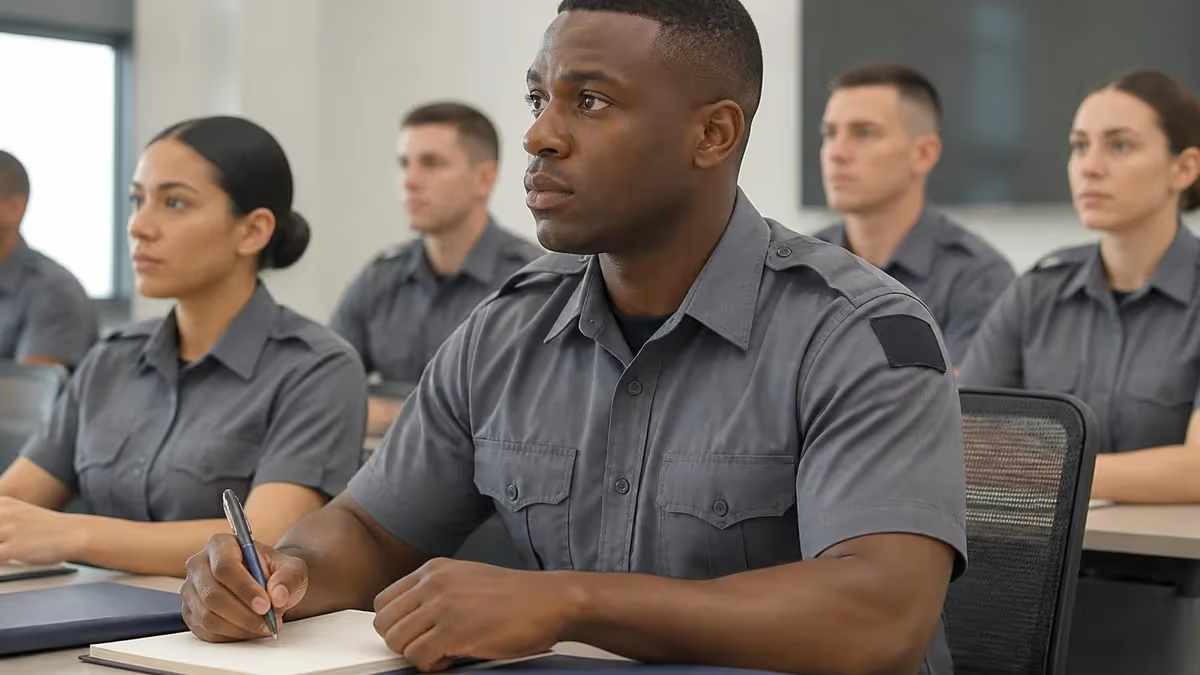
Here's the question that pops up in nearly every correctional officer interview, every academy orientation, and every family dinner conversation when someone announces they're entering the field: do correctional officers carry guns? The short answer surprises most people. No—the vast majority of correctional officers working inside a prison or jail do not carry firearms during their shift. Not a sidearm.
Not a rifle. Nothing that fires a bullet. And there's a very specific reason for that policy, one rooted in nearly a century of hard-learned lessons about what happens when armed staff work in close quarters with thousands of inmates. The mental image most civilians have—an officer striding through a cell block with a holstered .45—is just Hollywood. Real corrections looks very different.
But that's only part of the story. Some officers absolutely do carry guns—and they carry serious firepower. Tower officers patrolling the perimeter. Transport teams moving inmates between facilities. Special response teams during riots or cell extractions. Federal Bureau of Prisons staff at certain posts. The answer really depends on where the officer is stationed, what state they work in, and what the specific situation demands.
If you're considering a career in corrections, or you're just curious about what's actually on an officer's duty belt, you need to understand the full picture. Let's break it down post by post, tool by tool, and policy by policy—because this is one of the most misunderstood corners of American law enforcement, and getting it right matters whether you're applying for the job or just trying to understand how prisons actually work.

CO Firearms by the Numbers
So why don't officers inside the cell blocks carry firearms? It comes down to one chilling word: seizure. Picture a single officer walking through a housing unit holding 80 inmates. If that officer is carrying a loaded sidearm, every inmate in that unit has a potential weapon within arm's reach. One coordinated rush, one slip, one moment of distraction—and that weapon becomes the property of someone you really don't want holding it.
The math just doesn't work in the officer's favor. Outnumbered eighty to one, you cannot win a physical struggle for a holstered gun. So the policy is simple. The gun never enters the equation. No firearm, no firearm to lose. The inmate population stays unarmed because the staff population stays unarmed inside the secure footprint.
This isn't theory. It's been tested in blood. Throughout the 1900s, American prisons that allowed armed officers inside housing units watched their staff get killed with their own weapons. The 1971 Attica uprising, the 1980 New Mexico riot, dozens of smaller incidents—all reinforced the same lesson. An armed officer inside a prison population is a supply depot for inmates planning escape or assault.
By the 1980s, virtually every state corrections department had adopted what's now standard doctrine: firearms stay outside the secure perimeter except in carefully controlled circumstances. The American Correctional Association reinforces this position in its accreditation standards, and the National Institute of Corrections has spent decades documenting why armed-inside policies fail.
There's also a softer argument that matters. When officers walk a tier unarmed, the entire dynamic of the unit shifts. Officers rely on verbal communication, professional rapport, and the credibility of the prison's response system rather than the threat of immediate gunfire. Inmates know that if they assault staff, an extraction team responds with overwhelming force—but they also know that day-to-day interactions are going to be human, not a tense armed standoff. The unarmed model produces better long-term order, even if it means individual officers accept some physical risk on shift.
The Core Rule of Corrections
Firearms do not enter areas where inmates can reach them. This single principle drives nearly every weapons policy in American corrections. Officers inside housing units, dayrooms, dining halls, work areas, and recreation yards are unarmed. The only firearms inside a prison are kept in secured armories and locked control booths that inmates cannot physically access.
Now let's talk about who actually does carry. Tower officers. These are the staff stationed in improved guard towers around the perimeter of a prison, and yes—they are armed. Heavily. The standard tower loadout includes a high-powered rifle (typically a Mini-14, AR-15 variant, or a .308 bolt-action), a sidearm, less-lethal munitions, and binoculars. Their job is straightforward. Watch the walls. Stop escapes.
Provide overwatch if anything goes sideways inside. Because the tower is physically isolated from inmate contact—you can't reach a tower without scaling razor wire and a thirty-foot wall—the seizure problem disappears. The officer can be armed safely. Tower posts are often considered desirable assignments because they're physically less demanding than housing unit work, and senior officers frequently bid for them as they accumulate seniority.
The same logic applies to mobile perimeter patrols. You'll see corrections vehicles driving the outer fence line at most state and federal facilities. Those officers carry rifles and sidearms. They're the last line of defense against an escape attempt, and they have full authority to use deadly force on anyone breaching the perimeter.
Some facilities also maintain armed posts at the front gate, the sally port (the vehicle entry), and certain visitation control points. Anywhere inmates physically cannot reach the officer, firearms become not just acceptable but expected. Control booths inside housing units—those raised, ballistic-glass enclosures that officers operate doors and cameras from—are sometimes armed posts too, depending on the facility's design and security level.
Armed CO Post Categories
Improved guard towers around the perimeter of the prison. Officers carry high-powered rifles (often Mini-14, AR-15 variant, or .308 bolt-action), agency-issued sidearms, and less-lethal launchers. The tower is physically isolated from inmate contact behind walls and razor wire, so armed posts are entirely safe and effective for stopping escape attempts.
Mobile units driving the outer fence line in marked corrections vehicles. Armed with rifles and pistols, sometimes shotguns for backup. Authorized to use deadly force on escape attempts breaching the wall or fence. Patrols typically run continuously around the clock at major state and federal facilities.
Officers moving inmates between facilities, to court appearances, to medical appointments outside the prison, or to specialized housing. Armed with sidearms and frequently with shotguns or rifles for high-security transfers. Once an inmate leaves the secure perimeter, the threat picture changes and armed escort becomes mandatory.
SORT, CERT, or SRT tactical units deployed during riots, hostage situations, mass disturbances, or high-risk cell extractions involving violent inmates. Equipped with rifles, shotguns, 40mm less-lethal launchers, flashbang grenades, ballistic shields, and breaching tools. Train monthly on tactics, weapons handling, and team coordination.
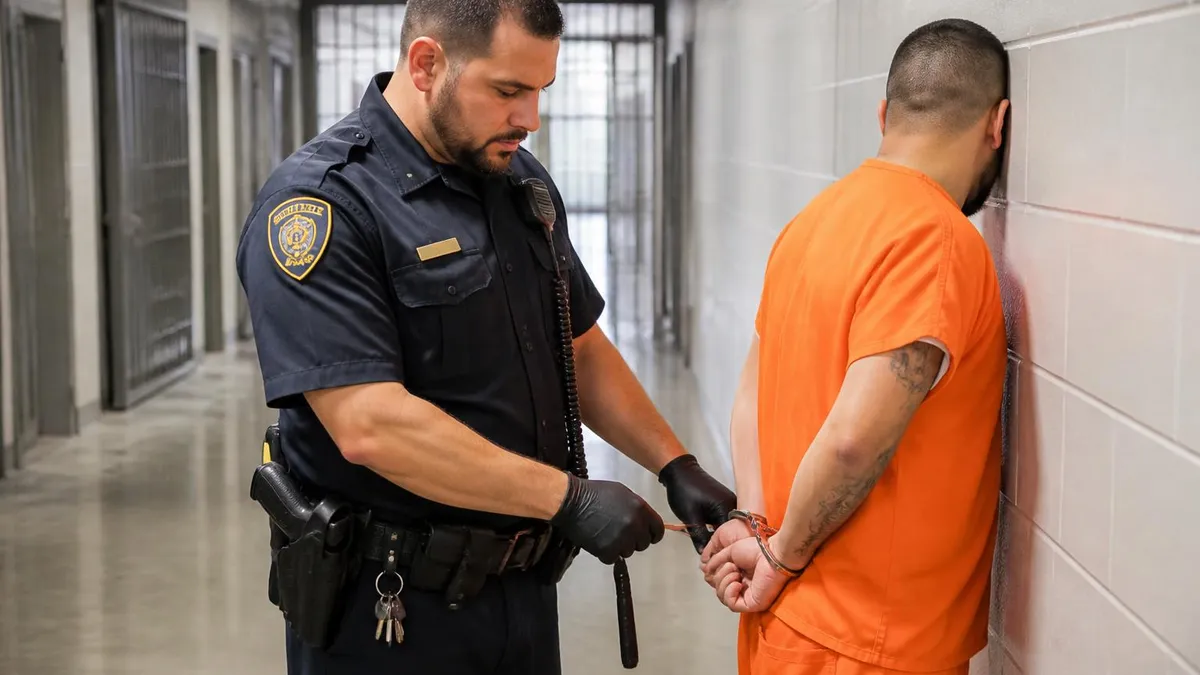
Transport is the next big armed assignment. When inmates leave the secure perimeter—heading to court, to a hospital, to another facility, anywhere outside the walls—armed officers escort them. The transport officer carries a sidearm at minimum, and for higher-security transfers, you'll see shotguns and rifles in the vehicle. Why armed?
Because the moment an inmate is outside the controlled environment of the prison, the rules change. Escape becomes geographically possible. Outside accomplices could attempt a rescue. The transport officer is no longer operating in a building full of locked doors and electronic controls. They're on a public highway, and they need the tools to handle whatever comes at them.
You also need to know about the special teams. Every major correctional system maintains a tactical unit—the Special Operations Response Team (SORT) in federal BOP language, Corrections Emergency Response Teams (CERT) in many states, or Special Response Teams (SRT) elsewhere. These are the corrections equivalent of SWAT. They train constantly.
They're called when something goes wrong: a riot, a hostage situation, a cell extraction involving a violent inmate, a planned high-risk operation. When SORT rolls in, they bring rifles, shotguns, less-lethal launchers, flashbang grenades, ballistic shields, and breaching tools. They are absolutely armed, and they will use those weapons if the situation demands it.
Firearms Policy by Facility Type
The Federal Bureau of Prisons follows strict armed-post protocols backed by detailed program statements. Officers inside housing units carry no firearms whatsoever. Perimeter posts, mobile patrols, and transport assignments are armed with rifles and sidearms—typically Glock 22 in .40 caliber or the Glock 17 in 9mm. SORT teams deploy with full tactical loadouts including M4 rifles, shotguns, and less-lethal munitions during emergencies, hostage incidents, or planned high-risk operations.
The federal system has its own particular flavor. The Bureau of Prisons issues Glock 22s (.40 caliber) and Glock 17s (9mm) for armed posts. Federal officers complete extensive firearms training at the Federal Law Enforcement Training Center in Glynco, Georgia—two weeks of pistol, rifle, and shotgun work before they ever set foot on an armed post. They requalify twice a year minimum, and any officer who fails qualification gets pulled from armed duty until they pass. The standards are non-negotiable. Miss your score, lose your post.
State systems range from rigorous to nearly identical. Texas Department of Criminal Justice runs one of the most heavily armed corrections operations in the country—their officers handle massive prison units with extensive armed perimeter coverage. California Department of Corrections and Rehabilitation maintains armed control booths overlooking certain housing units, with officers behind ballistic glass capable of firing into a unit if a riot breaks out. New York, Florida, Pennsylvania, Ohio—all run similar models. The specifics shift, but the principle holds: armed where seizure is impossible, unarmed where it isn't.
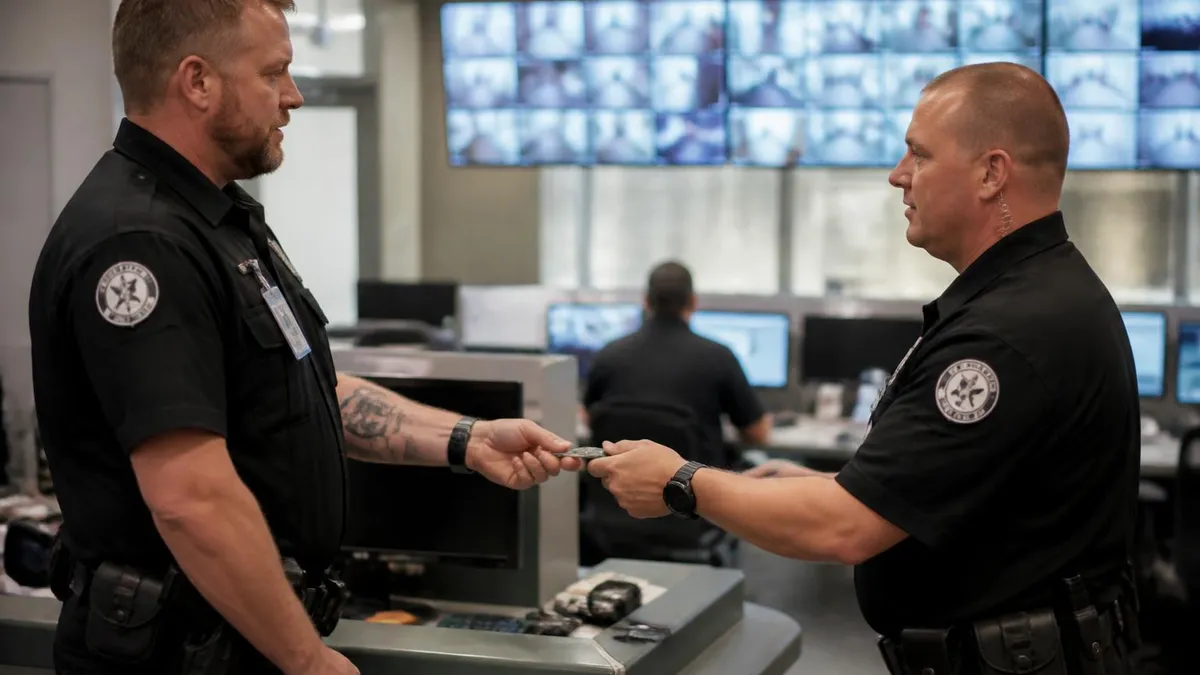
If you're an officer working inside a housing unit, your duty belt typically holds: handcuffs (sometimes two pairs), a key ring, a radio, OC pepper spray, a collapsible baton (ASP), gloves, and a flashlight. Some agencies issue Tasers to specific officers. You do not carry a firearm. That's the standard loadout for the vast majority of corrections work, and these less-lethal tools handle the overwhelming majority of incidents.
So if officers don't carry guns inside, what do they carry? Plenty. The modern corrections officer has a strong set of less-lethal tools, and these are the weapons that actually get used in 99% of incidents. OC spray—oleoresin capsicum, what you'd call pepper spray—is the workhorse. Every officer carries a canister, and a properly placed burst can stop a fight, subdue a resistive inmate, or break up a small disturbance without anyone catching a serious injury.
The collapsible baton, usually an ASP brand, is the next tier up. Officers train on baton strikes, restraint techniques, and defensive positioning during academy. It's a real weapon. Used incorrectly, it can break bones or kill, so officers learn precise target zones and force thresholds.
Tasers are spreading through corrections fast. Not every agency issues them, and not every officer is qualified to carry one, but more departments add them every year. A Taser deployment ends most physical altercations in under five seconds—the inmate locks up, drops to the ground, and the officer can apply restraints.
Beyond the personal gear, facilities maintain stun grenades (flashbangs), 40mm less-lethal launchers firing foam or rubber rounds, chemical munitions for crowd dispersion, and ballistic shields. When a cell extraction goes down, the team coming through the door has all of this available. The goal is always to end the incident with minimum injury—to staff and inmates alike.
Standard CO Duty Belt Items
- ✓OC pepper spray canister (mandatory on every duty belt)
- ✓Collapsible ASP baton or fixed straight baton
- ✓Handcuffs and flex cuffs for restraint
- ✓Two-way radio with emergency button
- ✓Heavy-duty flashlight (also useful as a defensive tool)
- ✓Cut-resistant gloves and protective equipment
- ✓Taser X26P or X2 (agency-dependent, not universal)
Now—what about training? Even though most officers won't carry a firearm on the floor, virtually every state academy still includes firearms training. Why? Because you might rotate to a tower post. You might pull transport duty. You might join SORT. You need to be qualified. The standard academy firearms block runs 40 to 80 hours depending on the state, covering pistol fundamentals, shotgun handling, rifle marksmanship, low-light shooting, and judgmental use-of-force scenarios.
You'll fire several hundred rounds during academy, qualify on multiple courses, and learn the legal framework for deadly force in your jurisdiction. Recruits also study agency policy on warning shots (usually prohibited), shoot-to-stop versus shoot-to-kill doctrine (corrections uses shoot-to-stop), and post-shooting administrative procedures.
After academy, requalification is a non-negotiable part of the job. Most agencies require twice-yearly qualification for any officer who could be assigned to an armed post. Specialized assignments—SORT members, instructors, transport specialists—shoot far more often. SORT teams typically train monthly on tactics, breaching, and weapons handling.
If your shooting skills slip, you're off the team. Period. The standards exist because the consequences of a missed shot in a corrections environment are catastrophic. There's no room for sloppy work. Every armed officer also completes annual use-of-force refreshers, scenario-based decision-making drills, and legal updates on case law affecting deadly force in their state.
Beyond firearms, the broader training picture matters. Officers spend more academy hours on defensive tactics, restraint techniques, verbal de-escalation, and crisis intervention than on shooting. That ratio reflects reality. The skills you'll actually use every shift are talking, listening, reading body language, and applying handcuffs without injury—not pulling a trigger. A well-trained officer prevents violence before it requires force at all, and that's the standard agencies push for in modern corrections.
Unarmed-Inside Policy: Pros and Cons
- +Eliminates the seizure risk inside housing units
- +Less-lethal tools handle the vast majority of incidents safely
- +Reduces officer-on-inmate fatal force events significantly
- +Keeps armed force concentrated at the perimeter where escape happens
- +Allows extensive de-escalation and verbal control techniques
- −Officers face physical risk if multiple inmates attack simultaneously
- −Response to active assault requires waiting for armed backup
- −Hostage situations inside require special teams to deploy
- −Mass disturbances can overwhelm unarmed staff before SORT arrives
- −Some critics argue armed staff would deter inmate violence
Pros and Cons at a Glance
| Pros | Cons |
|---|---|
| Eliminates the seizure risk inside housing units | Officers face physical risk if multiple inmates attack simultaneously |
| Less-lethal tools handle the vast majority of incidents safely | Response to active assault requires waiting for armed backup |
| Reduces officer-on-inmate fatal force events significantly | Hostage situations inside require special teams to deploy |
| Keeps armed force concentrated at the perimeter where escape happens | Mass disturbances can overwhelm unarmed staff before SORT arrives |
| Allows extensive de-escalation and verbal control techniques | Some critics argue armed staff would deter inmate violence |
One more area worth covering: off-duty carry. Can a correctional officer carry a firearm when they're not at work? This depends entirely on the agency, the state, and sometimes the individual's qualifications. Federal BOP officers have authority similar to other federal law enforcement and may carry off-duty under specific conditions. Many state corrections departments authorize off-duty carry for officers who maintain firearms qualifications, and some states extend Law Enforcement Officers Safety Act (LEOSA) coverage to corrections personnel—meaning they can carry concealed across state lines just like sworn police officers.
That said, plenty of corrections officers can't legally carry off-duty. Some agencies don't authorize it. Some states don't recognize corrections officers as full law enforcement for LEOSA purposes. If you're entering the field and concealed carry matters to you, research your specific agency's policy before signing on. The rules vary widely.
What's universal is that corrections officers attract attention from former inmates, and many in the field choose to maintain firearms proficiency and carry permits for personal protection regardless of agency policy. Some officers obtain a civilian concealed carry permit as a backup if their agency credential doesn't qualify under LEOSA in a given state.
Personal safety outside the gate is a real conversation in this profession. You'll learn faces over years on the job—hundreds of them—and statistically, you'll cross paths with former inmates in your community. Most of those interactions are uneventful. A nod at the grocery store. A polite conversation at a gas station. But a small minority of releases come out angry, and corrections officers do occasionally face threats, stalking, or assault off-duty. Knowing your agency's policy on retaliatory threats, address protection, and self-defense tools is part of the long-term picture for anyone considering this career.
Let's bring it all together. Do correctional officers carry guns? The honest answer is: it depends entirely on the post. If you're working a housing unit, a dayroom, a chow hall, or any area where inmates can reach you—no, you won't have a firearm, and that policy exists for very good reasons. Decades of evidence shows that armed staff in inmate-accessible areas become casualties of their own weapons.
Less-lethal tools combined with sound tactics, teamwork, and verbal de-escalation handle nearly every situation that arises inside. Pepper spray, batons, and Tasers are the everyday equipment, and they work well across the vast majority of incidents an officer will face during a typical career.
If you're a tower officer, on perimeter patrol, running transport, or wearing the SORT armor when a unit goes hot—yes, you carry serious firepower, and you train constantly to use it correctly. Different jobs, different tools. The corrections profession has built a layered approach over the last century, and it works.
The system isn't perfect—nothing involving thousands of inmates ever is—but the firearms doctrine has saved countless officer lives. If you're heading into this field, understand the why behind the policy. It'll make you a better officer. You'll make smarter tactical decisions when you grasp the logic behind every piece of gear you do and don't carry.
One last point. Public perception lags reality. Movies and TV shows love to put armed officers in dramatic standoffs with inmates inside the cell block, but that's not how American corrections actually operates. The real work is quieter, more procedural, and far less Hollywood than the imagery suggests. Understanding that—truly understanding it—is part of becoming a professional in this field. Study the policy. Respect the doctrine. Train hard. The career will reward you for it.
Sample Correctional Officer Practice Questions
Try these questions from our free Correctional Officer practice tests. The correct answer and an explanation follow each question.
In the event of a hostage situation inside a correctional facility, what is the MOST important initial guideline for responding officers?
- A. Attempt to physically overpower the hostage-taker as quickly as possible
- B. Contain the situation, avoid escalation, and wait for trained negotiators
- C. Offer to trade another inmate for the hostage to resolve it quickly
- D. Allow the hostage-taker to leave the facility to prevent inmate harm
Answer: B. Contain the situation, avoid escalation, and wait for trained negotiators
Initial response focuses on containment and de-escalation while specialized negotiators are brought in to manage the situation safely.
Which level of government typically offers correctional officers the highest average salary?
- A. City/municipal government
- B. County government
- C. State government
- D. Federal government
Answer: D. Federal government
Federal correctional officers generally earn higher average salaries than their state or local counterparts due to federal pay scales and benefits.
What kind of training is required for correctional officers?
- A. Legal analysis and courtroom procedures
- B. Correctional laws, self-defense and first aid
- C. Advance computer programming
- D. Financial management and accounting
Answer: B. Correctional laws, self-defense and first aid
Correctional officers undergo rigorous training that covers a range of essential skills and knowledge areas. This typically includes correctional laws and procedures, self-defense techniques for managing combative individuals, and first aid to respond to medical emergencies. This comprehensive training prepares them for the complex and often challenging environment of correctional facilities.
During a hostage situation inside a correctional facility, who typically serves as the primary negotiator?
- A. The warden
- B. A trained crisis negotiator or designated negotiation team
- C. The responding SWAT commander
- D. The facility chaplain
Answer: B. A trained crisis negotiator or designated negotiation team
Trained crisis negotiators handle communication during hostage situations to achieve a peaceful resolution.
CO Questions and Answers
About the Author

Educational Psychologist & Academic Test Preparation Expert
Columbia University Teachers CollegeDr. Lisa Patel holds a Doctorate in Education from Columbia University Teachers College and has spent 17 years researching standardized test design and academic assessment. She has developed preparation programs for SAT, ACT, GRE, LSAT, UCAT, and numerous professional licensing exams, helping students of all backgrounds achieve their target scores.
Join the Discussion
Connect with other students preparing for this exam. Share tips, ask questions, and get advice from people who have been there.
View discussion (9 replies)