
Certified Medication Technician Training: Complete Guide 2026 October
Prepare for the Certified Medication Technician certification. 📝 Practice questions with answer explanations covering all exam domains.
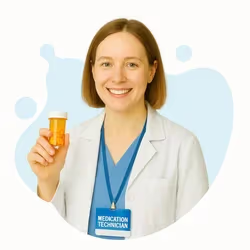
Certified medication technician training is the pathway to one of healthcare's most important front-line roles. Medication technicians — sometimes called med techs or med aides — work under nurse supervision to administer medications to residents in long-term care, assisted living, and residential facilities. Getting certified requires completing an approved training program, passing a competency evaluation, and in most states, a background check.
If you're exploring this career path, the training process is shorter than many allied health credentials — typically a matter of weeks, not years — and it opens doors to stable healthcare employment with room to grow. Here's what you need to know about certified medication technician training programs before you enroll.
What Certified Medication Technician Training Covers
CMT training programs are designed to give you the practical knowledge and supervised practice to safely administer medications in a healthcare setting. The curriculum varies by state (because each state's nurse aide or medication assistant regulations differ), but most programs cover the same core areas:
Medication fundamentals: Drug classifications, routes of administration (oral, topical, ophthalmic, etc.), medication forms (tablets, capsules, liquids, patches), and the five rights of medication administration — right patient, right drug, right dose, right route, right time. This is foundational material every CMT must know cold.
Anatomy and physiology basics: You need enough understanding of body systems to understand how medications work, where they're absorbed, and what effects (and side effects) to watch for. Programs don't turn you into a pharmacist, but you need a working understanding of how drugs interact with the body.
Medication storage and handling: How different medications are stored (temperature requirements, light sensitivity), controlled substance handling protocols, proper disposal of medications, and documentation requirements for both routine and controlled substance administration.
Documentation and record-keeping: Medication Administration Records (MARs) are the legal documentation of every medication given. Accurate, timely documentation is non-negotiable in healthcare settings, and training programs emphasize proper documentation practices extensively.
Infection control: Hand hygiene, personal protective equipment, and standard precautions for medication preparation and administration. Infection control in medication administration contexts is specific — you need to understand not just general principles but how they apply when handling medications, preparing injections (if applicable in your state), and working with high-risk populations.
Resident rights and ethical responsibilities: Patients and residents have specific rights related to medication — the right to refuse, the right to information, the right to privacy. Training covers how to handle refusals, how to document them, and how to escalate concerns appropriately.
Emergency procedures: What to do when a medication error occurs, how to recognize adverse drug reactions, when to call for nursing assistance, and basic first response procedures while waiting for a nurse.
Supervised clinical practice: Most programs include a clinical component where you practice medication administration under direct nurse supervision before you're allowed to work independently. This hands-on component is where theoretical knowledge becomes practical skill — and where programs confirm you're safe to certify.
Certified Medication Technician Training Program Formats
Training is available in several formats, and the right choice depends on your schedule, learning style, and what's required in your state:
In-person classroom programs: Offered through community colleges, vocational schools, nursing facilities, and healthcare staffing organizations. These programs typically run two to four weeks of intensive instruction followed by clinical hours. The structured schedule and in-person instructor access help many students learn the material more effectively than self-paced alternatives.
Certified medication technician training online: The didactic (classroom theory) portion of training is increasingly available online, which allows more flexible scheduling. However, the clinical hours must be completed in person under nurse supervision — no state allows clinical skills to be demonstrated virtually. If you're considering an online program, verify how and where the clinical component is structured before enrolling.
Hybrid programs: Combination formats that deliver theoretical content online with in-person clinical training at an affiliated facility. These offer flexibility for the academic content while ensuring appropriate in-person supervised practice.
Employer-sponsored training: Many nursing homes and assisted living facilities offer CMT training to their existing CNA staff. If you're already working as a certified nursing assistant, check whether your employer offers or sponsors CMT training — it's often the most cost-effective path and may come with a commitment to employ you as a CMT upon certification.
For a fuller set of questions on this topic, see our medication technician online study resource.
State Requirements for CMT Certification
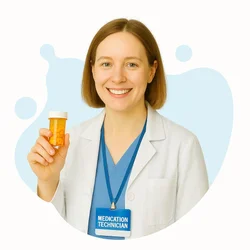
Certified medication technician requirements vary significantly by state. Not every state has a CMT program — some states don't permit non-nurses to administer medications in any capacity, while others have strong CMT programs with detailed requirements. Before enrolling in training, confirm your state's specific requirements.
Common state requirements include:
- Active CNA certification (most states require you to be a certified nursing assistant before becoming a CMT)
- Minimum hours of CNA work experience (varies by state — some require six months to a year of CNA experience before CMT training eligibility)
- Completion of a state-approved CMT training program
- Passing a written competency examination
- Passing a skills demonstration evaluation
- Background check clearance
States that have formal CMT programs include Maryland, Missouri, Indiana, Virginia, and others — each with its own version of the credential. In some states, the credential is called a Medication Aide (MA), Medication Assistant, or Medication Technician rather than CMT specifically. The substance is similar even when the name differs.
If your state doesn't have a specific CMT or medication aide program, check whether assisted living facilities in your area use a different framework — some states allow assisted living facilities to train and use unlicensed medication assistants under specific supervision protocols, even without a formal certification program.
Finding Certified Medication Technician Training Near You
Locating certified medication technician training near you starts with your state's nursing regulatory board or Department of Health. These agencies maintain lists of approved training programs, which is the only reliable way to confirm a program will lead to a recognized certification.
Beyond state agency lists, programs are commonly offered through:
- Community colleges and vocational/technical schools
- Healthcare staffing agencies (Red Cross chapters in some states)
- Long-term care facilities and nursing homes (employer-sponsored)
- Assisted living associations and industry groups
- Online healthcare education platforms (for didactic content)
When evaluating a program, ask directly: Is this program approved by [your state's] nursing board or Department of Health? Will completing this program make me eligible to sit for the state competency examination? Where is the clinical component completed, and how many hours are included?
Programs that can't answer these questions directly, or that aren't listed on your state's approved program list, are red flags. Completing a non-approved program won't make you eligible for certification, regardless of how much you learned.
CMT Competency Examination Preparation
After completing training, you'll need to pass a competency evaluation — typically a written exam and a skills demonstration. Preparation for the exam follows logically from your training content, but targeted practice in the highest-tested areas pays dividends.
The five rights of medication administration appear on virtually every CMT exam. So does documentation — what belongs on a MAR, when to document, what to do if you make an error. Medication storage and controlled substance protocols are also heavily tested.
Practice tests help you familiarize yourself with the question format, identify gaps in your knowledge before the real exam, and build confidence with the material. The skills portion — typically observed by a nurse evaluator — requires demonstrating that you can follow proper hand hygiene, prepare and administer a medication correctly, complete documentation accurately, and respond appropriately to a simulated adverse reaction or refusal scenario.
Career Outlook for Certified Medication Technicians
The demand for CMTs is closely tied to the growth of the long-term care and assisted living sector, which is expanding steadily as the US population ages. Facilities that employ CMTs can extend medication administration capacity beyond their nursing staff, which is an operational necessity in facilities where nurse-to-resident ratios are high.
Most CMTs work in nursing homes, assisted living facilities, group homes, and residential care settings. Some hospitals employ medication technicians in specific units. Compensation varies significantly by state, facility type, and experience level — but CMT positions typically pay meaningfully more than CNA positions, reflecting the additional responsibility and training involved.
For CNAs looking to advance without committing to a full nursing education, CMT certification is often the most accessible first step. It adds a marketable credential, increases earning potential, and provides direct experience with a core clinical function that's valued across healthcare settings. Many CMTs eventually pursue LPN or RN programs — the medication knowledge from CMT training is directly relevant to nursing education and gives you a head start.



Sample Certified Medication Technician Practice Questions
Try these questions from our free Certified Medication Technician practice tests. The correct answer and an explanation follow each question.
Which of the following actions by a CMT best demonstrates the principle of medical asepsis?
- A. Using sterile gloves to administer oral medications.
- B. Washing hands before preparing each resident's medications.
- C. Sterilizing all medication cups in an autoclave before use.
- D. Requiring all residents to wear a mask during medication pass.
Answer: B. Washing hands before preparing each resident's medications.
Medical asepsis, or clean technique, involves practices that reduce the number of microorganisms and prevent their spread. Handwashing is a cornerstone of medical asepsis. Sterilizing items (autoclave) and using sterile gloves for a non-sterile procedure are components of surgical asepsis, which is a higher level of infection control.
What does 'PRN' mean on a medication administration record?
- A. As needed
- B. Before meals
- C. Every night
- D. Per registered nurse
Answer: A. As needed
PRN means 'pro re nata,' a Latin term meaning 'as needed,' indicating medication is given only when required.
A medication technician is asked to crush a resident's medication to mix it in food without the resident's knowledge. This action is:
- A. Acceptable if the nurse approves
- B. A violation of the resident's right to informed consent
- C. Standard practice for residents with swallowing difficulties
- D. Only permissible for Schedule IV medications
Answer: B. A violation of the resident's right to informed consent
Covertly administering medications without a resident's knowledge violates their right to informed consent and is considered a form of medication deception.
During a medication pass, a resident's family member pulls the CMT aside and asks for the names and purposes of all the medications their loved one is taking. How should the CMT respond to protect the resident's rights?
- A. Provide a complete list of the medications and their uses to the family member.
- B. Tell the family member they are not allowed to have that information.
- C. Refer the family member to the supervising nurse to discuss information sharing, in accordance with HIPAA and facility policy.
- D. Ask the resident for permission in front of the family member before sharing the information.
Answer: C. Refer the family member to the supervising nurse to discuss information sharing, in accordance with HIPAA and facility policy.
Under the Health Insurance Portability and Accountability Act (HIPAA), a patient's health information is protected. A CMT cannot disclose this information without the patient's consent or as permitted by law. The appropriate action is to refer the family member to the licensed nurse, who can verify if a release of information is on file and handle the request according to legal and facility guidelines.
About the Author

Educational Psychologist & Academic Test Preparation Expert
Columbia University Teachers CollegeDr. Lisa Patel holds a Doctorate in Education from Columbia University Teachers College and has spent 17 years researching standardized test design and academic assessment. She has developed preparation programs for SAT, ACT, GRE, LSAT, UCAT, and numerous professional licensing exams, helping students of all backgrounds achieve their target scores.
Join the Discussion
Connect with other students preparing for this exam. Share tips, ask questions, and get advice from people who have been there.
View discussion (9 replies)